A French Word to Live By
Translate Passager to English
/pa.sa.ʒe/
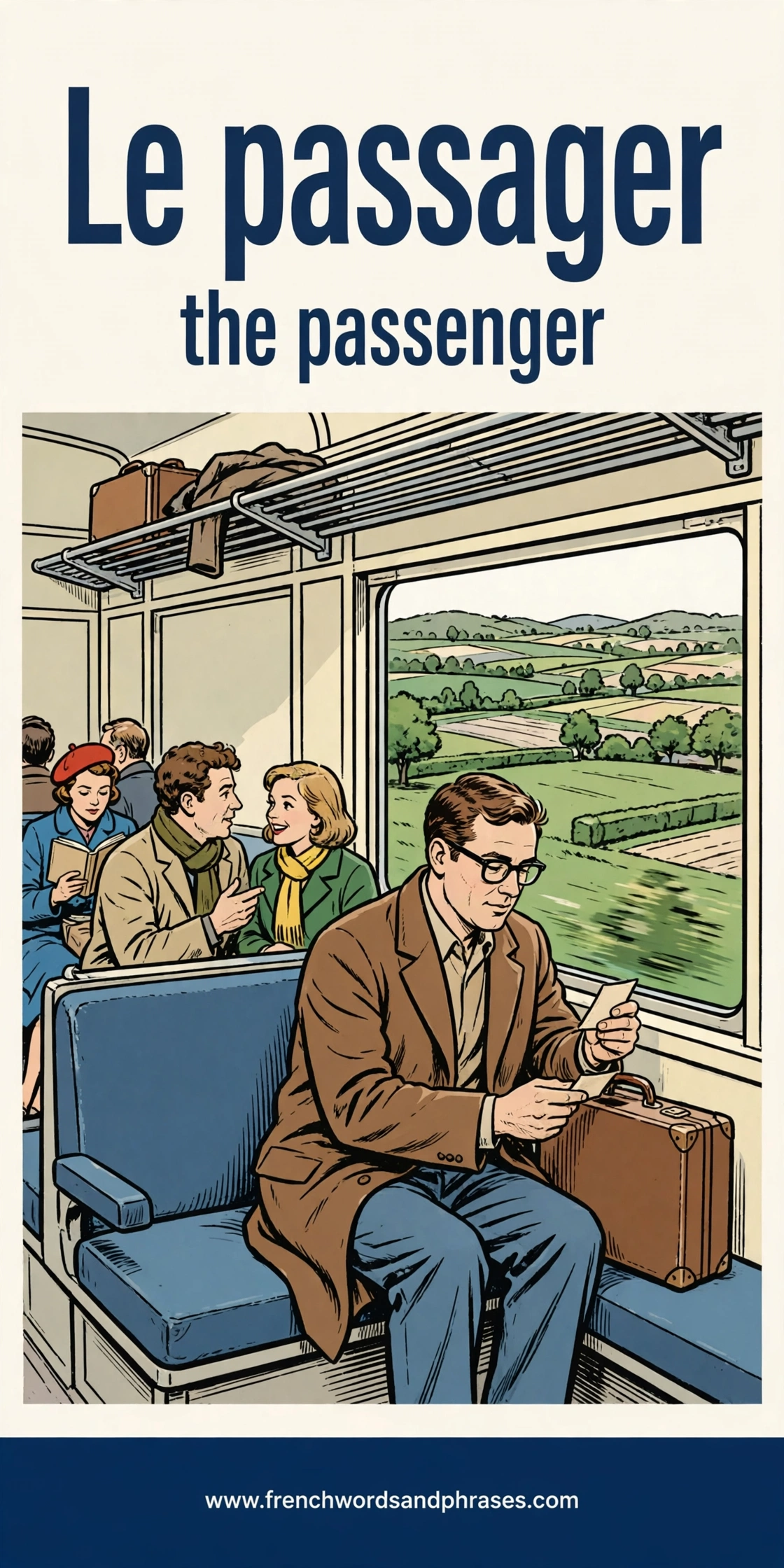
Le passager means the passenger.
Seatbelt fastened, ticket in hand, eyes on the window as the ground falls away: le passager, the passenger — the traveller who is carried, by train, by plane, by boat, while someone else does the driving.
In this guide, you’ll learn what passager means in English, how to use it with its articles, how to form its plural, and how it appears in everyday French. Explore French examples, English translations, and practice quizzes.
Understanding the French Noun Passager
Passager is a masculine French noun, learned with its article: le passager, un passager. A woman passenger is une passagère — the word changes its ending and its article with the traveller. It comes from passage, the crossing: the passager is the one who makes the passage, but does not steer.
It means a passenger — a person travelling in a vehicle without driving it: les passagers du train, the train’s passengers, un passager clandestin, a stowaway (literally a secret passenger). The word also lives a second life as an adjective meaning fleeting, short-lived: une douleur passagère, a passing pain, un amour passager, a fleeting love. On board, the announcements are for you: les passagers sont priés de…, passengers are requested to…
Gender: Masculine — le passager (a woman: une passagère)
Definite article: le — le passager (the passenger)
Indefinite article: un — un passager (a passenger)
Plural: les passagers — regular, with a simple -s
Feminine form: une passagère — the ending changes, and so does the article
Second life: as an adjective: passager/passagère = fleeting, short-lived
English equivalents: The passenger.
You are a passager dans a train, a plane or a car — les passagers dans le train — and you travel en train, en avion, en voiture. The driver is le conducteur; everyone else aboard is a passager, including the one sitting beside the driver: le passager avant, the front-seat passenger.
Experience the Word
Passager is the word for trusting strangers with your journey: you sit down, you fasten, you watch the world go by, and the driving is not your problem.
Imagine the night train crossing France, a passager asleep against the window while the lights of unknown towns slide past — carried through the dark by a machine, a timetable and a driver he will never meet.
You have not just named a traveller. You have named the one who is carried — le passager, the passenger, free to look out of the window.
How to Use Passager in French: Complete Guide
Let’s explore how passager works in French, beginning with its articles — le passager, un passager, les passagers du train.
Passager with the Definite Article (Le, Les)
Used for a specific passenger — the one by the window, the one still missing.
| Form | French |
|---|---|
| Masculine singular | le passager |
| Plural | les passagers |
Example
Le passager de la place 12 dort déjà.
The passenger in seat 12 is already asleep.
Passager with the Indefinite Article (Un, Des)
Used for a passenger in general — any traveller on board.
| Form | French |
|---|---|
| Masculine singular | un passager |
| Plural | des passagers |
Example
Un passager a oublié son sac dans le train.
A passenger left his bag on the train.
Passager by Vehicle (Du train, De l’avion…)
The passenger belongs to his vehicle — French names him by what carries him.
| Vehicle | French |
|---|---|
| the train’s passengers | les passagers du train |
| the plane’s passengers | les passagers de l’avion |
| the boat’s passengers | les passagers du bateau |
| the bus passengers | les passagers du bus |
| a stowaway | un passager clandestin |
Example
Les passagers de l’avion attendent devant la porte.
The plane’s passengers are waiting at the gate.
Quick Quiz 1
Complete the sentence:
______ passager montre son billet au contrôleur. (the)
Reveal the answer
Le
Le passager montre son billet au contrôleur.
The passenger shows his ticket to the inspector — passager is masculine, so le.
The Plural of Passager
Passager takes a regular plural in -s — passengers travel in crowds.
| Number | French |
|---|---|
| Singular | le passager |
| Plural | les passagers |
Example
Tous les passagers descendent à la prochaine gare.
All the passengers get off at the next station.
Passager with Possessive Adjectives (Mon, Ton, Son…)
Possessives agree with the noun: passager is masculine, so mon, ton, son in the singular.
| Owner | French |
|---|---|
| my | mon passager |
| your (tu) | ton passager |
| his / her | son passager |
| our | notre passager |
| your (vous) | votre passager |
| their | leur passager |
Example
Le chauffeur compte ses passagers avant de partir.
The driver counts his passengers before leaving.
Quick Quiz 2
Complete the sentence:
Elle aide ______ passager à porter sa valise. (her)
Reveal the answer
son
Elle aide son passager à porter sa valise.
She helps her passenger carry his suitcase — son, because passager is masculine.
Passager with Demonstrative Adjectives (Ce, Ces)
Used to point: ce passager, this passenger — usually the one without a ticket.
| Form | French |
|---|---|
| Masculine singular | ce passager |
| Plural | ces passagers |
Example
Ce passager cherche la voiture numéro cinq.
This passenger is looking for carriage number five.
Passager with Adjectives
Adjectives agree with passager — and the adjective passager itself means fleeting.
| Adjective | With Passager |
|---|---|
| clandestin (secret, stowaway) | un passager clandestin |
| avant (front-seat) | le passager avant |
| fatigué (tired) | un passager fatigué |
| passager (fleeting, fem.) | une douleur passagère |
| fidèle (loyal, regular) | un passager fidèle |
Example
Une douleur passagère ne doit pas vous inquiéter.
A passing pain should not worry you.
Quick Quiz 3
Complete the sentence:
Un passager ______ voyage sans billet. (stowaway)
Reveal the answer
clandestin
Un passager clandestin voyage sans billet.
A stowaway travels without a ticket — clandestin, masculine, to agree with passager.
Everyday Expressions with Passager
Stations, airports and announcements — the passager phrases of travel.
| Expression | In English |
|---|---|
| les passagers sont priés de… | passengers are requested to… |
| un passager clandestin | a stowaway |
| le passager avant | the front-seat passenger |
| la liste des passagers | the passenger list |
| passager en correspondance | a connecting passenger |
Example
Les passagers sont priés de garder leur ceinture attachée.
Passengers are requested to keep their seatbelts fastened.
Words from the Same Family as Passager
Carrying and being carried — the words that travel with passager.
| French | In English |
|---|---|
| le conducteur | the driver |
| le voyageur | the traveller |
| le billet | the ticket |
| le passage | the crossing, the passage |
| passer | to pass, to go by (the verb) |
Example
Le voyageur devient passager quand il monte dans le train.
The traveller becomes a passenger when he boards the train.
Quick Quiz 4
What is un passager clandestin?
Reveal the answer
A stowaway — a secret passenger travelling without a ticket or permission.
On a trouvé un passager clandestin dans le train de nuit.
They found a stowaway on the night train.
Passager in Everyday French: Real-Life Examples
Now that you know the word, let’s see how passager appears in everyday French.
Example 1 — On the train
Le passager regarde le paysage par la fenêtre.
The passenger watches the countryside go by the window.
Example 2 — At the airport
Les passagers attendent l’appel de leur vol.
The passengers are waiting for their flight to be called.
Example 3 — In the car
Le passager avant tient la carte.
The front-seat passenger holds the map.
Example 4 — The announcement
Les passagers sont priés de rester assis.
Passengers are requested to remain seated.
Example 5 — The missing one
Il manque un passager, le bus ne part pas.
One passenger is missing, the bus is not leaving.
Example 6 — The adjective
C’est une joie passagère, profites-en.
It is a fleeting joy, make the most of it.
Beyond Translation: The Meaning of Passager
Passager carries a small philosophy inside it: everything passes. The noun names the traveller who is carried, and the adjective — une douleur passagère, un bonheur passager — names anything that will not last. French built both from passer, to pass: the passenger is quite literally a passer-by with a seat. That is why the word feels gentle rather than sad: to be passager is to be on your way somewhere.
To say passager is to remember that we are all just passing through — some of us with a window seat.
It evokes the night train, the ferry deck and the long road home — everywhere a human being sits down and trusts the journey.
How to Remember the French Noun Passager
Remember it this way: Passager is the passenger — masculine: le passager; a woman is une passagère, and as an adjective it means fleeting.
- Always masculine for the noun — le passager, un passager, mon passager.
- The woman traveller — une passagère, with -ère and a changed article.
- The double life — une douleur passagère, a passing pain: passager also means fleeting.
The key idea is le passager — the passenger, masculine; une passagère = a woman passenger; passager (adj.) = fleeting.
Test Your Knowledge of Passager
Let’s see how much you’ve learned. Try answering these questions before revealing the answers.
Question 1
Is passager masculine or feminine?
Reveal the answer
Masculine — le passager, un passager; a woman passenger is une passagère.
Question 2
How do you say a stowaway?
Reveal the answer
Un passager clandestin.
Question 3
Translate: The passengers are waiting at the gate.
Reveal the answer
Les passagers attendent devant la porte.
Question 4
What does the adjective passager mean in une douleur passagère?
Reveal the answer
Fleeting, passing — a pain that will not last.
Question 5
Complete the sentence:
______ passagers descendent à Lyon. (the)
Reveal the answer
Les
Les passagers descendent à Lyon.
The passengers get off at Lyon.
Your Final Challenge
Can You Use It?
How would you say this in French?
“The passengers are requested to keep their seatbelts fastened.”
Reveal the answer
Les passagers sont priés de garder leur ceinture attachée.
The passengers are requested to keep their seatbelts fastened.
A little French. A little curiosity. A richer everyday life.
LEARN FRENCH ONE WORD AT A TIME