A French Word to Live By
Translate Fièvre to English
/fjɛvʁ/
La fièvre means the fever.
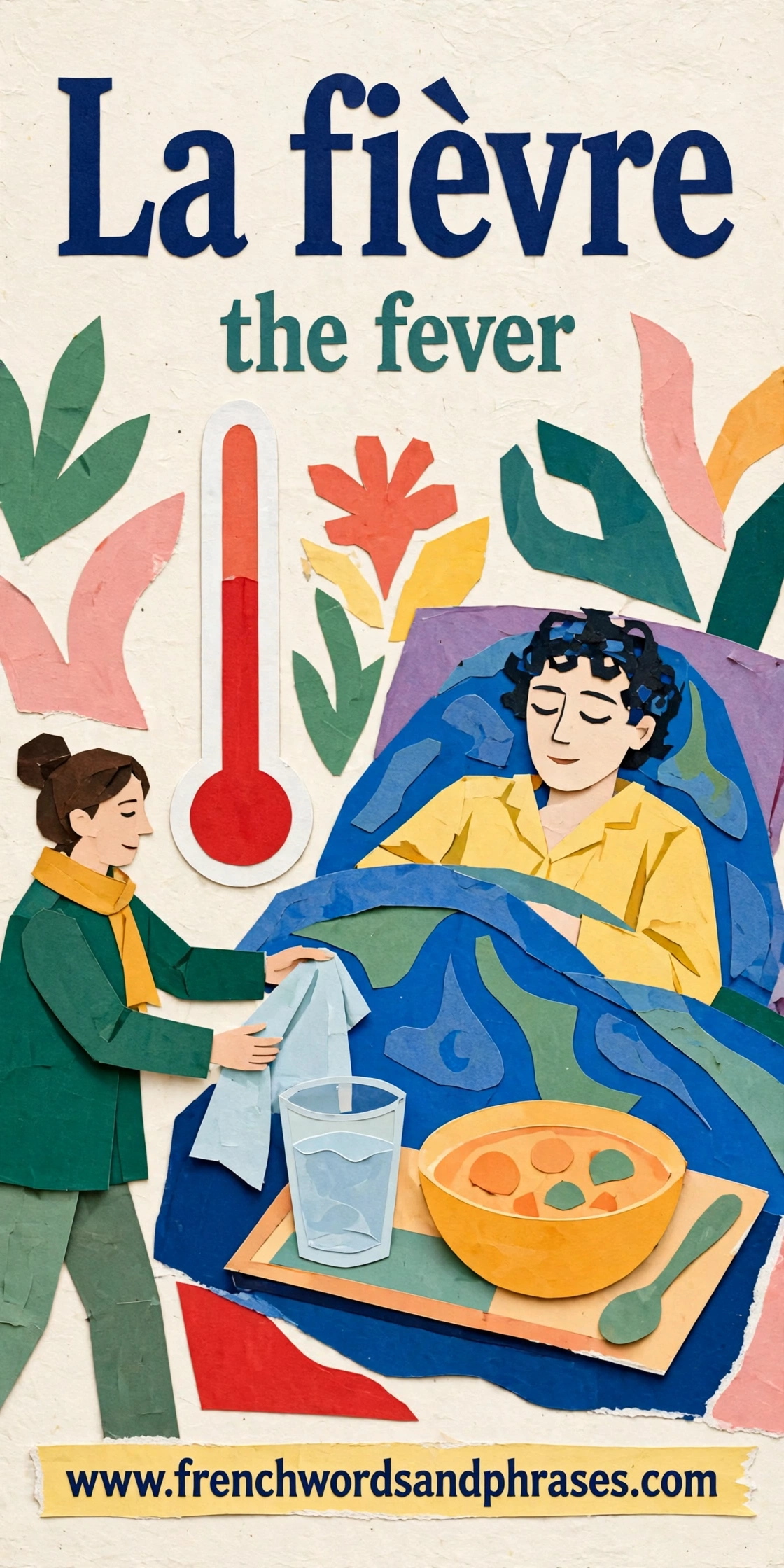
A hand on a hot forehead, the thermometer’s small verdict, the household suddenly quiet: la fièvre, the fever — the body’s alarm bell, and a word French also gives to every excitement that runs a little too hot.
In this guide, you’ll learn what fièvre means in English, how to use it with its articles, how to form its plural, and how it appears in everyday French. Explore French examples, English translations, and practice quizzes.
Understanding the French Noun Fièvre
Fièvre is a feminine French noun, learned with its article: la fièvre, une fièvre. It comes from the Latin febris — the same root that gives English fever and February, the fever month of the Roman year. In French the word kept both its lives: the temperature that climbs, and the passion that does the same.
It means fever — the body’s raised temperature: avoir de la fièvre, to have a fever, une forte fièvre, a high fever, la fièvre monte, the fever is rising, la fièvre tombe, the fever is going down. You measure it with un thermomètre and you say the number: il a trente-neuf de fièvre, he has a temperature of thirty-nine. Then the metaphor: la fièvre de l’or, gold fever, la fièvre du samedi soir, Saturday-night fever — any excitement that heats a crowd.
Gender: Feminine — la fièvre
Definite article: la — la fièvre (the fever)
Indefinite article: de la — avoir de la fièvre (to have a fever)
Plural: les fièvres — used for kinds of fever: les fièvres tropicales
The key phrase: avoir de la fièvre — to have a fever, to have a temperature
The metaphor: la fièvre de l’or — gold fever; any burning excitement
English equivalents: The fever.
To have a fever, French uses the partitive: avoir de la fièvre — never « avoir une fièvre » for the everyday case. The number follows the person, not the word: elle a trente-huit cinq de fièvre, she has a temperature of 38.5. And a child with a temperature is fiévreux — feverish, the adjective of the family.
Experience the Word
Fièvre is the word for heat where heat should not be: in the body it is a warning, in the heart it is a passion, and French trusts you to know which fire is meant.
Imagine the mother at two in the morning, hand flat on her daughter’s forehead, feeling the heat before the thermometer confirms it — la fièvre. The whole house organises itself around that one warm forehead until the fever falls.
You have not just named a symptom. You have named the body’s red flag — la fièvre, the fever, in the blood and in the imagination alike.
How to Use Fièvre in French: Complete Guide
Let’s explore how fièvre works in French, beginning with its articles — la fièvre, de la fièvre, avoir de la fièvre.
Fièvre with the Definite Article (La, Les)
Used for a specific fever — the one that is rising, the one that finally fell.
| Form | French |
|---|---|
| Feminine singular | la fièvre |
| Plural | les fièvres |
Example
La fièvre monte depuis ce matin.
The fever has been rising since this morning.
Fièvre with the Partitive (De la fièvre…)
Fever as a state takes the partitive: de la fièvre, un peu de fièvre, beaucoup de fièvre.
| Quantity | French |
|---|---|
| some fever | de la fièvre |
| a little fever | un peu de fièvre |
| a high fever | une forte fièvre |
| no fever any more | plus de fièvre |
| a temperature of 39 | trente-neuf de fièvre |
Example
L’enfant a un peu de fièvre ce soir.
The child has a slight fever this evening.
The Fever’s Movements (Monter, Tomber…)
French follows the fever like a tide — it rises, it falls, it breaks.
| Movement | French |
|---|---|
| the fever is rising | la fièvre monte |
| the fever is going down | la fièvre tombe |
| to have a fever | avoir de la fièvre |
| to take someone’s temperature | prendre la température |
| feverish | fiévreux, fiévreuse |
Example
Vers minuit, la fièvre est enfin tombée.
Around midnight, the fever finally went down.
Quick Quiz 1
Complete the sentence:
______ fièvre de l’enfant inquiète ses parents. (the)
Reveal the answer
La
La fièvre de l’enfant inquiète ses parents.
The child’s fever worries his parents — fièvre is feminine, so la.
The Plural of Fièvre
The plural les fièvres names kinds of fever — the fevers of hot countries and old medical books.
| Number | French |
|---|---|
| Singular | la fièvre |
| Plural | les fièvres |
Example
Les fièvres tropicales sont dangereuses.
Tropical fevers are dangerous.
Fièvre with Possessive Adjectives (Ma, Ta, Sa…)
Possessives agree with the noun: fièvre is feminine, so ma, ta, sa in the singular.
| Owner | French |
|---|---|
| my | ma fièvre |
| your (tu) | ta fièvre |
| his / her | sa fièvre |
| our | notre fièvre |
| your (vous) | votre fièvre |
| their | leur fièvre |
Example
Sa fièvre a duré trois jours.
His fever lasted three days.
Quick Quiz 2
Complete the sentence:
Elle surveille ______ fièvre toute la nuit. (her)
Reveal the answer
sa
Elle surveille sa fièvre toute la nuit.
She watches over her fever all night — sa, because fièvre is feminine.
Fièvre with Demonstrative Adjectives (Cette, Ces)
Used to point: cette fièvre, this fever — the stubborn one that will not fall.
| Form | French |
|---|---|
| Feminine singular | cette fièvre |
| Plural | ces fièvres |
Example
Cette fièvre ne tombe pas, il faut appeler le médecin.
This fever won’t go down, we must call the doctor.
Fièvre with Adjectives
Adjectives agree with fièvre — feminine singular: une forte fièvre, une fièvre légère.
| Adjective | With Fièvre |
|---|---|
| forte (high, strong) | une forte fièvre |
| légère (slight) | une fièvre légère |
| longue (long) | une longue fièvre |
| tropicale (tropical) | une fièvre tropicale |
| de cheval (very high, informal) | une fièvre de cheval |
Example
Il a une fièvre de cheval depuis hier.
He has had a raging fever since yesterday.
Quick Quiz 3
Complete the sentence:
C’est une ______ fièvre, presque quarante. (high)
Reveal the answer
forte
C’est une forte fièvre, presque quarante.
It is a high fever, almost forty — forte, feminine, to agree with fièvre.
Everyday Expressions with Fièvre
Sickrooms and gold rushes — the fièvre phrases of daily life.
| Expression | In English |
|---|---|
| avoir de la fièvre | to have a fever, a temperature |
| la fièvre monte / tombe | the fever is rising / going down |
| une fièvre de cheval | a raging fever (informal) |
| la fièvre de l’or | gold fever |
| la fièvre du samedi soir | Saturday-night fever |
Example
La fièvre de l’or a rempli la Californie de chercheurs.
Gold fever filled California with prospectors.
Words from the Same Family as Fièvre
Heat and illness — the words that travel with fièvre.
| French | In English |
|---|---|
| le thermomètre | the thermometer |
| la température | the temperature |
| fiévreux | feverish (the adjective) |
| tomber malade | to fall ill (the verb phrase) |
| le médecin | the doctor |
Example
Le thermomètre montre trente-neuf de fièvre.
The thermometer shows a temperature of thirty-nine.
Quick Quiz 4
What is une fièvre de cheval?
Reveal the answer
A raging fever — a very high temperature, in informal French.
Avec une fièvre de cheval, il reste au lit.
With a raging fever, he is staying in bed.
Fièvre in Everyday French: Real-Life Examples
Now that you know the word, let’s see how fièvre appears in everyday French.
Example 1 — At home
L’enfant a de la fièvre ce soir.
The child has a fever this evening.
Example 2 — The thermometer
Elle a trente-neuf de fièvre.
She has a temperature of thirty-nine.
Example 3 — Rising
La fièvre monte, il faut se reposer.
The fever is rising, you must rest.
Example 4 — Falling
Bonne nouvelle : la fièvre est tombée.
Good news: the fever has gone down.
Example 5 — Feverish
Il est fiévreux et il tremble.
He is feverish and shivering.
Example 6 — The metaphor
La fièvre des soldes commence demain.
The sales fever starts tomorrow.
Beyond Translation: The Meaning of Fièvre
Fièvre descends from Latin febris, and English fever is its cousin — but French stretched the word further into metaphor. A body with la fièvre is fighting; a crowd with la fièvre is dreaming: gold, football, Saturday night, the sales. The thermometer number is stated with beautiful economy — trente-neuf de fièvre, thirty-nine of fever — as if fever were a substance you could hold thirty-nine degrees of. And the adjective fiévreux describes not only the patient but the hand that trembles and the city before a final.
To say fièvre is to take the temperature of a body — or of a whole country.
It evokes the cool hand on the forehead, the quiet sickroom, and every excitement that ever ran too hot.
How to Remember the French Noun Fièvre
Remember it this way: Fièvre is the fever — feminine, and you have it with the partitive: avoir de la fièvre.
- Always feminine — la fièvre, ma fièvre, cette fièvre.
- The partitive phrase — avoir de la fièvre, to have a fever; the number follows: trente-neuf de fièvre.
- The tide — la fièvre monte, it rises; la fièvre tombe, it falls.
The key idea is la fièvre — the fever, feminine; avoir de la fièvre = to have a temperature.
Test Your Knowledge of Fièvre
Let’s see how much you’ve learned. Try answering these questions before revealing the answers.
Question 1
Is fièvre masculine or feminine?
Reveal the answer
Feminine — la fièvre, une fièvre.
Question 2
How do you say to have a fever?
Reveal the answer
Avoir de la fièvre.
Question 3
Translate: The fever has gone down.
Reveal the answer
La fièvre est tombée.
Question 4
What is une fièvre de cheval?
Reveal the answer
A raging fever — a very high temperature, informally.
Question 5
Complete the sentence:
______ fièvres tropicales sont dangereuses. (the)
Reveal the answer
Les
Les fièvres tropicales sont dangereuses.
Tropical fevers are dangerous.
Your Final Challenge
Can You Use It?
How would you say this in French?
“The child has a fever this evening.”
Reveal the answer
L’enfant a de la fièvre ce soir.
The child has a fever this evening.
A little French. A little curiosity. A richer everyday life.
LEARN FRENCH ONE WORD AT A TIME