A French Word to Live By
Translate Employé to English
/ɑ̃.plwa.je/
L’Employé means the employee.
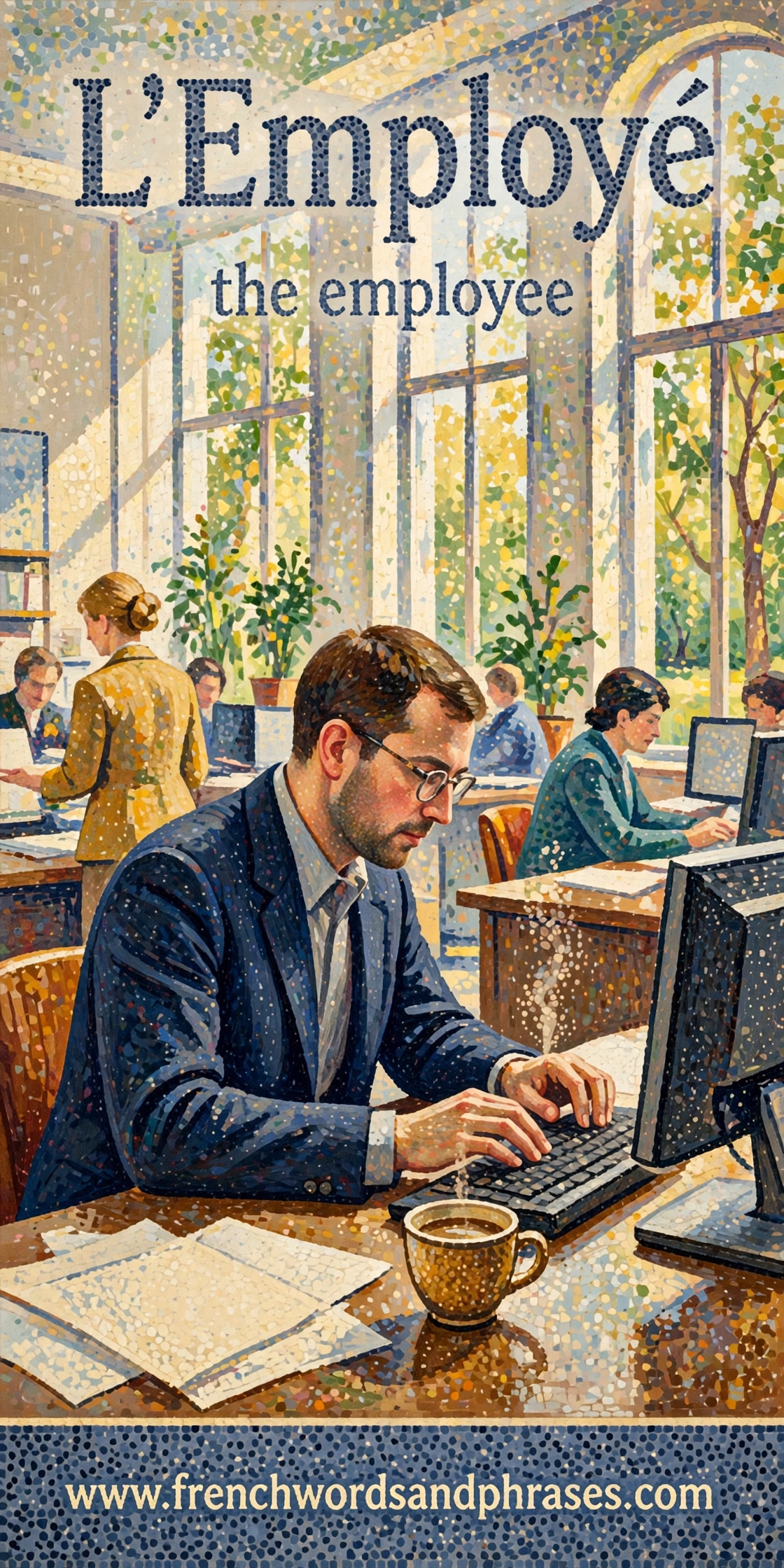
Badge at the door, coffee at the desk, a name on the rota for nine o’clock: l’employé, the employee — the person a company runs on, one working day at a time, from the shop floor to the open-plan office.
In this guide, you’ll learn what employé means in English, how to use it with its articles, how to form its plural, and how it appears in everyday French. Explore French examples, English translations, and practice quizzes.
Understanding the French Noun Employé
Employé is a masculine French noun, learned with its article: l’employé, un employé. It begins with a vowel, so the article melts into it: l’employé, never le employé. The word is the past participle of employer, to employ, turned into a person: an employé is literally “the employed one”. Its feminine form changes shape: une employée, a woman employee — one of the regular -é / -ée pairs of French job words.
It means an employee — a person who works for a company or an employer: un employé de bureau, an office employee, les employés de la société, the company’s employees, un nouvel employé, a new employee. French labour vocabulary is precise around him: his boss is l’employeur or le patron, his contract un contrat de travail, and the whole staff together is le personnel. An employé works à temps plein or à temps partiel — full-time or part-time.
Gender: Masculine — l’employé (feminine: une employée)
Definite article: l’ — l’employé (the employee), melted before the vowel
Indefinite article: un — un employé (an employee)
Plural: les employés — regular, with a simple -s
Spelling note: the past participle of employer become a person: the employed one
The pair at work: l’employé works for l’employeur, the employer
English equivalents: The employee.
The employé stands in a family of exact words: un salarié is any salaried worker, un fonctionnaire works for the state, and un employé in older office French could mean specifically a white-collar clerk, against un ouvrier, a manual worker. Modern usage is broad — any staff member. When the employé is a woman, the whole word adjusts: l’employée, with the article still melted and the ending doubled in sound and spelling.
Experience the Word
Employé is the economy in the singular: behind every company, every open shop and answered phone, there is an employé who turned up at nine.
Imagine the first morning at a new job — a desk cleared, a badge still warm from the printer, and a whole team learning your name before lunch.
You have not just named a worker. You have named the person every organisation is made of — l’employé, the employee, the employed one.
How to Use Employé in French: Complete Guide
Let’s explore how employé works in French, beginning with its articles — l’employé, un employé, une employée.
Employé with the Definite Article (L’, Les)
Used for a specific employee — the new one, the one at the desk. The vowel opening makes le melt into l’.
| Form | French |
|---|---|
| Masculine singular | l’employé |
| Plural | les employés |
Example
L’employé accueille les clients à l’entrée.
The employee welcomes the customers at the entrance.
Employé with the Indefinite Article (Un, Une, Des)
A woman employee takes the changed form: une employée — the -ée ending is the feminine of the job.
| Form | French |
|---|---|
| A man employee | un employé |
| A woman employee | une employée |
| Plural | des employés |
Example
Une nouvelle employée commence lundi prochain.
A new employee (a woman) starts next Monday.
Employé at Work (De bureau, À temps plein…)
The employé’s working world — office, hours and contracts in one table.
| Item | French |
|---|---|
| an office employee | un employé de bureau |
| a full-time employee | un employé à temps plein |
| a part-time employee | un employé à temps partiel |
| a new employee | un nouvel employé |
| the company’s employees | les employés de la société |
Example
C’est un employé à temps partiel, il travaille trois jours par semaine.
He’s a part-time employee, he works three days a week.
Quick Quiz 1
Complete the sentence:
______ employé de la banque parle trois langues. (the)
Reveal the answer
L’
L’employé de la banque parle trois langues.
The bank employee speaks three languages — le melts into l’ before the vowel.
The Plural of Employé
Employé takes a regular plural in -s — les employés is the workforce, the staff as people.
| Number | French |
|---|---|
| Singular | l’employé |
| Plural | les employés |
Example
Les employés reçoivent leur salaire à la fin du mois.
The employees receive their salary at the end of the month.
Employé with Possessive Adjectives (Mon, Ton, Son…)
Before a vowel-initial noun, possessives take the smooth forms mon, ton, son — for the employé and the employée alike.
| Owner | French |
|---|---|
| my | mon employé |
| your (tu) | ton employé |
| his / her | son employé |
| our | notre employé |
| your (vous) | votre employé |
| their | leur employé |
Example
Le directeur remercie son employé pour son travail.
The manager thanks his employee for his work.
Quick Quiz 2
Complete the sentence:
______ employés arrivent à neuf heures. (the/our — choose the definite article)
Reveal the answer
Les
Les employés arrivent à neuf heures.
The employees arrive at nine o’clock — les, the plural definite article.
Employé with Demonstrative Adjectives (Cet, Ces)
Used to point: cet employé, this employee — cet, because the noun begins with a vowel.
| Form | French |
|---|---|
| Masculine singular | cet employé |
| Plural | ces employés |
Example
Cet employé travaille ici depuis dix ans.
This employee has worked here for ten years.
Employé with Adjectives
Adjectives agree with employé — masculine singular: un employé nouveau, un employé compétent.
| Adjective | With Employé |
|---|---|
| nouveau (new) | un nouvel employé |
| compétent (competent) | un employé compétent |
| à temps plein (full-time) | un employé à temps plein |
| ancien (long-serving) | un employé ancien |
| jeune (young) | un jeune employé |
Example
Un employé compétent et aimable, c’est précieux.
A competent, friendly employee is a treasure.
Quick Quiz 3
Complete the sentence:
C’est un ______ employé, il a commencé hier. (new, before a vowel)
Reveal the answer
nouvel
C’est un nouvel employé, il a commencé hier.
He’s a new employee, he started yesterday — nouvel, the form nouveau takes before a vowel.
Everyday Expressions with Employé
Contracts, hours and pay days — the employé phrases of daily life.
| Expression | In English |
|---|---|
| un contrat de travail | an employment contract |
| le personnel | the staff — all the employés together |
| un employé à temps plein | a full-time employee |
| embaucher un employé | to hire an employee |
| l’employé du mois | the employee of the month |
Example
Le nouvel employé signe son contrat de travail.
The new employee is signing his employment contract.
Words from the Same Family as Employé
Work and wages — the words that travel with employé.
| French | In English |
|---|---|
| l’employeur | the employer — the other side of the desk |
| employer | to employ (the verb at the root) |
| un salarié | a salaried worker |
| un fonctionnaire | a civil servant — the state’s employé |
| le salaire | the salary the employé receives |
Example
L’employeur accueille les nouveaux employés.
The employer welcomes the new employees.
Quick Quiz 4
How do you say a woman employee?
Reveal the answer
Une employée — the feminine form takes -ée.
Une employée du magasin m’a aidé.
An employee of the shop (a woman) helped me.
Employé in Everyday French: Real-Life Examples
Now that you know the word, let’s see how employé appears in everyday French.
Example 1 — First day
Le nouvel employé visite les bureaux.
The new employee is touring the offices.
Example 2 — At the shop
Un employé du magasin m’a conseillé.
An employee of the shop advised me.
Example 3 — Hours
Les employés finissent à dix-huit heures.
The employees finish at six in the evening.
Example 4 — Hiring
L’entreprise cherche deux employés pour l’été.
The company is looking for two employees for the summer.
Example 5 — The team
C’est une employée formidable, toujours souriante.
She’s a wonderful employee, always smiling.
Example 6 — Pay day
Chaque employé reçoit son salaire le dernier jour du mois.
Every employee receives their salary on the last day of the month.
Beyond Translation: The Meaning of Employé
Employé is a participle that became a person — the employed one, defined entirely by the relationship that feeds him. French labour law built a cathedral of protections around the word: the contrat de travail, the thirty-five-hour week, the congés payés that astonish the world every August. To call someone un employé is therefore never neutral: it places them inside one of the most defended statuses in French life, opposite l’employeur, in a balance the law watches like a referee.
To say employé is to name the person inside the contract.
It evokes badges and rotas, first mornings and pay days — the employed one, on whom everything runs.
How to Remember the French Noun Employé
Remember it this way: Employé is the employee — masculine with a melted article: l’employé, un employé; a woman is une employée.
- Masculine, vowel first — l’employé, un employé, mon employé, cet employé.
- The feminine — une employée, with the -ée ending.
- The pair — l’employé works for l’employeur.
The key idea is l’employé — the employee, masculine; feminine une employée.
Test Your Knowledge of Employé
Let’s see how much you’ve learned. Try answering these questions before revealing the answers.
Question 1
Is employé masculine or feminine?
Reveal the answer
Masculine — l’employé, un employé; the feminine is une employée.
Question 2
How do you say a woman employee?
Reveal the answer
Une employée.
Question 3
Translate: The employees arrive at nine o’clock.
Reveal the answer
Les employés arrivent à neuf heures.
Question 4
What is the opposite side of the desk — the employer?
Reveal the answer
L’employeur — the one who employs the employé.
Question 5
Complete the sentence:
______ employée parle trois langues. (the)
Reveal the answer
L’
L’employée parle trois langues.
The employee (a woman) speaks three languages.
Your Final Challenge
Can You Use It?
How would you say this in French?
“A new employee starts next Monday.”
Reveal the answer
Un nouvel employé commence lundi prochain.
A new employee starts next Monday.
A little French. A little curiosity. A richer everyday life.
LEARN FRENCH ONE WORD AT A TIME