A French Word to Live By
Translate Salaire to English
/sa.lɛʁ/
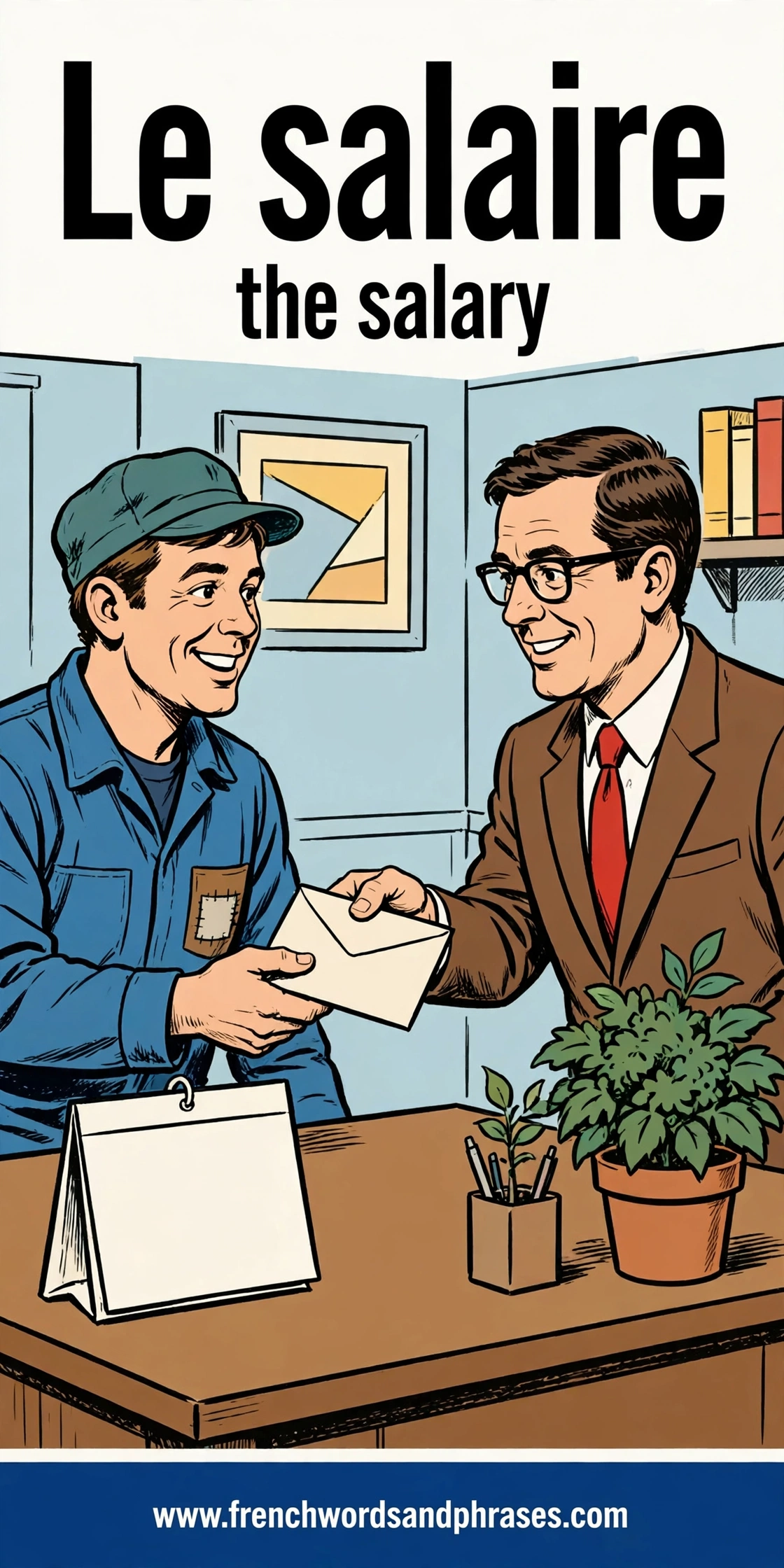
Le salaire means the salary.
The last day of the month, the phone buzzing with a bank notification, a whole month of mornings converted into one number: le salaire, the salary — the pay that lands, regular as rent, in exchange for the working days of a life.
In this guide, you’ll learn what salaire means in English, how to use it with its articles, how to form its plural, and how it appears in everyday French. Explore French examples, English translations, and practice quizzes.
Understanding the French Noun Salaire
Salaire is a masculine French noun, learned with its article: le salaire, un salaire. Its ancestry is deliciously concrete: Latin salarium, the salt money — the allowance Roman soldiers received for salt, from sal. French keeps the whole pay family distinct: le salaire is the regular pay of an employee, la paie is payday itself and the act of paying, and a freelancer invoices des honoraires instead.
It means a salary, wages — the money an employee earns for their work: un bon salaire, a good salary, le salaire mensuel, the monthly salary, recevoir son salaire, to receive one’s pay. France names its floor: le salaire minimum, shortened everywhere to le SMIC, the legal minimum wage. Payslips split the word in two: le salaire brut, gross pay before deductions, and le salaire net, what actually arrives — the only one of the pair anyone celebrates.
Gender: Masculine — le salaire
Definite article: le — le salaire (the salary)
Indefinite article: un — un salaire (a salary)
Plural: les salaires — regular, with a simple -s
Spelling note: from Latin salarium, salt money — the soldier’s allowance for salt
The payslip pair: salaire brut (gross) vs salaire net (take-home)
English equivalents: The salary, the wages.
The salaire arrives à la fin du mois, at the end of the month, and French conversation guards it politely — asking tu gagnes combien ? is as delicate in Paris as anywhere. The verbs matter: gagner un salaire, to earn a salary, toucher son salaire, to receive it (touch it, in the vivid French idiom), augmenter for the rise everyone awaits: une augmentation de salaire.
Experience the Word
Salaire is time made spendable: thirty mornings, twenty commutes and one difficult meeting, all distilled into a single bank line.
Imagine the café conversation on the first of the month — rent paid, fridge filled, a small treat allowed — the whole city breathing out as les salaires land.
You have not just named money. You have named the month’s reward — le salaire, the salary, salt money grown up.
How to Use Salaire in French: Complete Guide
Let’s explore how salaire works in French, beginning with its articles — le salaire, un salaire, toucher son salaire.
Salaire with the Definite Article (Le, Les)
Used for a specific salary — yours, the one on the payslip.
| Form | French |
|---|---|
| Masculine singular | le salaire |
| Plural | les salaires |
Example
Le salaire arrive le dernier jour du mois.
The salary arrives on the last day of the month.
Salaire with the Indefinite Article (Un, Des)
Used for a salary in general — any pay worth working for.
| Form | French |
|---|---|
| Masculine singular | un salaire |
| Plural | des salaires |
Example
Elle cherche un travail avec un bon salaire.
She is looking for a job with a good salary.
Kinds of Salaire (Brut, Net, Minimum…)
The payslip’s vocabulary — gross, net, and the legal floor beneath them all.
| Kind | French |
|---|---|
| gross salary | le salaire brut |
| net salary, take-home pay | le salaire net |
| monthly salary | le salaire mensuel |
| the minimum wage | le salaire minimum (le SMIC) |
| a pay rise | une augmentation de salaire |
Example
Le salaire net est plus petit que le salaire brut.
The net salary is smaller than the gross salary.
Quick Quiz 1
Complete the sentence:
______ salaire de Paul a augmenté cette année. (the)
Reveal the answer
Le
Le salaire de Paul a augmenté cette année.
Paul’s salary has gone up this year — salaire is masculine, so le.
The Plural of Salaire
Salaire takes a regular plural in -s — whole companies’ worth of them land on the same day.
| Number | French |
|---|---|
| Singular | le salaire |
| Plural | les salaires |
Example
Les salaires sont payés le trente du mois.
The salaries are paid on the thirtieth of the month.
Salaire with Possessive Adjectives (Mon, Ton, Son…)
Possessives agree with the noun: salaire is masculine, so mon, ton, son in the singular.
| Owner | French |
|---|---|
| my | mon salaire |
| your (tu) | ton salaire |
| his / her | son salaire |
| our | notre salaire |
| your (vous) | votre salaire |
| their | leur salaire |
Example
Je mets une partie de mon salaire de côté chaque mois.
I put part of my salary aside every month.
Quick Quiz 2
Complete the sentence:
Elle a reçu ______ salaire hier soir. (her)
Reveal the answer
son
Elle a reçu son salaire hier soir.
She received her salary last night — son, because salaire is masculine.
Salaire with Demonstrative Adjectives (Ce, Ces)
Used to point: ce salaire, this salary — this offer, this figure.
| Form | French |
|---|---|
| Masculine singular | ce salaire |
| Plural | ces salaires |
Example
Ce salaire ne suffit pas pour vivre à Paris.
This salary is not enough to live on in Paris.
Salaire with Adjectives
Adjectives agree with salaire — masculine singular: un salaire élevé, un bon salaire.
| Adjective | With Salaire |
|---|---|
| élevé (high) | un salaire élevé |
| bas (low) | un salaire bas |
| mensuel (monthly) | un salaire mensuel |
| minimum (minimum) | le salaire minimum |
| bon (good) | un bon salaire |
Example
Un salaire élevé ne fait pas tout le bonheur.
A high salary is not everything in happiness.
Quick Quiz 3
Complete the sentence:
Il gagne un salaire ______. (high)
Reveal the answer
élevé
Il gagne un salaire élevé.
He earns a high salary — élevé, masculine, to agree with salaire.
Everyday Expressions with Salaire
Payslips and pay days — the salaire phrases of daily life.
| Expression | In English |
|---|---|
| toucher son salaire | to receive one’s salary (literally, to touch it) |
| gagner un salaire | to earn a salary |
| une augmentation de salaire | a pay rise |
| le bulletin de salaire | the payslip |
| le SMIC | the legal minimum wage |
Example
Elle touche son salaire le vingt-huit de chaque mois.
She receives her salary on the twenty-eighth of each month.
Words from the Same Family as Salaire
Pay and payslips — the words that travel with salaire.
| French | In English |
|---|---|
| un salarié | a salaried employee |
| la paie | payday; the act of paying |
| un employé | an employee — the one who receives it |
| gagner | to earn (the verb) |
| le sel | salt — the word’s tasty ancestor |
Example
Le salarié attend la paie avec impatience.
The employee waits impatiently for payday.
Quick Quiz 4
What is the difference between le salaire brut and le salaire net?
Reveal the answer
Gross versus take-home — brut is before deductions, net is what actually arrives.
On regarde toujours le salaire net.
Everyone always looks at the net salary.
Salaire in Everyday French: Real-Life Examples
Now that you know the word, let’s see how salaire appears in everyday French.
Example 1 — Pay day
Mon salaire est arrivé ce matin.
My salary arrived this morning.
Example 2 — Job hunting
Ce poste offre un très bon salaire.
This job offers a very good salary.
Example 3 — The rise
Elle demande une augmentation de salaire.
She is asking for a pay rise.
Example 4 — Saving
Il met son salaire à la banque chaque mois.
He puts his salary in the bank every month.
Example 5 — The minimum
Le salaire minimum augmente en janvier.
The minimum wage goes up in January.
Example 6 — Comparing
Le salaire net, c’est ce qui compte.
The net salary is what counts.
Beyond Translation: The Meaning of Salaire
Salaire keeps a Roman soldier in its etymology: salarium, the salt allowance, money for the mineral that preserved food and paid for empires’ marches. The word grew from a ration into the central contract of modern life — and France, characteristically, legislated its floor and named it: le SMIC, the minimum below which no salaire may fall. Every payslip still tells the old story twice, in brut and in net: what your work is worth on paper, and what of it survives the journey home.
To say salaire is to count the month in money.
It evokes the bank notification, the paid rent and the small first-of-the-month treat — salt money, two thousand years on.
How to Remember the French Noun Salaire
Remember it this way: Salaire is the salary — masculine: le salaire, un salaire, split on the payslip into brut and net.
- Always masculine — le salaire, un salaire, mon salaire.
- The payslip pair — salaire brut (gross) and salaire net (take-home).
- The root — Latin salarium, salt money, from sal, salt.
The key idea is le salaire — the salary, masculine; brut vs net on the payslip.
Test Your Knowledge of Salaire
Let’s see how much you’ve learned. Try answering these questions before revealing the answers.
Question 1
Is salaire masculine or feminine?
Reveal the answer
Masculine — le salaire, un salaire.
Question 2
What do brut and net mean on a payslip?
Reveal the answer
Brut is gross, before deductions; net is the take-home pay.
Question 3
Translate: She received her salary last night.
Reveal the answer
Elle a reçu son salaire hier soir.
Question 4
What is le SMIC?
Reveal the answer
The legal minimum wage — short for salaire minimum.
Question 5
Complete the sentence:
______ salaires sont payés le trente. (the)
Reveal the answer
Les
Les salaires sont payés le trente.
The salaries are paid on the thirtieth.
Your Final Challenge
Can You Use It?
How would you say this in French?
“I put part of my salary aside every month.”
Reveal the answer
Je mets une partie de mon salaire de côté chaque mois.
I put part of my salary aside every month.
A little French. A little curiosity. A richer everyday life.
LEARN FRENCH ONE WORD AT A TIME