A French Word to Live By
Translate École Primaire to English
/e.kɔl pʁi.mɛʁ/
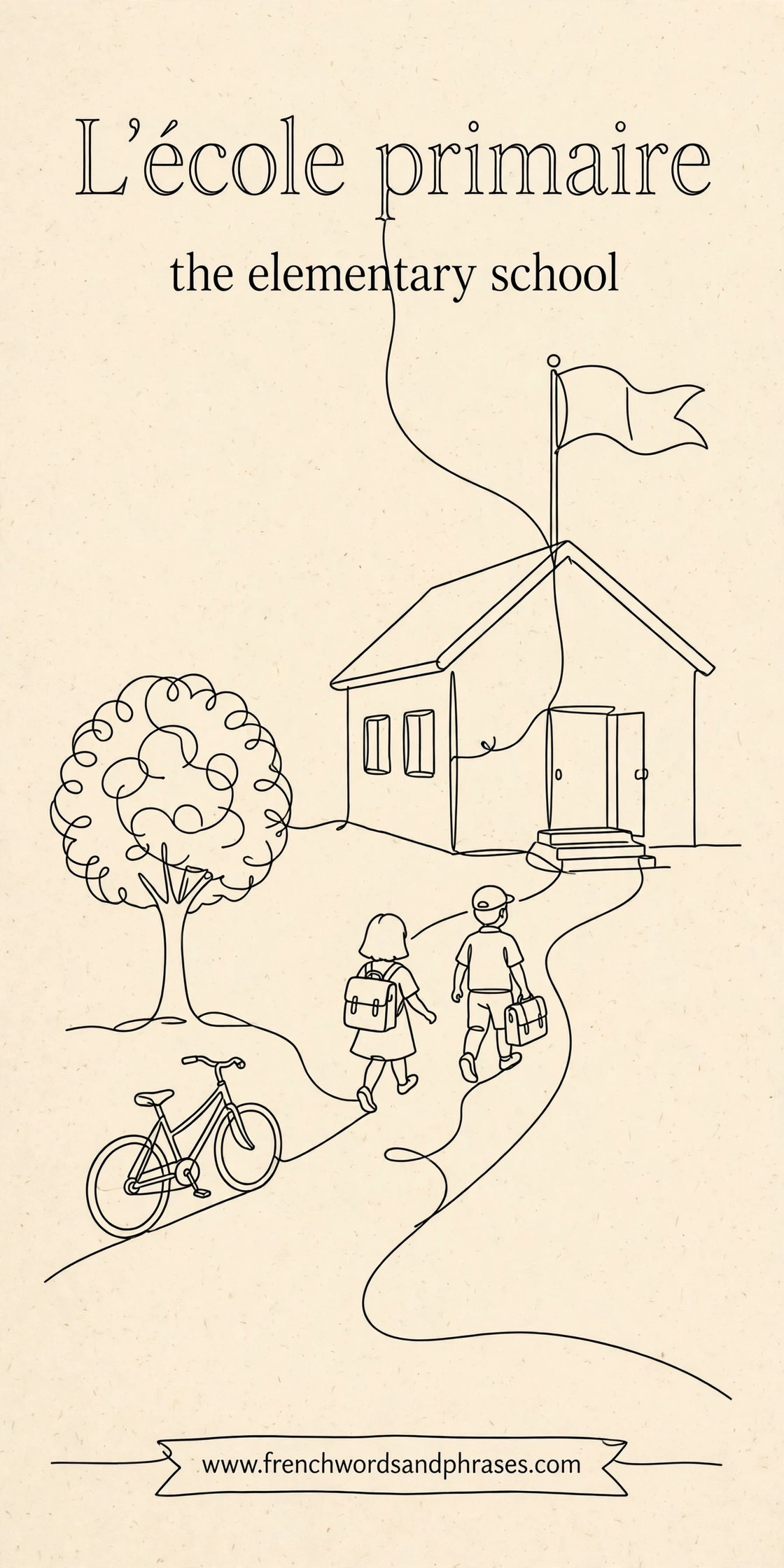
L’école primaire means the elementary school.
A real desk, a satchel of books, and reading — at last — on your own: l’école primaire, the elementary school, where French children from six to eleven learn the tools of everything else.
In this guide, you’ll learn what école primaire means in English, how to use it with its articles, how to form its plural, and how it appears in everyday French. Explore French examples, English translations, and practice quizzes.
Understanding the French Noun École Primaire
École primaire is a feminine French compound noun, learned with its article: l’école primaire, une école primaire. The article melts before the vowel: l’école. Primaire means first — the first true school of lessons, after the gentle école maternelle. Its five years climb from the CP (cours préparatoire, where reading begins) to the CM2, the last year before the leap to le collège.
It means elementary school, primary school — the school for children aged six to eleven: aller à l’école primaire, to go to primary school, un élève de l’école primaire, a primary school pupil. The five classes are the CP, CE1, CE2, CM1 and CM2 — initials every French parent recites like a phone number. The teacher is le maître or la maîtresse, the room is la salle de classe, and the day turns on la récréation and the midday cantine.
Gender: Feminine — l’école primaire
Definite article: l’ — l’école primaire (the elementary school), melted before the vowel
Indefinite article: une — une école primaire (an elementary school)
Plural: les écoles primaires — regular, with a simple -s
Spelling note: primaire means first — the first school of real lessons
The five years: CP, CE1, CE2, CM1, CM2 — ages six to eleven
English equivalents: The elementary school, the primary school.
The staircase again: l’école maternelle (three to six), l’école primaire (six to eleven), le collège (eleven to fifteen), le lycée (fifteen to eighteen). The pupil of the primaire is un élève — the word that replaces « enfant » in school talk. And the great event of the CP year has its sentence: il apprend à lire, he is learning to read.
Experience the Word
École primaire is where childhood gets its tools: the first pen that is not a crayon, the first book read alone, the first map of a country that turns out to be yours.
Imagine the September courtyard — cartables in a rainbow row, the maîtresse calling the roll under the plane trees, and a hundred small voices answering « présent ! » like a choir.
You have not just named a school. You have named the workshop of everything — l’école primaire, the elementary school, where reading begins.
How to Use École Primaire in French: Complete Guide
Let’s explore how école primaire works in French, beginning with its articles — l’école primaire, une école primaire, du CP au CM2.
École Primaire with the Definite Article (L’, Les)
Used for a specific primary school — the one in the village, the one your children attend.
| Form | French |
|---|---|
| Feminine singular | l’école primaire |
| Plural | les écoles primaires |
Example
L’école primaire est au bout de la rue.
The primary school is at the end of the street.
École Primaire with the Indefinite Article (Une, Des)
Used for a primary school in general — every town and village has one.
| Form | French |
|---|---|
| Feminine singular | une école primaire |
| Plural | des écoles primaires |
Example
Chaque village a une école primaire et une mairie.
Every village has a primary school and a town hall.
The Years of École Primaire (CP, CE1, CE2, CM1, CM2)
Five years, five sets of initials — the map every French parent knows by heart.
| Year | French |
|---|---|
| first year (age 6) | le CP — cours préparatoire |
| second year (age 7) | le CE1 |
| third year (age 8) | le CE2 |
| fourth year (age 9) | le CM1 |
| fifth year (age 10) | le CM2 |
Example
Ma fille est en CE2, elle lit déjà très bien.
My daughter is in CE2, she already reads very well.
Quick Quiz 1
Complete the sentence:
______ école primaire ouvre ses portes à huit heures. (the)
Reveal the answer
L’
L’école primaire ouvre ses portes à huit heures.
The primary school opens its doors at eight o’clock — le melts into l’ before the vowel.
The Plural of École Primaire
École primaire takes a regular plural in -s on both words — écoles primaires.
| Number | French |
|---|---|
| Singular | l’école primaire |
| Plural | les écoles primaires |
Example
Les écoles primaires du quartier se partagent le gymnase.
The primary schools of the neighbourhood share the gym.
École Primaire with Possessive Adjectives (Son, Sa…)
Possessives agree with école, feminine — but before its vowel, ma, ta, sa become mon, ton, son: son école primaire.
| Owner | French |
|---|---|
| my | mon école primaire |
| your (tu) | ton école primaire |
| his / her | son école primaire |
| our | notre école primaire |
| your (vous) | votre école primaire |
| their | leur école primaire |
Example
Son école primaire est la même que la mienne autrefois.
His primary school is the same one I went to, long ago.
Quick Quiz 2
Complete the sentence:
Il accompagne son fils à ______ école primaire. (his — careful, école starts with a vowel)
Reveal the answer
son
Il accompagne son fils à son école primaire.
He takes his son to his primary school — son, not sa, before the vowel of école.
École Primaire with Demonstrative Adjectives (Cette, Ces)
Used to point: cette école primaire, this primary school — the one with the blue gate.
| Form | French |
|---|---|
| Feminine singular | cette école primaire |
| Plural | ces écoles primaires |
Example
Cette école primaire a une grande cour.
This primary school has a big playground.
École Primaire with Adjectives
Adjectives agree with école — feminine singular: une école primaire publique, une grande école primaire.
| Adjective | With École Primaire |
|---|---|
| publique (public, state) | une école primaire publique |
| privée (private) | une école primaire privée |
| grande (big) | une grande école primaire |
| nouvelle (new) | une nouvelle école primaire |
| ancienne (old) | une ancienne école primaire |
Example
Une grande école primaire accueille quatre cents élèves.
A big primary school takes four hundred pupils.
Quick Quiz 3
Complete the sentence:
C’est une école primaire ______, elle a cent ans. (old)
Reveal the answer
ancienne
C’est une école primaire ancienne, elle a cent ans.
It’s an old primary school, a hundred years old — ancienne, feminine, to agree with école.
Everyday Expressions with École Primaire
Roll calls, canteens and reading — the primaire phrases of daily life.
| Expression | In English |
|---|---|
| aller à l’école primaire | to go to primary school |
| un élève de l’école primaire | a primary school pupil |
| le CP | the first year — where reading begins |
| la salle de classe | the classroom |
| la cantine | the school canteen |
Example
En CP, les enfants apprennent à lire et à écrire.
In CP, children learn to read and write.
Words from the Same Family as École Primaire
The staircase of French schools — the words that travel with école primaire.
| French | In English |
|---|---|
| l’école maternelle | the preschool — the step before |
| le collège | the middle school — the step after |
| l’élève | the pupil, the student |
| la maîtresse / le maître | the teacher |
| le cartable | the schoolbag |
Example
Après l’école primaire, les élèves entrent au collège.
After primary school, pupils go into middle school.
Quick Quiz 4
In which year of the école primaire do children learn to read?
Reveal the answer
In the CP — the cours préparatoire, the first year, at age six.
En CP, on apprend à lire.
In CP, you learn to read.
École Primaire in Everyday French: Real-Life Examples
Now that you know the word, let’s see how école primaire appears in everyday French.
Example 1 — The walk
Les enfants vont à l’école primaire à pied.
The children walk to primary school.
Example 2 — Reading
En CP, ma fille apprend à lire.
In CP, my daughter is learning to read.
Example 3 — The pupil
Un élève de l’école primaire a gagné le concours.
A primary school pupil won the competition.
Example 4 — The canteen
À midi, les élèves mangent à la cantine.
At noon, the pupils eat at the canteen.
Example 5 — The next step
Après le CM2, c’est le collège.
After CM2, it’s middle school.
Example 6 — Memory
Mon école primaire avait une cour immense.
My primary school had a huge playground.
Beyond Translation: The Meaning of École Primaire
The école primaire is the republic’s foundation stone: free, secular and compulsory since the laws of the 1880s, planted in every village beside the mairie, so that the schoolhouse and the town hall face the square together. Its five years carry the great common inheritance — reading in the CP, the map of France on the wall, the dictée, the multiplication tables chanted in chorus. Ask any French adult and they will name their maîtresse of the CM2 before they name a minister. The primaire is where a country quietly decides to be one country.
To say école primaire is to name the first page of the national story.
It evokes the roll call under the plane trees, the smell of chalk and the first book finished alone.
How to Remember the French Noun École Primaire
Remember it this way: École primaire is the elementary school — feminine, with a melted article: l’école primaire. Ages six to eleven, from CP to CM2.
- Feminine, vowel first — l’école primaire, une école primaire, son école primaire.
- The five years — CP, CE1, CE2, CM1, CM2, then le collège.
- The step before — l’école maternelle is preschool, ages three to six.
The key idea is l’école primaire — the elementary school, feminine; CP to CM2, ages 6–11.
Test Your Knowledge of École Primaire
Let’s see how much you’ve learned. Try answering these questions before revealing the answers.
Question 1
Is école primaire masculine or feminine?
Reveal the answer
Feminine — l’école primaire, une école primaire.
Question 2
How do you say a primary school pupil?
Reveal the answer
Un élève de l’école primaire.
Question 3
Translate: The primary school is at the end of the street.
Reveal the answer
L’école primaire est au bout de la rue.
Question 4
What comes after the école primaire?
Reveal the answer
Le collège — middle school, from age eleven.
Question 5
Complete the sentence:
______ écoles primaires du village sont deux. (the)
Reveal the answer
Les
Les écoles primaires du village sont deux.
The village’s primary schools are two in number.
Your Final Challenge
Can You Use It?
How would you say this in French?
“In CP, children learn to read and write.”
Reveal the answer
En CP, les enfants apprennent à lire et à écrire.
In CP, children learn to read and write.
A little French. A little curiosity. A richer everyday life.
LEARN FRENCH ONE WORD AT A TIME