A French Word to Live By
How to Conjugate Rester in French
Pronunciation: /ʁɛs.te/
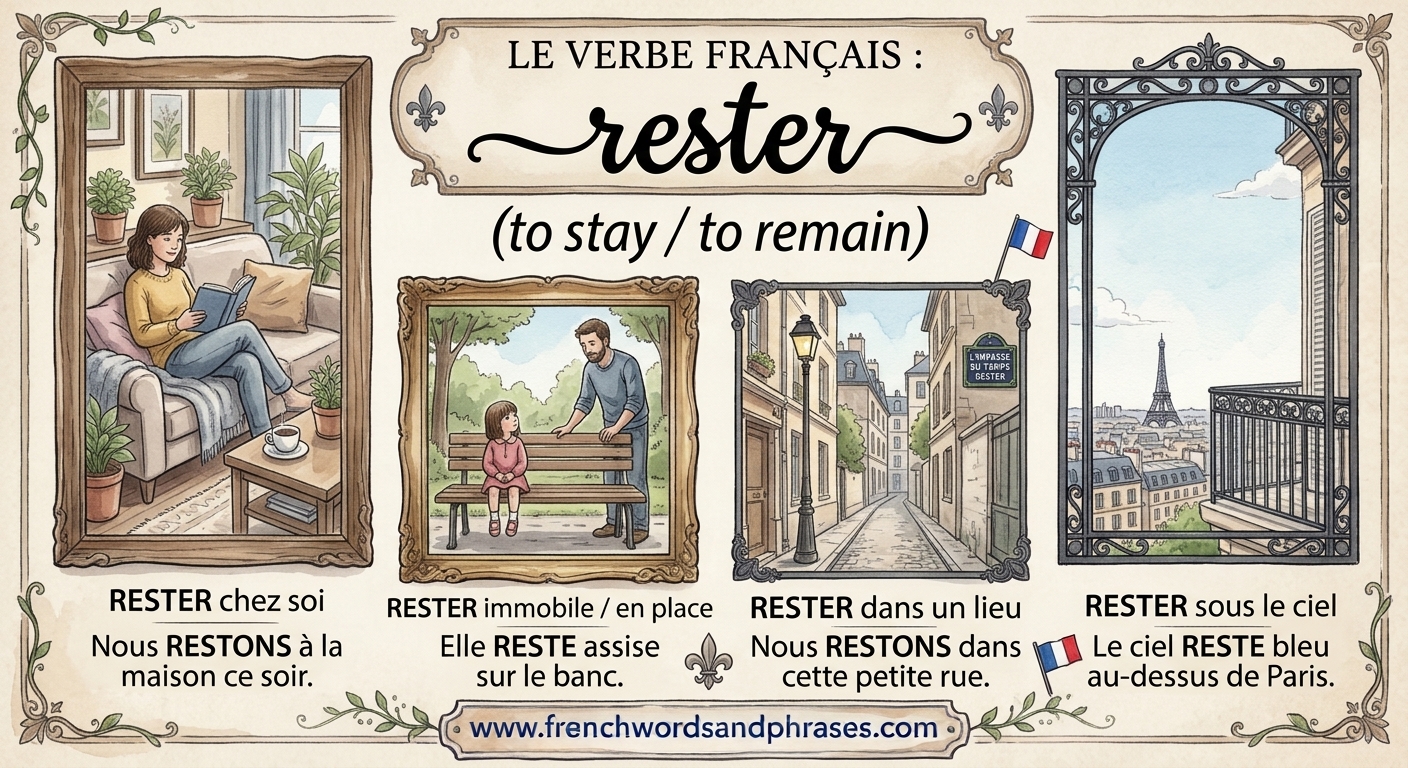
Rester means “to stay” or “to remain” in French.
Some of life’s most meaningful moments happen when we choose to stay. Whether you’re remaining in a beautiful place, spending time with someone you love, or simply taking a moment to enjoy the present, the French verb rester captures the idea of staying right where you are.
In this guide, you’ll learn how to conjugate rester in every major French tense and mood, with practical examples, pronunciation support, and short quizzes to help you remember each form.
Understanding the French Verb Rester
Rester is a regular first-group French verb ending in -er. Its conjugation is generally straightforward, following the familiar pattern of other regular -er verbs.
- Infinitive: rester
- Meaning: to stay, to remain
- Verb group: First group (-er)
- Auxiliary verb: être
- Past participle: resté
- Present participle: restant
One important detail makes rester especially useful to learn: it takes être as its auxiliary verb in compound tenses. Because of this, the past participle agrees with the subject in gender and number.
For example:
- Il est resté. — He stayed.
- Elle est restée. — She stayed.
- Ils sont restés. — They stayed (masculine or mixed group).
- Elles sont restées. — They stayed (feminine group).
The verb rester is often used with a place, an adjective, or an expression describing a state or condition.
- rester à la maison — to stay at home
- rester ici — to stay here
- rester calme — to remain calm
- rester amis — to remain friends
- rester en contact — to stay in touch
- il reste du temps — there is time left
Do not confuse rester with habiter. Both can relate to where someone lives, but habiter means to live or reside somewhere, while rester often describes staying somewhere for a period of time.
Experience the Word
Imagine a quiet afternoon on the French Riviera. The sun is shining, the sea is calm, and there’s nowhere else you need to be. You decide to stay a little longer.
Je veux rester ici encore un peu.
Je veux rester ici encore un peu.
I want to stay here a little longer.
That simple idea is at the heart of rester: staying, remaining, and sometimes choosing not to leave.
How to Conjugate Rester: Complete French Conjugation Guide
Indicatif — The Indicative Mood
The indicative mood is used to describe facts, actions, and events that are presented as real or certain. Let’s explore all nine indicative tenses of rester.
How to Conjugate Rester in the Présent
The present tense describes what is happening now, what happens regularly, or a general situation. Rester follows the regular -er pattern.
| Subject | Conjugation |
|---|---|
| je | reste |
| tu | restes |
| il / elle | reste |
| nous | restons |
| vous | restez |
| ils / elles | restent |
Nous restons à la maison ce soir.
We are staying at home tonight.
How to Conjugate Rester in the Passé Composé
The passé composé describes completed actions in the past. It is formed with the present tense of être and the past participle resté. Remember that the past participle agrees with the subject.
| Subject | Conjugation |
|---|---|
| je | suis resté / suis restée |
| tu | es resté / es restée |
| il / elle | est resté / est restée |
| nous | sommes restés / sommes restées |
| vous | êtes restés / êtes restées / êtes resté / êtes restée |
| ils / elles | sont restés / sont restées |
Elle est restée chez ses amis pendant le week-end.
She stayed at her friends’ house during the weekend.
How to Conjugate Rester in the Imparfait
The imparfait describes ongoing or habitual actions in the past. It is often used to set a scene, describe circumstances, or explain what used to happen.
| Subject | Conjugation |
|---|---|
| je | restais |
| tu | restais |
| il / elle | restait |
| nous | restions |
| vous | restiez |
| ils / elles | restaient |
Quand j’étais enfant, je restais souvent chez mes grands-parents.
When I was a child, I often stayed at my grandparents’ house.
How to Conjugate Rester in the Plus-que-parfait
The plus-que-parfait describes an action that had already happened before another event in the past. It is formed with the imparfait of être and the past participle resté.
| Subject | Conjugation |
|---|---|
| je | étais resté / étais restée |
| tu | étais resté / étais restée |
| il / elle | était resté / était restée |
| nous | étions restés / étions restées |
| vous | étiez restés / étiez restées / étiez resté / étiez restée |
| ils / elles | étaient restés / étaient restées |
Nous étions restés à l’hôtel avant de visiter la ville.
We had stayed at the hotel before visiting the city.
How to Conjugate Rester in the Passé Simple
The passé simple is a literary past tense, mainly encountered in novels, historical writing, and formal narratives. It is rarely used in everyday conversation.
| Subject | Conjugation |
|---|---|
| je | restai |
| tu | restas |
| il / elle | resta |
| nous | restâmes |
| vous | restâtes |
| ils / elles | restèrent |
Il resta dans le village jusqu’à la tombée de la nuit.
He remained in the village until nightfall.
How to Conjugate Rester in the Passé Antérieur
The passé antérieur is a literary tense used to describe an action completed immediately before another past action, often in a narrative. It is formed with the passé simple of être and the past participle.
| Subject | Conjugation |
|---|---|
| je | fus resté / fus restée |
| tu | fus resté / fus restée |
| il / elle | fut resté / fut restée |
| nous | fûmes restés / fûmes restées |
| vous | fûtes restés / fûtes restées / fûtes resté / fûtes restée |
| ils / elles | furent restés / furent restées |
Dès qu’il fut resté seul, il ouvrit la lettre.
As soon as he had been left alone, he opened the letter.
How to Conjugate Rester in the Futur Simple
The futur simple describes an action that will take place in the future. For regular -er verbs, the future stem is the infinitive rester, followed by the future endings.
| Subject | Conjugation |
|---|---|
| je | resterai |
| tu | resteras |
| il / elle | restera |
| nous | resterons |
| vous | resterez |
| ils / elles | resteront |
Je resterai quelques jours de plus en France.
I will stay a few more days in France.
How to Conjugate Rester in the Futur Antérieur
The futur antérieur describes an action that will have been completed by a particular point in the future. It is formed with the future simple of être and the past participle.
| Subject | Conjugation |
|---|---|
| je | serai resté / serai restée |
| tu | seras resté / seras restée |
| il / elle | sera resté / sera restée |
| nous | serons restés / serons restées |
| vous | serez restés / serez restées / serez resté / serez restée |
| ils / elles | seront restés / seront restées |
À la fin du mois, nous serons restés ici pendant un an.
By the end of the month, we will have stayed here for a year.
How to Conjugate Rester in the Futur Proche
The futur proche, or near future, describes something that is going to happen soon. It is formed with the present tense of aller followed by the infinitive rester.
| Subject | Conjugation |
|---|---|
| je | vais rester |
| tu | vas rester |
| il / elle | va rester |
| nous | allons rester |
| vous | allez rester |
| ils / elles | vont rester |
Nous allons rester à Paris jusqu’à dimanche.
We are going to stay in Paris until Sunday.
Le Conditionnel — The Conditional Mood
The conditional mood expresses what would happen under certain circumstances. It is also used to make polite requests and express wishes or possibilities.
How to Conjugate Rester in the Conditionnel Présent
The present conditional is used to describe what someone would do or what might happen under certain conditions.
| Subject | Conjugation |
|---|---|
| je | resterais |
| tu | resterais |
| il / elle | resterait |
| nous | resterions |
| vous | resteriez |
| ils / elles | resteraient |
Je resterais plus longtemps si je pouvais.
I would stay longer if I could.
How to Conjugate Rester in the Conditionnel Passé
The past conditional describes what would have happened in the past under different circumstances. It is formed with the conditional present of être and the past participle.
| Subject | Conjugation |
|---|---|
| je | serais resté / serais restée |
| tu | serais resté / serais restée |
| il / elle | serait resté / serait restée |
| nous | serions restés / serions restées |
| vous | seriez restés / seriez restées / seriez resté / seriez restée |
| ils / elles | seraient restés / seraient restées |
Elle serait restée si elle avait eu le temps.
She would have stayed if she had had the time.
How to Conjugate Rester in the Conditionnel Passé — Literary Alternative
This alternative form uses the imperfect subjunctive of être. It is extremely literary and rarely encountered outside older or highly formal French writing.
| Subject | Conjugation |
|---|---|
| je | fusse resté / fusse restée |
| tu | fusses resté / fusses restée |
| il / elle | fût resté / fût restée |
| nous | fussions restés / fussions restées |
| vous | fussiez restés / fussiez restées / fussiez resté / fussiez restée |
| ils / elles | fussent restés / fussent restées |
Il eût préféré qu’elle fût restée.
He would have preferred her to have stayed.
Le Subjonctif — The Subjunctive Mood
The subjunctive is used after certain expressions of emotion, doubt, necessity, desire, and uncertainty. It often appears after que.
How to Conjugate Rester in the Subjonctif Présent
The present subjunctive is commonly used when the main clause expresses a wish, feeling, doubt, or necessity about someone staying or remaining.
| Subject | Conjugation |
|---|---|
| que je | reste |
| que tu | restes |
| qu’il / qu’elle | reste |
| que nous | restions |
| que vous | restiez |
| qu’ils / qu’elles | restent |
Je veux que tu restes avec nous.
I want you to stay with us.
How to Conjugate Rester in the Subjonctif Imparfait
The imperfect subjunctive is a literary tense found mainly in formal writing and older literature. In everyday French, the present subjunctive is generally used instead.
| Subject | Conjugation |
|---|---|
| que je | restasse |
| que tu | restasses |
| qu’il / qu’elle | restât |
| que nous | restassions |
| que vous | restassiez |
| qu’ils / qu’elles | restassent |
Il souhaitait qu’elle restât encore quelques jours.
He wished that she would remain for a few more days.
How to Conjugate Rester in the Subjonctif Plus-que-parfait
The pluperfect subjunctive is a literary tense used to refer to an action that had already been completed in a subordinate clause. It is formed with the imperfect subjunctive of être and the past participle.
| Subject | Conjugation |
|---|---|
| que je | fusse resté / fusse restée |
| que tu | fusses resté / fusses restée |
| qu’il / qu’elle | fût resté / fût restée |
| que nous | fussions restés / fussions restées |
| que vous | fussiez restés / fussiez restées / fussiez resté / fussiez restée |
| qu’ils / qu’elles | fussent restés / fussent restées |
Il regrettait qu’elle fût restée si longtemps seule.
He regretted that she had remained alone for so long.
How to Conjugate Rester in the Subjonctif Passé
The past subjunctive describes an action that has already happened but is connected to a feeling, wish, doubt, or necessity. It is formed with the present subjunctive of être and the past participle.
| Subject | Conjugation |
|---|---|
| que je | sois resté / sois restée |
| que tu | sois resté / sois restée |
| qu’il / qu’elle | soit resté / soit restée |
| que nous | soyons restés / soyons restées |
| que vous | soyez restés / soyez restées / soyez resté / soyez restée |
| qu’ils / qu’elles | soient restés / soient restées |
Je suis heureux que vous soyez restés.
I am happy that you stayed.
L’Impératif — The Imperative Mood
The imperative is used to give commands, make suggestions, or offer instructions. It has three forms: tu, nous, and vous. Subject pronouns are omitted.
How to Conjugate Rester in the Impératif Présent
| Subject | Conjugation |
|---|---|
| (tu) | reste |
| (nous) | restons |
| (vous) | restez |
Reste ici, s’il te plaît !
Stay here, please!
Le Participe — French Participles
Participles are useful forms of a verb that can be used in compound tenses or as adjectives. Rester has a present participle and a past participle.
Présent — Present Participle
The present participle of rester is restant. It can describe an action happening at the same time as another action, or function as an adjective in certain contexts.
Restant près de la fenêtre, elle regardait la pluie.
Remaining near the window, she watched the rain.
Passé — Past Participle
The past participle is resté. Because rester takes être in compound tenses, the past participle agrees with the subject.
| Form | Conjugation |
|---|---|
| Masculine singular | resté |
| Masculine plural | restés |
| Feminine singular | restée |
| Feminine plural | restées |
Elles sont restées toute la journée.
They stayed all day.
Rester in Everyday French: Six Useful Examples
Here are six examples showing how rester appears in everyday conversation and writing.
1. Present — Présent
Je reste encore cinq minutes.
I’ll stay another five minutes.
2. Past — Passé composé
Nous sommes restés à la plage jusqu’au coucher du soleil.
We stayed at the beach until sunset.
3. Imperfect — Imparfait
Il restait toujours calme dans les situations difficiles.
He always remained calm in difficult situations.
4. Future — Futur simple
Elles resteront en France pendant trois semaines.
They will stay in France for three weeks.
5. Conditional — Conditionnel présent
Je resterais bien ici toute la journée.
I’d happily stay here all day.
6. Subjunctive — Subjonctif présent
Il faut que nous restions ensemble.
We must stay together.
Beyond Translation: Common Expressions with Rester
Learning a French verb becomes much easier when you discover the expressions in which it naturally appears. Here are some useful combinations with rester.
- rester à la maison — to stay at home
- rester en contact — to stay in touch
- rester calme — to remain calm
- rester debout — to remain standing
- rester fidèle — to remain faithful
- rester en vie — to stay alive
- rester sans réponse — to remain unanswered
- il reste du pain — there is some bread left
- il ne reste que deux jours — there are only two days left
Notice that rester does not always describe a person physically staying in one place. It can also express continuity or the fact that something remains.
How to Remember the Conjugation of Rester
Because rester is a regular -er verb, its simple tenses follow a pattern you can use with many other French verbs.
- Present: reste, restes, reste, restons, restez, restent.
- Imperfect: start with rest- and add the imperfect endings.
- Future: keep the infinitive rester and add the future endings.
- Conditional: use the same future stem with the imperfect endings.
- Compound tenses: use the appropriate form of être followed by resté.
The most important point to remember is that rester uses être, not avoir, in its compound tenses. This means that the past participle changes to match the subject.
Test Your Knowledge: Rester Conjugation Quiz
Try these five questions to see how well you understand the verb rester. Open each answer when you’re ready to check your work.
Question 1
How do you say “We are staying” in French?
Reveal answer
Nous restons.
This is the present tense of rester.
Question 2
Which auxiliary verb does rester use in the passé composé?
Reveal answer
Être.
For example: Elle est restée. — She stayed.
Question 3
Complete the sentence: Ils sont ______ à la maison.
Reveal answer
restés
The masculine plural past participle is restés.
Question 4
How do you say “I would stay” in French?
Reveal answer
Je resterais.
This is the present conditional.
Question 5
What is the present subjunctive form for nous?
Reveal answer
Que nous restions.
Your Final Challenge
Translate this sentence into French:
“We stayed at the hotel, but we will stay with our friends tomorrow.”
Reveal the French translation
Nous sommes restés à l’hôtel, mais nous resterons chez nos amis demain.
We stayed at the hotel, but we will stay with our friends tomorrow.
Remember: sommes restés is the passé composé, while resterons is the future simple.
A little French. A little curiosity. A richer everyday life.
LEARN FRENCH ONE WORD AT A TIME