A French Word to Live By
How to Conjugate Penser in French
Pronunciation: /pɑ̃.se/
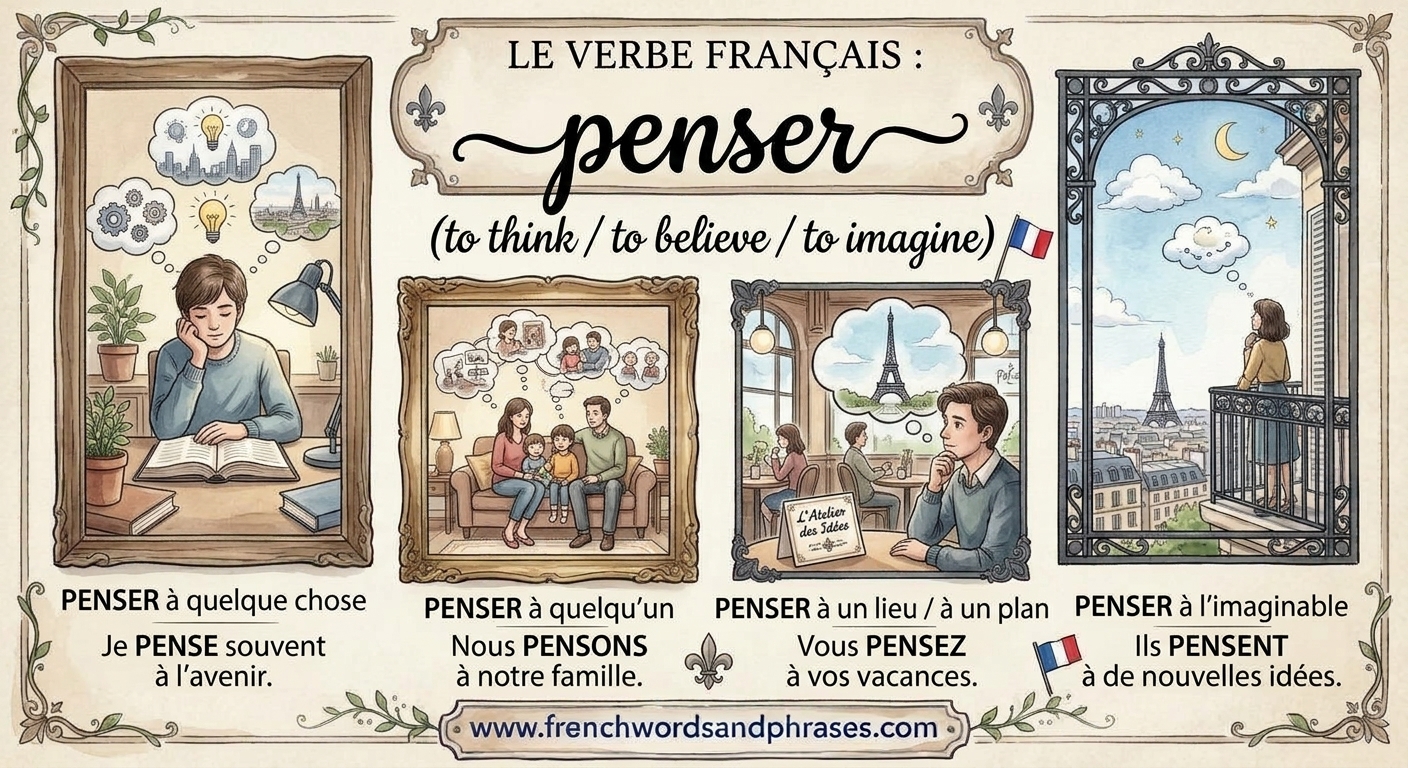
Penser means “to think” in French.
Our thoughts shape the way we see the world. We think about the past, imagine the future, consider possibilities, and form opinions about the people and places around us. In French, one little verb helps express all these ideas: penser.
Whether you want to say what you think, explain what is on your mind, or ask someone for their opinion, learning penser will make your everyday French more natural and expressive. This guide takes you through every major tense and mood, with conjugation tables, useful examples, and short quizzes along the way.
Understanding the French Verb Penser
Penser is a regular first-group French verb ending in -er. It follows the familiar conjugation pattern of regular -er verbs, making it relatively easy to learn.
- Infinitive: penser
- Meaning: to think
- Verb group: First group (-er)
- Auxiliary verb: avoir
- Past participle: pensé
- Present participle: pensant
One important feature of penser is how its meaning changes depending on the preposition that follows it.
- penser à — to think about someone or something
- penser de — to think of something or have an opinion about it
- penser que — to think or believe that
- penser à faire quelque chose — to think about doing something or remember to do something
For example:
- Je pense à toi. — I’m thinking about you.
- Que pensez-vous de ce film ? — What do you think of this movie?
- Je pense qu’il a raison. — I think he’s right.
- Je pense à acheter du pain. — I’m thinking about buying some bread.
In compound tenses, penser uses the auxiliary verb avoir. Its past participle, pensé, normally remains unchanged when used with avoir, but agrees with a preceding direct object when grammar requires it.
For example:
J’ai pensé à cette idée.
I thought about that idea.
Les idées que j’ai pensées étaient intéressantes.
The ideas that I thought up were interesting.
Experience the Word
Imagine sitting at a little café in Paris, watching the world go by. You have a thousand thoughts running through your mind. Perhaps you’re remembering a conversation, wondering about tomorrow, or simply enjoying the moment.
You might say:
Je pense à la vie.
I’m thinking about life.
Or perhaps you want to share an opinion:
Je pense que Paris est magnifique.
I think Paris is beautiful.
With penser, you can express ideas, beliefs, memories, and opinions. It’s a small verb with a wonderfully broad range of uses.
How to Conjugate Penser: Complete French Conjugation Guide
Indicatif — The Indicative Mood
The indicative mood is used to express facts, observations, opinions, and events presented as real or certain. Let’s explore all nine indicative tenses of penser.
How to Conjugate Penser in the Présent
The present tense describes what someone thinks now, what they regularly think, or what they believe in general. Penser follows the regular -er conjugation pattern.
| Subject | Conjugation |
|---|---|
| je | pense |
| tu | penses |
| il / elle | pense |
| nous | pensons |
| vous | pensez |
| ils / elles | pensent |
Je pense souvent à mes vacances.
I often think about my vacation.
How to Conjugate Penser in the Passé Composé
The passé composé describes completed actions in the past. It is formed with the present tense of avoir and the past participle pensé.
| Subject | Conjugation |
|---|---|
| je | ai pensé |
| tu | as pensé |
| il / elle | a pensé |
| nous | avons pensé |
| vous | avez pensé |
| ils / elles | ont pensé |
J’ai pensé à toi hier soir.
I thought about you last night.
How to Conjugate Penser in the Imparfait
The imparfait describes ongoing or habitual thoughts and opinions in the past. It can also establish background information or describe what someone used to think.
| Subject | Conjugation |
|---|---|
| je | pensais |
| tu | pensais |
| il / elle | pensait |
| nous | pensions |
| vous | pensiez |
| ils / elles | pensaient |
Quand j’étais jeune, je pensais devenir médecin.
When I was young, I thought I would become a doctor.
How to Conjugate Penser in the Plus-que-parfait
The plus-que-parfait describes something that had already happened before another event in the past. It is formed with the imparfait of avoir and the past participle pensé.
| Subject | Conjugation |
|---|---|
| je | avais pensé |
| tu | avais pensé |
| il / elle | avait pensé |
| nous | avions pensé |
| vous | aviez pensé |
| ils / elles | avaient pensé |
J’avais pensé à cette solution avant notre réunion.
I had thought about this solution before our meeting.
How to Conjugate Penser in the Passé Simple
The passé simple is a literary past tense, mainly encountered in novels, historical writing, and formal narratives. It is rarely used in everyday conversation.
| Subject | Conjugation |
|---|---|
| je | pensai |
| tu | pensas |
| il / elle | pensa |
| nous | pensâmes |
| vous | pensâtes |
| ils / elles | pensèrent |
Il pensa longtemps à sa décision avant de répondre.
He thought for a long time about his decision before answering.
How to Conjugate Penser in the Passé Antérieur
The passé antérieur is a literary tense used to describe an action completed before another past action. It is formed with the passé simple of avoir and the past participle.
| Subject | Conjugation |
|---|---|
| je | eus pensé |
| tu | eus pensé |
| il / elle | eut pensé |
| nous | eûmes pensé |
| vous | eûtes pensé |
| ils / elles | eurent pensé |
Dès qu’il eut pensé à une solution, il reprit confiance.
As soon as he had thought of a solution, he regained confidence.
How to Conjugate Penser in the Futur Simple
The futur simple describes an action or thought that will take place in the future. For regular -er verbs, the future stem is the infinitive penser, followed by the future endings.
| Subject | Conjugation |
|---|---|
| je | penserai |
| tu | penseras |
| il / elle | pensera |
| nous | penserons |
| vous | penserez |
| ils / elles | penseront |
Je penserai à toi pendant mon voyage.
I will think about you during my trip.
How to Conjugate Penser in the Futur Antérieur
The futur antérieur describes something that will have been completed by a particular point in the future. It is formed with the future simple of avoir and the past participle.
| Subject | Conjugation |
|---|---|
| je | aurai pensé |
| tu | auras pensé |
| il / elle | aura pensé |
| nous | aurons pensé |
| vous | aurez pensé |
| ils / elles | auront pensé |
Demain, j’aurai pensé à toutes les possibilités.
By tomorrow, I will have thought about all the possibilities.
How to Conjugate Penser in the Futur Proche
The futur proche, or near future, describes something that is going to happen soon. It is formed with the present tense of aller followed by the infinitive penser.
| Subject | Conjugation |
|---|---|
| je | vais penser |
| tu | vas penser |
| il / elle | va penser |
| nous | allons penser |
| vous | allez penser |
| ils / elles | vont penser |
Je vais penser à ce que tu m’as dit.
I’m going to think about what you told me.
Le Conditionnel — The Conditional Mood
The conditional mood expresses what would happen under certain circumstances. It is also used to make polite requests, express wishes, and discuss possibilities.
How to Conjugate Penser in the Conditionnel Présent
The present conditional describes what someone would think or consider in a particular situation.
| Subject | Conjugation |
|---|---|
| je | penserais |
| tu | penserais |
| il / elle | penserait |
| nous | penserions |
| vous | penseriez |
| ils / elles | penseraient |
Je penserais autrement si j’avais plus d’informations.
I would think differently if I had more information.
How to Conjugate Penser in the Conditionnel Passé
The past conditional describes what someone would have thought or believed under different circumstances. It is formed with the conditional present of avoir and the past participle pensé.
| Subject | Conjugation |
|---|---|
| je | aurais pensé |
| tu | aurais pensé |
| il / elle | aurait pensé |
| nous | aurions pensé |
| vous | auriez pensé |
| ils / elles | auraient pensé |
J’aurais pensé que tu viendrais avec nous.
I would have thought that you would come with us.
How to Conjugate Penser in the Conditionnel Passé — Literary Alternative
This alternative form uses the pluperfect subjunctive construction. It is extremely literary and rarely encountered outside older or highly formal French writing.
| Subject | Conjugation |
|---|---|
| je | eusse pensé |
| tu | eusses pensé |
| il / elle | eût pensé |
| nous | eussions pensé |
| vous | eussiez pensé |
| ils / elles | eussent pensé |
J’eusse pensé la même chose à ta place.
I would have thought the same thing in your place.
Le Subjonctif — The Subjunctive Mood
The subjunctive is used after certain expressions of emotion, doubt, necessity, desire, and uncertainty. It often appears in a subordinate clause introduced by que.
How to Conjugate Penser in the Subjonctif Présent
The present subjunctive is used when the main clause expresses a wish, feeling, doubt, or necessity concerning someone’s thoughts or opinions.
| Subject | Conjugation |
|---|---|
| que je | pense |
| que tu | penses |
| qu’il / qu’elle | pense |
| que nous | pensions |
| que vous | pensiez |
| qu’ils / qu’elles | pensent |
Il faut que tu penses à ton avenir.
You need to think about your future.
How to Conjugate Penser in the Subjonctif Imparfait
The imperfect subjunctive is a literary tense found mainly in formal writing and older literature. In everyday French, the present subjunctive is generally used instead.
| Subject | Conjugation |
|---|---|
| que je | pensasse |
| que tu | pensasses |
| qu’il / qu’elle | pensât |
| que nous | pensassions |
| que vous | pensassiez |
| qu’ils / qu’elles | pensassent |
Il souhaitait que je pensasse davantage à mon avenir.
He wished that I would think more about my future.
How to Conjugate Penser in the Subjonctif Plus-que-parfait
The pluperfect subjunctive is a literary tense used to refer to an action that had already been completed in a subordinate clause. It is formed with the pluperfect subjunctive of avoir and the past participle.
| Subject | Conjugation |
|---|---|
| que je | eusse pensé |
| que tu | eusses pensé |
| qu’il / qu’elle | eût pensé |
| que nous | eussions pensé |
| que vous | eussiez pensé |
| qu’ils / qu’elles | eussent pensé |
Il regrettait que nous n’eussions pas pensé à cette possibilité.
He regretted that we had not thought of that possibility.
How to Conjugate Penser in the Subjonctif Passé
The past subjunctive describes an action that has already happened but is connected to a feeling, wish, doubt, or necessity. It is formed with the present subjunctive of avoir and the past participle.
| Subject | Conjugation |
|---|---|
| que je | aie pensé |
| que tu | aies pensé |
| qu’il / qu’elle | ait pensé |
| que nous | ayons pensé |
| que vous | ayez pensé |
| qu’ils / qu’elles | aient pensé |
Je suis heureux que tu aies pensé à moi.
I’m happy that you thought of me.
L’Impératif — The Imperative Mood
The imperative is used to give commands, make suggestions, or offer instructions. It has three forms: tu, nous, and vous. Subject pronouns are omitted.
How to Conjugate Penser in the Impératif Présent
| Subject | Conjugation |
|---|---|
| (tu) | pense |
| (nous) | pensons |
| (vous) | pensez |
Pense à fermer la porte !
Remember to close the door!
Le Participe — French Participles
Participles are useful verb forms that can be used in compound tenses or as adjectives. Penser has a present participle and a past participle.
Présent — Present Participle
The present participle of penser is pensant. It can describe an action happening at the same time as another action, or function in a participial phrase.
En pensant à ses vacances, elle sourit.
Thinking about her vacation, she smiles.
Passé — Past Participle
The past participle of penser is pensé. It is used with avoir to form compound tenses. It normally remains unchanged, but it agrees with a preceding direct object when grammar requires it.
| Form | Conjugation |
|---|---|
| Masculine singular | pensé |
| Masculine plural | pensés |
| Feminine singular | pensée |
| Feminine plural | pensées |
Les solutions qu’elle a pensées sont intéressantes.
The solutions she thought up are interesting.
Penser in Everyday French: Six Useful Examples
Here are six examples showing how penser appears in everyday conversation and writing.
1. Present — Présent
Je pense que tu as raison.
I think you’re right.
2. Past — Passé composé
J’ai pensé à notre conversation toute la journée.
I thought about our conversation all day.
3. Imperfect — Imparfait
Elle pensait souvent à son enfance.
She often thought about her childhood.
4. Future — Futur simple
Nous penserons à une autre solution demain.
We will think about another solution tomorrow.
5. Conditional — Conditionnel présent
Je penserais à déménager si je trouvais un meilleur emploi.
I would consider moving if I found a better job.
6. Subjunctive — Subjonctif présent
Il est important que vous pensiez à votre santé.
It is important that you think about your health.
Beyond Translation: Common Expressions with Penser
Learning a French verb becomes much easier when you discover the expressions in which it naturally appears. Here are some useful combinations with penser.
- penser à quelqu’un — to think about someone
- penser à quelque chose — to think about something
- penser de quelque chose — to have an opinion about something
- penser que — to think or believe that
- penser à faire quelque chose — to think about doing something
- penser du bien de quelqu’un — to think highly of someone
- penser du mal de quelqu’un — to think badly of someone
- à mon avis — in my opinion
- je n’en pense pas moins — I still think the same / I haven’t changed my opinion
- y penser — to think about it
Penser à vs. Penser de: What’s the Difference?
These two expressions are especially important for French learners.
Penser à focuses on the person or thing occupying your thoughts.
Je pense à mes amis.
I’m thinking about my friends.
Penser de is commonly used when asking for or expressing an opinion.
Que penses-tu de ce restaurant ?
What do you think of this restaurant?
Remember this simple distinction: penser à is about what is on your mind; penser de is about your opinion of something.
Penser vs. Croire
Both penser and croire can mean “to think” or “to believe,” but they are not always interchangeable.
- penser often expresses an opinion, thought, or considered judgment.
- croire often expresses belief, confidence, or acceptance of something as true.
Je pense qu’il est intelligent.
I think he is intelligent.
Je crois qu’il dit la vérité.
I believe he is telling the truth.
The distinction is not absolute, and native speakers sometimes use the two verbs in similar ways. Context determines the most natural choice.
How to Remember the Conjugation of Penser
Because penser is a regular -er verb, its simple tenses follow a pattern you can use with many other French verbs.
- Present: pense, penses, pense, pensons, pensez, pensent.
- Imperfect: start with pens- and add the imperfect endings.
- Future: keep the infinitive penser and add the future endings.
- Conditional: use the same future stem with the imperfect endings.
- Compound tenses: use the appropriate form of avoir followed by pensé.
The most important point is that penser uses avoir in its compound tenses. The past participle normally stays pensé, regardless of whether the subject is masculine, feminine, singular, or plural.
Test Your Knowledge: Penser Conjugation Quiz
Try these five questions to see how well you understand the verb penser. Open each answer when you’re ready to check your work.
Question 1
How do you say “I think” in French?
Reveal answer
Je pense.
This is the present tense of penser.
Question 2
Which auxiliary verb does penser use in the passé composé?
Reveal answer
Avoir.
For example: J’ai pensé. — I thought.
Question 3
Complete the sentence: Nous ______ à nos vacances.
Reveal answer
pensons
Nous pensons à nos vacances. — We are thinking about our vacation.
Question 4
How do you say “I would think” in French?
Reveal answer
Je penserais.
This is the present conditional.
Question 5
Which expression would you use to ask someone what they think of a film?
Reveal answer
Que penses-tu de ce film ?
This uses penser de to ask for someone’s opinion.
Your Final Challenge
Translate this sentence into French:
“I thought about your suggestion, and I think it is a good idea.”
Reveal the French translation
J’ai pensé à ta suggestion, et je pense que c’est une bonne idée.
I thought about your suggestion, and I think it is a good idea.
Remember: j’ai pensé is the passé composé, while je pense is the present tense.
A little French. A little curiosity. A richer everyday life.
LEARN FRENCH ONE WORD AT A TIME