A French Word to Live By
How to Conjugate Laisser in French
Pronunciation: /le.se/
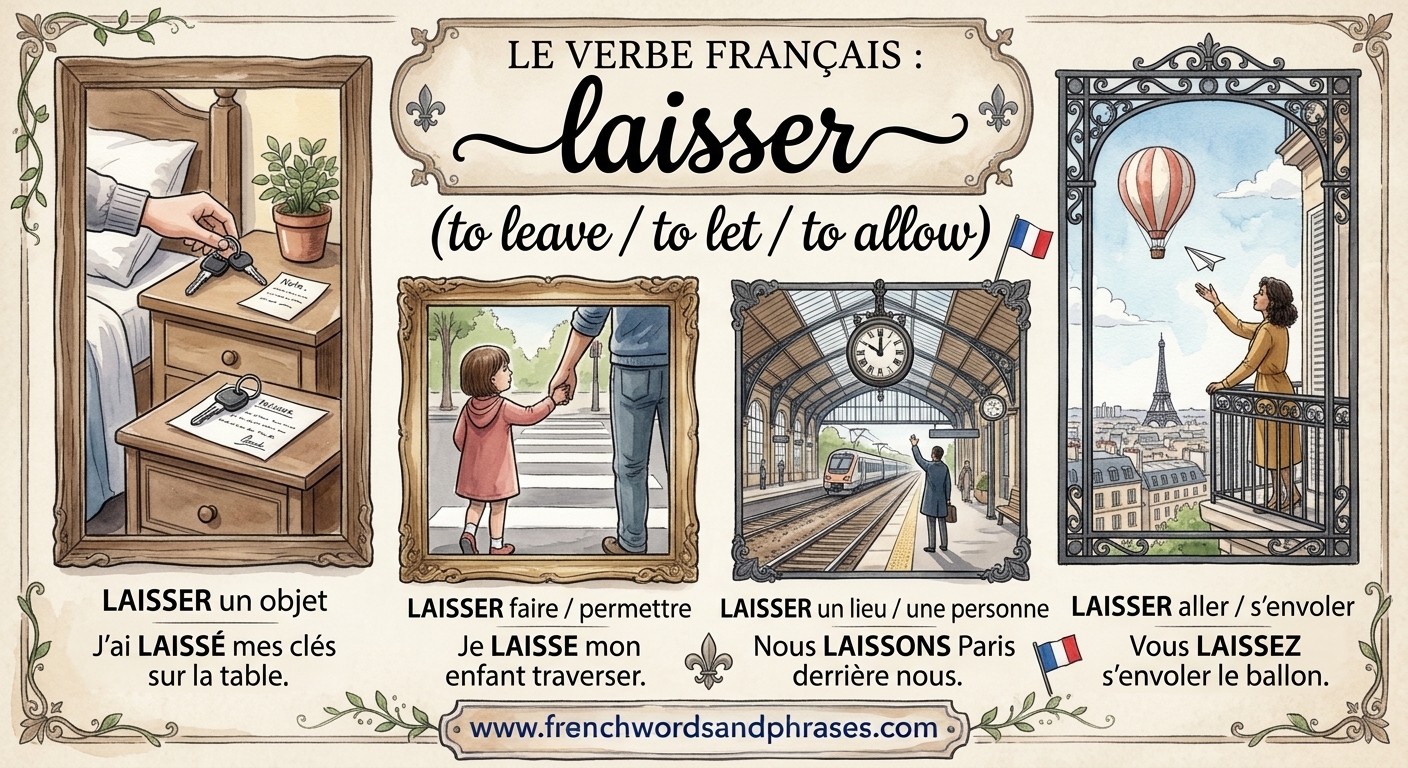
Laisser means “to leave,” “to let,” or “to allow” in French. It is a regular first-group verb ending in -er, and it is used in countless everyday situations, from leaving something behind to allowing someone the freedom to do something.
Sometimes the simplest words carry the greatest meaning. You might leave a book on a table, let a friend make their own decision, or allow a beautiful moment to unfold without interruption. In French, laisser helps express all these ideas naturally.
In this guide, you’ll learn how to conjugate laisser in every major French tense and mood. We’ll explore its grammar, discover useful everyday expressions, and practice with examples and quizzes along the way.
Understanding the French Verb Laisser
Laisser is a regular first-group French verb ending in -er. It follows the same general conjugation pattern as parler, aimer, and demander.
- Infinitive: laisser
- Meaning: to leave, to let, to allow
- Verb group: First group (regular -er verb)
- Auxiliary verb: avoir
- Past participle: laissé
- Present participle: laissant
How Laisser Is Conjugated
The stem of laisser is laiss-. Regular endings are added to this stem to form the present, imperfect, and other tenses.
For example, in the present tense:
- je laisse
- tu laisses
- il / elle laisse
- nous laissons
- vous laissez
- ils / elles laissent
The verb is regular, so there are no unusual stem changes to memorize. Its compound tenses use the auxiliary verb avoir followed by the past participle laissé.
How to Use Laisser
Laisser has several related meanings. The exact translation depends on the context.
- laisser quelque chose quelque part — to leave something somewhere
- laisser quelqu’un partir — to let someone leave
- laisser faire — to let it happen / to let someone do something
- laisser quelqu’un tranquille — to leave someone alone
- laisser tomber — to drop something / to give up
- laisser un message — to leave a message
J’ai laissé mes clés sur la table.
I left my keys on the table.
Laisse-moi réfléchir.
Let me think.
Laisser + Infinitive
One of the most important constructions with laisser is laisser + infinitive. It means to let or allow someone or something to perform an action.
Elle laisse son fils choisir.
She lets her son choose.
Nous les avons laissés entrer.
We let them come in.
In everyday French, this construction is extremely common. It can express permission, freedom, or simply allowing something to happen.
Laisser vs. Quitter
Laisser and quitter can both sometimes be translated as “to leave,” but they are not interchangeable in every situation.
Laisser often means to leave something behind, leave something somewhere, or let someone do something.
J’ai laissé mon téléphone à la maison.
I left my phone at home.
Quitter usually means to leave a person, place, or situation.
Je quitte le bureau à six heures.
I leave the office at six o’clock.
Remember: laisser often focuses on what is left behind or what is permitted, while quitter focuses on departing from someone or somewhere.
Experience the Word
Imagine spending a peaceful afternoon in a French café. You leave your book on the table, let the conversation wander, and allow yourself to enjoy the moment.
Laisser is the perfect verb for describing these small everyday actions.
Je laisse mon téléphone dans mon sac et je profite du moment.
I leave my phone in my bag and enjoy the moment.
It is a practical verb with a surprisingly wide range of uses. Once you become comfortable with laisser, you’ll begin noticing it everywhere in French conversation.
How to Conjugate Laisser: Complete French Conjugation Guide
Indicatif
The indicative mood is used to describe facts, actions, observations, and events presented as real. Laisser follows the regular -er conjugation pattern throughout its indicative forms.
How to Conjugate Laisser in the Présent (Present Tense)
The present tense describes actions happening now, habitual actions, and general statements.
| Subject | Conjugation |
|---|---|
| je | laisse |
| tu | laisses |
| il / elle | laisse |
| nous | laissons |
| vous | laissez |
| ils / elles | laissent |
Je laisse toujours une note sur la table.
I always leave a note on the table.
Notice that the final -ent in laissent is silent. The singular and plural third-person forms are pronounced alike.
Quick Quiz: Laisser in the Present
How do you say “We leave the door open” in French?
Show the answer
Nous laissons la porte ouverte.
The correct present-tense form for nous is laissons.
How to Conjugate Laisser in the Passé Composé (Compound Past Tense)
The passé composé describes completed actions in the past. It is formed with the present tense of avoir followed by the past participle laissé.
| Subject | Conjugation |
|---|---|
| j’ | ai laissé |
| tu | as laissé |
| il / elle | a laissé |
| nous | avons laissé |
| vous | avez laissé |
| ils / elles | ont laissé |
Elle a laissé son sac dans la voiture.
She left her bag in the car.
Laisser uses avoir in the passé composé. The past participle normally remains unchanged when the direct object follows the verb. When a direct object precedes the verb, the usual agreement rule with avoir applies.
How to Conjugate Laisser in the Imparfait (Imperfect Tense)
The imparfait describes repeated or ongoing actions in the past. It is also used for background situations and things that someone used to allow or leave behind.
| Subject | Conjugation |
|---|---|
| je | laissais |
| tu | laissais |
| il / elle | laissait |
| nous | laissions |
| vous | laissiez |
| ils / elles | laissaient |
Quand j’étais enfant, mes parents me laissaient jouer dehors.
When I was a child, my parents let me play outside.
The imperfect stem is laiss-, followed by the standard imperfect endings.
Quick Quiz: Laisser in the Imparfait
Complete the sentence: “They used to leave the windows open.”
Show the answer
Ils laissaient les fenêtres ouvertes.
The imperfect form for ils and elles is laissaient.
How to Conjugate Laisser in the Plus-que-parfait (Pluperfect Tense)
The plus-que-parfait describes an action that had already been completed before another past event. It is formed with the imperfect tense of avoir and the past participle laissé.
| Subject | Conjugation |
|---|---|
| j’ | avais laissé |
| tu | avais laissé |
| il / elle | avait laissé |
| nous | avions laissé |
| vous | aviez laissé |
| ils / elles | avaient laissé |
J’avais laissé mes documents au bureau.
I had left my documents at the office.
This tense is useful when explaining what had happened before another moment in the past.
How to Conjugate Laisser in the Passé Simple (Simple Past Tense)
The passé simple is mainly used in literature, historical accounts, and formal narratives. It describes completed past actions and is rarely heard in everyday conversation.
| Subject | Conjugation |
|---|---|
| je | laissai |
| tu | laissas |
| il / elle | laissa |
| nous | laissâmes |
| vous | laissâtes |
| ils / elles | laissèrent |
Il laissa son manteau près de la porte.
He left his coat near the door.
You are unlikely to use this tense in ordinary conversation, but recognizing it will help you understand French novels and historical writing.
How to Conjugate Laisser in the Passé Antérieur (Past Anterior Tense)
The passé antérieur is a literary tense used to describe an action completed immediately before another past action. It is formed with the passé simple of avoir and the past participle laissé.
| Subject | Conjugation |
|---|---|
| j’ | eus laissé |
| tu | eus laissé |
| il / elle | eut laissé |
| nous | eûmes laissé |
| vous | eûtes laissé |
| ils / elles | eurent laissé |
Dès qu’il eut laissé ses affaires, il sortit.
As soon as he had left his belongings, he went out.
This tense is mostly encountered in formal and literary French.
How to Conjugate Laisser in the Futur Simple (Simple Future Tense)
The futur simple describes what someone will leave, let, or allow in the future. It is formed by adding the standard future endings to the infinitive laisser.
| Subject | Conjugation |
|---|---|
| je | laisserai |
| tu | laisseras |
| il / elle | laissera |
| nous | laisserons |
| vous | laisserez |
| ils / elles | laisseront |
Je laisserai les clés chez le voisin.
I will leave the keys with the neighbor.
The future stem is the full infinitive laisser.
Quick Quiz: Laisser in the Future
How would you say “She will leave a message”?
Show the answer
Elle laissera un message.
The future form for elle is laissera.
How to Conjugate Laisser in the Futur Antérieur (Future Perfect Tense)
The futur antérieur describes an action that will have been completed before a particular point in the future. It is formed with the future tense of avoir and the past participle laissé.
| Subject | Conjugation |
|---|---|
| j’ | aurai laissé |
| tu | auras laissé |
| il / elle | aura laissé |
| nous | aurons laissé |
| vous | aurez laissé |
| ils / elles | auront laissé |
À midi, nous aurons laissé la maison en ordre.
By noon, we will have left the house in order.
How to Conjugate Laisser in the Futur Proche (Near Future Tense)
The futur proche describes something that is going to happen soon. It is formed with the present tense of aller followed by the infinitive laisser.
| Subject | Conjugation |
|---|---|
| je | vais laisser |
| tu | vas laisser |
| il / elle | va laisser |
| nous | allons laisser |
| vous | allez laisser |
| ils / elles | vont laisser |
Je vais laisser mon manteau ici.
I’m going to leave my coat here.
The futur proche is very common in spoken French and is especially useful for immediate plans and intentions.
Conditionnel
The conditional mood expresses hypothetical situations, possibilities, and actions that depend on certain circumstances. It is also used to make polite requests and suggestions.
How to Conjugate Laisser in the Conditionnel Présent (Present Conditional)
The present conditional is formed by adding the imperfect endings to the infinitive laisser.
| Subject | Conjugation |
|---|---|
| je | laisserais |
| tu | laisserais |
| il / elle | laisserait |
| nous | laisserions |
| vous | laisseriez |
| ils / elles | laisseraient |
Je te laisserais choisir le restaurant.
I would let you choose the restaurant.
The conditional is useful when expressing what you would allow or leave under different circumstances.
How to Conjugate Laisser in the Conditionnel Passé (Past Conditional)
The past conditional describes what would have happened under different circumstances. It is formed with the conditional present of avoir and the past participle laissé.
| Subject | Conjugation |
|---|---|
| j’ | aurais laissé |
| tu | aurais laissé |
| il / elle | aurait laissé |
| nous | aurions laissé |
| vous | auriez laissé |
| ils / elles | auraient laissé |
J’aurais laissé la porte ouverte si tu me l’avais demandé.
I would have left the door open if you had asked me.
How to Conjugate Laisser in the Conditionnel Passé – Alternative Form
This literary alternative uses the imperfect subjunctive of avoir followed by the past participle laissé. It is rare in modern spoken French but may appear in older literature and formal writing.
| Subject | Conjugation |
|---|---|
| j’ | eusse laissé |
| tu | eusses laissé |
| il / elle | eût laissé |
| nous | eussions laissé |
| vous | eussiez laissé |
| ils / elles | eussent laissé |
Il eût laissé davantage de temps à ses invités.
He would have given his guests more time.
Subjonctif
The subjunctive mood is used to express doubt, uncertainty, emotion, necessity, and subjective judgment. Laisser follows its regular conjugation pattern in the subjunctive forms.
How to Conjugate Laisser in the Subjonctif Présent (Present Subjunctive)
The present subjunctive is used when the action is influenced by doubt, desire, necessity, or emotion.
| Subject | Conjugation |
|---|---|
| que je | laisse |
| que tu | laisses |
| qu’il / qu’elle | laisse |
| que nous | laissions |
| que vous | laissiez |
| qu’ils / qu’elles | laissent |
Il faut que tu laisses un peu de temps pour réfléchir.
You need to leave a little time to think.
The expression il faut que introduces a requirement, so the verb that follows takes the subjunctive.
How to Conjugate Laisser in the Subjonctif Imparfait (Imperfect Subjunctive)
The imperfect subjunctive is a literary tense that is rarely used in modern everyday French. It is mainly encountered in older novels and formal writing.
| Subject | Conjugation |
|---|---|
| que je | laissasse |
| que tu | laissasses |
| qu’il / qu’elle | laissât |
| que nous | laissassions |
| que vous | laissassiez |
| qu’ils / qu’elles | laissassent |
Il souhaitait qu’elle le laissât terminer son travail.
He wished that she would let him finish his work.
How to Conjugate Laisser in the Subjonctif Plus-que-parfait (Pluperfect Subjunctive)
The pluperfect subjunctive is a literary tense describing an action that had been completed before another past event in a context requiring the subjunctive.
| Subject | Conjugation |
|---|---|
| que j’ | eusse laissé |
| que tu | eusses laissé |
| qu’il / qu’elle | eût laissé |
| que nous | eussions laissé |
| que vous | eussiez laissé |
| qu’ils / qu’elles | eussent laissé |
Il regrettait qu’ils eussent laissé leurs affaires dehors.
He regretted that they had left their belongings outside.
How to Conjugate Laisser in the Subjonctif Passé (Past Subjunctive)
The past subjunctive describes a completed action in a context requiring the subjunctive. It is formed with the present subjunctive of avoir and the past participle laissé.
| Subject | Conjugation |
|---|---|
| que j’ | aie laissé |
| que tu | aies laissé |
| qu’il / qu’elle | ait laissé |
| que nous | ayons laissé |
| que vous | ayez laissé |
| qu’ils / qu’elles | aient laissé |
Je suis heureux que tu aies laissé un message.
I’m happy that you left a message.
Impératif
The imperative mood is used to give commands, instructions, advice, or encouragement. Laisser has three imperative forms: tu, nous, and vous. The subject pronoun is omitted.
How to Conjugate Laisser in the Impératif Présent (Present Imperative)
| Subject | Conjugation |
|---|---|
| (tu) | laisse |
| (nous) | laissons |
| (vous) | laissez |
The imperative of laisser is particularly common in everyday French. It appears in familiar instructions and expressions.
Laisse-moi tranquille !
Leave me alone!
Laissez vos affaires ici, s’il vous plaît.
Please leave your belongings here.
Quick Quiz: Laisser in the Imperative
How would you tell a friend, “Let me speak”?
Show the answer
Laisse-moi parler.
Use the tu imperative laisse, followed by the pronoun moi.
French Participles: Laisser
Participles are important verb forms used in compound tenses and other grammatical constructions. Laisser has a regular present participle and past participle.
Present Participle
The present participle of laisser is laissant. It can describe an action in progress or be used in certain grammatical constructions.
En laissant la fenêtre ouverte, elle a rafraîchi la pièce.
By leaving the window open, she cooled the room.
Past Participle
The past participle of laisser is laissé. It is used with avoir to form compound tenses.
- laissé — masculine singular
- laissés — masculine plural
- laissée — feminine singular
- laissées — feminine plural
Elle a laissé les lettres sur le bureau.
She left the letters on the desk.
Because laisser uses avoir, the past participle does not normally agree with the subject. It agrees with a preceding direct object when the usual agreement rule applies.
Laisser in Everyday French: Six Useful Examples
Here are six examples showing how laisser works in different tenses and moods.
1. Present — Leaving something somewhere
Je laisse mon livre sur la table.
I leave my book on the table.
2. Passé composé — A completed action
Nous avons laissé la voiture au garage.
We left the car at the garage.
3. Imparfait — A repeated past action
Elle me laissait choisir le film.
She used to let me choose the film.
4. Futur simple — A future action
Ils laisseront les clés à la réception.
They will leave the keys at reception.
5. Conditionnel présent — A hypothetical situation
Je te laisserais utiliser mon ordinateur.
I would let you use my computer.
6. Subjonctif présent — Expressing necessity
Il faut que nous laissions partir nos invités.
We must let our guests leave.
Beyond Translation: The Many Uses of Laisser
Laisser is much more than a simple way to say “to leave.” It appears in many everyday expressions and constructions that are worth learning.
Laisser Tomber
Laisser tomber literally means “to let fall,” but it is also commonly used to mean “to give up,” “to drop it,” or “forget about it.”
Laisse tomber, ce n’est pas important.
Forget it, it’s not important.
Laisser Faire
Laisser faire means to let things happen or allow someone to act without interfering.
Parfois, il vaut mieux laisser faire les choses.
Sometimes it’s better to let things happen.
Laisser Quelqu’un Tranquille
This expression means to leave someone alone or stop bothering them.
Laisse-moi tranquille, je travaille.
Leave me alone, I’m working.
Laisser un Message
This is the everyday expression used when leaving a message for someone, especially by telephone.
Vous pouvez laisser un message après le bip.
You can leave a message after the beep.
Laisser à Quelqu’un
Laisser can also be followed by an indirect object to indicate who receives something that is being left behind or entrusted to them.
J’ai laissé les documents à Marie.
I left the documents with Marie.
Laisser + Infinitive
Remember this particularly useful construction. Laisser followed by an infinitive expresses permission or allowing an action to happen.
Le professeur laisse les élèves poser des questions.
The teacher lets the students ask questions.
Ne laisse pas ton chien courir dans la rue.
Don’t let your dog run in the street.
Laisser vs. Abandonner
Laisser and abandonner can both sometimes suggest leaving something behind, but abandonner generally carries a stronger meaning of giving up, deserting, or abandoning something.
J’ai laissé mon parapluie dans le train.
I left my umbrella on the train.
Il a abandonné son projet.
He abandoned his project.
Understanding these differences will help you choose the right verb in different situations.
How to Remember the Conjugation of Laisser
The good news is that laisser is a regular -er verb. Once you know the conjugation pattern of a verb such as parler or aimer, you already know how to conjugate laisser in most situations.
- Present: laiss- + e, es, e, ons, ez, ent
- Imperfect: laiss- + ais, ais, ait, ions, iez, aient
- Future: laisser- + ai, as, a, ons, ez, ont
- Conditional: laisser- + ais, ais, ait, ions, iez, aient
- Past participle: laissé
- Present participle: laissant
Pay special attention to the compound tenses. They all use the auxiliary verb avoir followed by laissé.
For everyday practice, try memorizing these short expressions:
- Laisse-moi tranquille. — Leave me alone.
- Laisse tomber. — Forget it.
- Laisse-moi réfléchir. — Let me think.
- J’ai laissé mes clés ici. — I left my keys here.
- Il faut laisser faire. — You have to let things happen.
Short, practical expressions are an excellent way to make a new French verb part of your everyday vocabulary.
Test Your Knowledge: Laisser
Let’s see how well you have learned to conjugate laisser. Try answering each question before revealing the answer.
Question 1
What is the correct present-tense form for nous?
Show the answer
Nous laissons.
Question 2
What is the past participle of laisser?
Show the answer
Laissé.
Question 3
Complete the sentence: “She will leave a message.”
Show the answer
Elle laissera un message.
Question 4
Which auxiliary verb is used to form the passé composé of laisser?
Show the answer
Avoir. For example: j’ai laissé.
Question 5
How do you say “Let me think” in French?
Show the answer
Laisse-moi réfléchir.
Your Final Challenge
Translate this sentence into French:
“I would let you choose.”
Reveal the translation
Je te laisserais choisir.
I would let you choose.
Remember the present conditional form laisserais and the useful construction laisser + infinitive.
A little French. A little curiosity. A richer everyday life.
LEARN FRENCH ONE WORD AT A TIME