A French Word to Live By
Translate Pause to English
/poz/
La pause means the pause.
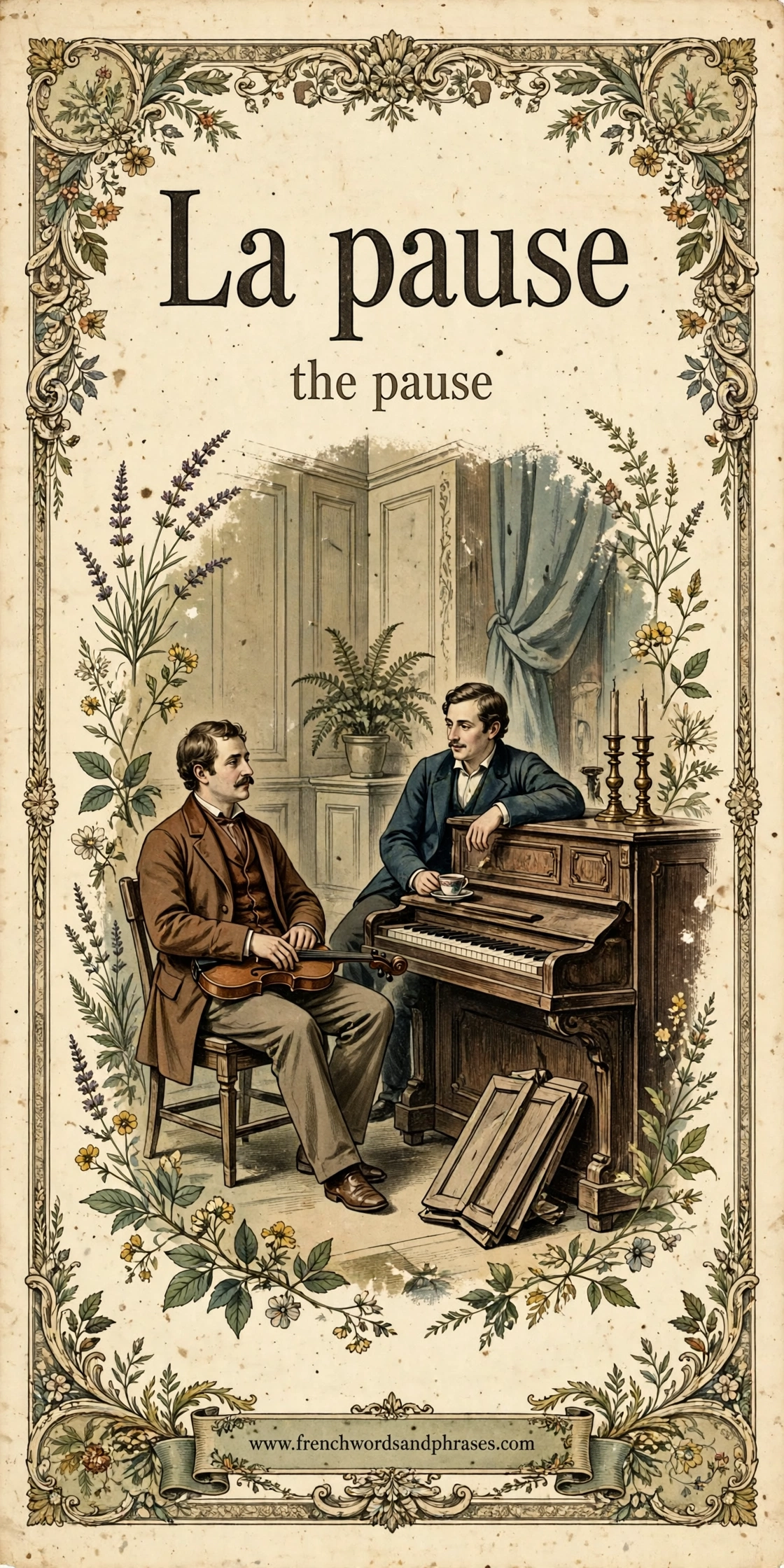
The machines stop, the classroom empties into the corridor, the orchestra lowers its bows for one held breath: la pause, the pause — the small, deliberate gap in the middle of things where French life catches its breath and has a coffee.
In this guide, you’ll learn what pause means in English, how to use it with its articles, how to form its plural, and how it appears in everyday French. Explore French examples, English translations, and practice quizzes.
Understanding the French Noun Pause
Pause is a feminine French noun, learned with its article: la pause, une pause. It comes from the Latin pausa, a halt or rest, itself from Greek. French uses it for every kind of stop that is not an end: a break at work, a pause in conversation, the rest between movements of a symphony.
It means a pause, a break — a short stop in an activity: une pause café, a coffee break, la pause déjeuner, the lunch break, faire une pause, to take a break. At school it is the sacred word of the timetable: la pause de dix heures, the mid-morning break, and the longer récréation is its playground cousin. In music, une pause is also a rest — a whole bar of silence with its own sign.
Gender: Feminine — la pause
Definite article: la — la pause (the pause)
Indefinite article: une — une pause (a pause, a break)
Plural: les pauses — regular, with a simple -s
Spelling note: from Latin pausa, a halt — the same root as English pause
Key verb: faire une pause — to take a break
English equivalents: The pause, the break.
The working day in France is built around pauses: la pause café at ten, la pause déjeuner at one — and woe betide the manager who shortens them. To ask for one, you say on fait une pause ? On the phone and in films, mettre sur pause is to pause a recording. A pause in speech is also une pause — the silence that gives the next sentence its weight.
Experience the Word
Pause is the punctuation of the French day: not an ending, but the comma that lets the sentence go on.
Imagine the office at ten o’clock: screens dim, chairs roll back, and the whole floor drifts to the coffee machine as one body. Fifteen minutes of nothing urgent — la pause — and the morning is suddenly possible again.
You have not just named a stop. You have named the art of stopping well — la pause, the break that saves the day.
How to Use Pause in French: Complete Guide
Let’s explore how pause works in French, beginning with its articles — la pause, une pause, faire une pause.
Pause with the Definite Article (La, Les)
Used for a specific pause — the one at ten, the one in the music.
| Form | French |
|---|---|
| Feminine singular | la pause |
| Plural | les pauses |
Example
La pause commence dans cinq minutes.
The break starts in five minutes.
Pause with the Indefinite Article (Une, Des)
Used for a pause in general — any break you can take.
| Form | French |
|---|---|
| Feminine singular | une pause |
| Plural | des pauses |
Example
Après deux heures de route, il faut une pause.
After two hours on the road, you need a break.
Pause with the Breaks of the Day (Café, Déjeuner…)
French names its pauses by what fills them — coffee, lunch, a cigarette, a breath of air.
| Quantity | French |
|---|---|
| a coffee break | une pause café |
| the lunch break | la pause déjeuner |
| a short break | une petite pause |
| a ten-minute break | une pause de dix minutes |
| a break (at school) | la pause de dix heures |
Example
La pause déjeuner dure une heure et demie.
The lunch break lasts an hour and a half.
Quick Quiz 1
Complete the sentence:
______ pause est finie, tout le monde retourne travailler. (the)
Reveal the answer
La
La pause est finie, tout le monde retourne travailler.
The break is over, everyone goes back to work — pause is feminine, so la.
The Plural of Pause
Pause takes a regular plural in -s — a well-run day has several.
| Number | French |
|---|---|
| Singular | la pause |
| Plural | les pauses |
Example
Les pauses sont importantes pour la concentration.
Breaks are important for concentration.
Pause with Possessive Adjectives (Ma, Ta, Sa…)
Possessives agree with the noun: pause is feminine, so ma, ta, sa in the singular.
| Owner | French |
|---|---|
| my | ma pause |
| your (tu) | ta pause |
| his / her | sa pause |
| our | notre pause |
| your (vous) | votre pause |
| their | leur pause |
Example
Je prends ma pause à dix heures et demie.
I take my break at half past ten.
Quick Quiz 2
Complete the sentence:
Elle a pris ______ pause plus tôt aujourd’hui. (her)
Reveal the answer
sa
Elle a pris sa pause plus tôt aujourd’hui.
She took her break earlier today — sa, because pause is feminine.
Pause with Demonstrative Adjectives (Cette, Ces)
Used to point: cette pause, this pause — usually the one you are longing for.
| Form | French |
|---|---|
| Feminine singular | cette pause |
| Plural | ces pauses |
Example
Cette pause arrive au bon moment.
This break comes at just the right time.
Pause with Adjectives
Adjectives agree with pause — feminine singular: une pause courte, une longue pause.
| Adjective | With Pause |
|---|---|
| courte (short) | une pause courte |
| longue (long) | une longue pause |
| petite (small, short) | une petite pause |
| bienvenue (welcome) | une pause bienvenue |
| musicale (musical) | une pause musicale |
Example
Après ce long rapport, une pause bienvenue s’impose.
After this long report, a welcome break is in order.
Quick Quiz 3
Complete the sentence:
Faisons une petite ______ avant de continuer. (break)
Reveal the answer
pause
Faisons une petite pause avant de continuer.
Let’s take a short break before continuing.
Everyday Expressions with Pause
Offices, schools and orchestras — the pause phrases of daily life.
| Expression | In English |
|---|---|
| faire une pause | to take a break |
| la pause café | the coffee break |
| la pause déjeuner | the lunch break |
| mettre sur pause | to pause (a film, a recording) |
| sans pause | without a break, non-stop |
Example
Il a travaillé sans pause jusqu’à minuit.
He worked without a break until midnight.
Words from the Same Family as Pause
Stopping and resting — the words that travel with pause.
| French | In English |
|---|---|
| la récréation | the school break, playtime |
| le repos | rest |
| une interruption | an interruption |
| se reposer | to rest (the verb) |
| la respiration | breathing — a pause for breath |
Example
Après la pause, un peu de repos et on repart.
After the break, a little rest and off we go again.
Quick Quiz 4
What does faire une pause mean?
Reveal the answer
To take a break — to stop for a short rest in the middle of an activity.
On fait une pause ? J’ai besoin d’un café.
Shall we take a break? I need a coffee.
Pause in Everyday French: Real-Life Examples
Now that you know the word, let’s see how pause appears in everyday French.
Example 1 — At work
On fait une pause café à dix heures.
We take a coffee break at ten.
Example 2 — On the road
Après deux heures, le conducteur fait une pause.
After two hours, the driver takes a break.
Example 3 — At school
La pause de dix heures dure quinze minutes.
The mid-morning break lasts fifteen minutes.
Example 4 — Music
Le chef marque une longue pause avant le final.
The conductor marks a long pause before the finale.
Example 5 — A film
Mets le film sur pause, s’il te plaît.
Pause the film, please.
Example 6 — Conversation
Elle a marqué une pause avant de répondre.
She paused before answering.
Beyond Translation: The Meaning of Pause
Pause is a traveller: Greek pausis, a stopping, became Latin pausa and then the same word in almost every European language. French gave it a second career in the timetable: where English scatters break, rest, interval and recess, French gathers them all into la pause — the coffee pause, the lunch pause, the pause that is a whole bar of silence in a score.
To say pause is to defend the empty moment.
It evokes the corridor coffee, the playground bell, the conductor’s raised baton — the small silences that make the noise bearable.
How to Remember the French Noun Pause
Remember it this way: Pause is the break — feminine: la pause, and the phrase that runs the French day is faire une pause.
- Always feminine — la pause, une pause, ma pause.
- The key phrase — faire une pause, to take a break; la pause café, the coffee break.
- Same word as English — pause, from Latin pausa; only the article is new.
The key idea is la pause — the pause, feminine; faire une pause = to take a break.
Test Your Knowledge of Pause
Let’s see how much you’ve learned. Try answering these questions before revealing the answers.
Question 1
Is pause masculine or feminine?
Reveal the answer
Feminine — la pause, une pause.
Question 2
How do you say to take a break?
Reveal the answer
Faire une pause.
Question 3
Translate: The lunch break lasts an hour.
Reveal the answer
La pause déjeuner dure une heure.
Question 4
How do you say coffee break in French?
Reveal the answer
La pause café — the break named by what fills it.
Question 5
Complete the sentence:
______ pauses sont importantes pour la santé. (the)
Reveal the answer
Les
Les pauses sont importantes pour la santé.
Breaks are important for your health.
Your Final Challenge
Can You Use It?
How would you say this in French?
“Let’s take a short break before continuing.”
Reveal the answer
Faisons une petite pause avant de continuer.
Let’s take a short break before continuing.
A little French. A little curiosity. A richer everyday life.
LEARN FRENCH ONE WORD AT A TIME