A French Word to Live By
Translate Probable to English
/pʁɔ.babl/
Probable means probable, likely.
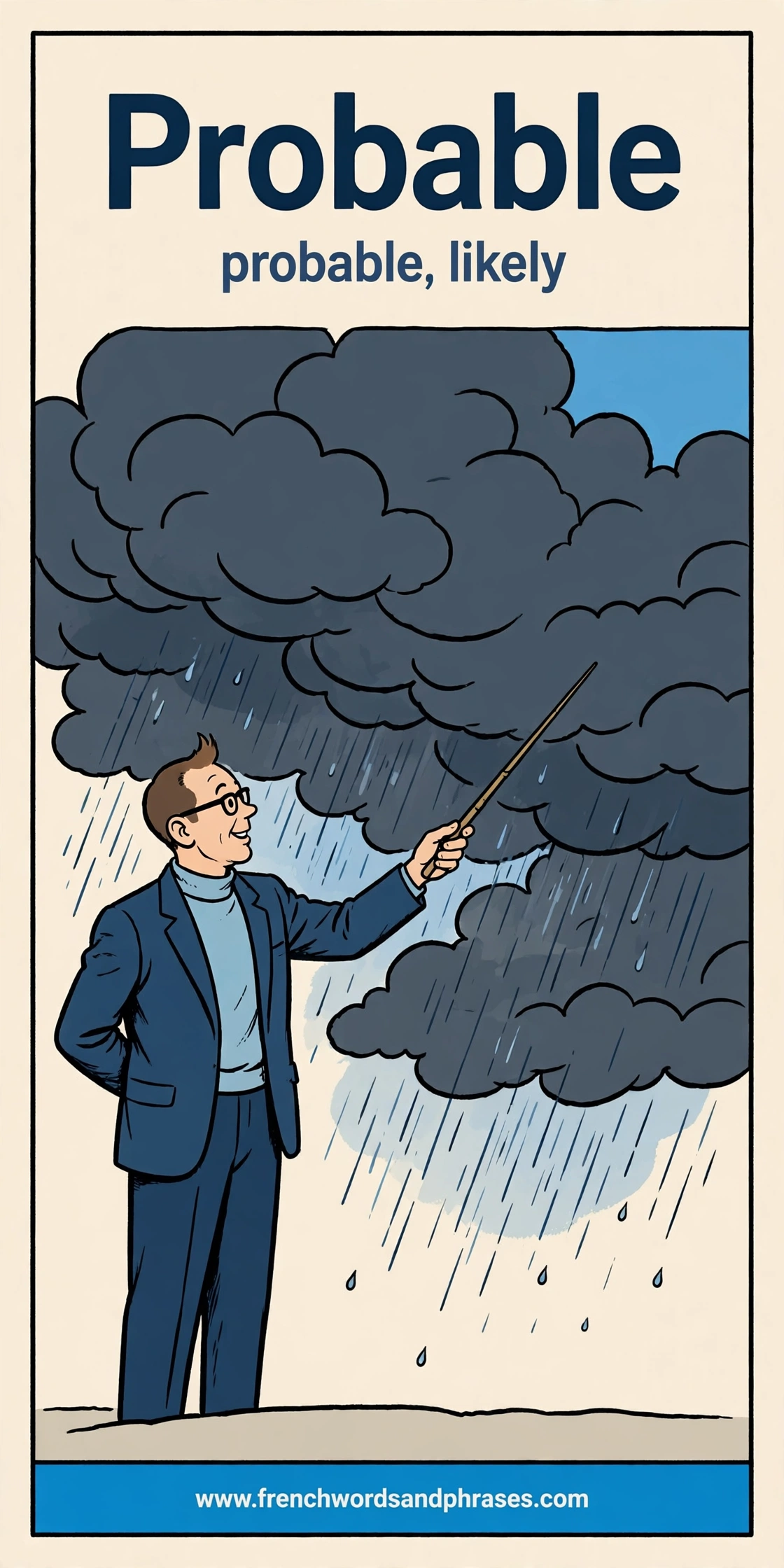
The sky is the colour of wet slate, the wind has turned, and the old sailor sniffs the air once: « La pluie est probable. » Probable is the adjective of the likely — stronger than possible, humbler than certain: the word French reaches for when the evidence leans, but has not yet landed.
In this guide, you’ll learn what probable means in English, why its feminine never changes, how it builds the phrase il est probable que, and how it differs from possible and certain. Explore French examples, English translations, and practice quizzes.
Understanding the French Adjective Probable
Probable is a French adjective of likelihood. It comes from the Latin probabilis, that which can be proved or approved — from probare, to test, to prove. It is invariable in gender, because it already ends in -e: un résultat probable, une victoire probable, des pluies probables. Only the plural changes, adding an s. Its noun is la probabilité, and its adverb probablement, probably.
It means probable, likely — expected to happen or to be true, on the evidence available: un succès probable, a likely success; la cause probable, the probable cause; il est probable qu’il pleuve, it is likely to rain. Probable stands between possible and certain on the French scale of belief: possible may happen, probable probably will, certain definitely will.
Type: Adjective of likelihood — expected, on the evidence
Answers the question: How likely is it? — probable, more likely than not
Changes form: Invariable in gender — probable for him and for her; plural probables
English equivalents: Probable; likely.
One important usage detail: in careful French, the phrase il est probable que is followed by the subjunctive — il est probable qu’il vienne, it is likely he will come — while il est peu probable que, it is unlikely that, demands it absolutely. Everyday speech often relaxes the first; the second never relaxes. And probable never changes for the feminine: never invent a new form.
Experience the Word
Probable is the adjective of the weighed forecast — the meteorologist’s map, the doctor’s caution, the gambler’s nod.
Imagine the harbourmaster at dawn, reading the barometer’s slow fall and the gulls flying inland. Il regarde le ciel et dit simplement : la tempête est probable. By noon, every boat in the port is double-tied.
You have not just said maybe. You have weighed the evidence and leaned — probable, the likelihood with its sleeves rolled up.
How to Use Probable in French: Complete Guide
Let’s explore how probable works in French, beginning with the whole word on one card.
Probable at a Glance
Before the details, here is the whole word on one card.
The Whole Word on One Card
Meaning, type, position and forms — probable in four lines.
| Point | Probable |
|---|---|
| Meaning | probable, likely — expected on the evidence |
| Type | adjective of likelihood |
| Usual position | after the noun — un résultat probable; after être — il est probable que |
| Form | probable for both genders — probables in the plural |
Example
Un retard est probable, vu la neige.
A delay is likely, given the snow.
The Four Forms of Probable
Probable already ends in -e, so masculine and feminine are identical; only the plural adds an s.
| Form | Probable | Example |
|---|---|---|
| Masculine singular | probable | un succès probable — a likely success |
| Feminine singular | probable | une victoire probable — a likely victory |
| Masculine plural | probables | des retards probables — likely delays |
| Feminine plural | probables | des pluies probables — likely rain showers |
Example
Des pluies probables sont annoncées pour demain.
Likely showers are forecast for tomorrow.
Quick Quiz 1
What is the feminine of probable?
Reveal the answer
probable
Une issue probable — the word already ends in -e, so the feminine changes nothing.
A likely outcome.
The Feminine of Probable: The Same Word
Probable keeps one single form for him and for her, like all adjectives ending in -e — only the noun in front of it changes.
| Situation | Example |
|---|---|
| Masculine | un vainqueur probable — a likely winner |
| Feminine | une gagnante probable — identical: the -e is already there |
| Why | adjectives ending in -e do not change for the feminine |
| The plural | add s — des résultats probables, likely results |
Example
La gagnante probable du concours est une pianiste de seize ans.
The likely winner of the competition is a sixteen-year-old pianist.
Where Probable Goes: After the Noun, and in il est probable que
Probable follows the noun it describes, and its most famous home is the frame il est probable que — it is likely that.
| Pattern | Example |
|---|---|
| After the noun | la cause probable — the probable cause |
| After être | la pluie est probable — rain is likely |
| The frame | il est probable que + subjunctive — it is likely that |
| The negative | il est peu probable que — it is unlikely that |
Example
Il est probable qu’elle accepte l’invitation.
It is likely that she will accept the invitation.
Quick Quiz 2
How do you say ‘a probable cause’ — une probable cause or une cause probable?
Reveal the answer
une cause probable
Probable stands after the noun in ordinary French.
A probable cause.
More Probable: Comparing with Probable
Probable compares the regular way, with plus, moins and aussi — a scale of likelihood.
| Degree | Example |
|---|---|
| As likely as | aussi probable que — as likely as |
| More likely | plus probable — more likely |
| Less likely | moins probable — less likely |
| The most likely (masc.) | le plus probable — le plus probable des résultats |
| The most likely (fem.) | la plus probable — la plus probable des issues |
Example
Le retard est plus probable que l’annulation.
A delay is more likely than a cancellation.
Everyday Expressions with Probable
Forecasts, diagnoses and detective work — probable at its daily posts.
| Expression | In English |
|---|---|
| il est probable que | it is likely that |
| il est peu probable que | it is unlikely that |
| la cause probable | the probable cause |
| un résultat probable | a likely result |
| très probable | very likely |
| le vainqueur probable | the likely winner |
Example
Il est peu probable qu’il arrive avant midi.
It is unlikely that he will arrive before noon.
Quick Quiz 3
What does il est peu probable qu’il vienne mean?
Reveal the answer
It is unlikely that he will come
Peu probable — little likely: the evidence leans against.
It is unlikely that he will come.
Probable and Its Neighbours
Probable sits on a scale — learn the neighbours and you can grade any forecast in French.
| French | In English |
|---|---|
| possible | possible — it may happen |
| certain | certain — it definitely will |
| sûr | sure, certain — the everyday word |
| vraisemblable | plausible, likely (of stories) |
| improbable | unlikely, improbable — the opposite |
| probablement | probably — the adverb |
Example
Possible n’est pas probable, et probable n’est pas certain.
Possible is not probable, and probable is not certain.
Watch Out: The Traps Around Probable
The traps here are the subjunctive after il est probable que, and the temptation to invent a feminine form.
| Trap | The truth |
|---|---|
| The feminine | une victoire probable — no new form: probable is invariable in gender |
| The plural | des issues probables — the plural still adds s, for both genders |
| The subjunctive | il est probable qu’il vienne — careful French uses the subjunctive after the frame |
| Not possible | probable is stronger than possible: it leans towards yes |
Example
Il est probable qu’elle soit en retard.
It is likely that she is late.
Quick Quiz 4
How do you say ‘likely delays’?
Reveal the answer
des retards probables
Probable follows the noun and takes the plural s: probables.
Likely delays.
Probable in Everyday French: Real-Life Examples
Now that you know the word, let’s see how probable appears in everyday French.
Example 1 — Weather
La pluie est probable cet après-midi.
Rain is likely this afternoon.
Example 2 — Travel
Un retard est probable, vu la neige.
A delay is likely, given the snow.
Example 3 — Plans
Il est probable que nous partions tôt.
It is likely that we will leave early.
Example 4 — Unlikely
Il est peu probable qu’il téléphone.
It is unlikely that he will phone.
Example 5 — Sport
Le vainqueur probable est le champion en titre.
The likely winner is the reigning champion.
Example 6 — Cause
La cause probable de la panne est électrique.
The probable cause of the breakdown is electrical.
Beyond Translation: The Meaning of Probable
Probable carries a courtroom in its ancestry: Latin probabilis meant provable, fit to be approved — a probable claim was one that could stand a test. French kept the leaning without the verdict: probable is the adjective of honest forecasters, the word that respects the evidence without pretending to be prophecy.
Probable is likelihood with good manners — it leans, and says so.
Learn it on its scale — possible, probable, certain — and every French forecast, diagnosis and prediction falls into place.
How to Remember the French Adjective Probable
Remember it this way: Probable is the likely adjective — one form for him and for her, an s in the plural, and its home in il est probable que.
- You learn it once for both genders — un succès probable, une victoire probable.
- You place it on the scale — possible, probable, certain.
- You watch the frame — il est probable qu’il vienne, with the subjunctive in careful French.
The key idea is probable means probable and likely; invariable in gender, plural probables.
Test Your Knowledge of Probable
Let’s see how much you’ve learned. Try answering these questions before revealing the answers.
Question 1
What does probable mean?
Reveal the answer
Probable, likely — expected, on the evidence.
Question 2
What is the feminine of probable?
Reveal the answer
probable — unchanged: the word already ends in -e.
Question 3
Translate: Rain is likely this afternoon.
Reveal the answer
La pluie est probable cet après-midi.
Question 4
Complete the sentence:
Il est probable qu’elle ______ en retard. (be)
Reveal the answer
soit
Il est probable qu’elle soit en retard.
It is likely that she is late — the subjunctive of être.
Question 5
What is the opposite of probable?
Reveal the answer
improbable — unlikely; and stronger still, impossible.
Your Final Challenge
Can You Use It?
How would you say this in French?
“It is likely that we will leave early.”
Reveal the answer
Il est probable que nous partions tôt.
It is likely that we will leave early.
A little French. A little curiosity. A richer everyday life.
LEARN FRENCH ONE WORD AT A TIME