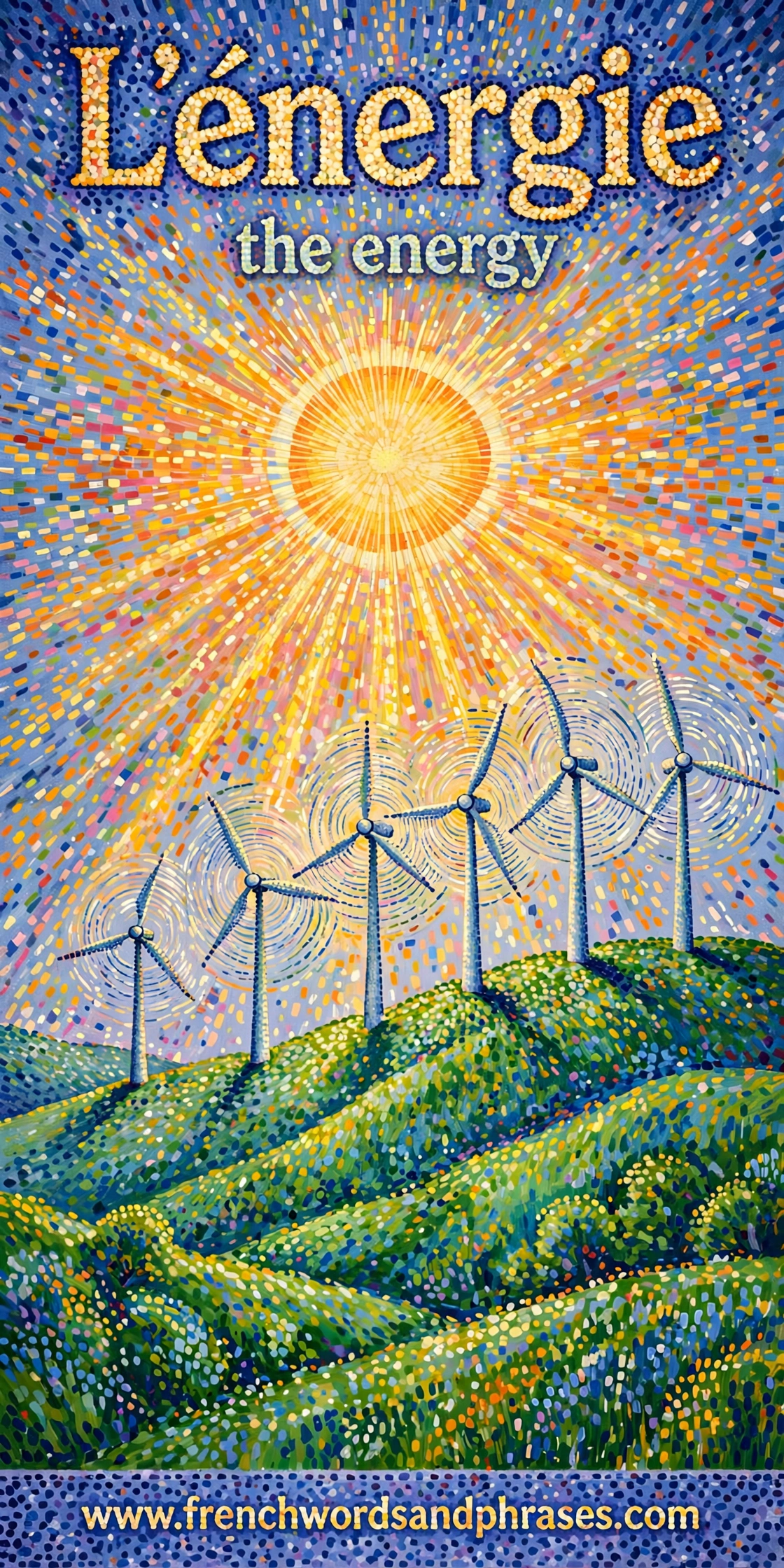
A French Word to Live By
Translate Énergie to English
/e.nɛʁ.ʒi/
L’Énergie means the energy.
The runner at dawn, the child who cannot sit still, the battery at a hundred per cent: l’énergie, energy — the invisible fuel that moves bodies, lights cities and decides whether the day feels possible at all.
In this guide, you’ll learn what énergie means in English, how to use it with its articles, how to form its plural, and how it appears in everyday French. Explore French examples, English translations, and practice quizzes.
Understanding the French Noun Énergie
Énergie is a feminine French noun, learned with its article: l’énergie, une énergie. It begins with a vowel, so the article melts into it: l’énergie, never la énergie. It comes from the Greek energeia, activity, being at work — energy is, in the word’s own memory, work waiting to happen.
It means energy — first the strength in a body: avoir de l’énergie, to have energy, être plein d’énergie, to be full of energy, manquer d’énergie, to lack energy. Then the power that runs the world: l’énergie solaire, solar energy, l’énergie électrique, electrical energy, les énergies renouvelables, renewable energies. One word covers the toddler at breakfast and the power station on the hill.
Gender: Feminine — l’énergie
Definite article: l’ — l’énergie (the energy), melted before the vowel
Indefinite article: une — une énergie (an energy, a form of energy)
Plural: les énergies — used above all for kinds of energy: les énergies renouvelables
Spelling note: from Greek energeia, activity — energy is work waiting to happen
Key verb: avoir de l’énergie — to have energy, to feel full of life
English equivalents: The energy, power, strength.
Because énergie begins with a vowel, the singular possessives borrow the masculine forms — mon énergie, ton énergie, son énergie — never ma énergie. For personal strength, French usually uses the partitive: avoir de l’énergie, plein d’énergie. For power supplies, count the kinds instead: une énergie propre, des énergies renouvelables.
Experience the Word
Énergie is the tide inside a person: some mornings it floods in before the alarm, some evenings it has ebbed away entirely.
Imagine the village fête at midnight — the band still playing, the dancers still turning, the old mayor still on his feet. D’où vient toute cette énergie ? Nobody knows, and nobody wants it to stop.
You have not just named a force of physics. You have named the spark of the day — l’énergie, energy, the strength to begin.
How to Use Énergie in French: Complete Guide
Let’s explore how énergie works in French, beginning with its articles — l’énergie, une énergie, avoir de l’énergie.
Énergie with the Definite Article (L’, Les)
Used for energy in general, or a specific supply of it. The vowel opening makes la melt into l’.
| Form | French |
|---|---|
| Feminine singular | l’énergie |
| Plural | les énergies |
Example
L’énergie du soleil chauffe la maison.
The sun’s energy heats the house.
Énergie with the Indefinite Article (Une, Des)
Used for one kind of energy — solar, wind, nuclear — a single source among others.
| Form | French |
|---|---|
| Feminine singular | une énergie |
| Plural | des énergies |
Example
Le vent est une énergie propre et gratuite.
Wind is a clean, free energy.
Énergie with Quantities (Beaucoup d’énergie…)
Personal energy is measured with the partitive — some, plenty, none left at all.
| Quantity | French |
|---|---|
| a lot of energy | beaucoup d’énergie |
| full of energy | plein d’énergie |
| a burst of energy | un regain d’énergie |
| no energy left | sans énergie |
| too much energy | trop d’énergie |
Example
Les enfants ont beaucoup d’énergie le matin.
The children have lots of energy in the morning.
Quick Quiz 1
Complete the sentence:
______ énergie solaire est gratuite. (the)
Reveal the answer
L’
L’énergie solaire est gratuite.
Solar energy is free — le/la melts into l’ before the vowel.
The Plural of Énergie
The plural les énergies names the kinds of energy — the word of energy policy and science pages.
| Number | French |
|---|---|
| Singular | l’énergie |
| Plural | les énergies |
Example
Les énergies renouvelables remplacent peu à peu le pétrole.
Renewable energies are gradually replacing oil.
Énergie with Possessive Adjectives (Mon, Ton, Son…)
Énergie is feminine but begins with a vowel, so the singular possessives borrow the masculine forms: mon, ton, son — the words must flow.
| Owner | French |
|---|---|
| my | mon énergie |
| your (tu) | ton énergie |
| his / her | son énergie |
| our | notre énergie |
| your (vous) | votre énergie |
| their | leur énergie |
Example
Je garde mon énergie pour la fin de la course.
I save my energy for the end of the race.
Quick Quiz 2
Complete the sentence:
Elle dépense ______ énergie sans compter. (her)
Reveal the answer
son
Elle dépense son énergie sans compter.
She spends her energy without counting — son, because énergie begins with a vowel.
Énergie with Demonstrative Adjectives (Cette, Ces)
Used to point: cette énergie, this energy — usually someone’s astonishing supply of it.
| Form | French |
|---|---|
| Feminine singular | cette énergie |
| Plural | ces énergies |
Example
Cette énergie, chez un enfant de cinq ans, est épuisante.
This energy, in a five-year-old, is exhausting.
Énergie with Adjectives
Adjectives agree with énergie — feminine singular: une énergie renouvelable, une énergie débordante.
| Adjective | With Énergie |
|---|---|
| renouvelable (renewable) | une énergie renouvelable |
| solaire (solar) | l’énergie solaire |
| électrique (electrical) | l’énergie électrique |
| débordante (boundless) | une énergie débordante |
| propre (clean) | une énergie propre |
Example
Une énergie débordante anime toute l’équipe.
Boundless energy drives the whole team.
Quick Quiz 3
Complete the sentence:
C’est une énergie ______, elle ne pollue pas. (clean)
Reveal the answer
propre
C’est une énergie propre, elle ne pollue pas.
It is a clean energy, it does not pollute — propre agrees with the feminine noun.
Everyday Expressions with Énergie
Bodies, batteries and power bills — the énergie phrases of daily life.
| Expression | In English |
|---|---|
| avoir de l’énergie | to have energy |
| être plein d’énergie | to be full of energy |
| manquer d’énergie | to lack energy, to feel flat |
| l’énergie solaire | solar energy |
| faire le plein d’énergie | to recharge one’s batteries |
Example
Après les vacances, elle a fait le plein d’énergie.
After the holidays, she recharged her batteries.
Words from the Same Family as Énergie
Strength and its opposites — the words that travel with énergie.
| French | In English |
|---|---|
| énergique | energetic (the adjective) |
| la force | strength, force |
| la vitalité | vitality |
| la fatigue | tiredness — the opposite |
| un regain d’énergie | a new burst of energy |
Example
Malgré la fatigue, il reste énergique jusqu’au soir.
Despite the tiredness, he stays energetic until the evening.
Quick Quiz 4
What does être plein d’énergie mean?
Reveal the answer
To be full of energy — bursting with strength and life.
Les enfants sont pleins d’énergie après le petit-déjeuner.
The children are full of energy after breakfast.
Énergie in Everyday French: Real-Life Examples
Now that you know the word, let’s see how énergie appears in everyday French.
Example 1 — Morning
Les enfants ont de l’énergie dès le réveil.
The children have energy from the moment they wake up.
Example 2 — Sport
Elle garde son énergie pour le dernier kilomètre.
She saves her energy for the last kilometre.
Example 3 — At home
L’énergie solaire chauffe l’eau de la maison.
Solar energy heats the house’s water.
Example 4 — Tired
Le soir, je manque d’énergie pour cuisiner.
In the evening, I lack the energy to cook.
Example 5 — Work
Ce projet demande beaucoup d’énergie.
This project demands a lot of energy.
Example 6 — Holidays
La mer et le soleil, voilà le plein d’énergie.
The sea and the sun — that’s a full recharge.
Beyond Translation: The Meaning of Énergie
Énergie travelled from Greek philosophy into physics and then into the kitchen: energeia was Aristotle’s word for being-at-work, actuality — a thing doing what it is for. French kept both ends of the journey. The engineer measures l’énergie in joules; the grandmother measures it in grandchildren, and both are talking about the same invisible something that makes things happen.
To say énergie is to name the capacity to act — in a body, in a battery, in a country.
It evokes the dawn run, the humming power line and the child who cannot sit still — everything that moves, measured in one word.
How to Remember the French Noun Énergie
Remember it this way: Énergie is energy — feminine with a melted article: l’énergie, and mon énergie because it begins with a vowel.
- Feminine, vowel first — l’énergie, une énergie, cette énergie.
- The possessive trick — mon énergie, ton énergie, son énergie, never ma.
- Two worlds — avoir de l’énergie in the body, l’énergie solaire in the sky.
The key idea is l’énergie — the energy, feminine; mon énergie, because it starts with a vowel.
Test Your Knowledge of Énergie
Let’s see how much you’ve learned. Try answering these questions before revealing the answers.
Question 1
Is énergie masculine or feminine?
Reveal the answer
Feminine — l’énergie, une énergie.
Question 2
How do you say to have energy?
Reveal the answer
Avoir de l’énergie.
Question 3
Translate: Solar energy is free.
Reveal the answer
L’énergie solaire est gratuite.
Question 4
Why do we say mon énergie and not ma énergie?
Reveal the answer
Because énergie begins with a vowel — the feminine possessives ma, ta, sa give way to mon, ton, son so the words flow.
Question 5
Complete the sentence:
______ énergies renouvelables sont l’avenir. (the)
Reveal the answer
Les
Les énergies renouvelables sont l’avenir.
Renewable energies are the future.
Your Final Challenge
Can You Use It?
How would you say this in French?
“The children are full of energy after breakfast.”
Reveal the answer
Les enfants sont pleins d’énergie après le petit-déjeuner.
The children are full of energy after breakfast.
A little French. A little curiosity. A richer everyday life.
LEARN FRENCH ONE WORD AT A TIME