A French Word to Live By
Translate Plein to English
/plɛ̃/
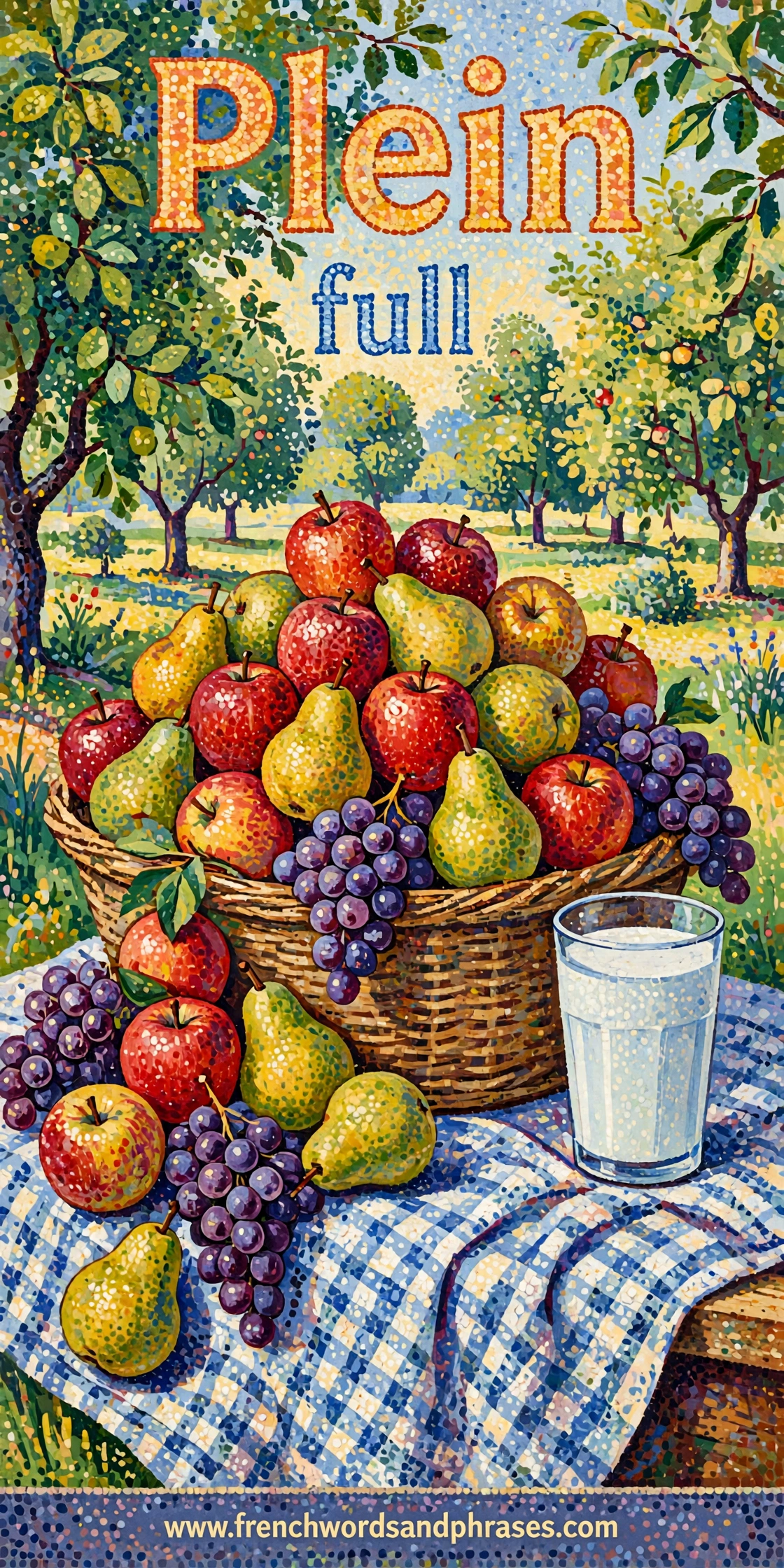
Plein means full.
The glass filled to the brim, the train with no seat left, the moon round and complete in a black sky: plein, full — the adjective of nothing-missing, of containers, rooms and days that hold all they can hold.
In this guide, you’ll learn what plein means in English, how its feminine pleine is formed, where it stands in the sentence, and why plein de can mean a lot of. Explore French examples, English translations, and practice quizzes.
Understanding the French Adjective Plein
Plein is a French adjective of quantity and completeness. It comes from the Latin plenus, full — the same root as English plenty. Its feminine is pleine: the nasal sound opens up and the n is heard — plein /plɛ̃/, pleine /plɛn/. The plurals are pleins and pleines.
It means full — the opposite of vide, empty: un verre plein, a full glass; une salle pleine, a packed room; la pleine lune, the full moon. Followed by de, it overflows into quantity: plein de monde, lots of people; plein d’idées, full of ideas. And plein stands at the heart of fixed phrases where fullness becomes intensity: en plein air, in the open air; en plein jour, in broad daylight; en pleine forme, in top form.
Type: Adjective of quantity — fullness and completeness
Answers the question: How full? — full, filled, packed
Changes form: plein / pleine / pleins / pleines — the feminine hears the n
English equivalents: Full; filled; packed; plein de — full of, lots of.
One important usage detail: plein normally agrees like any adjective — une boîte pleine, des verres pleins — but in the familiar expression plein de meaning lots of, everyday French often leaves it unchanged before the noun: plein de gens, plein d’erreurs. In careful French it still agrees when it truly means full of: une valise pleine de livres. Learn both, use the agreeing form in writing.
Experience the Word
Plein is the adjective of the brim — the moment before overflow, when a thing holds exactly all it can.
Imagine the little bistro at one o’clock: every table taken, glasses full, the room loud with lunch. La salle est pleine, says the waiter, half proud, half sorry — full, complete, alive.
You have not just described a container. You have measured abundance — plein, full to the edge.
How to Use Plein in French: Complete Guide
Let’s explore how plein works in French, beginning with the whole word on one card.
Plein at a Glance
Before the details, here is the whole word on one card.
The Whole Word on One Card
Meaning, type, position and forms — plein in four lines.
| Point | Plein |
|---|---|
| Meaning | full, filled, packed — the opposite of vide, empty |
| Type | adjective of quantity and completeness |
| Usual position | after the noun — un verre plein |
| Forms | plein, pleine, pleins, pleines |
Example
Le verre est plein jusqu’au bord.
The glass is full to the brim.
The Four Forms of Plein
The feminine pleine opens the nasal vowel and lets you hear the n: plein /plɛ̃/, pleine /plɛn/.
| Form | Plein | Example |
|---|---|---|
| Masculine singular | plein | un verre plein — a full glass |
| Feminine singular | pleine | une salle pleine — a packed room |
| Masculine plural | pleins | des verres pleins — full glasses |
| Feminine plural | pleines | des salles pleines — packed rooms |
Example
Les salles pleines font la fierté du théâtre.
Packed rooms are the theatre’s pride.
Quick Quiz 1
What is the feminine of plein?
Reveal the answer
pleine
Une pleine lune — the n is heard in the feminine: /plɛn/.
A full moon.
The Feminine of Plein: Pleine
Pleine is one of the -in / -ine feminines: bon, bonne works the same family way — a written e that wakes the consonant up.
| Situation | Example |
|---|---|
| Masculine | un sac plein — a full bag |
| Feminine | une valise pleine — a full suitcase |
| The moon | la pleine lune — the full moon (fixed phrase) |
| The sea | la pleine mer — the open sea, high seas |
Example
La pleine lune éclaire le jardin entier.
The full moon lights the whole garden.
Where Plein Goes: After the Noun, and Plein de
Plein follows its noun; followed by de, it pours into the next word — full of, and in familiar French, lots of.
| Pattern | Example |
|---|---|
| After the noun | un verre plein — a full glass |
| After être | la salle est pleine — the room is packed |
| Plein de + noun | plein d’idées — full of ideas |
| En plein + noun | en plein air — in the open air |
Example
Il est arrivé avec une tête pleine d’idées nouvelles.
He arrived with a head full of new ideas.
Quick Quiz 2
How do you say ‘a full suitcase’ — un plein valise or une valise pleine?
Reveal the answer
une valise pleine
Plein stands after the noun and agrees with it: valise is feminine, so pleine.
A full suitcase.
More Plein: Comparing with Plein
Fullness has degrees — French compares plein with plus, moins and aussi, and tops it with tout plein in familiar speech.
| Degree | Example |
|---|---|
| As full as | aussi plein que — as full as |
| Fuller | plus plein — more full |
| Less full | moins plein — less full |
| Completely full | tout plein, rempli à ras bord — full to the brim |
| Half full | à moitié plein — half full |
Example
Ce verre est plus plein que l’autre.
This glass is fuller than the other.
Everyday Expressions with Plein
Plein lives in the phrases of open air, broad daylight and full strength.
| Expression | In English |
|---|---|
| en plein air | in the open air, outdoors |
| en plein jour | in broad daylight |
| en pleine forme | in top form, full of energy |
| la pleine lune | the full moon |
| plein de monde | lots of people, crowded |
| à pleins poumons | at the top of one’s lungs |
Example
Nous avons déjeuné en plein air, sous les pommiers.
We had lunch in the open air, under the apple trees.
Quick Quiz 3
What does en plein jour mean?
Reveal the answer
In broad daylight
En plein jour — in the full light of day, openly.
In broad daylight.
Plein and Its Neighbours
Plein keeps company with the words of filling — and faces vide, its great opposite.
| French | In English |
|---|---|
| rempli | filled, filled up |
| complet | complete; fully booked, no seats left |
| bondé | packed, crammed (a train, a bus) |
| chargé | loaded; busy (a schedule) |
| vide | empty — the opposite |
| à moitié vide | half empty |
Example
Le train bondé et le verre vide : plein et son contraire voyagent ensemble.
The packed train and the empty glass: plein and its opposite travel together.
Watch Out: The Traps Around Plein
The traps are agreement with plein de, and the false friend complet, which for a hotel means fully booked, not full.
| Trap | The truth |
|---|---|
| Plein de = lots of | in familiar French plein de gens means lots of people, not full people |
| Agreement | careful French agrees: une valise pleine de livres; familiar speech often leaves plein de invariable |
| Complet | un hôtel complet is fully booked — for a full glass, say un verre plein |
| The feminine sound | pleine hears its n: /plɛn/ — do not carry the nasal over |
Example
Il y avait plein de monde au marché ce matin.
There were lots of people at the market this morning.
Quick Quiz 4
How do you say ‘packed rooms’?
Reveal the answer
des salles pleines
Plein follows the noun and agrees, feminine plural: pleines.
Packed rooms.
Plein in Everyday French: Real-Life Examples
Now that you know the word, let’s see how plein appears in everyday French.
Example 1 — At the café
Un verre plein, s’il vous plaît, il fait très chaud.
A full glass, please, it is very hot.
Example 2 — At the station
Le train est plein, il faut attendre le suivant.
The train is full, we must wait for the next one.
Example 3 — At night
La pleine lune éclaire la route comme un lampadaire.
The full moon lights the road like a street lamp.
Example 4 — Outdoors
Les enfants jouent en plein air tout l’après-midi.
The children play in the open air all afternoon.
Example 5 — Energy
Après ses vacances, elle est en pleine forme.
After her holiday, she is in top form.
Example 6 — Crowds
Il y avait plein de monde à la fête du village.
There were lots of people at the village fête.
Beyond Translation: The Meaning of Plein
Plein is one of Latin’s most generous gifts to French: plenus gives plein, plenty and plénitude, and French spends the word everywhere fullness matters — stomachs and stadiums, moons and schedules. Its finest trick is grammatical: add de and the adjective becomes a measure — plein de, full of, then simply lots of, as if quantity itself were a kind of overflow.
Plein is the brim of the glass — the exact point where there is room for nothing more.
Learn it against vide, and the pair will measure half the visible world for you: verres, salles, rues, journées — pleins ou vides.
How to Remember the French Adjective Plein
Remember it this way: Plein is full — feminine pleine, with the n awake: un verre plein, une salle pleine, and plein de for lots of.
- The four forms — plein, pleine, pleins, pleines; the feminine hears the n.
- The phrases — en plein air, outdoors; en plein jour, in broad daylight; la pleine lune, the full moon.
- The overflow — plein de monde, lots of people.
The key idea is plein means full; feminine pleine, and plein de means full of, lots of.
Test Your Knowledge of Plein
Let’s see how much you’ve learned. Try answering these questions before revealing the answers.
Question 1
What does plein mean?
Reveal the answer
Full — filled, packed; the opposite of vide, empty.
Question 2
What is the feminine of plein?
Reveal the answer
pleine — une salle pleine, with the n pronounced.
Question 3
Translate: in broad daylight.
Reveal the answer
En plein jour.
Question 4
Complete the sentence:
La bouteille est ______ d’eau fraîche.
Reveal the answer
pleine
La bouteille est pleine d’eau fraîche.
The bottle is full of fresh water.
Question 5
What does plein de monde mean?
Reveal the answer
Lots of people — a crowd: il y avait plein de monde, there were lots of people.
Your Final Challenge
Can You Use It?
How would you say this in French?
“There were lots of people at the village fête.”
Reveal the answer
Il y avait plein de monde à la fête du village.
There were lots of people at the village fête.
A little French. A little curiosity. A richer everyday life.
LEARN FRENCH ONE WORD AT A TIME