A French Word to Live By
How to Conjugate Décider in French
/de.si.de/
Décider means to decide — to settle a question, choose a course and end the hesitation: a family deciding where to live, a judge deciding a case, a coin deciding nothing at all.
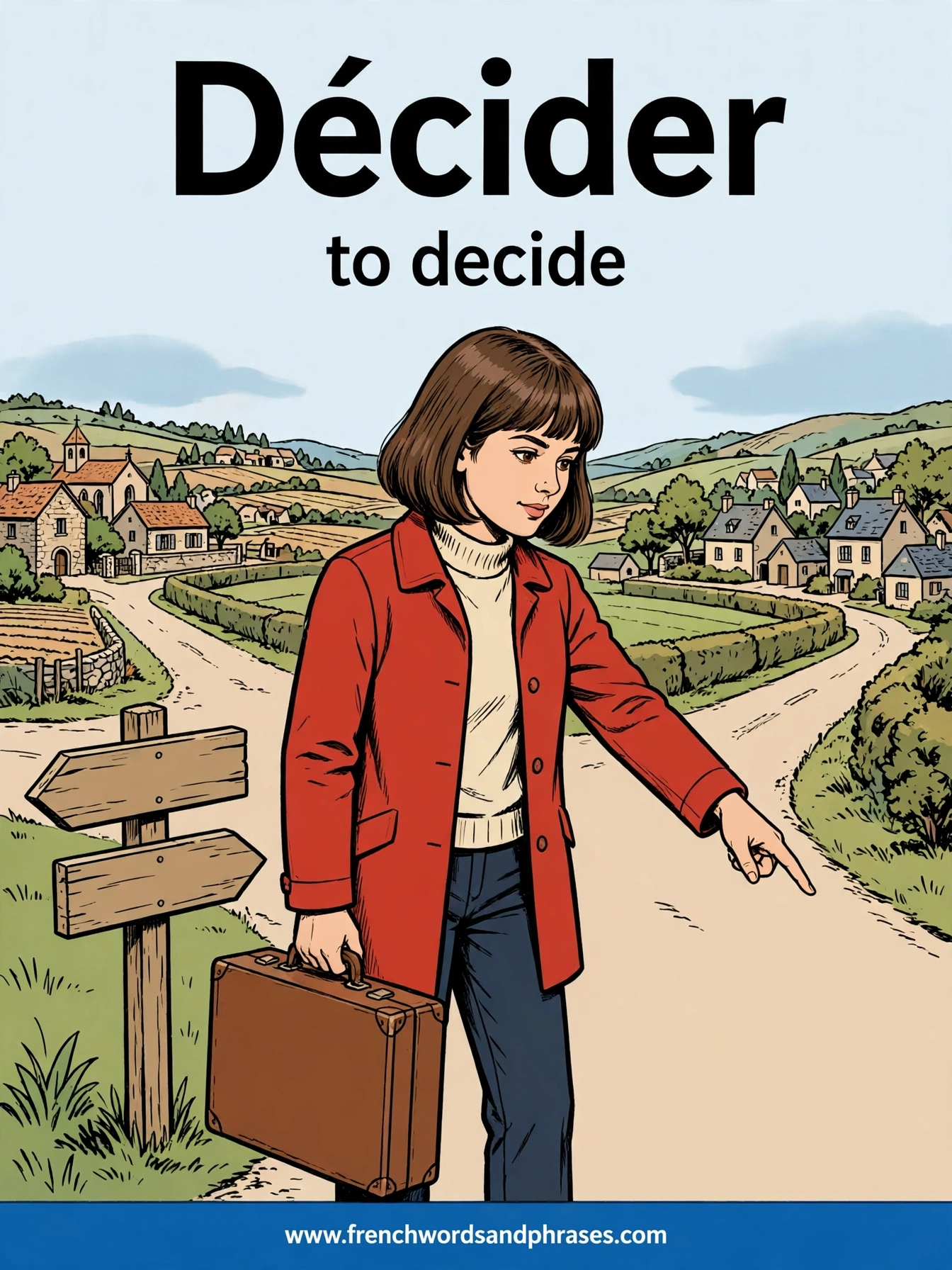
Two roads at a crossroads, a menu too long, a house to buy or refuse — décider is the verb of the moment when thinking stops and choosing begins: the cut between maybe and yes.
In this guide, you’ll learn how to conjugate décider in all the major French tenses and moods. Explore complete conjugation tables, French examples, English translations, and practice quizzes.
Understanding the French Verb Décider
Décider is a regular French verb belonging to the first group of verbs, those ending in-er.
It means to decide. Décider also rules in formal French: a court décide (rules, hands down a decision), a committee décide une augmentation, and the outcome is une décision. The adjective décidé describes a determined person — un air décidé, a resolute look — and décidé à tout means ready for anything.
Verb classification: First group (-er)
Auxiliary verb: Avoir
Past participle: décidé
Present participle: décidant
English equivalents: To decide, to settle, to determine; décider de faire quelque chose — to decide to do something; décider quelqu’un à faire quelque chose — to persuade someone to do something; décider du prix — to settle the price; se décider — to make up one’s mind.
One important detail: décider is perfectly regular — je décide, nous décidons, ils décident, past participle décidé — but its constructions do the real work: décider de + infinitive (to decide to do), décider que + clause, and the pronominal twin se décider, to make up one’s own mind at last: il s’est enfin décidé. Do not confuse the two: décider settles the question, se décider settles oneself.
Experience the Word
Décider is the verb of the cut — Latin decidere means to cut off, and every decision still cuts away the other possibilities.
Imagine the family around the kitchen table in February, two brochures side by side: la mer ou la montagne ? The parents hesitate, the children campaign — then grandmother closes both brochures: « On décide ce soir, et on n’en parle plus. » Tonight we decide, and that is the end of it.
The brochures are closed, the summer is chosen. That is décider — hesitation, cut cleanly in two.
How to Conjugate Décider: Complete French Conjugation Guide
Let’s explore every major conjugation of décider, beginning with the indicative mood.
How to Conjugate Décider in the Indicative Mood
The indicative mood is used to express facts, observations, actions, and events.
How to Conjugate Décider in the Present Tense (Présent)
Used for actions happening now, habitual actions, and general truths.
| Subject | Conjugation |
|---|---|
| je | décide |
| tu | décides |
| il / elle | décide |
| nous | décidons |
| vous | décidez |
| ils / elles | décident |
Example
Chaque matin, il décide du menu du restaurant.
Every morning, he decides the restaurant’s menu.
Quick Quiz 1
Complete the sentence:
Nous ______ de partir en train.
Reveal the answer
décidons
Nous décidons de partir en train.
We decide to go by train.
How to Conjugate Décider in the Passé Composé
Used for completed actions in the past. Décider takes the auxiliary verb avoir.
| Subject | Conjugation |
|---|---|
| j’ | ai décidé |
| tu | as décidé |
| il / elle | a décidé |
| nous | avons décidé |
| vous | avez décidé |
| ils / elles | ont décidé |
Example
Nous avons décidé de partir en train.
We decided to go by train.
How to Conjugate Décider in the Imparfait (Imperfect Tense)
Used for habitual past actions, descriptions, and ongoing situations in the past.
| Subject | Conjugation |
|---|---|
| je | décidais |
| tu | décidais |
| il / elle | décidait |
| nous | décidions |
| vous | décidiez |
| ils / elles | décidaient |
Example
Autrefois, le directeur décidait de tout, tout seul.
In the old days, the director decided everything, all alone.
Quick Quiz 2
Choose the correct form:
We decided to stay.
Nous ______ de rester. (avons décidé / sommes décidés)
Reveal the answer
avons décidé
Nous avons décidé de rester.
Décider takes avoir.
How to Conjugate Décider in the Plus-que-parfait
Used to describe an action that had already been completed before another past event.
| Subject | Conjugation |
|---|---|
| j’ | avais décidé |
| tu | avais décidé |
| il / elle | avait décidé |
| nous | avions décidé |
| vous | aviez décidé |
| ils / elles | avaient décidé |
Example
Elle avait décidé de vendre la maison avant Noël.
She had decided to sell the house before Christmas.
How to Conjugate Décider in the Passé Simple
Primarily used in formal writing, literature, and historical narratives. It is rarely used in everyday conversation.
| Subject | Conjugation |
|---|---|
| je | décidai |
| tu | décidas |
| il / elle | décida |
| nous | décidâmes |
| vous | décidâtes |
| ils / elles | décidèrent |
Example
Le roi décida de construire un nouveau palais.
The king decided to build a new palace.
How to Conjugate Décider in the Passé Antérieur
A literary tense used to express an action completed immediately before another past action, generally in the passé simple.
| Subject | Conjugation |
|---|---|
| j’ | eus décidé |
| tu | eus décidé |
| il / elle | eut décidé |
| nous | eûmes décidé |
| vous | eûtes décidé |
| ils / elles | eurent décidé |
Example
Dès qu’ils eurent décidé du prix, ils signèrent le contrat.
As soon as they had settled the price, they signed the contract.
How to Conjugate Décider in the Future Tense (Futur Simple)
Used to describe actions that will take place in the future.
| Subject | Conjugation |
|---|---|
| je | déciderai |
| tu | décideras |
| il / elle | décidera |
| nous | déciderons |
| vous | déciderez |
| ils / elles | décideront |
Example
Tu décideras demain, après une bonne nuit de sommeil.
You will decide tomorrow, after a good night’s sleep.
How to Conjugate Décider in the Futur Antérieur (Future Perfect)
Used for an action that will have been completed before a particular point in the future.
| Subject | Conjugation |
|---|---|
| j’ | aurai décidé |
| tu | auras décidé |
| il / elle | aura décidé |
| nous | aurons décidé |
| vous | aurez décidé |
| ils / elles | auront décidé |
Example
À midi, nous aurons décidé de l’heure du départ.
By noon, we will have decided on the departure time.
How to Conjugate Décider in the Near Future (Futur Proche)
Used to describe something that is going to happen soon. Formed with aller + infinitive.
| Subject | Conjugation |
|---|---|
| je | vais décider |
| tu | vas décider |
| il / elle | va décider |
| nous | allons décider |
| vous | allez décider |
| ils / elles | vont décider |
Example
Je vais décider ce soir, promis.
I am going to decide tonight, I promise.
How to Conjugate Décider in the Conditional Mood
The conditional mood expresses what would happen under certain circumstances. It is also frequently used to make polite requests or express wishes.
How to Conjugate Décider in the Present Conditional
| Subject | Conjugation |
|---|---|
| je | déciderais |
| tu | déciderais |
| il / elle | déciderait |
| nous | déciderions |
| vous | décideriez |
| ils / elles | décideraient |
Example
À ta place, je déciderais autrement.
In your place, I would decide differently.
How to Conjugate Décider in the Past Conditional
| Subject | Conjugation |
|---|---|
| j’ | aurais décidé |
| tu | aurais décidé |
| il / elle | aurait décidé |
| nous | aurions décidé |
| vous | auriez décidé |
| ils / elles | auraient décidé |
Example
Ils auraient décidé plus tôt sans cette réunion inutile.
They would have decided earlier without that useless meeting.
Décider in the Literary Past Conditional Form
This less common literary form uses the imperfect subjunctive of avoir.
| Subject | Conjugation |
|---|---|
| j’ | eusse décidé |
| tu | eusses décidé |
| il / elle | eût décidé |
| nous | eussions décidé |
| vous | eussiez décidé |
| ils / elles | eussent décidé |
Example
Le conseil eût décidé la guerre sans l’ambassadeur.
The council would have decided on war, had it not been for the ambassador.
How to Conjugate Décider in the Subjunctive Mood
The subjunctive is used to express wishes, emotions, doubts, necessity, and uncertainty. It frequently follows expressions such as il faut que (it is necessary that) or bien que (although).
How to Conjugate Décider in the Present Subjunctive
| Subject | Conjugation |
|---|---|
| que je | décide |
| que tu | décides |
| qu’il / qu’elle | décide |
| que nous | décidions |
| que vous | décidiez |
| qu’ils / qu’elles | décident |
Example
Il faut que tu décides avant vendredi.
You must decide before Friday.
Quick Quiz 3
Complete the sentence using the subjunctive:
Je suis content que vous ______ de rester.
Reveal the answer
ayez décidé
Je suis content que vous ayez décidé de rester.
I am glad you decided to stay.
How to Conjugate Décider in the Imperfect Subjunctive
A literary tense, rarely encountered in modern spoken French.
| Subject | Conjugation |
|---|---|
| que je | décidasse |
| que tu | décidasses |
| qu’il / qu’elle | décidât |
| que nous | décidassions |
| que vous | décidassiez |
| qu’ils / qu’elles | décidassent |
Example
Elle craignait qu’il décidât seul de l’avenir de l’entreprise.
She feared he might decide the company’s future alone.
How to Conjugate Décider in the Pluperfect Subjunctive
A literary construction used to express an action completed before another past action.
| Subject | Conjugation |
|---|---|
| que j’ | eusse décidé |
| que tu | eusses décidé |
| qu’il / qu’elle | eût décidé |
| que nous | eussions décidé |
| que vous | eussiez décidé |
| qu’ils / qu’elles | eussent décidé |
Example
On racontait que le roi eût décidé la paix en une nuit.
People said the king had decided on peace in a single night.
How to Conjugate Décider in the Past Subjunctive
| Subject | Conjugation |
|---|---|
| que j’ | aie décidé |
| que tu | aies décidé |
| qu’il / qu’elle | ait décidé |
| que nous | ayons décidé |
| que vous | ayez décidé |
| qu’ils / qu’elles | aient décidé |
Example
Je suis content que vous ayez décidé de rester.
I am glad you decided to stay.
How to Conjugate Décider in the Imperative
The imperative is used to give commands, instructions, invitations, or suggestions. Subject pronouns are omitted.
How to Conjugate Décider in the Present Imperative
| Person | Conjugation |
|---|---|
| (tu) | décide |
| (nous) | décidons |
| (vous) | décidez |
Example
Décidez maintenant, il n’y a plus de temps à perdre !
Decide now, there is no more time to lose!
Quick Quiz 4
How would you say Decide now (vous form)?
Reveal the answer
Décidez maintenant !
French Participles of Décider
Participles are verb forms that can be used in compound tenses and other grammatical constructions.
Present Participle of Décider
décidant
En décidant trop tard, il a perdu la maison de ses rêves.
By deciding too late, he lost the house of his dreams.
Past Participle of Décider
décidé
Décidée en une minute, la réponse a surpris tout le monde.
Decided in one minute, the answer surprised everyone.
Décider in Everyday French: Real-Life Examples
Now that you know the conjugations, let’s see how décider appears in everyday French.
Example 1 — Present
Il décide du menu chaque matin.
He decides the menu every morning.
Example 2 — Passé composé
Nous avons décidé de partir en train.
We decided to go by train.
Example 3 — Imparfait
Le directeur décidait de tout, tout seul.
The director decided everything, all alone.
Example 4 — Future
Tu décideras demain, après une nuit de sommeil.
You will decide tomorrow, after a night’s sleep.
Example 5 — Conditional
À ta place, je déciderais autrement.
In your place, I would decide differently.
Example 6 — Imperative
Décidez maintenant, il est tard !
Decide now, it is late!
Beyond Translation: The Meaning of Décider
English decide and French décider are the same Latin scissors — decidere, to cut off — and the family resemblance runs deep: decision, décision, and the herbicide that cuts weeds the same way. French keeps the blade sharp in daily life: décider de for one’s own choices, se décider for the inner moment when the mind finally closes around one of them.
Every decision is a small execution of the alternatives.
Learn the pair décider / se décider and you can narrate the whole drama of choice, from the king’s council to the restaurant menu.
How to Remember the French Verb Décider
Remember it this way: Décider is about the family closing the two brochures and choosing the summer tonight.
- Décider de + infinitive: décider de partir — to decide to leave.
- Se décider is the inner twin: il s’est enfin décidé — he finally made up his mind.
- Regular -er with avoir: je décide, nous décidons, past participle décidé; the noun is une décision.
The key idea is the family closing the two brochures and choosing the summer tonight.
Test Your Knowledge of Décider
Let’s see how much you’ve learned. Try answering these questions before revealing the answers.
Question 1
How do you say to decide to leave in French?
Reveal the answer
Décider de partir.
Question 2
What is the difference between décider and se décider?
Reveal the answer
Décider settles the question; se décider settles oneself — to make up one’s mind.
Question 3
Translate: We decided to go by train.
Reveal the answer
Nous avons décidé de partir en train.
Question 4
What is the past participle of décider?
Reveal the answer
Décidé.
Question 5
Complete the sentence:
Il faut que tu ______ avant vendredi.
Reveal the answer
décides
Il faut que tu décides avant vendredi.
You must decide before Friday.
Your Final Challenge
Can You Use It?
How would you say this in French?
We decide tonight, and that is the end of it: the sea or the mountains, we must choose.
Reveal the answer
On décide ce soir, et on n’en parle plus : la mer ou la montagne, il faut choisir.
We decide tonight, and that is the end of it: the sea or the mountains, we must choose.
A little French. A little curiosity. A richer everyday life.
LEARN FRENCH ONE WORD AT A TIME