A French Word to Live By
Translate Demi to English
/də.mi/
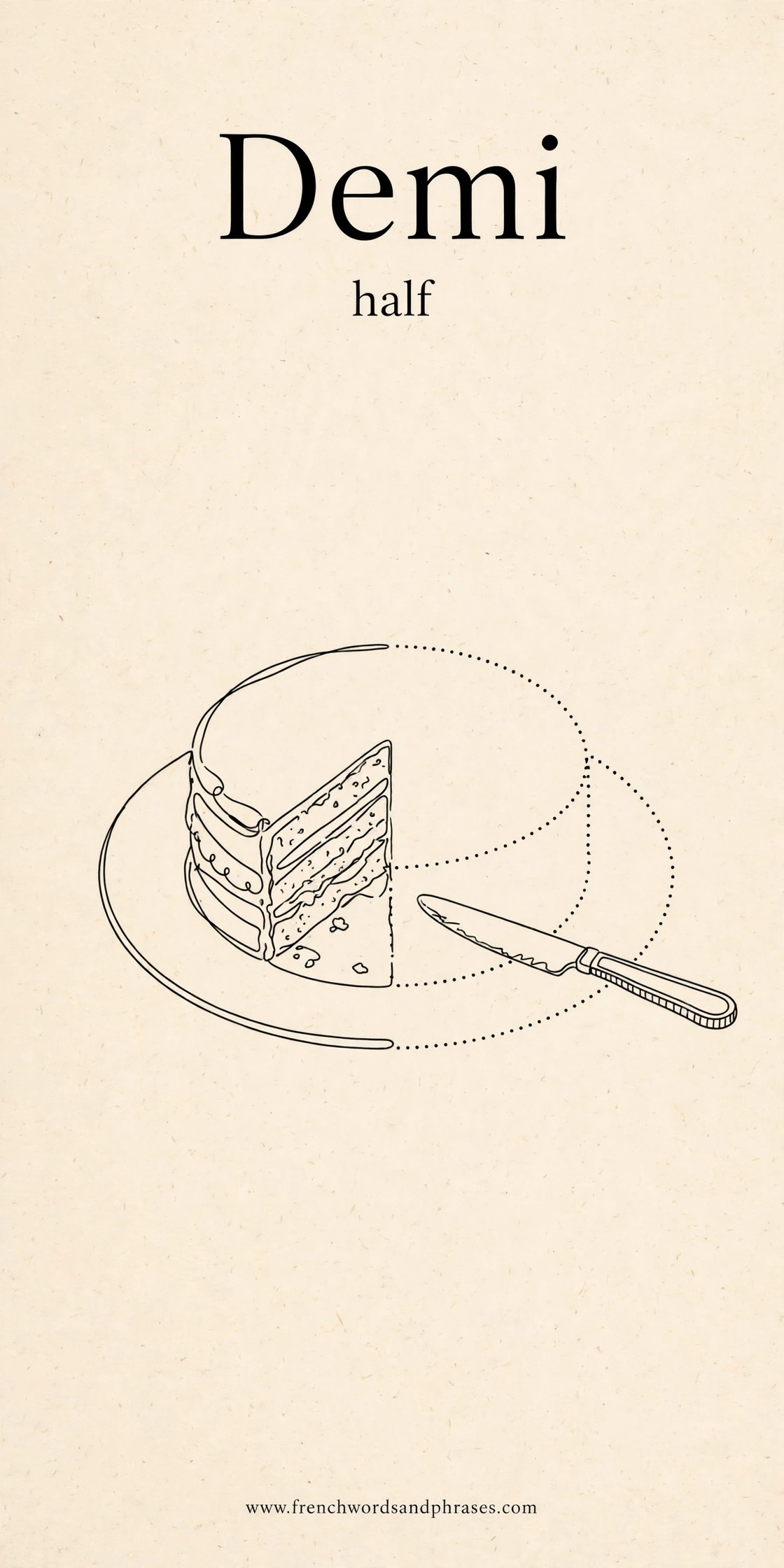
Demi means half.
Half an hour, half a baguette, half the cake gone before the guests arrive: demi. Demi is the adjective of the equal split — the share that makes two of one, the clock’s favourite fraction, and the word that changes its behaviour depending on which side of the noun it stands.
In this guide, you’ll learn what demi means in English, why it never changes before a noun, when its feminine demie appears after et, and how it differs from its noun twin la moitié. Explore French examples, English translations, and practice quizzes.
Understanding the French Adjective Demi
Demi is a French adjective of quantity meaning half. It leads a double life ruled by position: BEFORE the noun, joined by a hyphen, it is invariable — une demi-heure, a half-hour; des demi-frères, half-brothers. AFTER the noun, behind et, it agrees like an ordinary adjective: deux heures et demie, two and a half hours; midi et demi, half past twelve. Its feminine in that second life is demie.
It means half — one of two equal parts: une demi-bouteille, a half-bottle; un demi-litre, half a litre; à demi plein, half full. Time is its home ground: une demi-heure, half an hour; et demi(e) after the hour — une heure et demie, an hour and a half. Family uses it too: un demi-frère, a half-brother; une demi-sœur, a half-sister. For the half as a thing in itself, French uses the noun la moitié: la moitié du gâteau, half of the cake.
Type: Adjective of quantity — one of two equal parts
Answers the question: How much? — half
Changes form: Invariable before the noun (une demi-heure); demie after et (deux heures et demie)
English equivalents: Half; a half-.
One important usage detail: position is everything. Before the noun, demi is welded on with a hyphen and NEVER agrees: des demi-journées, half-days — demi stays demi even for a feminine plural. After et, it behaves and agrees: deux heures et demie, trois jours et demi (masculine: no e). And midday is special: midi et demi, half past twelve — demi, because midi is masculine.
Experience the Word
Demi is the adjective of the fair division — the knife paused over the cake while two children watch that both halves are born equal.
Imagine the baker at closing time with one baguette left and two customers at the door. He cuts, weighs with his eyes, and smiles: une demi-baguette chacun — half each, and the peace is kept.
You have not just measured a thing. You have shared it — demi, the fraction of fairness.
How to Use Demi in French: Complete Guide
Let’s explore how demi works in French, beginning with the whole word on one card.
Demi at a Glance
Before the details, here is the whole word on one card.
The Whole Word on One Card
Meaning, type, position and forms — demi in four lines.
| Point | Demi |
|---|---|
| Meaning | half — one of two equal parts |
| Type | adjective of quantity |
| Usual position | before the noun, with a hyphen — une demi-heure |
| Form | demi invariable before the noun; demi / demie after et |
Example
Le train part dans une demi-heure.
The train leaves in half an hour.
The Four Forms of Demi
Demi’s forms depend on where it stands: welded before the noun it never changes; after et it agrees like other adjectives.
| Form | Demi | Example |
|---|---|---|
| Before a masculine noun | demi- | un demi-litre — half a litre |
| Before a feminine noun | demi- | une demi-heure — half an hour (no change!) |
| After et, masculine | et demi | un jour et demi — a day and a half |
| After et, feminine | et demie | deux heures et demie — two and a half hours |
Example
Nous avons marché trois heures et demie.
We walked for three and a half hours.
Quick Quiz 1
What is the feminine of demi in deux heures et ______?
Reveal the answer
demie
Deux heures et demie — after et, demi agrees with the feminine noun heures.
Two and a half hours.
The Feminine of Demi: Demie, Only After Et
Demie exists, but only in one place: after et, agreeing with a feminine noun. Before the noun, the feminine is simply demi.
| Situation | Example |
|---|---|
| Before a feminine noun | une demi-journée — a half-day (demi, unchanged) |
| After et + feminine | une heure et demie — an hour and a half |
| Before a masculine noun | un demi-litre — half a litre |
| After et + masculine | un an et demi — a year and a half |
Example
La réunion dure une heure et demie.
The meeting lasts an hour and a half.
Where Demi Goes: Before the Noun, or After Et
Demi is the great exception among French adjectives: its home is before the noun, hyphenated — or after the noun, behind et.
| Pattern | Example |
|---|---|
| Before the noun | une demi-bouteille — a half-bottle |
| Before the noun (family) | un demi-frère — a half-brother |
| After the noun + et | deux heures et demie — two and a half hours |
| Alone, with à | à demi plein — half full |
Example
Il a un demi-frère et une demi-sœur.
He has a half-brother and a half-sister.
Quick Quiz 2
How do you say ‘half an hour’ — une demie-heure or une demi-heure?
Reveal the answer
une demi-heure
Before the noun, demi never changes — not even for a feminine noun like heure.
Half an hour.
More or Less than Demi: The Scale of Halves
Demi does not compare with plus like other adjectives — French measures around it with moitié and the fractions.
| Degree | Example |
|---|---|
| Exactly half | la moitié — la moitié du gâteau, half of the cake |
| More than half | plus de la moitié — more than half |
| Less than half | moins de la moitié — less than half |
| Half and half | moitié-moitié — half and half, fifty-fifty |
| Almost half | près de la moitié — nearly half |
Example
Plus de la moitié des élèves ont réussi.
More than half of the pupils passed.
Everyday Expressions with Demi
Demi appears wherever French splits, shares or tells the time — clocks, bottles and families.
| Expression | In English |
|---|---|
| une demi-heure | half an hour |
| midi et demi | half past twelve |
| un demi-frère, une demi-sœur | a half-brother, a half-sister |
| à demi | half-, halfway: à demi plein, half full |
| une demi-bouteille | a half-bottle (of wine) |
Example
Le cours commence à midi et demi.
The lesson begins at half past twelve.
Quick Quiz 3
What does midi et demi mean?
Reveal the answer
Half past twelve
Midi et demi — demi, not demie, because midi is masculine.
Half past twelve.
Demi and Its Neighbours
Demi keeps company with the other words of division — each with its own territory.
| French | In English |
|---|---|
| la moitié | the half — the noun: la moitié du pain |
| un tiers | a third |
| un quart | a quarter |
| entier | whole, entire — the opposite |
| moitié-moitié | half and half, fifty-fifty |
Example
La moitié du pain pour toi, l’autre moitié pour moi.
Half of the bread for you, the other half for me.
Watch Out: The Traps Around Demi
The traps here are all about position: the hyphen before the noun, and agreement only after et.
| Trap | The truth |
|---|---|
| Before a feminine noun | une demi-heure — demi does NOT become demie before the noun |
| After et | deux heures et demie (feminine), un jour et demi (masculine) — here it agrees |
| Demi or moitié? | demi- joins a noun (une demi-heure); la moitié stands alone with de (la moitié de l’heure is not used — but la moitié du gâteau is) |
| The hyphen | before a noun, demi is hyphenated: demi-frère, demi-litre |
Example
Une demi-heure de retard, puis deux heures et demie de route : quelle journée !
Half an hour late, then two and a half hours on the road: what a day!
Quick Quiz 4
How do you say ‘two and a half hours’?
Reveal the answer
deux heures et demie
After et, demi agrees with heures, feminine: demie.
Two and a half hours.
Demi in Everyday French: Real-Life Examples
Now that you know the word, let’s see how demi appears in everyday French.
Example 1 — Time
Le film commence dans une demi-heure.
The film starts in half an hour.
Example 2 — The clock
Il est déjà midi et demi, déjeunons.
It is already half past twelve, let’s have lunch.
Example 3 — Cooking
Ajoute un demi-litre de lait à la pâte.
Add half a litre of milk to the batter.
Example 4 — Family
Sa demi-sœur habite à Bordeaux.
His half-sister lives in Bordeaux.
Example 5 — Duration
Le voyage dure trois heures et demie.
The journey lasts three and a half hours.
Example 6 — Sharing
On partage le gâteau : une moitié chacun — non, demi-gâteau chacun !
Let’s share the cake: half each!
Beyond Translation: The Meaning of Demi
Demi comes from the Latin dimidius — di-, apart, plus medius, the middle: the thing cut through the middle. French schoolchildren meet its rule as one of the great spelling adventures: the same word that refuses to change in une demi-heure blossoms into demie in deux heures et demie, a tiny grammar lesson about position ruling form.
Demi is the adjective of the honest cut — French for the half that makes two people equal.
Learn it beside la moitié: demi- is the adjective welded to its noun, moitié is the noun that stands on its own — between them, French divides everything fairly.
How to Remember the French Adjective Demi
Remember it this way: Demi is the half adjective — welded and unchanged before the noun, agreeing only after et.
- You weld it before the noun — une demi-heure, un demi-litre, jamais d’accord.
- You agree it after et — deux heures et demie, un jour et demi.
- You keep the noun for the thing itself — la moitié du gâteau, half of the cake.
The key idea is demi means half — invariable before the noun (une demi-heure), demie after et.
Test Your Knowledge of Demi
Let’s see how much you’ve learned. Try answering these questions before revealing the answers.
Question 1
What does demi mean?
Reveal the answer
Half — one of two equal parts.
Question 2
How do you say half an hour?
Reveal the answer
Une demi-heure — before the noun, demi never changes.
Question 3
Translate: two and a half hours.
Reveal the answer
Deux heures et demie.
Question 4
Complete the sentence:
Il est midi et ______.
Reveal the answer
demi
Il est midi et demi.
It is half past twelve — midi is masculine, so demi.
Question 5
What is the noun for ‘half of the cake’?
Reveal the answer
La moitié — la moitié du gâteau; demi- is the adjective welded to a noun.
Your Final Challenge
Can You Use It?
How would you say this in French?
“The journey lasts three and a half hours.”
Reveal the answer
Le voyage dure trois heures et demie.
The journey lasts three and a half hours.
A little French. A little curiosity. A richer everyday life.
LEARN FRENCH ONE WORD AT A TIME