
A French Word to Live By
How to Conjugate Multiplier in French
/myl.ti.pli.je/
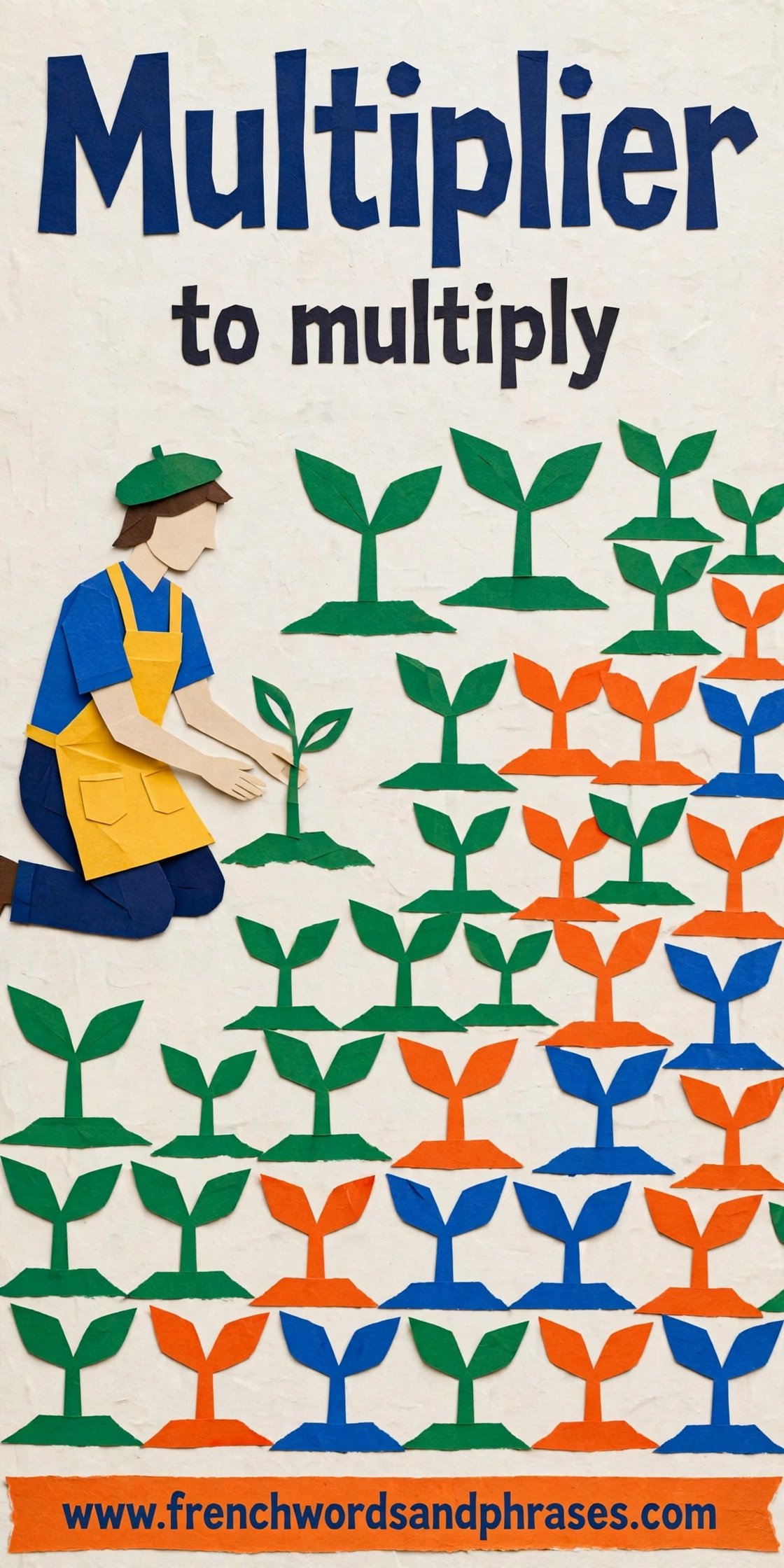
Multiplier means to multiply — in arithmetic, to grow a number by another number; and in life, to increase the number of things: efforts, visits, examples, chances.
A child chanting times tables at the kitchen table, a gardener turning one plant into ten by cuttings, a mayor opening new schools across a growing town — multiplier is the verb of increase: whatever it touches becomes more.
In this guide, you’ll learn how to conjugate multiplier in all the major French tenses and moods. Explore complete conjugation tables, French examples, English translations, and practice quizzes.
Understanding the French Verb Multiplier
Multiplier is a regular French verb belonging to the first group of verbs, those ending in-er.
It means to multiply. Beyond the classroom, multiplier is the verb of deliberate increase: multiplier les contrôles (to step up checks), multiplier les rencontres (to meet more and more often). Its reflexive twin se multiplier describes things increasing by themselves — les lapins se multiplient, rabbits multiply — and French newspapers love it for everything from bacteria to bicycle lanes.
Verb classification: First group (-er)
Auxiliary verb: Avoir
Past participle: multiplié
Present participle: multipliant
English equivalents: To multiply; multiplier six par sept — to multiply six by seven; multiplier les efforts — to multiply one’s efforts, to redouble them; multiplier les exemples — to give more and more examples; se multiplier — to multiply, to increase in number (rabbits, problems, bacteria).
One important detail: multiplier is an -ier verb, so watch the double i in the nous and vous forms of the imperfect and the present subjunctive: nous multipliions, vous multipliiez — two i’s in a row, one from the stem, one from the ending. The rest is regular: je multiplie, nous multiplions in the present, past participle multiplié. And the arithmetic frame is multiplier X par Y — six par sept, six times seven.
Experience the Word
Multiplier is the verb of more — the moment one becomes many by rule, by effort or by nature.
Imagine the primary-school classroom in October, the tables chanted like a football song: deux fois deux, quatre ; deux fois trois, six… The teacher taps the desk, thirty voices multiplient les nombres together, and by Christmas every child carries the whole multiplication table in their head like a song they cannot unlearn.
The chant fades, the skill stays. That is multiplier — increase you can count on.
How to Conjugate Multiplier: Complete French Conjugation Guide
Let’s explore every major conjugation of multiplier, beginning with the indicative mood.
How to Conjugate Multiplier in the Indicative Mood
The indicative mood is used to express facts, observations, actions, and events.
How to Conjugate Multiplier in the Present Tense (Présent)
Used for actions happening now, habitual actions, and general truths.
| Subject | Conjugation |
|---|---|
| je | multiplie |
| tu | multiplies |
| il / elle | multiplie |
| nous | multiplions |
| vous | multipliez |
| ils / elles | multiplient |
Example
Si tu multiplies six par sept, tu obtiens quarante-deux.
If you multiply six by seven, you get forty-two.
Quick Quiz 1
Complete the sentence:
Nous ______ les nombres par dix.
Reveal the answer
multiplions
Nous multiplions les nombres par dix.
We multiply the numbers by ten.
How to Conjugate Multiplier in the Passé Composé
Used for completed actions in the past. Multiplier takes the auxiliary verb avoir.
| Subject | Conjugation |
|---|---|
| j’ | ai multiplié |
| tu | as multiplié |
| il / elle | a multiplié |
| nous | avons multiplié |
| vous | avez multiplié |
| ils / elles | ont multiplié |
Example
Nous avons multiplié les efforts pour finir à temps.
We multiplied our efforts to finish on time.
How to Conjugate Multiplier in the Imparfait (Imperfect Tense)
Used for habitual past actions, descriptions, and ongoing situations in the past.
| Subject | Conjugation |
|---|---|
| je | multipliais |
| tu | multipliais |
| il / elle | multipliait |
| nous | multipliions |
| vous | multipliiez |
| ils / elles | multipliaient |
Example
Enfant, il multipliait les chiffres de tête sans erreur.
As a child, he multiplied numbers in his head without a mistake.
Quick Quiz 2
Choose the correct form:
We multiplied our efforts.
Nous ______ les efforts. (avons multiplié / sommes multipliés)
Reveal the answer
avons multiplié
Nous avons multiplié les efforts.
Multiplier takes avoir.
How to Conjugate Multiplier in the Plus-que-parfait
Used to describe an action that had already been completed before another past event.
| Subject | Conjugation |
|---|---|
| j’ | avais multiplié |
| tu | avais multiplié |
| il / elle | avait multiplié |
| nous | avions multiplié |
| vous | aviez multiplié |
| ils / elles | avaient multiplié |
Example
Elle avait multiplié les visites chez sa grand-mère avant l’hiver.
She had multiplied her visits to her grandmother before the winter.
How to Conjugate Multiplier in the Passé Simple
Primarily used in formal writing, literature, and historical narratives. It is rarely used in everyday conversation.
| Subject | Conjugation |
|---|---|
| je | multipliai |
| tu | multiplias |
| il / elle | multiplia |
| nous | multipliâmes |
| vous | multipliâtes |
| ils / elles | multiplièrent |
Example
Le jardinier multiplia les plantes par boutures.
The gardener multiplied the plants by cuttings.
How to Conjugate Multiplier in the Passé Antérieur
A literary tense used to express an action completed immediately before another past action, generally in the passé simple.
| Subject | Conjugation |
|---|---|
| j’ | eus multiplié |
| tu | eus multiplié |
| il / elle | eut multiplié |
| nous | eûmes multiplié |
| vous | eûtes multiplié |
| ils / elles | eurent multiplié |
Example
Quand il eut multiplié les preuves, le juge fut convaincu.
When he had multiplied the proofs, the judge was convinced.
How to Conjugate Multiplier in the Future Tense (Futur Simple)
Used to describe actions that will take place in the future.
| Subject | Conjugation |
|---|---|
| je | multiplierai |
| tu | multiplieras |
| il / elle | multipliera |
| nous | multiplierons |
| vous | multiplierez |
| ils / elles | multiplieront |
Example
Tu multiplieras trois par neuf pour vérifier.
You will multiply three by nine to check.
How to Conjugate Multiplier in the Futur Antérieur (Future Perfect)
Used for an action that will have been completed before a particular point in the future.
| Subject | Conjugation |
|---|---|
| j’ | aurai multiplié |
| tu | auras multiplié |
| il / elle | aura multiplié |
| nous | aurons multiplié |
| vous | aurez multiplié |
| ils / elles | auront multiplié |
Example
À la fin du cours, vous aurez multiplié des centaines de nombres.
By the end of the course, you will have multiplied hundreds of numbers.
How to Conjugate Multiplier in the Near Future (Futur Proche)
Used to describe something that is going to happen soon. Formed with aller + infinitive.
| Subject | Conjugation |
|---|---|
| je | vais multiplier |
| tu | vas multiplier |
| il / elle | va multiplier |
| nous | allons multiplier |
| vous | allez multiplier |
| ils / elles | vont multiplier |
Example
Je vais multiplier les exemples pour être plus clair.
I am going to multiply the examples to be clearer.
How to Conjugate Multiplier in the Conditional Mood
The conditional mood expresses what would happen under certain circumstances. It is also frequently used to make polite requests or express wishes.
How to Conjugate Multiplier in the Present Conditional
| Subject | Conjugation |
|---|---|
| je | multiplierais |
| tu | multiplierais |
| il / elle | multiplierait |
| nous | multiplierions |
| vous | multiplieriez |
| ils / elles | multiplieraient |
Example
Avec cette méthode, on multiplierait les résultats par deux.
With this method, we would multiply the results by two.
How to Conjugate Multiplier in the Past Conditional
| Subject | Conjugation |
|---|---|
| j’ | aurais multiplié |
| tu | aurais multiplié |
| il / elle | aurait multiplié |
| nous | aurions multiplié |
| vous | auriez multiplié |
| ils / elles | auraient multiplié |
Example
Sans calculatrice, ils auraient multiplié les erreurs.
Without a calculator, they would have multiplied the mistakes.
Multiplier in the Literary Past Conditional Form
This less common literary form uses the imperfect subjunctive of avoir.
| Subject | Conjugation |
|---|---|
| j’ | eusse multiplié |
| tu | eusses multiplié |
| il / elle | eût multiplié |
| nous | eussions multiplié |
| vous | eussiez multiplié |
| ils / elles | eussent multiplié |
Example
Le fermier eût multiplié ses champs sans la sécheresse.
The farmer would have multiplied his fields, had it not been for the drought.
How to Conjugate Multiplier in the Subjunctive Mood
The subjunctive is used to express wishes, emotions, doubts, necessity, and uncertainty. It frequently follows expressions such as il faut que (it is necessary that) or bien que (although).
How to Conjugate Multiplier in the Present Subjunctive
| Subject | Conjugation |
|---|---|
| que je | multiplie |
| que tu | multiplies |
| qu’il / qu’elle | multiplie |
| que nous | multipliions |
| que vous | multipliiez |
| qu’ils / qu’elles | multiplient |
Example
Il faut que tu multiplies par dix, pas par deux.
You must multiply by ten, not by two.
Quick Quiz 3
Complete the sentence using the subjunctive:
Le professeur exigeait que nous ______ sans calculatrice.
Reveal the answer
multipliions
Le professeur exigeait que nous multipliions sans calculatrice.
The double i of the -ier verbs: multipliions.
How to Conjugate Multiplier in the Imperfect Subjunctive
A literary tense, rarely encountered in modern spoken French.
| Subject | Conjugation |
|---|---|
| que je | multipliasse |
| que tu | multipliasses |
| qu’il / qu’elle | multipliât |
| que nous | multipliassions |
| que vous | multipliassiez |
| qu’ils / qu’elles | multipliassent |
Example
Le professeur exigeait que nous multipliions sans calculatrice.
The teacher required us to multiply without a calculator.
How to Conjugate Multiplier in the Pluperfect Subjunctive
A literary construction used to express an action completed before another past action.
| Subject | Conjugation |
|---|---|
| que j’ | eusse multiplié |
| que tu | eusses multiplié |
| qu’il / qu’elle | eût multiplié |
| que nous | eussions multiplié |
| que vous | eussiez multiplié |
| qu’ils / qu’elles | eussent multiplié |
Example
On doutait qu’il eût multiplié les chiffres si vite.
People doubted he had multiplied the figures so quickly.
How to Conjugate Multiplier in the Past Subjunctive
| Subject | Conjugation |
|---|---|
| que j’ | aie multiplié |
| que tu | aies multiplié |
| qu’il / qu’elle | ait multiplié |
| que nous | ayons multiplié |
| que vous | ayez multiplié |
| qu’ils / qu’elles | aient multiplié |
Example
Je suis content que vous ayez multiplié les occasions de parler français.
I am glad you multiplied the opportunities to speak French.
How to Conjugate Multiplier in the Imperative
The imperative is used to give commands, instructions, invitations, or suggestions. Subject pronouns are omitted.
How to Conjugate Multiplier in the Present Imperative
| Person | Conjugation |
|---|---|
| (tu) | multiplie |
| (nous) | multiplions |
| (vous) | multipliez |
Example
Multiplie par cent pour passer en centimètres !
Multiply by a hundred to convert to centimetres!
Quick Quiz 4
How would you say Multiply by ten (tu form)?
Reveal the answer
Multiplie par dix !
French Participles of Multiplier
Participles are verb forms that can be used in compound tenses and other grammatical constructions.
Present Participle of Multiplier
multipliant
En multipliant les exemples, le professeur rend la règle évidente.
By multiplying the examples, the teacher makes the rule obvious.
Past Participle of Multiplier
multiplié
Multipliés par mille, ces petits gains deviennent une fortune.
Multiplied by a thousand, these small gains become a fortune.
Multiplier in Everyday French: Real-Life Examples
Now that you know the conjugations, let’s see how multiplier appears in everyday French.
Example 1 — Present
Si tu multiplies six par sept, tu obtiens quarante-deux.
If you multiply six by seven, you get forty-two.
Example 2 — Passé composé
Nous avons multiplié les efforts pour finir à temps.
We multiplied our efforts to finish on time.
Example 3 — Imparfait
Il multipliait les chiffres de tête sans erreur.
He multiplied numbers in his head without a mistake.
Example 4 — Future
Tu multiplieras trois par neuf pour vérifier.
You will multiply three by nine to check.
Example 5 — Conditional
On multiplierait les résultats par deux avec cette méthode.
We would multiply the results by two with this method.
Example 6 — Imperative
Multiplie par dix, pas par deux !
Multiply by ten, not by two!
Beyond Translation: The Meaning of Multiplier
Multiplier carries the whole optimism of arithmetic: nothing is only itself, everything can become more. Latin multiplicare — to make many folds, multus plus plicare — already joined the number to the gesture of folding one thing into many.
To multiply is to refuse the single.
French hears the word everywhere increase is willed or feared: efforts and examples we multiply on purpose, rabbits and rumours that multiply themselves. Learn the double i of nous multipliions and you own the verb in every tense.
How to Remember the French Verb Multiplier
Remember it this way: Multiplier is about the classroom chanting its times tables, turning one number into many.
- Arithmetic frame: multiplier X par Y — multiplier six par sept, six times seven.
- The -ier double i: nous multipliions, vous multipliiez in the imperfect and subjunctive.
- Regular -er with avoir: je multiplie, nous multiplions, past participle multiplié; se multiplier for things that increase by themselves.
The key idea is the classroom chanting its times tables, turning one number into many.
Test Your Knowledge of Multiplier
Let’s see how much you’ve learned. Try answering these questions before revealing the answers.
Question 1
How do you say to multiply six by seven in French?
Reveal the answer
Multiplier six par sept.
Question 2
Why does nous multipliions have two i’s?
Reveal the answer
Multiplier is an -ier verb — the stem’s i meets the ending’s i in the nous and vous forms of the imperfect and subjunctive.
Question 3
Translate: We multiplied our efforts to finish on time.
Reveal the answer
Nous avons multiplié les efforts pour finir à temps.
Question 4
What is the past participle of multiplier?
Reveal the answer
Multiplié.
Question 5
Complete the sentence:
Il faut que tu ______ par dix, pas par deux.
Reveal the answer
multiplies
Il faut que tu multiplies par dix, pas par deux.
You must multiply by ten, not by two.
Your Final Challenge
Can You Use It?
How would you say this in French?
By multiplying examples and efforts, we also multiply the chances of success.
Reveal the answer
En multipliant les exemples et les efforts, on multiplie aussi les chances de réussir.
By multiplying examples and efforts, we also multiply the chances of success.
A little French. A little curiosity. A richer everyday life.
LEARN FRENCH ONE WORD AT A TIME




