A French Word to Live By
How to Conjugate Carreler in French
/kaʁ.le/
Carreler means to tile, to pave — to cover a floor or a wall with carreaux, square tiles laid in neat rows until the whole surface shines.
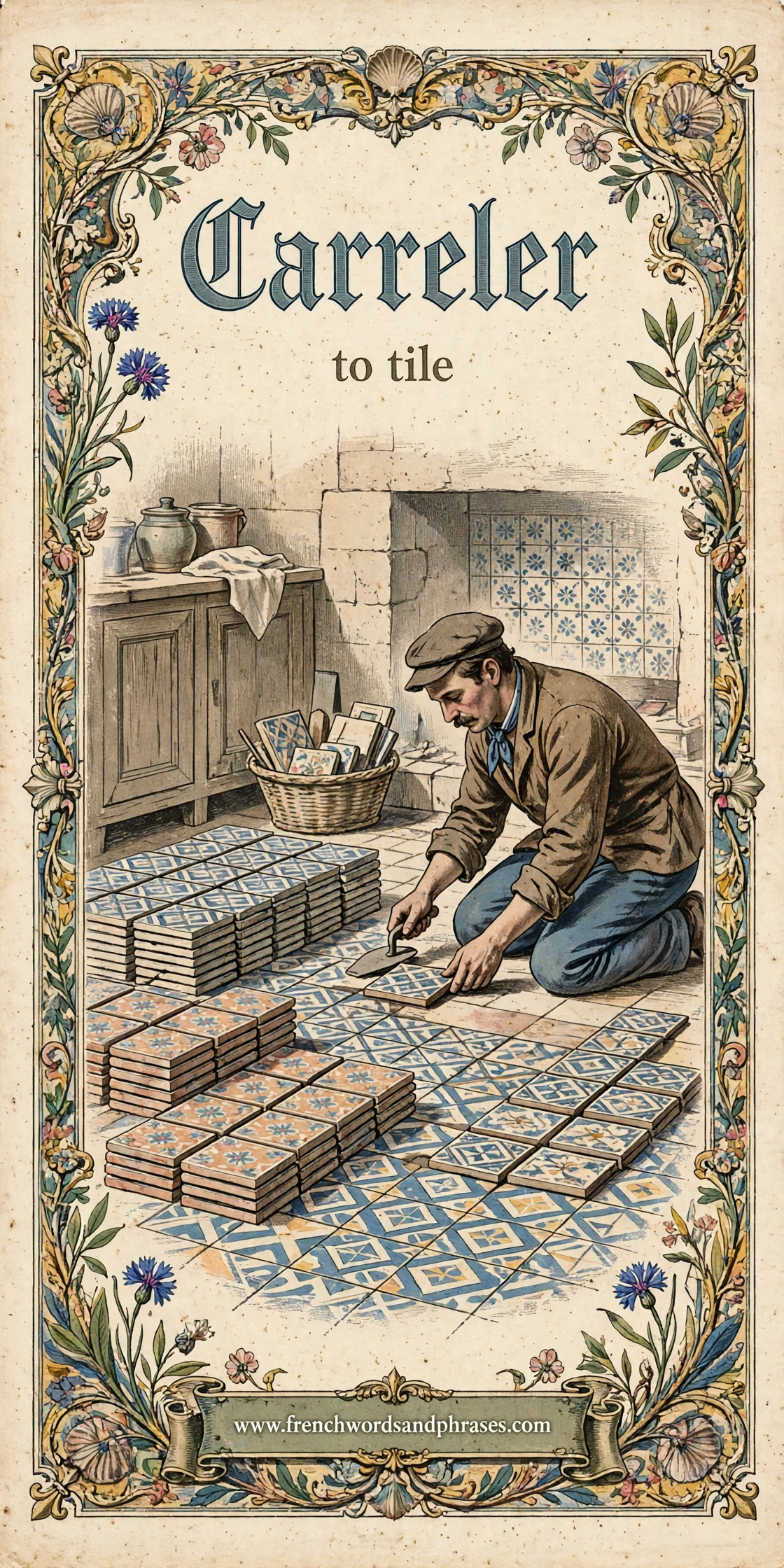
A tiler on his knees in a new bathroom, a bucket of cement at his side and a line of white squares growing across the floor — carreler is the builder’s verb for covering the world, tile by tile, in cool, washable order.
In this guide, you’ll learn how to conjugate carreler in all the major French tenses and moods. Explore complete conjugation tables, French examples, English translations, and practice quizzes.
Understanding the French Verb Carreler
Carreler is a regular French verb belonging to the first group of verbs, those ending in-er.
It means to tile, to pave. It covers floors and walls alike — kitchens, bathrooms, terraces, station halls — and its product, le carrelage, is the word for tiling as a surface and a trade. The professional is un carreleur, and the work is prized in French homes: cool in summer, easy to wash, and laid to outlast its layer.
Verb classification: First group (-er)
Auxiliary verb: Avoir
Past participle: carrelé
Present participle: carrelant
English equivalents: To tile, to pave with tiles; carreler une cuisine — to tile a kitchen; carreler une salle de bains — to tile a bathroom; carreler un sol — to tile a floor; un carreleur — a tiler; le carrelage — the tiling, the tiles themselves.
One important detail: carreler is an appeler-type verb — the l of the stem doubles wherever the next syllable is a mute e: in the present singular and third plural, the subjunctive singular and third plural, the tu imperative, and throughout the future and conditional: je carrelle, tu carrelles, ils carrellent, je carrellerai. Where the ending is sounded, the l stays single: nous carrelons, vous carrelez, je carrelais, and in the infinitive and participle, carreler, carrelé. The squares themselves are les carreaux — the same carreau that names a window pane and the diamonds of a card suit.
Experience the Word
Carreler is the verb of the growing grid — square after square, until bare concrete becomes a floor.
Imagine a tiler at dawn in an empty flat. He chalks his lines, spreads his cement, and carrele le sol de la cuisine — each tile tapped level, each joint true — and by evening the room stands on a chessboard of cool white squares.
The kitchen exists now, before a single cupboard arrives. It has been tiled — carrelée, square by patient square.
How to Conjugate Carreler: Complete French Conjugation Guide
Let’s explore every major conjugation of carreler, beginning with the indicative mood.
How to Conjugate Carreler in the Indicative Mood
The indicative mood is used to express facts, observations, actions, and events.
How to Conjugate Carreler in the Present Tense (Présent)
Used for actions happening now, habitual actions, and general truths.
| Subject | Conjugation |
|---|---|
| je | carrelle |
| tu | carrelles |
| il / elle | carrelle |
| nous | carrelons |
| vous | carrelez |
| ils / elles | carrellent |
Example
Le carreleur carrelle la salle de bains aujourd’hui.
The tiler is tiling the bathroom today.
Quick Quiz 1
Complete the sentence:
Nous ______ la terrasse ce week-end.
Reveal the answer
carrelons
Nous carrelons la terrasse ce week-end.
We are tiling the terrace this weekend.
How to Conjugate Carreler in the Passé Composé
Used for completed actions in the past. Carreler takes the auxiliary verb avoir.
| Subject | Conjugation |
|---|---|
| j’ | ai carrelé |
| tu | as carrelé |
| il / elle | a carrelé |
| nous | avons carrelé |
| vous | avez carrelé |
| ils / elles | ont carrelé |
Example
Nous avons carrelé toute la cuisine le week-end dernier.
We tiled the whole kitchen last weekend.
How to Conjugate Carreler in the Imparfait (Imperfect Tense)
Used for habitual past actions, descriptions, and ongoing situations in the past.
| Subject | Conjugation |
|---|---|
| je | carrelais |
| tu | carrelais |
| il / elle | carrelait |
| nous | carrelions |
| vous | carreliez |
| ils / elles | carrelaient |
Example
Autrefois, les artisans carrelaient les cours des fermes.
In the old days, craftsmen used to pave farmyards with tiles.
Quick Quiz 2
Choose the correct form:
Tomorrow, I will tile the shower wall.
Demain, je ______ le mur de la douche. (carrellerai / carrelerai)
Reveal the answer
carrellerai
Demain, je carrellerai le mur de la douche.
The future doubles the l, like appeler: je carrellerai.
How to Conjugate Carreler in the Plus-que-parfait
Used to describe an action that had already been completed before another past event.
| Subject | Conjugation |
|---|---|
| j’ | avais carrelé |
| tu | avais carrelé |
| il / elle | avait carrelé |
| nous | avions carrelé |
| vous | aviez carrelé |
| ils / elles | avaient carrelé |
Example
Elle avait carrelé la terrasse avant l’arrivée des invités.
She had tiled the terrace before the guests arrived.
How to Conjugate Carreler in the Passé Simple
Primarily used in formal writing, literature, and historical narratives. It is rarely used in everyday conversation.
| Subject | Conjugation |
|---|---|
| je | carrelai |
| tu | carrelas |
| il / elle | carrela |
| nous | carrelâmes |
| vous | carrelâtes |
| ils / elles | carrelèrent |
Example
En une semaine, l’ouvrier carrela tout le rez-de-chaussée.
In one week, the workman tiled the whole ground floor.
How to Conjugate Carreler in the Passé Antérieur
A literary tense used to express an action completed immediately before another past action, generally in the passé simple.
| Subject | Conjugation |
|---|---|
| j’ | eus carrelé |
| tu | eus carrelé |
| il / elle | eut carrelé |
| nous | eûmes carrelé |
| vous | eûtes carrelé |
| ils / elles | eurent carrelé |
Example
Quand ils eurent carrelé le sol, ils posèrent les meubles.
When they had tiled the floor, they put the furniture in.
How to Conjugate Carreler in the Future Tense (Futur Simple)
Used to describe actions that will take place in the future.
| Subject | Conjugation |
|---|---|
| je | carrellerai |
| tu | carrelleras |
| il / elle | carrellera |
| nous | carrellerons |
| vous | carrellerez |
| ils / elles | carrelleront |
Example
Demain, je carrellerai le mur de la douche.
Tomorrow, I will tile the shower wall.
How to Conjugate Carreler in the Futur Antérieur (Future Perfect)
Used for an action that will have been completed before a particular point in the future.
| Subject | Conjugation |
|---|---|
| j’ | aurai carrelé |
| tu | auras carrelé |
| il / elle | aura carrelé |
| nous | aurons carrelé |
| vous | aurez carrelé |
| ils / elles | auront carrelé |
Example
À la fin du mois, vous aurez carrelé les trois pièces.
By the end of the month, you will have tiled all three rooms.
How to Conjugate Carreler in the Near Future (Futur Proche)
Used to describe something that is going to happen soon. Formed with aller + infinitive.
| Subject | Conjugation |
|---|---|
| je | vais carreler |
| tu | vas carreler |
| il / elle | va carreler |
| nous | allons carreler |
| vous | allez carreler |
| ils / elles | vont carreler |
Example
Ce week-end, on va carreler la cuisine.
This weekend, we are going to tile the kitchen.
How to Conjugate Carreler in the Conditional Mood
The conditional mood expresses what would happen under certain circumstances. It is also frequently used to make polite requests or express wishes.
How to Conjugate Carreler in the Present Conditional
| Subject | Conjugation |
|---|---|
| je | carrellerais |
| tu | carrellerais |
| il / elle | carrellerait |
| nous | carrellerions |
| vous | carrelleriez |
| ils / elles | carrelleraient |
Example
Avec de plus grands carreaux, je carrellerais plus vite.
With bigger tiles, I would tile faster.
How to Conjugate Carreler in the Past Conditional
| Subject | Conjugation |
|---|---|
| j’ | aurais carrelé |
| tu | aurais carrelé |
| il / elle | aurait carrelé |
| nous | aurions carrelé |
| vous | auriez carrelé |
| ils / elles | auraient carrelé |
Example
Ils auraient carrelé la terrasse si la pluie ne les avait pas arrêtés.
They would have tiled the terrace if the rain had not stopped them.
Carreler in the Literary Past Conditional Form
This less common literary form uses the imperfect subjunctive of avoir.
| Subject | Conjugation |
|---|---|
| j’ | eusse carrelé |
| tu | eusses carrelé |
| il / elle | eût carrelé |
| nous | eussions carrelé |
| vous | eussiez carrelé |
| ils / elles | eussent carrelé |
Example
L’artisan eût carrelé la cour en une saison.
The craftsman would have paved the courtyard in one season.
How to Conjugate Carreler in the Subjunctive Mood
The subjunctive is used to express wishes, emotions, doubts, necessity, and uncertainty. It frequently follows expressions such as il faut que (it is necessary that) or bien que (although).
How to Conjugate Carreler in the Present Subjunctive
| Subject | Conjugation |
|---|---|
| que je | carrelle |
| que tu | carrelles |
| qu’il / qu’elle | carrelle |
| que nous | carrelions |
| que vous | carreliez |
| qu’ils / qu’elles | carrellent |
Example
Il faut que tu carrelles ce mur avant de peindre.
You must tile this wall before painting.
Quick Quiz 3
Complete the sentence using the subjunctive:
Il faut que vous ______ aussi l’entrée.
Reveal the answer
carreliez
Il faut que vous carreliez aussi l’entrée.
You must tile the hall as well.
How to Conjugate Carreler in the Imperfect Subjunctive
A literary tense, rarely encountered in modern spoken French.
| Subject | Conjugation |
|---|---|
| que je | carrelasse |
| que tu | carrelasses |
| qu’il / qu’elle | carrelât |
| que nous | carrelassions |
| que vous | carrelassiez |
| qu’ils / qu’elles | carrelassent |
Example
Le client souhaitait que l’on carrelât aussi l’entrée.
The client wished the hall to be tiled too.
How to Conjugate Carreler in the Pluperfect Subjunctive
A literary construction used to express an action completed before another past action.
| Subject | Conjugation |
|---|---|
| que j’ | eusse carrelé |
| que tu | eusses carrelé |
| qu’il / qu’elle | eût carrelé |
| nous | eussions carrelé |
| que vous | eussiez carrelé |
| qu’ils / qu’elles | eussent carrelé |
Example
On racontait que les Romains eussent carrelé leurs thermes de marbre.
People said the Romans had paved their baths with marble.
How to Conjugate Carreler in the Past Subjunctive
| Subject | Conjugation |
|---|---|
| que j’ | aie carrelé |
| que tu | aies carrelé |
| qu’il / qu’elle | ait carrelé |
| que nous | ayons carrelé |
| que vous | ayez carrelé |
| qu’ils / qu’elles | aient carrelé |
Example
Je suis content que vous ayez carrelé la salle de bains.
I am glad you tiled the bathroom.
How to Conjugate Carreler in the Imperative
The imperative is used to give commands, instructions, invitations, or suggestions. Subject pronouns are omitted.
How to Conjugate Carreler in the Present Imperative
| Person | Conjugation |
|---|---|
| (tu) | carrelle |
| (nous) | carrelons |
| (vous) | carrelez |
Example
Carrelle le sol de l’entrée d’abord !
Tile the hall floor first!
Quick Quiz 4
How would you say Tile the floor (tu form)?
Reveal the answer
Carrelle le sol !
French Participles of Carreler
Participles are verb forms that can be used in compound tenses and other grammatical constructions.
Present Participle of Carreler
carrelant
En carrelant la cuisine, il a découvert d’anciennes tuiles.
While tiling the kitchen, he discovered old tiles underneath.
Past Participle of Carreler
carrelé
Carrelée de blanc, la pièce semblait deux fois plus grande.
Tiled in white, the room seemed twice as big.
Carreler in Everyday French: Real-Life Examples
Now that you know the conjugations, let’s see how carreler appears in everyday French.
Example 1 — Present
Le carreleur carrelle la salle de bains.
The tiler is tiling the bathroom.
Example 2 — Passé composé
Nous avons carrelé la cuisine.
We tiled the kitchen.
Example 3 — Imparfait
Les artisans carrelaient les cours des fermes.
Craftsmen used to pave farmyards.
Example 4 — Future
Je carrellerai le mur de la douche.
I will tile the shower wall.
Example 5 — Conditional
Je carrellerais plus vite avec de grands carreaux.
I would tile faster with big tiles.
Example 6 — Imperative
Carrelle le sol de l’entrée d’abord !
Tile the hall floor first!
Beyond Translation: The Meaning of Carreler
English tile names the square; French carreler names the geometry — un carreau is a square, and the verb lays the world out in squares.
The same carreau is everywhere.
A window pane, a checked pattern, the diamond suit at cards — French sees carreaux wherever squares repeat, and carreler is the workhorse verb that turns them into floors, walls and cool Mediterranean terraces.
How to Remember the French Verb Carreler
Remember it this way: Carreler is about the tiler’s growing chessboard — squares doubling the l as they go.
- Appeler-type doubling: je carrelle with ll in the present, but je carrellerai too — the future doubles as well.
- Single l where the ending sounds: nous carrelons, vous carrelez, je carrelais.
- The family: un carreau (a tile), le carrelage (the tiling), un carreleur (the tiler).
The key idea is the tiler’s growing chessboard — squares doubling the l as they go.
Test Your Knowledge of Carreler
Let’s see how much you’ve learned. Try answering these questions before revealing the answers.
Question 1
Why is it je carrelle but nous carrelons?
Reveal the answer
The appeler-type rule — the l doubles before a mute e (je carrelle, je carrellerai) and stays single before a sounded ending (nous carrelons).
Question 2
How do you say The tiler is tiling the bathroom in French?
Reveal the answer
Le carreleur carrelle la salle de bains.
Question 3
Translate: We tiled the whole kitchen.
Reveal the answer
Nous avons carrelé toute la cuisine.
Question 4
What is the past participle of carreler?
Reveal the answer
Carrelé.
Question 5
Complete the sentence:
Il faut que tu ______ ce mur avant de peindre.
Reveal the answer
carrelles
Il faut que tu carrelles ce mur avant de peindre.
You must tile this wall before painting.
Your Final Challenge
Can You Use It?
How would you say this in French?
The tiler tiles the kitchen from morning to evening, and by evening the room shines like a new chessboard.
Reveal the answer
Le carreleur carrelle la cuisine du matin au soir, et le soir, la pièce brille comme un échiquier neuf.
The tiler tiles the kitchen from morning to evening, and by evening the room shines like a new chessboard.
A little French. A little curiosity. A richer everyday life.
LEARN FRENCH ONE WORD AT A TIME