A French Word to Live By
Translate Chèvre to English
/ʃɛvʁ/
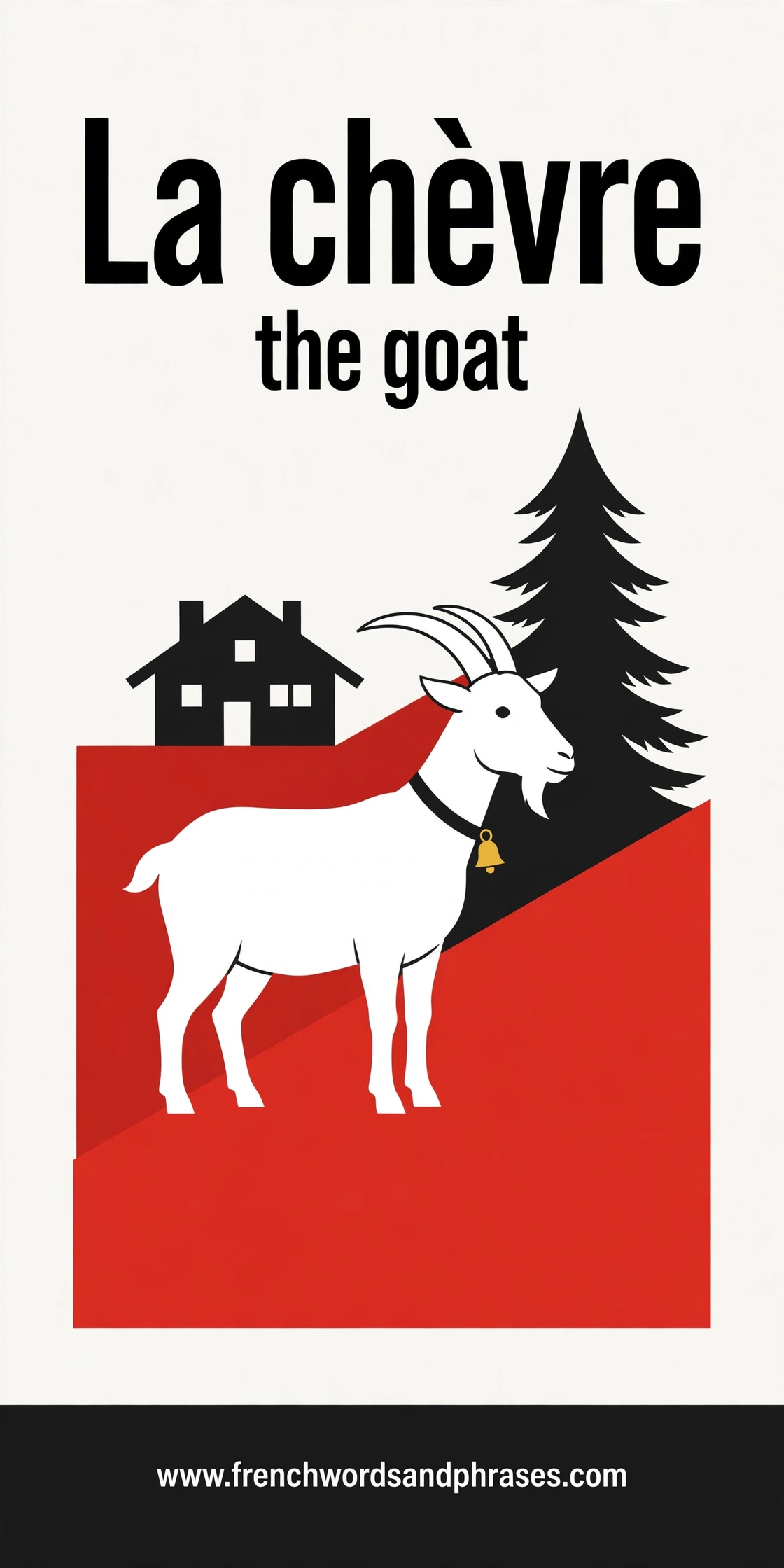
La chèvre means the goat.
Sure-footed on the steepest rock, beard wagging, eyes full of mischief: la chèvre, the goat — the mountain’s acrobat, the farm’s comedian, and the maker of France’s most beloved cheeses.
In this guide, you’ll learn what chèvre means in English, how to use it with its articles, how to form its plural, and how it appears in everyday French. Explore French examples, English translations, and practice quizzes.
Understanding the French Noun Chèvre
Chèvre is a feminine French noun, learned with its article: la chèvre, une chèvre. It comes from the Latin capra, the she-goat. The word leads a famous double life in France: at the market, un chèvre — masculine, and usually warm, un chèvre chaud — is a goat’s cheese, one of the glories of the French table. The animal is feminine; the cheese is masculine; context and the article keep them apart.
It means a goat — the female goat, sure-footed climber of mountains and stepladders: une chèvre de montagne, a mountain goat, le lait de chèvre, goat’s milk, un troupeau de chèvres, a herd of goats. The male is le bouc, the young one is le chevreau — which is also, tender and roasted, a dish. And every French child knows la chèvre de Monsieur Seguin, the little goat of the famous tale who wanted freedom more than safety.
Gender: Feminine — la chèvre
Definite article: la — la chèvre (the goat)
Indefinite article: une — une chèvre (a goat)
Plural: les chèvres — regular, with a simple -s
Spelling note: from Latin capra — and the grave accent è marks the open sound
Double life: un chèvre (masculine) is a goat’s cheese: un chèvre chaud, a warm goat’s cheese
English equivalents: The goat.
Keep the two chèvres apart by their articles: la chèvre climbs the mountain, un chèvre arrives on your salad, warm, on a slice of toast — une salade au chèvre chaud is a classic of every bistro menu. Goat’s milk is le lait de chèvre, and the cheese family is huge: frais, sec, cendré — fresh, dry, ash-covered.
Experience the Word
Chèvre is independence on four hooves: the animal that climbs where sheep would not dream, and looks down at the valley like it owns it.
Imagine the mountain farm at dawn — the goats pouring out of the barn in a white and brown river, bells ringing, heading for the high grass while the cheese of next month begins as milk.
You have not just named an animal. You have named the climber and the cheese at once — la chèvre, the goat, France’s mountain dairymaid.
How to Use Chèvre in French: Complete Guide
Let’s explore how chèvre works in French, beginning with its articles — la chèvre, une chèvre, le lait de chèvre.
Chèvre with the Definite Article (La, Les)
Used for a specific goat — the one on the rock, the one that escaped again.
| Form | French |
|---|---|
| Feminine singular | la chèvre |
| Plural | les chèvres |
Example
La chèvre grimpe sur le rocher sans effort.
The goat climbs onto the rock effortlessly.
Chèvre with the Indefinite Article (Une, Des)
Used for a goat in general — one animal of the herd.
| Form | French |
|---|---|
| Feminine singular | une chèvre |
| Plural | des chèvres |
Example
Une chèvre broute près de la clôture.
A goat is grazing near the fence.
Kinds of Chèvre (De montagne, le fromage…)
The word covers the animal, its milk and its famous cheese — the kinds to know.
| Kind | French |
|---|---|
| a mountain goat | une chèvre de montagne |
| a herd of goats | un troupeau de chèvres |
| goat’s milk | le lait de chèvre |
| a goat’s cheese | un chèvre (fromage de chèvre) |
| a warm goat’s cheese | un chèvre chaud |
Example
La salade au chèvre chaud est ma préférée.
The warm goat’s cheese salad is my favourite.
Quick Quiz 1
Complete the sentence:
______ chèvre de Monsieur Seguin voulait être libre. (the)
Reveal the answer
La
La chèvre de Monsieur Seguin voulait être libre.
Monsieur Seguin’s goat wanted to be free — chèvre is feminine, so la.
The Plural of Chèvre
Chèvre takes a regular plural in -s — goats travel in herds, bells ringing.
| Number | French |
|---|---|
| Singular | la chèvre |
| Plural | les chèvres |
Example
Les chèvres descendent de la montagne le soir.
The goats come down from the mountain in the evening.
Chèvre with Possessive Adjectives (Ma, Ta, Sa…)
Possessives agree with the noun: chèvre is feminine, so ma, ta, sa in the singular.
| Owner | French |
|---|---|
| my | ma chèvre |
| your (tu) | ta chèvre |
| his / her | sa chèvre |
| our | notre chèvre |
| your (vous) | votre chèvre |
| their | leur chèvre |
Example
Le fermier appelle sa chèvre préférée Blanchette.
The farmer calls his favourite goat Blanchette.
Quick Quiz 2
Complete the sentence:
Elle donne du lait de ______ chèvre aux enfants. (her)
Reveal the answer
sa
Elle donne du lait de sa chèvre aux enfants.
She gives the children milk from her goat — sa, because chèvre is feminine.
Chèvre with Demonstrative Adjectives (Cette, Ces)
Used to point: cette chèvre, this goat — usually the one on the roof of the shed.
| Form | French |
|---|---|
| Feminine singular | cette chèvre |
| Plural | ces chèvres |
Example
Cette chèvre grimpe partout, même sur les voitures.
This goat climbs everywhere, even onto cars.
Chèvre with Adjectives
Adjectives agree with chèvre — feminine singular: une chèvre blanche, une petite chèvre.
| Adjective | With Chèvre |
|---|---|
| blanche (white) | une chèvre blanche |
| petite (small) | une petite chèvre |
| têtue (stubborn) | une chèvre têtue |
| sauvage (wild) | une chèvre sauvage |
| jeune (young) | une jeune chèvre |
Example
Une chèvre têtue refuse de rentrer à l’étable.
A stubborn goat refuses to go back into the barn.
Quick Quiz 3
Complete the sentence:
C’est une chèvre très ______, elle grimpe sur tous les rochers. (stubborn)
Reveal the answer
têtue
C’est une chèvre très têtue, elle grimpe sur tous les rochers.
She’s a very stubborn goat, she climbs on all the rocks — têtue, feminine, to agree with chèvre.
Everyday Expressions with Chèvre
Farms, tales and bistro salads — the chèvre phrases of daily life.
| Expression | In English |
|---|---|
| le lait de chèvre | goat’s milk |
| un chèvre chaud | a warm goat’s cheese (on toast, in a salad) |
| un fromage de chèvre | a goat’s cheese |
| la chèvre de Monsieur Seguin | Monsieur Seguin’s goat — the famous tale |
| un troupeau de chèvres | a herd of goats |
Example
Je commande une salade au chèvre chaud.
I’ll order a warm goat’s cheese salad.
Words from the Same Family as Chèvre
Goats and their world — the words that travel with chèvre.
| French | In English |
|---|---|
| le bouc | the billy goat — the male |
| le chevreau | the kid — the young goat |
| le fromage | the cheese |
| grimper | to climb (the verb) |
| la montagne | the mountain — the goat’s kingdom |
Example
Le chevreau reste près de sa mère, la chèvre.
The kid stays near its mother, the goat.
Quick Quiz 4
What is un chèvre chaud?
Reveal the answer
A warm goat’s cheese — served on toast, usually in a salad; here chèvre is the cheese, masculine.
La salade au chèvre chaud arrive.
The warm goat’s cheese salad is coming.
Chèvre in Everyday French: Real-Life Examples
Now that you know the word, let’s see how chèvre appears in everyday French.
Example 1 — On the farm
La chèvre donne du lait tous les matins.
The goat gives milk every morning.
Example 2 — Climbing
Regarde, la chèvre est sur le rocher.
Look, the goat is on the rock.
Example 3 — At the bistro
Une salade au chèvre chaud, s’il vous plaît.
A warm goat’s cheese salad, please.
Example 4 — The herd
Les chèvres rentrent à la ferme le soir.
The goats come back to the farm in the evening.
Example 5 — The tale
Les enfants écoutent l’histoire de la chèvre de Monsieur Seguin.
The children listen to the story of Monsieur Seguin’s goat.
Example 6 — Stubborn
Cette chèvre têtue ne veut pas bouger.
This stubborn goat won’t move.
Beyond Translation: The Meaning of Chèvre
La chèvre carries two of France’s treasures in one word: the animal that turns steep, poor land into milk, and the cheese that milk becomes — frais, sec, cendré, chaud — a whole shelf of the fromagerie. Literature took her too: Daudet’s little goat of Monsieur Seguin, who traded safety for one night of freedom in the mountains, is the story every French child hears about liberty and its price. Between the tale and the cheese board, the goat is woven into the country’s imagination.
To say chèvre is to name the climber, the milk and the cheese in a single breath.
It evokes the ringing bells of the herd, the high pastures and the warm cheese on toast — mountain France, served.
How to Remember the French Noun Chèvre
Remember it this way: Chèvre is the goat — feminine: la chèvre. And remember the cheese: un chèvre chaud, masculine, is a warm goat’s cheese.
- Always feminine for the animal — la chèvre, une chèvre, ma chèvre.
- The double life — un chèvre (masculine) is the cheese, not the animal.
- The family — le bouc is the male, le chevreau the kid.
The key idea is la chèvre — the goat, feminine; un chèvre = a goat’s cheese.
Test Your Knowledge of Chèvre
Let’s see how much you’ve learned. Try answering these questions before revealing the answers.
Question 1
Is chèvre masculine or feminine?
Reveal the answer
Feminine — la chèvre, une chèvre.
Question 2
How do you say goat’s milk?
Reveal the answer
Le lait de chèvre.
Question 3
Translate: The goat climbs onto the rock.
Reveal the answer
La chèvre grimpe sur le rocher.
Question 4
What is un chèvre chaud?
Reveal the answer
A warm goat’s cheese — the cheese sense of chèvre, masculine, served on toast in a salad.
Question 5
Complete the sentence:
______ chèvres descendent de la montagne. (the)
Reveal the answer
Les
Les chèvres descendent de la montagne.
The goats come down from the mountain.
Your Final Challenge
Can You Use It?
How would you say this in French?
“The goat climbs onto the rock effortlessly.”
Reveal the answer
La chèvre grimpe sur le rocher sans effort.
The goat climbs onto the rock effortlessly.
A little French. A little curiosity. A richer everyday life.
LEARN FRENCH ONE WORD AT A TIME