
A French Word to Live By
How to Conjugate Cailler in French
/ka.je/
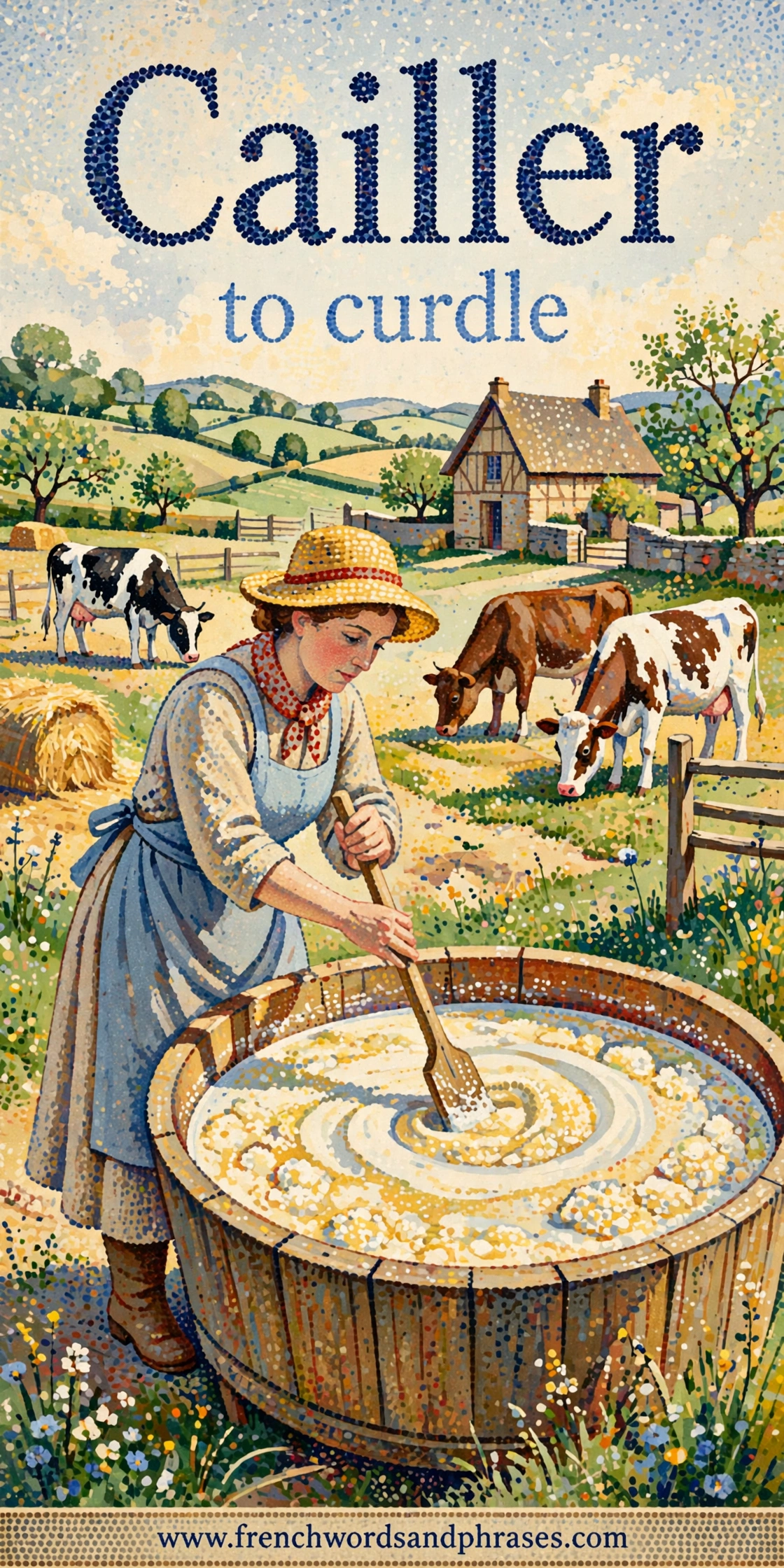
Cailler means to curdle, to clot, to coagulate — what milk does on its way to cheese, and what blood does when it sets over a wound.
Rennet drops into warm milk and the white sea begins to set; a cut finger stops bleeding as the blood thickens — cailler is the quiet chemistry verb of liquids becoming solid, in the dairy and in the body alike.
In this guide, you’ll learn how to conjugate cailler in all the major French tenses and moods. Explore complete conjugation tables, French examples, English translations, and practice quizzes.
Understanding the French Verb Cailler
Cailler is a regular French verb belonging to the first group of verbs, those ending in-er.
It means to curdle, to clot, to coagulate. It governs two kitchens of nature: the dairy (milk curdling into cheese) and the body (blood clotting, le sang caille or se caille). The transitive use, cailler le lait, belongs to cheesemakers; the intransitive, le lait caille, is what every cook fears in a sauce and hopes for in a cheese.
Verb classification: First group (-er)
Auxiliary verb: Avoir
Past participle: caillé
Present participle: caillant
English equivalents: To curdle, to clot, to coagulate; faire cailler le lait — to curdle the milk; le lait caille — the milk curdles; le sang caille — the blood clots; du lait caillé — curds, curdled milk.
One important detail: cailler is a plain regular -er verb — je caille, nous caillons, past participle caillé — and its past participle lives a second life as a noun and adjective: le caillé is curds, and du lait caillé is curdled milk, eaten as a dessert in many regions. The cheesemaker’s phrase is faire cailler le lait, with rennet, la présure. Keep it apart from its reflexive cousin se cailler, which in familiar French means to be freezing cold.
Experience the Word
Cailler is the verb of the great thickening — the moment a liquid stops flowing and starts holding its shape.
Imagine a mountain fromagerie at five in the morning. The cheesemaker stirs a few drops of rennet into a copper vat of warm milk, folds his arms, and waits. Une heure plus tard, le lait a caillé — he can cut the curd with a long knife, and the day’s tommes are already on their way.
Nothing was cooked, nothing was forced. The milk simply curdled — caillé, at the rennet’s quiet command.
How to Conjugate Cailler: Complete French Conjugation Guide
Let’s explore every major conjugation of cailler, beginning with the indicative mood.
How to Conjugate Cailler in the Indicative Mood
The indicative mood is used to express facts, observations, actions, and events.
How to Conjugate Cailler in the Present Tense (Présent)
Used for actions happening now, habitual actions, and general truths.
| Subject | Conjugation |
|---|---|
| je | caille |
| tu | cailles |
| il / elle | caille |
| nous | caillons |
| vous | caillez |
| ils / elles | caillent |
Example
Le lait caille dès qu’on ajoute la présure.
The milk curdles as soon as the rennet is added.
Quick Quiz 1
Complete the sentence:
Nous ______ le lait avec la présure.
Reveal the answer
caillons
Nous caillons le lait avec la présure.
We curdle the milk with rennet.
How to Conjugate Cailler in the Passé Composé
Used for completed actions in the past. Cailler takes the auxiliary verb avoir.
| Subject | Conjugation |
|---|---|
| j’ | ai caillé |
| tu | as caillé |
| il / elle | a caillé |
| nous | avons caillé |
| vous | avez caillé |
| ils / elles | ont caillé |
Example
Le lait a caillé en moins d’une heure.
The milk curdled in less than an hour.
How to Conjugate Cailler in the Imparfait (Imperfect Tense)
Used for habitual past actions, descriptions, and ongoing situations in the past.
| Subject | Conjugation |
|---|---|
| je | caillais |
| tu | caillais |
| il / elle | caillait |
| nous | caillions |
| vous | cailliez |
| ils / elles | caillaient |
Example
Dans cette ferme, le lait caillait chaque matin pour le fromage.
On this farm, the milk curdled every morning for the cheese.
Quick Quiz 2
Choose the correct form:
The milk curdled in an hour.
Le lait ______ en une heure. (a caillé / est caillé)
Reveal the answer
a caillé
Le lait a caillé en une heure.
Cailler takes avoir.
How to Conjugate Cailler in the Plus-que-parfait
Used to describe an action that had already been completed before another past event.
| Subject | Conjugation |
|---|---|
| j’ | avais caillé |
| tu | avais caillé |
| il / elle | avait caillé |
| nous | avions caillé |
| vous | aviez caillé |
| ils / elles | avaient caillé |
Example
Le sang avait caillé avant l’arrivée des secours.
The blood had clotted before help arrived.
How to Conjugate Cailler in the Passé Simple
Primarily used in formal writing, literature, and historical narratives. It is rarely used in everyday conversation.
| Subject | Conjugation |
|---|---|
| je | caillai |
| tu | caillas |
| il / elle | cailla |
| nous | caillâmes |
| vous | caillâtes |
| ils / elles | caillèrent |
Example
Le lait cailla lentement dans la grande cuve de cuivre.
The milk curdled slowly in the great copper vat.
How to Conjugate Cailler in the Passé Antérieur
A literary tense used to express an action completed immediately before another past action, generally in the passé simple.
| Subject | Conjugation |
|---|---|
| j’ | eus caillé |
| tu | eus caillé |
| il / elle | eut caillé |
| nous | eûmes caillé |
| vous | eûtes caillé |
| ils / elles | eurent caillé |
Example
Dès que le lait eut caillé, le fromager le découpa.
As soon as the milk had curdled, the cheesemaker cut it.
How to Conjugate Cailler in the Future Tense (Futur Simple)
Used to describe actions that will take place in the future.
| Subject | Conjugation |
|---|---|
| je | caillerai |
| tu | cailleras |
| il / elle | caillera |
| nous | caillerons |
| vous | caillerez |
| ils / elles | cailleront |
Example
Le lait caillera plus vite s’il fait chaud.
The milk will curdle faster if the weather is warm.
How to Conjugate Cailler in the Futur Antérieur (Future Perfect)
Used for an action that will have been completed before a particular point in the future.
| Subject | Conjugation |
|---|---|
| j’ | aurai caillé |
| tu | auras caillé |
| il / elle | aura caillé |
| nous | aurons caillé |
| vous | aurez caillé |
| ils / elles | auront caillé |
Example
Quand le lait aura caillé, nous le mettrons en moules.
When the milk has curdled, we will put it into moulds.
How to Conjugate Cailler in the Near Future (Futur Proche)
Used to describe something that is going to happen soon. Formed with aller + infinitive.
| Subject | Conjugation |
|---|---|
| je | vais cailler |
| tu | vas cailler |
| il / elle | va cailler |
| nous | allons cailler |
| vous | allez cailler |
| ils / elles | vont cailler |
Example
La sauce va cailler si tu continues à la chauffer.
The sauce is going to curdle if you keep heating it.
How to Conjugate Cailler in the Conditional Mood
The conditional mood expresses what would happen under certain circumstances. It is also frequently used to make polite requests or express wishes.
How to Conjugate Cailler in the Present Conditional
| Subject | Conjugation |
|---|---|
| je | caillerais |
| tu | caillerais |
| il / elle | caillerait |
| nous | caillerions |
| vous | cailleriez |
| ils / elles | cailleraient |
Example
Le lait caillerait mieux avec une présure fraîche.
The milk would curdle better with fresh rennet.
How to Conjugate Cailler in the Past Conditional
| Subject | Conjugation |
|---|---|
| j’ | aurais caillé |
| tu | aurais caillé |
| il / elle | aurait caillé |
| nous | aurions caillé |
| vous | auriez caillé |
| ils / elles | auraient caillé |
Example
Le lait aurait caillé plus régulièrement à température constante.
The milk would have curdled more evenly at a constant temperature.
Cailler in the Literary Past Conditional Form
This less common literary form uses the imperfect subjunctive of avoir.
| Subject | Conjugation |
|---|---|
| j’ | eusse caillé |
| tu | eusses caillé |
| il / elle | eût caillé |
| nous | eussions caillé |
| v | eussiez caillé |
| ils / elles | eussent caillé |
Example
Le lait eût caillé de même dans toute autre cuve.
The milk would have curdled just the same in any other vat.
How to Conjugate Cailler in the Subjunctive Mood
The subjunctive is used to express wishes, emotions, doubts, necessity, and uncertainty. It frequently follows expressions such as il faut que (it is necessary that) or bien que (although).
How to Conjugate Cailler in the Present Subjunctive
| Subject | Conjugation |
|---|---|
| que je | caille |
| que tu | cailles |
| qu’il / qu’elle | caille |
| que nous | caillions |
| que vous | cailliez |
| qu’ils / qu’elles | caillent |
Example
Il faut que le lait caille avant midi.
The milk must curdle before midday.
Quick Quiz 3
Complete the sentence using the subjunctive:
Il faut que le lait ______ avant midi.
Reveal the answer
caille
Il faut que le lait caille avant midi.
The milk must curdle before midday.
How to Conjugate Cailler in the Imperfect Subjunctive
A literary tense, rarely encountered in modern spoken French.
| Subject | Conjugation |
|---|---|
| que je | caillasse |
| que tu | caillasses |
| qu’il / qu’elle | caillât |
| que nous | caillassions |
| que vous | caillassiez |
| qu’ils / qu’elles | caillassent |
Example
Elle attendait que le lait caillât dans la cuve.
She was waiting for the milk to curdle in the vat.
How to Conjugate Cailler in the Pluperfect Subjunctive
A literary construction used to express an action completed before another past action.
| Subject | Conjugation |
|---|---|
| que j’ | eusse caillé |
| que tu | eusses caillé |
| qu’il / qu’elle | eût caillé |
| que nous | eussions caillé |
| que vous | eussiez caillé |
| qu’ils / qu’elles | eussent caillé |
Example
On racontait que le lait eût caillé en vingt minutes.
People said the milk had curdled in twenty minutes.
How to Conjugate Cailler in the Past Subjunctive
| Subject | Conjugation |
|---|---|
| que j’ | aie caillé |
| que tu | aies caillé |
| qu’il / qu’elle | ait caillé |
| que nous | ayons caillé |
| que vous | ayez caillé |
| qu’ils / qu’elles | aient caillé |
Example
Je suis content que le lait ait caillé si nettement.
I am glad the milk curdled so cleanly.
How to Conjugate Cailler in the Imperative
The imperative is used to give commands, instructions, invitations, or suggestions. Subject pronouns are omitted.
How to Conjugate Cailler in the Present Imperative
| Person | Conjugation |
|---|---|
| (tu) | caille |
| (nous) | caillons |
| (vous) | caillez |
Example
Ne caille pas trop vite, petit lait !
Do not curdle too fast, little milk!
Quick Quiz 4
How would you say Curdle the milk without stirring it (tu form)?
Reveal the answer
Fais cailler le lait sans le remuer !
French Participles of Cailler
Participles are verb forms that can be used in compound tenses and other grammatical constructions.
Present Participle of Cailler
caillant
En caillant, le lait se sépare du petit-lait.
As it curdles, the milk separates from the whey.
Past Participle of Cailler
caillé
Caillé à la présure, le lait devient un caillé ferme.
Curdled with rennet, the milk becomes a firm curd.
Cailler in Everyday French: Real-Life Examples
Now that you know the conjugations, let’s see how cailler appears in everyday French.
Example 1 — Present
Le lait caille avec la présure.
The milk curdles with the rennet.
Example 2 — Passé composé
Le lait a caillé en une heure.
The milk curdled in an hour.
Example 3 — Imparfait
Le lait caillait chaque matin.
The milk curdled every morning.
Example 4 — Future
Le lait caillera plus vite au chaud.
The milk will curdle faster in the warmth.
Example 5 — Conditional
Le lait caillerait mieux au frais.
The milk would curdle better in a cool place.
Example 6 — Imperative
Fais cailler le lait sans le remuer !
Curdle the milk without stirring it!
Beyond Translation: The Meaning of Cailler
English splits the work between dairy and surgery — curdle for milk, clot for blood — while French cailler calmly covers both with one word, straight from the Latin coagulare.
One thickening, two theatres.
And when a French speaker is freezing cold, the same image returns in slang: on se caille — we are setting solid with cold, like milk in the vat. The dairy is never far away.
How to Remember the French Verb Cailler
Remember it this way: Cailler is about rennet in the vat — milk setting, blood setting, one verb for both.
- Faire cailler le lait — the cheesemaker’s phrase, with la présure, rennet.
- Le caillé is the curd itself: the past participle turned into dinner.
- Regular -er: je caille, nous caillons, past participle caillé.
The key idea is rennet in the vat — milk setting, blood setting, one verb for both.
Test Your Knowledge of Cailler
Let’s see how much you’ve learned. Try answering these questions before revealing the answers.
Question 1
What is la présure?
Reveal the answer
Rennet — the cheesemaker adds it to make milk cailler: faire cailler le lait.
Question 2
How do you say The milk curdles as soon as the rennet is added in French?
Reveal the answer
Le lait caille dès qu’on ajoute la présure.
Question 3
Translate: The milk curled in less than an hour.
Reveal the answer
Le lait a caillé en moins d’une heure.
Question 4
What is the past participle of cailler?
Reveal the answer
Caillé — le caillé is curds; du lait caillé is curdled milk.
Question 5
Complete the sentence:
Il faut que le lait ______ avant midi.
Reveal the answer
caille
Il faut que le lait caille avant midi.
The milk must curdle before midday.
Your Final Challenge
Can You Use It?
How would you say this in French?
The milk curdles in silence in the vat, and tomorrow’s cheese is already sleeping in the white curd.
Reveal the answer
Le lait caille en silence dans la cuve, et le fromage de demain dort déjà dans le caillé blanc.
The milk curdles in silence in the vat, and tomorrow’s cheese is already sleeping in the white curd.
A little French. A little curiosity. A richer everyday life.
LEARN FRENCH ONE WORD AT A TIME




