A French Word to Live By
Translate Chine to English
/ʃin/
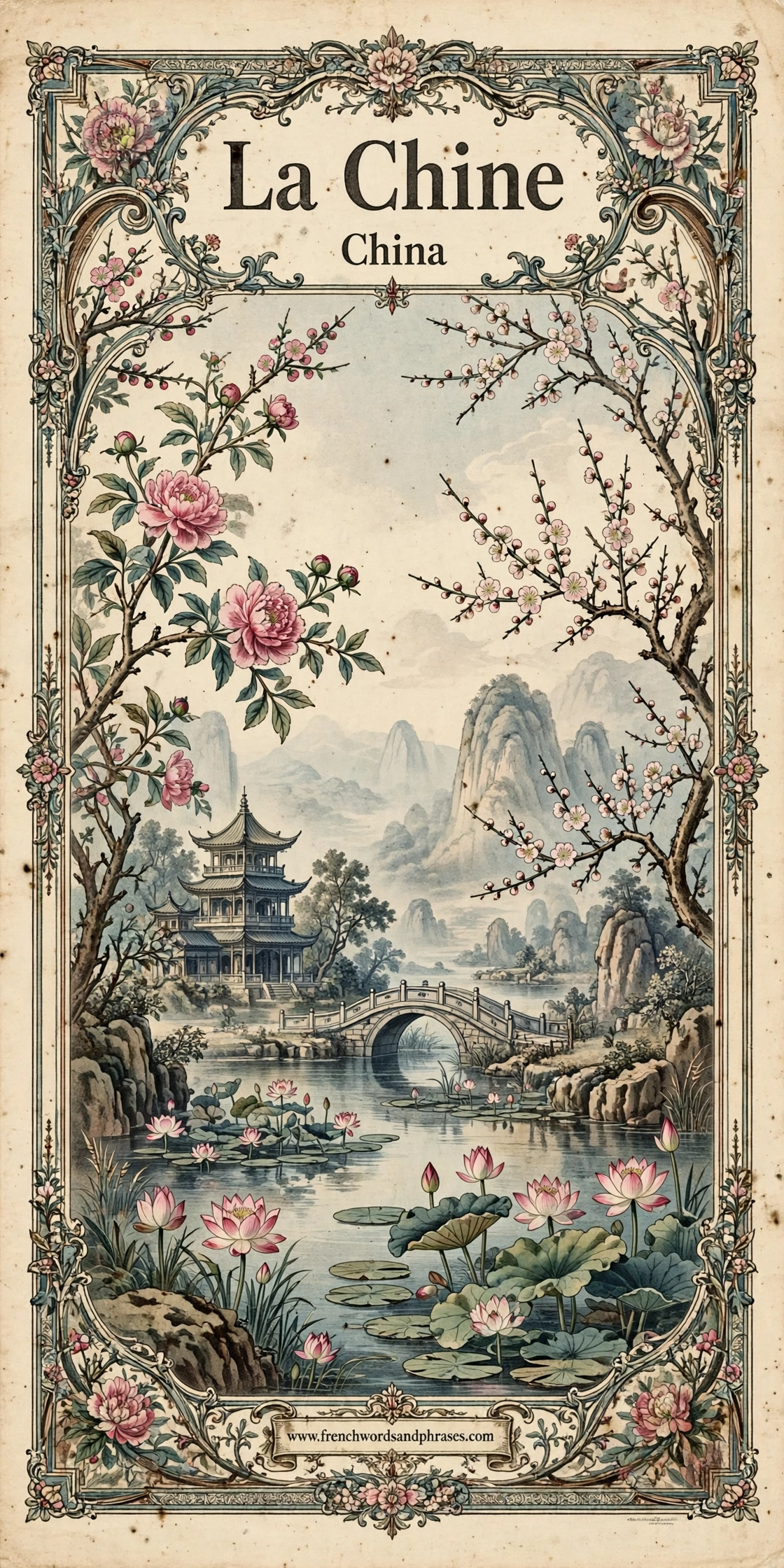
La Chine means China.
Dragons, great walls and the oldest continuous civilisation on Earth: la Chine, China — a country so large it contains deserts, jungles, megacities and five time zones’ worth of sun in a single time zone.
In this guide, you’ll learn what Chine means in English, how to use it with its articles, how to form its plural, and how it appears in everyday French. Explore French examples, English translations, and practice quizzes.
Understanding the French Noun Chine
Chine is a feminine proper noun, learned with its article: la Chine. Countries ending in -e are feminine, and Chine follows the rule — en Chine for in/to, de Chine for from. The French name descends, through many languages, from the Qin dynasty, the first imperial dynasty of China — the same root English uses in China.
It means China — the vast country of East Asia, the most populous of the world for centuries, with Pékin, Beijing, as its capital. Its people are les Chinois and les Chinoises, its language le chinois — in everyday French, le chinois usually means Mandarin. China gave the world paper, tea, silk and la Grande Muraille, the Great Wall, the largest structure ever built by human hands.
Gender: Feminine — la Chine
Definite article: la — la Chine (China)
Saying in / to: en — en Chine
Saying from: de — venir de Chine
Capital: Pékin
The people: les Chinois, les Chinoises
English equivalents: China.
Chine behaves like France: en Chine, de Chine, and la Chine as subject or object. Watch the everyday idiom built on the country: ce n’est pas la Chine means it is not far away, it is no big deal — and something incomprehensible is du chinois, “Chinese”, the French cousin of “it’s all Greek to me”.
Experience the Word
Chine is scale itself: a fifth of humanity, a wall visible in legend from space, and cities whose names — Pékin, Shanghai, Canton — French schoolchildren learn like spells.
Imagine the train crossing China at night, province after province rolling past the window, rice terraces giving way to desert — you sleep in one landscape and wake in another, still in la Chine.
You have not just named a country. You have named an empire of age and size — la Chine, China, the Middle Kingdom.
How to Use Chine in French: Complete Guide
Let’s explore how Chine works in French, beginning with its article and prepositions — la Chine, en Chine, de Chine.
Chine with the Definite Article (La)
As subject or object, Chine keeps her article: la Chine.
| Form | French |
|---|---|
| The country | la Chine |
| Southern China | la Chine du Sud |
| All of China | toute la Chine |
Example
La Chine est un pays immense.
China is an immense country.
Saying In, To and From: En Chine, De Chine
Feminine countries take en for in/to and de for from — the article disappears after both.
| Meaning | French |
|---|---|
| in China, to China | en Chine |
| from China | de Chine |
| across China | dans toute la Chine |
| to the capital | à Pékin |
Example
Il travaille en Chine depuis trois ans.
He has been working in China for three years.
The People of China: Les Chinois
The inhabitants take a capital letter — and chinois, small c, is the language and the adjective.
| Person | French |
|---|---|
| a Chinese man | un Chinois |
| a Chinese woman | une Chinoise |
| Chinese men / the Chinese | les Chinois |
| Chinese women | les Chinoises |
Example
Les Chinois fêtent le Nouvel An au printemps.
The Chinese celebrate New Year in spring.
Quick Quiz 1
Complete the sentence:
Ils voyagent ______ Chine au printemps. (to)
Reveal the answer
en
Ils voyagent en Chine au printemps.
They’re travelling to China in spring — feminine countries take en, with no article.
The Language and the Adjective: Chinois
Chinois names the language — usually Mandarin — and the adjective that agrees like any other.
| Use | French |
|---|---|
| the language | le chinois |
| masculine adjective | un thé chinois |
| feminine adjective | une ville chinoise |
| to speak Chinese | parler chinois |
Example
Le chinois est une langue très ancienne.
Chinese is a very ancient language.
Chine at a Glance
The facts every beginner meets first — capital, currency, language.
| Point | Chine |
|---|---|
| Capital | Pékin |
| Currency | le yuan |
| Language | le chinois (mandarin) |
| Wonder | la Grande Muraille — the Great Wall |
| New Year | le Nouvel An chinois |
Example
Pékin est la capitale de la Chine.
Beijing is the capital of China.
Quick Quiz 2
What is the capital of China?
Reveal the answer
Pékin
Pékin est la capitale de la Chine.
Beijing is the capital of China.
Chine and Its Neighbours
China borders more countries than almost any other state on Earth.
| Direction | French |
|---|---|
| to the north | la Mongolie et la Russie |
| to the south | le Vietnam |
| to the west | l’Inde |
| across the sea | le Japon |
Example
La Russie est au nord de la Chine.
Russia is north of China.
Chine with Adjectives
Adjectives agree with Chine — feminine singular: la Chine entière, the whole of China.
| Adjective | With Chine |
|---|---|
| entière (whole) | la Chine entière |
| ancienne (ancient) | la Chine ancienne |
| moderne (modern) | la Chine moderne |
| grande (great) | la grande Chine |
Example
La Chine moderne change très vite.
Modern China is changing very fast.
Quick Quiz 3
Complete the sentence:
C’est une ville ______ très moderne. (Chinese)
Reveal the answer
chinoise
C’est une ville chinoise très moderne.
It’s a very modern Chinese city — chinoise, feminine, to agree with ville.
Everyday Expressions with Chine
Walls, tea and idioms — the Chine phrases of daily life.
| Expression | In English |
|---|---|
| en Chine | in China |
| de Chine | from China; Chinese (of origin) |
| la Grande Muraille de Chine | the Great Wall of China |
| ce n’est pas la Chine | it’s not far / it’s no big deal (familiar) |
| c’est du chinois | it’s incomprehensible — “it’s all Greek to me” |
Example
Ne t’inquiète pas, ce n’est pas la Chine !
Don’t worry, it’s not the end of the world!
Words from the Same Family as Chine
Chinese and China — the words that travel with Chine.
| French | In English |
|---|---|
| chinois | Chinese — the language and the adjective |
| un Chinois | a Chinese man |
| la muraille | a great wall, a rampart |
| le thé | tea — China’s gift to the world |
| la soie | silk |
Example
La Grande Muraille traverse le nord de la Chine.
The Great Wall crosses the north of China.
Quick Quiz 4
What does c’est du chinois mean?
Reveal the answer
It’s incomprehensible — the French way of saying “it’s all Greek to me”.
Ce texte, pour moi, c’est du chinois.
This text, for me, is incomprehensible.
Chine in Everyday French: Real-Life Examples
Now that you know the word, let’s see how Chine appears in everyday French.
Example 1 — Travel
Nous partons en Chine le mois prochain.
We’re leaving for China next month.
Example 2 — Language
Elle apprend le chinois à l’université.
She is learning Chinese at university.
Example 3 — The Wall
La Grande Muraille de Chine est très longue.
The Great Wall of China is very long.
Example 4 — Tea
Ce thé vient de Chine.
This tea comes from China.
Example 5 — Work
Son entreprise travaille avec la Chine.
His company works with China.
Example 6 — An idiom
Pour moi, les maths, c’est du chinois.
For me, maths is incomprehensible.
Beyond Translation: The Meaning of Chine
Chine in French is a name that travelled the Silk Road: from the Qin dynasty through Persian and Latin mouths until it reached Paris. France and China have admired each other from a distance for centuries — Jesuit letters from Pékin fed the Enlightenment’s imagination, and chinoiserie filled French salons with painted dragons. The language keeps a fond joke about the relationship: what a French ear cannot understand at all is, proverbially, du chinois.
To say Chine is to name the far, old, enormous east.
It evokes the Great Wall on its ridges, tea in a porcelain cup and New Year dragons in the street — China, ancient and ultramodern at once.
How to Remember the French Noun Chine
Remember it this way: Chine is feminine: la Chine — en Chine and de Chine, with no article, for in and from.
- Feminine with her article — la Chine as subject: la Chine est immense.
- The prepositions — en Chine (in, to), de Chine (from).
- The joke — c’est du chinois means it’s incomprehensible.
The key idea is la Chine — China, feminine; en Chine, de Chine.
Test Your Knowledge of Chine
Let’s see how much you’ve learned. Try answering these questions before revealing the answers.
Question 1
Is Chine masculine or feminine in French?
Reveal the answer
Feminine — la Chine.
Question 2
How do you say in China?
Reveal the answer
En Chine — feminine countries take en, without the article.
Question 3
Translate: This tea comes from China.
Reveal the answer
Ce thé vient de Chine.
Question 4
What is la Grande Muraille?
Reveal the answer
The Great Wall — la Grande Muraille de Chine, in the north of the country.
Question 5
Complete the sentence:
______ Chine est le pays du thé. (the)
Reveal the answer
La
La Chine est le pays du thé.
China is the country of tea.
Your Final Challenge
Can You Use It?
How would you say this in French?
“We’re leaving for China next month.”
Reveal the answer
Nous partons en Chine le mois prochain.
We’re leaving for China next month.
A little French. A little curiosity. A richer everyday life.
LEARN FRENCH ONE WORD AT A TIME