A French Word to Live By
How to Conjugate Aimer in French
Pronunciation: /e.me/
Aimer means “to like” or “to love” in French.
Few French verbs are as familiar or as useful as aimer. It is the verb you use to express affection, describe your favorite things, and tell someone what you enjoy. From saying that you love a person to explaining that you like a particular food, aimer is an essential part of everyday French.
In this guide, you will learn how to conjugate aimer in all the major French tenses and moods, with practical examples, pronunciation guidance, and quizzes to help you remember each form.
Understanding the French Verb Aimer
Aimer is a regular French verb belonging to the first group of verbs, which end in -er. It follows the standard conjugation pattern used by many common French verbs, making it a useful model for learning other regular -er verbs.
- Verb group: First group (-er)
- Auxiliary verb: Avoir
- Past participle: aimé
- Present participle: aimant
- English meanings: To like, to love
Aimer: Like or Love?
One interesting feature of aimer is that it can mean either “to like” or “to love.” The intended meaning often depends on what follows the verb.
- J’aime le café. – I like coffee.
- J’aime la musique. – I like music.
- J’aime Marie. – I love Marie.
- J’aime beaucoup ce livre. – I really like this book.
When talking about people, aimer generally expresses love or affection. When talking about activities, objects, or general preferences, it commonly means “to like.”
Aimer and Aimer Bien
French also uses aimer bien to express liking something or someone. When referring to a person, aimer bien often suggests affection or friendship rather than romantic love.
J’aime bien Paul.
I like Paul.
J’aime Paul.
I love Paul.
Aimer with an Infinitive
When aimer is followed by another verb in the infinitive, it expresses an activity that someone likes or loves doing.
J’aime voyager.
I like traveling.
Elle aime lire.
She likes reading.
In the passé composé, aimer uses the auxiliary verb avoir. Its past participle, aimé, normally does not agree with the subject. Agreement is required when a preceding direct object calls for it.
Experience the Word
Read these everyday expressions aloud. Notice how aimer can express preferences, affection, and enjoyment.
J’aime apprendre le français.
I like learning French.
Nous aimons passer du temps ensemble.
We like spending time together.
Elle aime beaucoup son travail.
She really likes her job.
How to Conjugate Aimer: Complete French Conjugation Guide
Indicatif (Indicative Mood)
The indicative mood is used to express facts, actions, and events that are presented as real or certain. It is the mood you will use most often in everyday French.
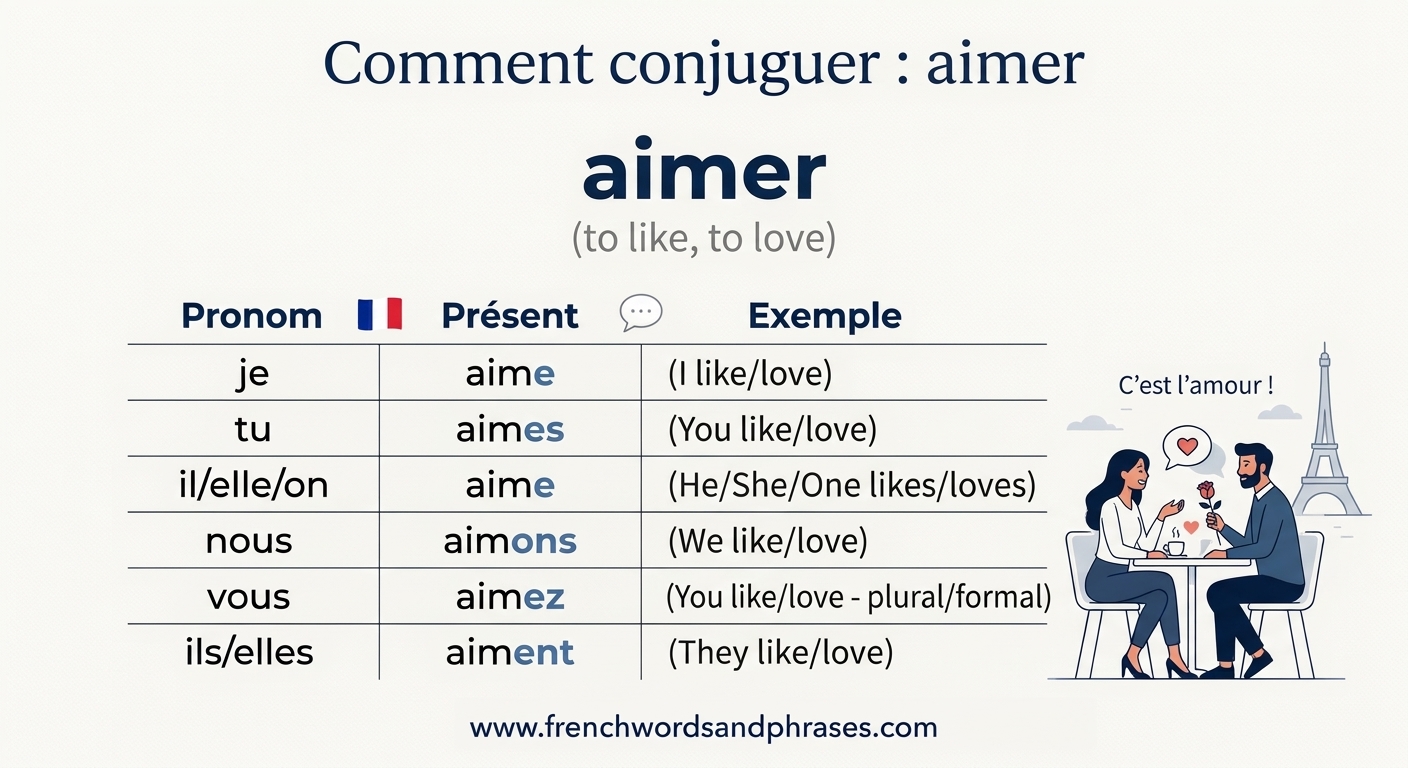
How to Conjugate Aimer in the Présent
The present tense describes actions happening now, regular habits, and general preferences. For example, j’aime le français means “I like French.”
| Subject | Conjugation |
|---|---|
| je | j’aime |
| tu | tu aimes |
| il/elle | il aime / elle aime |
| nous | nous aimons |
| vous | vous aimez |
| ils/elles | ils aiment / elles aiment |
Example:
J’aime les promenades au bord de la mer.
I like walks by the sea.
Quick Quiz
How would you say “We love music” in French?
Reveal the answer
Nous aimons la musique.
How to Conjugate Aimer in the Passé Composé
The passé composé describes completed actions in the past. It is formed with the present tense of avoir followed by the past participle aimé.
| Subject | Conjugation |
|---|---|
| je | j’ai aimé |
| tu | tu as aimé |
| il/elle | il a aimé / elle a aimé |
| nous | nous avons aimé |
| vous | vous avez aimé |
| ils/elles | ils ont aimé / elles ont aimé |
Example:
J’ai aimé ce film.
I liked this movie.
How to Conjugate Aimer in the Imparfait
The imparfait describes ongoing or repeated actions in the past. It is often used to talk about past habits, preferences, and things you used to enjoy.
| Subject | Conjugation |
|---|---|
| je | j’aimais |
| tu | tu aimais |
| il/elle | il aimait / elle aimait |
| nous | nous aimions |
| vous | vous aimiez |
| ils/elles | ils aimaient / elles aimaient |
Example:
Quand j’étais enfant, j’aimais les histoires de princesses.
When I was a child, I liked stories about princesses.
Quick Quiz
Which tense would you use to say “I used to love this song”?
Reveal the answer
J’aimais cette chanson.
I used to love this song.
How to Conjugate Aimer in the Plus-que-parfait
The plus-que-parfait describes an action or feeling that had already happened before another past event. It is formed with the imparfait of avoir and the past participle aimé.
| Subject | Conjugation |
|---|---|
| je | j’avais aimé |
| tu | tu avais aimé |
| il/elle | il avait aimé / elle avait aimé |
| nous | nous avions aimé |
| vous | vous aviez aimé |
| ils/elles | ils avaient aimé / elles avaient aimé |
Example:
J’avais toujours aimé cette ville avant de m’y installer.
I had always loved this city before moving there.
How to Conjugate Aimer in the Passé Simple
The passé simple is a literary past tense mainly found in novels, historical writing, and formal narratives. In everyday conversation, the passé composé is generally used instead.
| Subject | Conjugation |
|---|---|
| je | j’aimai |
| tu | tu aimas |
| il/elle | il aima / elle aima |
| nous | nous aimâmes |
| vous | vous aimâtes |
| ils/elles | ils aimèrent / elles aimèrent |
Example:
Il aima cette femme dès leur première rencontre.
He loved this woman from their first meeting.
How to Conjugate Aimer in the Passé Antérieur
The passé antérieur is another literary tense. It describes an action completed before another past action, usually in formal storytelling. It is formed with the passé simple of avoir and the past participle aimé.
| Subject | Conjugation |
|---|---|
| je | j’eus aimé |
| tu | tu eus aimé |
| il/elle | il eut aimé / elle eut aimé |
| nous | nous eûmes aimé |
| vous | vous eûtes aimé |
| ils/elles | ils eurent aimé / elles eurent aimé |
Example:
Dès qu’il eut aimé cette œuvre, il en parla à ses amis.
As soon as he had come to love this work, he spoke about it to his friends.
How to Conjugate Aimer in the Futur Simple
The futur simple expresses actions that will happen in the future. To form it, add the future endings to the infinitive aimer.
| Subject | Conjugation |
|---|---|
| je | j’aimerai |
| tu | tu aimeras |
| il/elle | il aimera / elle aimera |
| nous | nous aimerons |
| vous | vous aimerez |
| ils/elles | ils aimeront / elles aimeront |
Example:
Tu aimeras cette ville quand tu la connaîtras mieux.
You will love this city when you get to know it better.
Quick Quiz
How do you say “They will love this book”?
Reveal the answer
Ils aimeront ce livre.
They will love this book.
How to Conjugate Aimer in the Futur Antérieur
The futur antérieur describes an action that will have been completed before a particular moment in the future. It is formed with the futur simple of avoir and the past participle aimé.
| Subject | Conjugation |
|---|---|
| je | j’aurai aimé |
| tu | tu auras aimé |
| il/elle | il aura aimé / elle aura aimé |
| nous | nous aurons aimé |
| vous | vous aurez aimé |
| ils/elles | ils auront aimé / elles auront aimé |
Example:
À la fin du voyage, tu auras aimé chaque instant.
By the end of the trip, you will have loved every moment.
How to Conjugate Aimer in the Futur Proche
The futur proche, or near future, is used for actions that are going to happen soon or are already planned. It is formed with the present tense of aller followed by the infinitive aimer.
| Subject | Conjugation |
|---|---|
| je | je vais aimer |
| tu | tu vas aimer |
| il/elle | il va aimer / elle va aimer |
| nous | nous allons aimer |
| vous | vous allez aimer |
| ils/elles | ils vont aimer / elles vont aimer |
Example:
Je vais aimer ce restaurant, j’en suis sûr.
I am going to like this restaurant, I am sure.
Conditionnel (Conditional Mood)
The conditional mood is used to express possibilities, hypothetical situations, polite requests, and actions that would happen under certain conditions.
How to Conjugate Aimer in the Conditionnel Présent
The present conditional often translates as “would like” or “would love.” It is also particularly useful for making polite requests.
| Subject | Conjugation |
|---|---|
| je | j’aimerais |
| tu | tu aimerais |
| il/elle | il aimerait / elle aimerait |
| nous | nous aimerions |
| vous | vous aimeriez |
| ils/elles | ils aimeraient / elles aimeraient |
Example:
J’aimerais visiter Paris un jour.
I would like to visit Paris one day.
How to Conjugate Aimer in the Conditionnel Passé
The past conditional describes an action that would have happened but did not. It is formed with the conditional present of avoir and the past participle aimé.
| Subject | Conjugation |
|---|---|
| je | j’aurais aimé |
| tu | tu aurais aimé |
| il/elle | il aurait aimé / elle aurait aimé |
| nous | nous aurions aimé |
| vous | vous auriez aimé |
| ils/elles | ils auraient aimé / elles auraient aimé |
Example:
J’aurais aimé rester plus longtemps.
I would have liked to stay longer.
Conditionnel Passé – Literary Alternative
The following forms are an older literary construction of the past conditional. They are rarely used in modern everyday French, but you may encounter them in classical literature and formal writing.
| Subject | Conjugation |
|---|---|
| je | j’eusse aimé |
| tu | tu eusses aimé |
| il/elle | il eût aimé / elle eût aimé |
| nous | nous eussions aimé |
| vous | vous eussiez aimé |
| ils/elles | ils eussent aimé / elles eussent aimé |
Example:
Il eût aimé vous accompagner.
He would have liked to accompany you.
Subjonctif (Subjunctive Mood)
The subjunctive is used to express feelings, wishes, doubts, necessities, and uncertainty. It often follows expressions such as il faut que (it is necessary that), je veux que (I want that), and bien que (although).
How to Conjugate Aimer in the Subjonctif Présent
The present subjunctive is the most commonly used subjunctive tense. It often appears after expressions of desire, emotion, doubt, or necessity.
| Subject | Conjugation |
|---|---|
| que je | que j’aime |
| que tu | que tu aimes |
| qu’il/qu’elle | qu’il aime / qu’elle aime |
| que nous | que nous aimions |
| que vous | que vous aimiez |
| qu’ils/qu’elles | qu’ils aiment / qu’elles aiment |
Example:
Je veux que tu aimes ce que tu fais.
I want you to love what you do.
How to Conjugate Aimer in the Subjonctif Imparfait
The imperfect subjunctive is a literary tense rarely used in modern spoken French. It is mainly found in older literature and highly formal writing.
| Subject | Conjugation |
|---|---|
| que je | que j’aimasse |
| que tu | que tu aimasses |
| qu’il/qu’elle | qu’il aimât / qu’elle aimât |
| que nous | que nous aimassions |
| que vous | que vous aimassiez |
| qu’ils/qu’elles | qu’ils aimassent / qu’elles aimassent |
Example:
Elle souhaitait qu’il aimât la littérature.
She wished that he would love literature.
How to Conjugate Aimer in the Subjonctif Plus-que-parfait
The pluperfect subjunctive is a literary form used to describe an action that had already happened in a past context. It is rarely used in everyday French.
| Subject | Conjugation |
|---|---|
| que je | que j’eusse aimé |
| que tu | que tu eusses aimé |
| qu’il/qu’elle | qu’il eût aimé / qu’elle eût aimé |
| que nous | que nous eussions aimé |
| que vous | que vous eussiez aimé |
| qu’ils/qu’elles | qu’ils eussent aimé / qu’elles eussent aimé |
Example:
Je doutais qu’elle eût aimé cette pièce.
I doubted that she had liked that play.
How to Conjugate Aimer in the Subjonctif Passé
The past subjunctive describes an action that has been completed. It is formed with the present subjunctive of avoir and the past participle aimé.
| Subject | Conjugation |
|---|---|
| que je | que j’aie aimé |
| que tu | que tu aies aimé |
| qu’il/qu’elle | qu’il ait aimé / qu’elle ait aimé |
| que nous | que nous ayons aimé |
| que vous | que vous ayez aimé |
| qu’ils/qu’elles | qu’ils aient aimé / qu’elles aient aimé |
Example:
Je suis heureux que tu aies aimé le cadeau.
I am happy that you liked the gift.
Impératif (Imperative Mood)
The imperative is used to give commands, make requests, or offer advice. It is commonly used without a subject pronoun.
How to Conjugate Aimer in the Impératif Présent
The imperative of aimer has three forms: aime, aimons, and aimez. Notice that the second-person singular form drops the final -s, as is typical for regular -er verbs.
| Subject | Conjugation |
|---|---|
| (tu) | aime |
| (nous) | aimons |
| (vous) | aimez |
Examples:
Aime la vie !
Love life!
Aimons-nous les uns les autres.
Let us love one another.
Quick Quiz
How would you tell someone informally to enjoy life?
Reveal the answer
Aime la vie !
Love life!
French Participles: Aimant and Aimé
French participles are useful for forming compound tenses and describing actions. The verb aimer has a present participle and a past participle.
Present Participle: Aimant
The present participle of aimer is aimant. It can describe an action taking place at the same time as another action. It also appears in expressions using en + present participle.
Present participle:
aimant
Example:
En aimant les autres, on apprend à mieux se connaître.
By loving others, we learn to know ourselves better.
Past Participle: Aimé
The past participle of aimer is aimé. It is used to form compound tenses, including the passé composé, plus-que-parfait, and futur antérieur.
Because aimer uses avoir, the past participle normally does not agree with the subject. When a preceding direct object requires agreement, its ending can change:
- aimé – Masculine singular
- aimés – Masculine plural
- aimée – Feminine singular
- aimées – Feminine plural
Example:
Les chansons que j’ai aimées sont magnifiques.
The songs that I liked are beautiful.
Aimer in Everyday French: Six Useful Examples
Here are six examples showing how aimer appears in different tenses and everyday situations.
1. Present – Expressing a preference
J’aime le chocolat noir.
I like dark chocolate.
2. Passé composé – A past experience
Nous avons aimé notre séjour à Lyon.
We enjoyed our stay in Lyon.
3. Imparfait – A past preference
Elle aimait beaucoup les animaux quand elle était petite.
She really liked animals when she was little.
4. Futur simple – A future feeling
Tu aimeras cette nouvelle chanson.
You will like this new song.
5. Conditional – Expressing a wish
J’aimerais apprendre à jouer du piano.
I would like to learn to play the piano.
6. Subjunctive – Expressing a desire
Je souhaite que vous aimiez votre nouvelle maison.
I hope you like your new house.
Beyond Translation: Understanding Aimer
Although aimer is usually translated as “to like” or “to love,” its meaning depends on the context and the words that accompany it.
Aimer Quelqu’un
When used with a person, aimer generally expresses love or affection.
J’aime mes enfants.
I love my children.
Aimer Quelque Chose
When used with a thing, activity, or general preference, aimer usually means “to like.”
J’aime la cuisine française.
I like French cooking.
Aimer Bien
Aimer bien is commonly used to express liking something or someone. When referring to a person, it can sound less intense than aimer.
J’aime bien cette chanson.
I quite like this song.
Aimer Mieux
The expression aimer mieux means to prefer or like something better.
J’aime mieux le thé que le café.
I prefer tea to coffee.
Aimer à Faire Quelque Chose
The construction aimer à followed by an infinitive can express a fondness for doing something, although it is less common in everyday conversation than simply using aimer + infinitive.
Il aime à se promener dans le jardin.
He likes to take walks in the garden.
How to Remember the Conjugation of Aimer
Because aimer is a regular -er verb, it is a useful model for learning the first-group conjugation pattern.
Start by remembering the present-tense endings:
- je: -e
- tu: -es
- il/elle: -e
- nous: -ons
- vous: -ez
- ils/elles: -ent
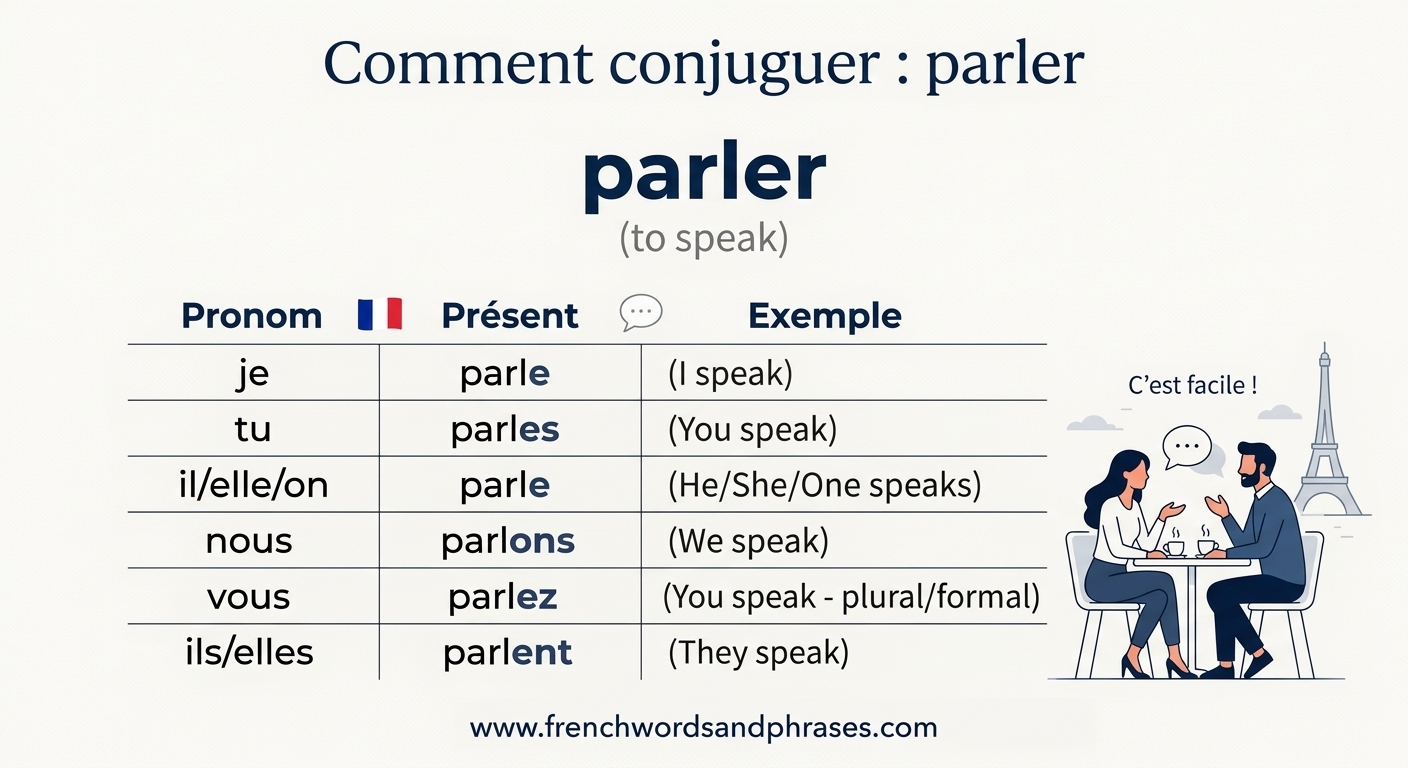
These endings appear in the present tense of many regular -er verbs. Once you are comfortable with aimer, you can use the same pattern to help conjugate verbs such as parler (to speak), chanter (to sing), and danser (to dance).
Also remember the two important participles:
- aimant – present participle
- aimé – past participle
Practice using aimer to describe things you enjoy, people you care about, and activities you like doing. Connecting the verb to your everyday life makes it easier to remember.
Test Your Knowledge of Aimer
Try these five questions to see how well you remember the conjugation and use of aimer.
Question 1
Which is the correct present-tense form for nous?
Reveal the answer
Nous aimons.
Question 2
How do you say “I liked it” using the passé composé?
Reveal the answer
J’ai aimé.
Question 3
What is the correct futur simple form for tu?
Reveal the answer
Tu aimeras.
Question 4
What does j’aimerais mean in English?
Reveal the answer
I would like.
Question 5
What is the past participle of aimer?
Reveal the answer
Aimé.
Your Final Challenge
Translate the following sentence into French:
“I would love to visit France one day.”
Reveal the answer
J’aimerais visiter la France un jour.
I would love to visit France one day.
A little French. A little curiosity. A richer everyday life.
LEARN FRENCH ONE WORD AT A TIME