A French Word to Live By
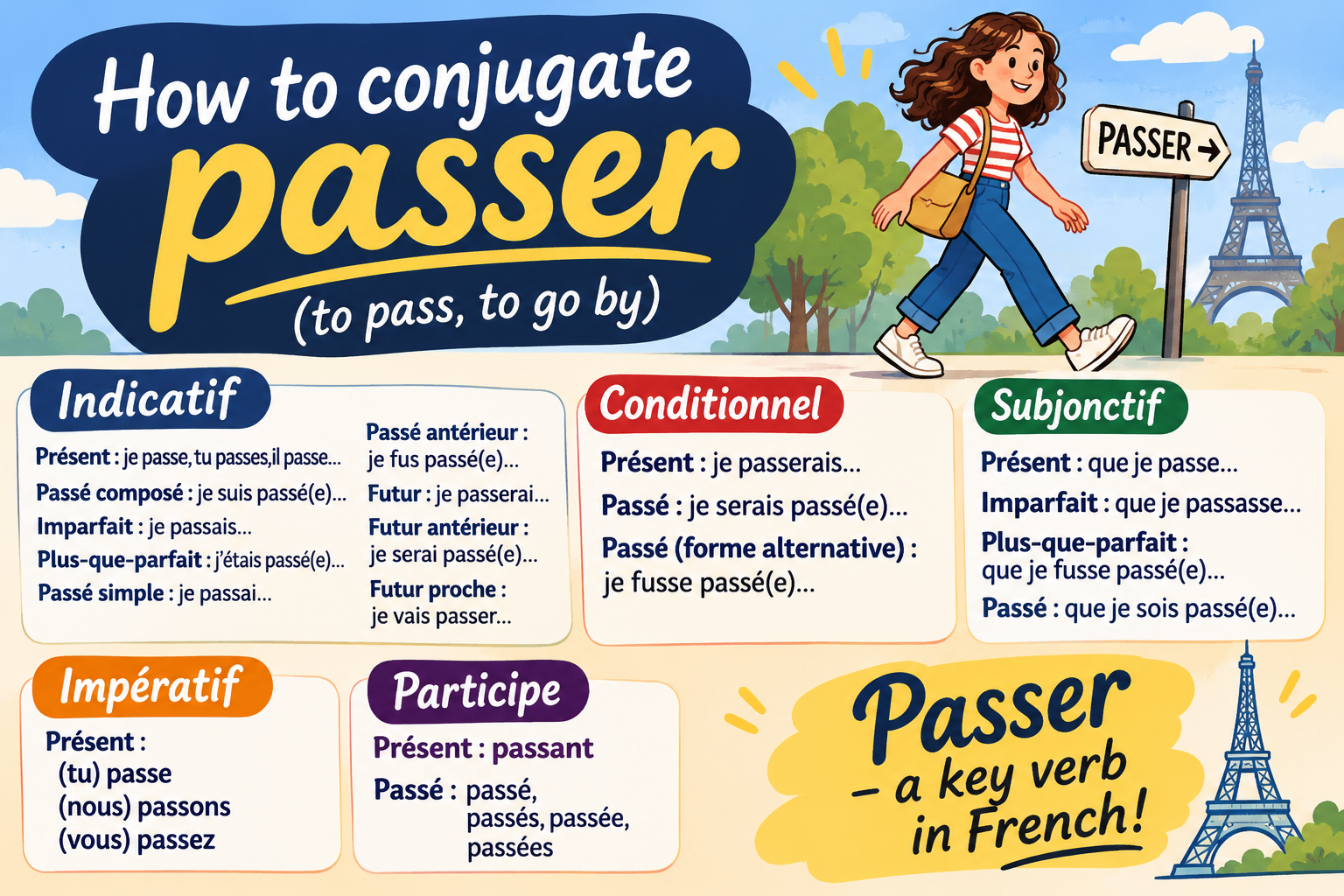
How to Conjugate Passer in French
Pronunciation: /pa.se/
Passer means “to pass,” “to go by,” or “to spend” in French.
Time passes, people pass by, and days turn into memories. The French verb passer is used in countless everyday situations, from describing a journey or the passage of time to explaining how you spend an afternoon. It is one of those versatile verbs that quickly becomes part of your everyday French vocabulary.
In this guide, you will learn how to conjugate passer in all the major French tenses and moods, with practical examples, pronunciation guidance, and quizzes to help you remember each form.
Understanding the French Verb Passer
Passer is a regular French verb belonging to the first group of verbs, which end in -er. Its conjugation follows the standard -er pattern in simple tenses. However, it has an important feature: it can use either être or avoir in compound tenses, depending on how it is used.
- Verb group: First group (-er)
- Auxiliary verb: Être or avoir, depending on the construction
- Past participle: passé
- Present participle: passant
- English meanings: To pass, to go by, to spend, to stop by, to take (an exam)
When Passer Uses Être
When passer describes movement or the act of going by or passing somewhere, it commonly uses être in compound tenses. The past participle agrees with the subject in gender and number.
Je suis passé devant la boulangerie.
I passed by the bakery.
Elle est passée chez moi hier.
She stopped by my place yesterday.
When Passer Uses Avoir
When passer takes a direct object, it generally uses avoir. This is common when talking about spending time, taking an exam, or showing something.
J’ai passé deux heures à étudier.
I spent two hours studying.
Il a passé son examen.
He took his exam.
With avoir, the past participle normally does not agree with the subject. It agrees with a preceding direct object when grammar requires it.
Useful Expressions with Passer
- Passer du temps – To spend time
- Passer devant – To pass in front of / pass by
- Passer chez quelqu’un – To stop by someone’s place
- Passer un examen – To take an exam
- Passer un appel – To make a phone call
- Passer à table – To sit down to eat
- Passer une bonne journée – To have a good day
- Le temps passe – Time passes
- Passer à autre chose – To move on to something else
The conjugation tables below show the être construction of passer, as used for movement and passing by. Remember that the avoir construction is also important in everyday French.
Experience the Word
Read these everyday expressions aloud. Notice how passer can describe movement, time, and visits.
Le temps passe vite.
Time passes quickly.
Je passe devant ta maison tous les jours.
I pass by your house every day.
Nous allons passer chez nos amis ce soir.
We are going to stop by our friends’ place this evening.
How to Conjugate Passer: Complete French Conjugation Guide
Indicatif (Indicative Mood)
The indicative mood is used to express facts, actions, and events that are presented as real or certain. It is the mood you will use most often in everyday French.
How to Conjugate Passer in the Présent
The present tense describes actions happening now, regular habits, and general facts. For example, je passe devant l’école means “I pass by the school.”
| Subject | Conjugation |
|---|---|
| je | je passe |
| tu | tu passes |
| il/elle | il passe / elle passe |
| nous | nous passons |
| vous | vous passez |
| ils/elles | ils passent / elles passent |
Example:
Je passe devant ce café chaque matin.
I pass by this café every morning.
Quick Quiz
How would you say “We pass by the park”?
Reveal the answer
Nous passons devant le parc.
How to Conjugate Passer in the Passé Composé
When passer describes movement or passing by, the passé composé is formed with the present tense of être followed by the past participle passé. The past participle agrees with the subject.
| Subject | Conjugation |
|---|---|
| je | je suis passé / je suis passée |
| tu | tu es passé / tu es passée |
| il/elle | il est passé / elle est passée |
| nous | nous sommes passés / nous sommes passées |
| vous | vous êtes passés / vous êtes passées / vous êtes passé / vous êtes passée |
| ils/elles | ils sont passés / elles sont passées |
Example:
Elle est passée devant le magasin hier.
She passed by the store yesterday.
How to Conjugate Passer in the Imparfait
The imparfait describes ongoing or repeated actions in the past. It is often used to describe habits, background situations, and things that used to happen.
| Subject | Conjugation |
|---|---|
| je | je passais |
| tu | tu passais |
| il/elle | il passait / elle passait |
| nous | nous passions |
| vous | vous passiez |
| ils/elles | ils passaient / elles passaient |
Example:
Quand j’habitais ici, je passais devant cette maison tous les jours.
When I lived here, I passed by this house every day.
Quick Quiz
Which tense would you use to describe something you regularly did in the past?
Reveal the answer
The imparfait. For example: Je passais souvent par ici. – I often used to pass this way.
How to Conjugate Passer in the Plus-que-parfait
The plus-que-parfait describes an action that had already happened before another past action. In the movement construction, it is formed with the imparfait of être and the past participle passé, which agrees with the subject.
| Subject | Conjugation |
|---|---|
| je | j’étais passé / j’étais passée |
| tu | tu étais passé / tu étais passée |
| il/elle | il était passé / elle était passée |
| nous | nous étions passés / nous étions passées |
| vous | vous étiez passés / vous étiez passées / vous étiez passé / vous étiez passée |
| ils/elles | ils étaient passés / elles étaient passées |
Example:
J’étais déjà passé devant cette maison avant notre rendez-vous.
I had already passed by this house before our appointment.
How to Conjugate Passer in the Passé Simple
The passé simple is a literary past tense mainly found in novels, historical writing, and formal narratives. In everyday conversation, the passé composé is generally used instead.
| Subject | Conjugation |
|---|---|
| je | je passai |
| tu | tu passas |
| il/elle | il passa / elle passa |
| nous | nous passâmes |
| vous | vous passâtes |
| ils/elles | ils passèrent / elles passèrent |
Example:
Il passa devant le château sans s’arrêter.
He passed by the castle without stopping.
How to Conjugate Passer in the Passé Antérieur
The passé antérieur is another literary tense. It describes an action completed before another past action, usually in formal storytelling. In the movement construction, it is formed with the passé simple of être and the past participle passé, which agrees with the subject.
| Subject | Conjugation |
|---|---|
| je | je fus passé / je fus passée |
| tu | tu fus passé / tu fus passée |
| il/elle | il fut passé / elle fut passée |
| nous | nous fûmes passés / nous fûmes passées |
| vous | vous fûtes passés / vous fûtes passées / vous fûtes passé / vous fûtes passée |
| ils/elles | ils furent passés / elles furent passées |
Example:
Dès qu’elle fut passée, le silence revint.
As soon as she had passed by, silence returned.
How to Conjugate Passer in the Futur Simple
The futur simple expresses actions that will happen in the future. To form it, add the future endings to the infinitive passer.
| Subject | Conjugation |
|---|---|
| je | je passerai |
| tu | tu passeras |
| il/elle | il passera / elle passera |
| nous | nous passerons |
| vous | vous passerez |
| ils/elles | ils passeront / elles passeront |
Example:
Je passerai chez toi demain matin.
I will stop by your place tomorrow morning.
How to Conjugate Passer in the Futur Antérieur
The futur antérieur describes an action that will have been completed before a particular moment in the future. In the movement construction, it is formed with the futur simple of être and the past participle passé, which agrees with the subject.
| Subject | Conjugation |
|---|---|
| je | je serai passé / je serai passée |
| tu | tu seras passé / tu seras passée |
| il/elle | il sera passé / elle sera passée |
| nous | nous serons passés / nous serons passées |
| vous | vous serez passés / vous serez passées / vous serez passé / vous serez passée |
| ils/elles | ils seront passés / elles seront passées |
Example:
À midi, elle sera déjà passée devant le bureau.
By noon, she will already have passed by the office.
Quick Quiz
How would you say “She will stop by tomorrow”?
Reveal the answer
Elle passera demain.
She will stop by tomorrow.
How to Conjugate Passer in the Futur Proche
The futur proche, or near future, is used for actions that are going to happen soon or are already planned. It is formed with the present tense of aller followed by the infinitive passer.
| Subject | Conjugation |
|---|---|
| je | je vais passer |
| tu | tu vas passer |
| il/elle | il va passer / elle va passer |
| nous | nous allons passer |
| vous | vous allez passer |
| ils/elles | ils vont passer / elles vont passer |
Example:
Nous allons passer chez nos amis ce soir.
We are going to stop by our friends’ place this evening.
Conditionnel (Conditional Mood)
The conditional mood is used to express possibilities, hypothetical situations, polite requests, and actions that would happen under certain conditions.
How to Conjugate Passer in the Conditionnel Présent
The present conditional often translates as “would pass” or “would stop by.” It can also make a suggestion or request sound more polite.
| Subject | Conjugation |
|---|---|
| je | je passerais |
| tu | tu passerais |
| il/elle | il passerait / elle passerait |
| nous | nous passerions |
| vous | vous passeriez |
| ils/elles | ils passeraient / elles passeraient |
Example:
Je passerais te voir si j’avais le temps.
I would stop by to see you if I had time.
How to Conjugate Passer in the Conditionnel Passé
The past conditional describes an action that would have happened but did not. In the movement construction, it is formed with the conditional present of être and the past participle passé, which agrees with the subject.
| Subject | Conjugation |
|---|---|
| je | je serais passé / je serais passée |
| tu | tu serais passé / tu serais passée |
| il/elle | il serait passé / elle serait passée |
| nous | nous serions passés / nous serions passées |
| vous | vous seriez passés / vous seriez passées / vous seriez passé / vous seriez passée |
| ils/elles | ils seraient passés / elles seraient passées |
Example:
Je serais passé te voir, mais j’étais trop occupé.
I would have stopped by to see you, but I was too busy.
Conditionnel Passé – Literary Alternative
The following forms are an older literary construction of the past conditional. They are rarely used in modern everyday French, but you may encounter them in classical literature and formal writing.
| Subject | Conjugation |
|---|---|
| je | je fusse passé / je fusse passée |
| tu | tu fusses passé / tu fusses passée |
| il/elle | il fût passé / elle fût passée |
| nous | nous fussions passés / nous fussions passées |
| vous | vous fussiez passés / vous fussiez passées / vous fussiez passé / vous fussiez passée |
| ils/elles | ils fussent passés / elles fussent passées |
Example:
Il fût passé plus tôt s’il avait pu.
He would have stopped by earlier if he had been able to.
Subjonctif (Subjunctive Mood)
The subjunctive is used to express feelings, wishes, doubts, necessities, and uncertainty. It often follows expressions such as il faut que (it is necessary that), je veux que (I want that), and bien que (although).
How to Conjugate Passer in the Subjonctif Présent
The present subjunctive is the most commonly used subjunctive tense. It often appears after expressions of desire, emotion, doubt, or necessity.
| Subject | Conjugation |
|---|---|
| que je | que je passe |
| que tu | que tu passes |
| qu’il/qu’elle | qu’il passe / qu’elle passe |
| que nous | que nous passions |
| que vous | que vous passiez |
| qu’ils/qu’elles | qu’ils passent / qu’elles passent |
Example:
Il faut que tu passes chez moi demain.
You need to stop by my place tomorrow.
How to Conjugate Passer in the Subjonctif Imparfait
The imperfect subjunctive is a literary tense rarely used in modern spoken French. It is mainly found in older literature and highly formal writing.
| Subject | Conjugation |
|---|---|
| que je | que je passasse |
| que tu | que tu passasses |
| qu’il/qu’elle | qu’il passât / qu’elle passât |
| que nous | que nous passassions |
| que vous | que vous passassiez |
| qu’ils/qu’elles | qu’ils passassent / qu’elles passassent |
Example:
Il souhaitait qu’elle passât le voir.
He wished that she would stop by to see him.
How to Conjugate Passer in the Subjonctif Plus-que-parfait
The pluperfect subjunctive is a literary form used to describe an action that had already happened in a past context. It is rarely used in everyday French. In the movement construction, it is formed with the imperfect subjunctive of être and the past participle passé, which agrees with the subject.
| Subject | Conjugation |
|---|---|
| que je | que je fusse passé / que je fusse passée |
| que tu | que tu fusses passé / que tu fusses passée |
| qu’il/qu’elle | qu’il fût passé / qu’elle fût passée |
| que nous | que nous fussions passés / que nous fussions passées |
| que vous | que vous fussiez passés / que vous fussiez passées / que vous fussiez passé / que vous fussiez passée |
| qu’ils/qu’elles | qu’ils fussent passés / qu’elles fussent passées |
Example:
Je doutais qu’elle fût passée par cette rue.
I doubted that she had passed through this street.
How to Conjugate Passer in the Subjonctif Passé
The past subjunctive describes an action that has been completed. In the movement construction, it is formed with the present subjunctive of être and the past participle passé, which agrees with the subject.
| Subject | Conjugation |
|---|---|
| que je | que je sois passé / que je sois passée |
| que tu | que tu sois passé / que tu sois passée |
| qu’il/qu’elle | qu’il soit passé / qu’elle soit passée |
| que nous | que nous soyons passés / que nous soyons passées |
| que vous | que vous soyez passés / que vous soyez passées / que vous soyez passé / que vous soyez passée |
| qu’ils/qu’elles | qu’ils soient passés / qu’elles soient passées |
Example:
Je suis heureux que tu sois passé me voir.
I am happy that you stopped by to see me.
Impératif (Imperative Mood)
The imperative is used to give commands, make requests, or offer advice. It is commonly used without a subject pronoun.
How to Conjugate Passer in the Impératif Présent
The imperative of passer has three forms: passe, passons, and passez. Notice that the second-person singular form drops the final -s, as is typical for regular -er verbs.
| Subject | Conjugation |
|---|---|
| (tu) | passe |
| (nous) | passons |
| (vous) | passez |
Examples:
Passe me voir demain !
Stop by and see me tomorrow!
Passons à autre chose.
Let’s move on to something else.
Quick Quiz
How would you tell someone informally to stop by tomorrow?
Reveal the answer
Passe demain !
Stop by tomorrow!
French Participles: Passant and Passé
French participles are useful for forming compound tenses and describing actions. The verb passer has a present participle and a past participle.
Present Participle: Passant
The present participle of passer is passant. It can describe an action taking place at the same time as another action. It also appears in expressions using en + present participle.
Present participle:
passant
Example:
En passant devant la fenêtre, j’ai vu mon ami.
While passing by the window, I saw my friend.
Past Participle: Passé
The past participle of passer is passé. It is used to form compound tenses with either être or avoir, depending on the construction.
With être, the past participle agrees with the subject:
- passé – Masculine singular
- passés – Masculine plural
- passée – Feminine singular
- passées – Feminine plural
Example:
Elle est passée devant la maison.
She passed by the house.
With avoir, the past participle normally does not agree with the subject. It agrees with a preceding direct object when required.
Les heures que j’ai passées ici étaient agréables.
The hours I spent here were pleasant.
Passer in Everyday French: Six Useful Examples
Here are six examples showing how passer appears in different tenses and everyday situations.
1. Present – Passing by a place
Je passe devant la gare chaque matin.
I pass by the train station every morning.
2. Passé composé – A visit
Elle est passée chez moi hier soir.
She stopped by my place last night.
3. Imparfait – A past habit
Nous passions nos étés à la campagne.
We used to spend our summers in the countryside.
4. Futur simple – A future visit
Je passerai te voir demain.
I will stop by to see you tomorrow.
5. Conditional – A possible visit
Je passerais si j’avais le temps.
I would stop by if I had time.
6. Subjunctive – Expressing a necessity
Il faut que tu passes à la maison.
You need to stop by the house.
Beyond Translation: Understanding Passer
Although passer is often translated as “to pass,” its meaning changes depending on the context. It can describe movement, time, visits, experiences, and even examinations.
Passer du Temps
This expression means “to spend time.” It uses avoir in compound tenses because temps is the direct object.
J’ai passé toute la journée avec ma famille.
I spent the whole day with my family.
Passer un Examen
In French, passer un examen means to take or sit an exam. It also uses avoir in compound tenses.
Il a passé son examen hier.
He took his exam yesterday.
Passer Chez Quelqu’un
This expression means to stop by someone’s home or place of work.
Je vais passer chez ma sœur ce soir.
I am going to stop by my sister’s place this evening.
Passer Devant
Use passer devant to describe going past or in front of a place or person.
Nous sommes passés devant le musée.
We passed by the museum.
Passer à Autre Chose
This common expression means to move on to something else or change the subject.
Il est temps de passer à autre chose.
It is time to move on to something else.
How to Remember the Conjugation of Passer
Because passer is a regular -er verb, its simple tenses follow the familiar first-group conjugation pattern.
Start by remembering the present-tense endings:
- je: -e
- tu: -es
- il/elle: -e
- nous: -ons
- vous: -ez
- ils/elles: -ent
These endings also appear in the present tense of many other regular -er verbs.
The most important thing to remember about passer is its choice of auxiliary verb:
- Être: When describing movement or passing by, as in elle est passée.
- Avoir: When the verb takes a direct object, as in elle a passé un examen.
Also remember the two important participles:
- passant – Present participle
- passé – Past participle
Practice using passer in complete sentences. Describing how you spend your day, where you go, and whom you visit is a natural way to make this useful verb part of your everyday French.
Test Your Knowledge of Passer
Try these five questions to see how well you remember the conjugation and use of passer.
Question 1
Which is the correct present-tense form for nous?
Reveal the answer
Nous passons.
Question 2
Which auxiliary is used in elle est passée devant la maison?
Reveal the answer
Être. The verb describes movement or passing by, and the past participle agrees with the subject.
Question 3
How do you say “I spent two hours here”?
Reveal the answer
J’ai passé deux heures ici.
I spent two hours here.
Question 4
What is the correct futur simple form for tu?
Reveal the answer
Tu passeras.
Question 5
What is the present participle of passer?
Reveal the answer
Passant.
Your Final Challenge
Translate the following sentence into French:
“She stopped by my house yesterday.”
Reveal the answer
Elle est passée chez moi hier.
She stopped by my house yesterday.
A little French. A little curiosity. A richer everyday life.
LEARN FRENCH ONE WORD AT A TIME