A French Word to Live By
How to Conjugate Parler in French
Pronunciation: /paʁ.le/
Parler means “to speak” or “to talk” in French.
Conversation is at the heart of everyday life. Whether you are talking with a friend, sharing an opinion, speaking another language, or simply asking someone how they are doing, parler is one of the most useful verbs you can learn in French.
In this guide, you will discover how to conjugate parler in all the major French tenses and moods, with practical examples, pronunciation guidance, and quizzes to help you remember each form.
Understanding the French Verb Parler
Parler is a regular French verb belonging to the first group of verbs, which means it ends in -er. It follows the standard conjugation pattern used by many common French verbs, making it an excellent model for learning how to conjugate other regular -er verbs.
- Verb group: First group (-er)
- Auxiliary verb: Avoir
- Past participle: parlé
- Present participle: parlant
- English meanings: To speak, to talk
One useful feature of parler is that it can be used in several different ways. You can parler français (speak French), parler à quelqu’un (talk to someone), or parler de quelque chose (talk about something).
Useful Expressions with Parler
- Parler français – To speak French
- Parler anglais – To speak English
- Parler à quelqu’un – To speak to someone
- Parler de quelque chose – To talk about something
- Parler avec un ami – To talk with a friend
- Parler couramment – To speak fluently
- Parler tout seul – To talk to oneself
A Helpful Grammar Note
When using parler, pay attention to the preposition that follows it:
- Je parle à Marie. – I am speaking to Marie.
- Je parle de mon travail. – I am talking about my work.
- Je parle avec mon frère. – I am talking with my brother.
In the passé composé, parler uses the auxiliary verb avoir. Its past participle, parlé, does not agree with the subject. It normally remains unchanged, although agreement is required when a preceding direct object calls for it.
Experience the Word
Read these everyday expressions aloud. Notice how naturally parler fits into ordinary French conversation.
Je parle un peu français.
I speak a little French.
Nous parlons de nos vacances.
We are talking about our vacation.
Elle parle avec sa mère.
She is talking with her mother.
How to Conjugate Parler: Complete French Conjugation Guide
Indicatif (Indicative Mood)
The indicative mood is used to express facts, actions, and events that are presented as real or certain. It is the mood you will use most often in everyday French.
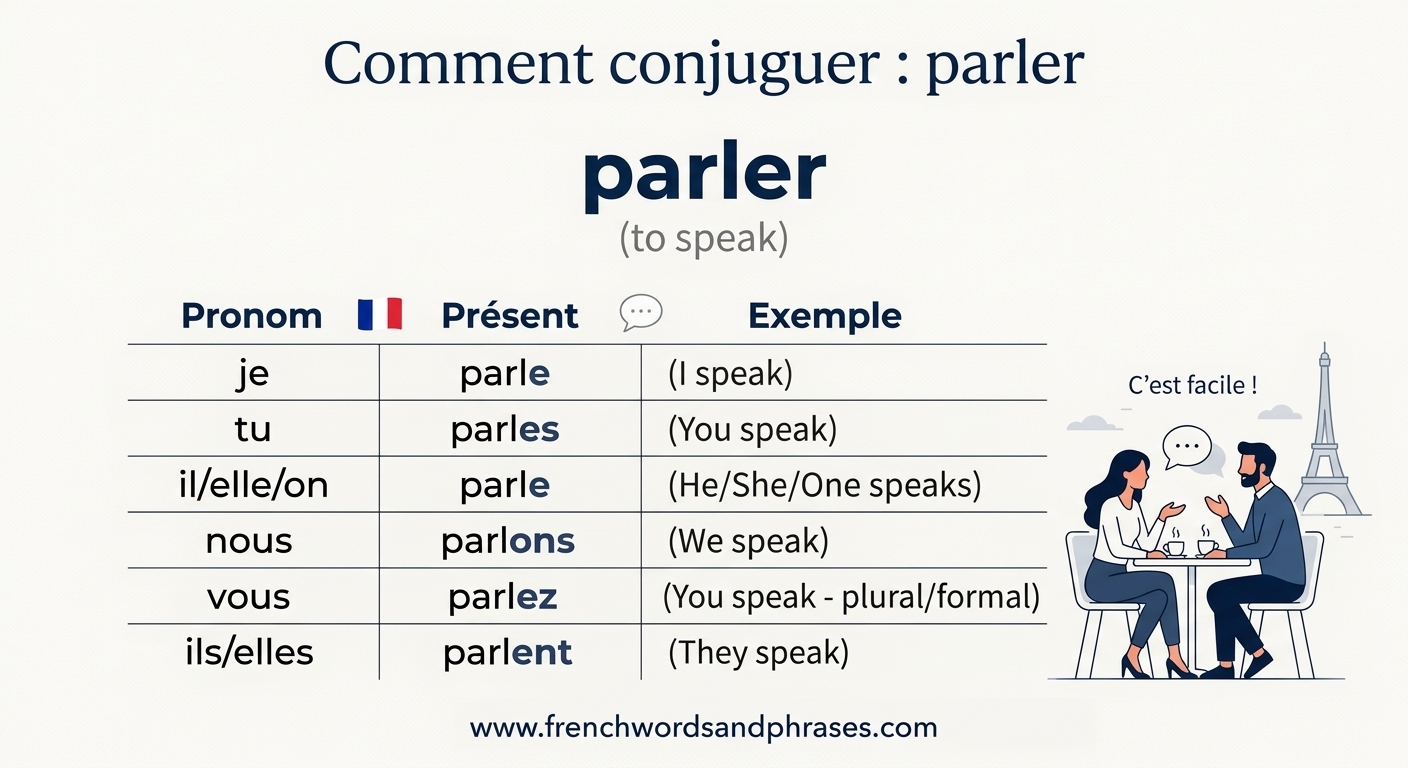
How to Conjugate Parler in the Présent
The present tense describes actions happening now, regular habits, and general facts. For example, je parle français means “I speak French” or “I am speaking French.”
| Subject | Conjugation |
|---|---|
| je | je parle |
| tu | tu parles |
| il/elle | il parle / elle parle |
| nous | nous parlons |
| vous | vous parlez |
| ils/elles | ils parlent / elles parlent |
Example:
Je parle français avec mes amis.
I speak French with my friends.
Quick Quiz
How would you say “We speak French”?
Reveal the answer
Nous parlons français.
How to Conjugate Parler in the Passé Composé
The passé composé describes completed actions in the past. It is formed with the present tense of avoir followed by the past participle parlé.
| Subject | Conjugation |
|---|---|
| je | j’ai parlé |
| tu | tu as parlé |
| il/elle | il a parlé / elle a parlé |
| nous | nous avons parlé |
| vous | vous avez parlé |
| ils/elles | ils ont parlé / elles ont parlé |
Example:
Nous avons parlé pendant deux heures.
We talked for two hours.
How to Conjugate Parler in the Imparfait
The imparfait describes ongoing or repeated actions in the past. It is often used to describe habits, background situations, and things that used to happen.
| Subject | Conjugation |
|---|---|
| je | je parlais |
| tu | tu parlais |
| il/elle | il parlait / elle parlait |
| nous | nous parlions |
| vous | vous parliez |
| ils/elles | ils parlaient / elles parlaient |
Example:
Quand j’étais jeune, je parlais souvent avec mon grand-père.
When I was young, I often talked with my grandfather.
Quick Quiz
Which tense would you use to describe something you regularly did in the past?
Reveal the answer
The imparfait. For example: Je parlais souvent avec lui. – I often used to talk with him.
How to Conjugate Parler in the Plus-que-parfait
The plus-que-parfait describes an action that had already happened before another past action. It is formed with the imparfait of avoir and the past participle parlé.
| Subject | Conjugation |
|---|---|
| je | j’avais parlé |
| tu | tu avais parlé |
| il/elle | il avait parlé / elle avait parlé |
| nous | nous avions parlé |
| vous | vous aviez parlé |
| ils/elles | ils avaient parlé / elles avaient parlé |
Example:
J’avais déjà parlé avec lui avant la réunion.
I had already spoken with him before the meeting.
How to Conjugate Parler in the Passé Simple
The passé simple is a literary past tense mainly found in novels, historical writing, and formal narratives. In everyday conversation, the passé composé is generally used instead.
| Subject | Conjugation |
|---|---|
| je | je parlai |
| tu | tu parlas |
| il/elle | il parla / elle parla |
| nous | nous parlâmes |
| vous | vous parlâtes |
| ils/elles | ils parlèrent / elles parlèrent |
Example:
Il parla avec courage devant le roi.
He spoke courageously before the king.
How to Conjugate Parler in the Passé Antérieur
The passé antérieur is another literary tense. It describes an action completed before another past action, usually in formal storytelling. It is formed with the passé simple of avoir and the past participle parlé.
| Subject | Conjugation |
|---|---|
| je | j’eus parlé |
| tu | tu eus parlé |
| il/elle | il eut parlé / elle eut parlé |
| nous | nous eûmes parlé |
| vous | vous eûtes parlé |
| ils/elles | ils eurent parlé / elles eurent parlé |
Example:
Dès qu’il eut parlé, le silence revint.
As soon as he had spoken, silence returned.
How to Conjugate Parler in the Futur Simple
The futur simple expresses actions that will happen in the future. To form it, add the future endings to the infinitive parler.
| Subject | Conjugation |
|---|---|
| je | je parlerai |
| tu | tu parleras |
| il/elle | il parlera / elle parlera |
| nous | nous parlerons |
| vous | vous parlerez |
| ils/elles | ils parleront / elles parleront |
Example:
Demain, je parlerai à mon professeur.
Tomorrow, I will speak to my teacher.
Quick Quiz
Complete the sentence: “Next week, we will talk.”
Reveal the answer
La semaine prochaine, nous parlerons.
How to Conjugate Parler in the Futur Antérieur
The futur antérieur describes an action that will have been completed before a particular moment in the future. It is formed with the futur simple of avoir and the past participle parlé.
| Subject | Conjugation |
|---|---|
| je | j’aurai parlé |
| tu | tu auras parlé |
| il/elle | il aura parlé / elle aura parlé |
| nous | nous aurons parlé |
| vous | vous aurez parlé |
| ils/elles | ils auront parlé / elles auront parlé |
Example:
À midi, j’aurai parlé avec tous les participants.
By noon, I will have spoken with all the participants.
How to Conjugate Parler in the Futur Proche
The futur proche, or near future, is used for actions that are going to happen soon or are already planned. It is formed with the present tense of aller followed by the infinitive parler.
| Subject | Conjugation |
|---|---|
| je | je vais parler |
| tu | tu vas parler |
| il/elle | il va parler / elle va parler |
| nous | nous allons parler |
| vous | vous allez parler |
| ils/elles | ils vont parler / elles vont parler |
Example:
Je vais parler à mon ami ce soir.
I am going to speak to my friend this evening.
Conditionnel (Conditional Mood)
The conditional mood is used to express possibilities, hypothetical situations, polite requests, and actions that would happen under certain conditions.
How to Conjugate Parler in the Conditionnel Présent
The present conditional often translates as “would speak” or “would talk.” It can also make a request sound more polite.
| Subject | Conjugation |
|---|---|
| je | je parlerais |
| tu | tu parlerais |
| il/elle | il parlerait / elle parlerait |
| nous | nous parlerions |
| vous | vous parleriez |
| ils/elles | ils parleraient / elles parleraient |
Example:
Je parlerais français si je le pouvais.
I would speak French if I could.
How to Conjugate Parler in the Conditionnel Passé
The past conditional describes an action that would have happened but did not. It is formed with the conditional present of avoir and the past participle parlé.
| Subject | Conjugation |
|---|---|
| je | j’aurais parlé |
| tu | tu aurais parlé |
| il/elle | il aurait parlé / elle aurait parlé |
| nous | nous aurions parlé |
| vous | vous auriez parlé |
| ils/elles | ils auraient parlé / elles auraient parlé |
Example:
J’aurais parlé avec elle, mais je n’ai pas eu le temps.
I would have spoken with her, but I didn’t have time.
Conditionnel Passé – Literary Alternative
The following forms are an older literary construction of the past conditional. They are rarely used in modern everyday French, but you may encounter them in classical literature and formal writing.
| Subject | Conjugation |
|---|---|
| je | j’eusse parlé |
| tu | tu eusses parlé |
| il/elle | il eût parlé / elle eût parlé |
| nous | nous eussions parlé |
| vous | vous eussiez parlé |
| ils/elles | ils eussent parlé / elles eussent parlé |
Example:
S’il avait été présent, il eût parlé.
If he had been present, he would have spoken.
Subjonctif (Subjunctive Mood)
The subjunctive is used to express feelings, wishes, doubts, necessities, and uncertainty. It often follows expressions such as il faut que (it is necessary that), je veux que (I want that), and bien que (although).
How to Conjugate Parler in the Subjonctif Présent
The present subjunctive is the most commonly used subjunctive tense. It often appears after expressions of desire, emotion, doubt, or necessity.
| Subject | Conjugation |
|---|---|
| que je | que je parle |
| que tu | que tu parles |
| qu’il/qu’elle | qu’il parle / qu’elle parle |
| que nous | que nous parlions |
| que vous | que vous parliez |
| qu’ils/qu’elles | qu’ils parlent / qu’elles parlent |
Example:
Il faut que tu parles avec ton professeur.
You need to speak with your teacher.
How to Conjugate Parler in the Subjonctif Imparfait
The imperfect subjunctive is a literary tense rarely used in modern spoken French. It is mainly found in older literature and highly formal writing.
| Subject | Conjugation |
|---|---|
| que je | que je parlasse |
| que tu | que tu parlasses |
| qu’il/qu’elle | qu’il parlât / qu’elle parlât |
| que nous | que nous parlassions |
| que vous | que vous parlassiez |
| qu’ils/qu’elles | qu’ils parlassent / qu’elles parlassent |
Example:
Il souhaitait qu’elle parlât plus clairement.
He wished that she would speak more clearly.
How to Conjugate Parler in the Subjonctif Plus-que-parfait
The pluperfect subjunctive is a literary form used to describe an action that had already happened in a past context. It is rarely used in everyday French.
| Subject | Conjugation |
|---|---|
| que je | que j’eusse parlé |
| que tu | que tu eusses parlé |
| qu’il/qu’elle | qu’il eût parlé / qu’elle eût parlé |
| que nous | que nous eussions parlé |
| que vous | que vous eussiez parlé |
| qu’ils/qu’elles | qu’ils eussent parlé / qu’elles eussent parlé |
Example:
Je doutais qu’il eût parlé à son directeur.
I doubted that he had spoken to his director.
How to Conjugate Parler in the Subjonctif Passé
The past subjunctive describes an action that has been completed. It is formed with the present subjunctive of avoir and the past participle parlé.
| Subject | Conjugation |
|---|---|
| que je | que j’aie parlé |
| que tu | que tu aies parlé |
| qu’il/qu’elle | qu’il ait parlé / qu’elle ait parlé |
| que nous | que nous ayons parlé |
| que vous | que vous ayez parlé |
| qu’ils/qu’elles | qu’ils aient parlé / qu’elles aient parlé |
Example:
Je suis heureux que tu aies parlé avec elle.
I am happy that you spoke with her.
Impératif (Imperative Mood)
The imperative is used to give commands, make requests, or offer advice. It is commonly used without a subject pronoun.
How to Conjugate Parler in the Impératif Présent
The imperative of parler has three forms: parle, parlons, and parlez. Notice that the second-person singular form drops the final -s, as is typical for regular -er verbs.
| Subject | Conjugation |
|---|---|
| (tu) | parle |
| (nous) | parlons |
| (vous) | parlez |
Examples:
Parle plus lentement, s’il te plaît.
Speak more slowly, please.
Parlons de nos projets.
Let’s talk about our plans.
Quick Quiz
How would you tell someone informally to speak French?
Reveal the answer
Parle français !
Speak French!
French Participles: Parlant and Parlé
French participles are useful for forming compound tenses and describing actions. The verb parler has a present participle and a past participle.
Present Participle: Parlant
The present participle of parler is parlant. It can describe an action taking place at the same time as another action. It also appears in expressions using en + present participle.
Present participle:
parlant
Example:
En parlant avec elle, j’ai appris beaucoup de choses.
By talking with her, I learned many things.
Past Participle: Parlé
The past participle of parler is parlé. It is used to form compound tenses, including the passé composé, plus-que-parfait, and futur antérieur.
Because parler uses avoir, the past participle normally does not agree with the subject. When a preceding direct object requires agreement, its ending can change:
- parlé – Masculine singular
- parlés – Masculine plural
- parlée – Feminine singular
- parlées – Feminine plural
Example:
Les langues que j’ai parlées sont le français et l’anglais.
The languages that I have spoken are French and English.
Parler in Everyday French: Six Useful Examples
Here are six examples showing how parler appears in different tenses and everyday situations.
1. Present – A language you speak
Je parle français et anglais.
I speak French and English.
2. Passé composé – A conversation that happened
J’ai parlé avec mon voisin ce matin.
I spoke with my neighbor this morning.
3. Imparfait – A past habit
Nous parlions souvent de nos voyages.
We often talked about our travels.
4. Futur simple – A future conversation
Je te parlerai demain.
I will talk to you tomorrow.
5. Conditional – A hypothetical situation
Je parlerais davantage si j’avais plus de temps.
I would speak more if I had more time.
6. Subjunctive – Expressing a necessity
Il faut que nous parlions ensemble.
We need to talk together.
Beyond Translation: Understanding Parler
Although parler is usually translated as “to speak” or “to talk,” its meaning depends on the context and the words that accompany it.
Parler une langue
Use parler when describing the languages someone speaks.
Elle parle trois langues.
She speaks three languages.
Parler à Quelqu’un
Use parler à when identifying the person you are speaking to.
Je dois parler à mon patron.
I need to speak to my boss.
Parler de Quelque Chose
Use parler de when introducing the subject of a conversation.
Ils parlent de politique.
They are talking about politics.
Parler Couramment
The expression parler couramment means to speak fluently.
Il parle couramment le français.
He speaks French fluently.
How to Remember the Conjugation of Parler
Because parler is a regular -er verb, it is a useful model for learning the first-group conjugation pattern.
Start by remembering the present-tense endings:
- je: -e
- tu: -es
- il/elle: -e
- nous: -ons
- vous: -ez
- ils/elles: -ent
These endings appear in the present tense of many regular -er verbs. Once you are comfortable with parler, you can use the same pattern to help conjugate verbs such as aimer (to like), chanter (to sing), and danser (to dance).
Also remember the two important participles:
- parlant – present participle
- parlé – past participle
Practice using the verb in complete sentences rather than memorizing isolated forms. A little conversation every day can make a big difference.
Test Your Knowledge of Parler
Try these five questions to see how well you remember the conjugation and use of parler.
Question 1
Which is the correct present-tense form for nous?
Reveal the answer
Nous parlons.
Question 2
How do you say “I spoke” using the passé composé?
Reveal the answer
J’ai parlé.
Question 3
What is the correct futur simple form for tu?
Reveal the answer
Tu parleras.
Question 4
Which preposition is used in the expression “to talk about something”?
Reveal the answer
De. For example: parler de musique – to talk about music.
Question 5
What is the past participle of parler?
Reveal the answer
Parlé.
Your Final Challenge
Translate the following sentence into French:
“Tomorrow, I will speak French with my friends.”
Reveal the answer
Demain, je parlerai français avec mes amis.
Tomorrow, I will speak French with my friends.
A little French. A little curiosity. A richer everyday life.
LEARN FRENCH ONE WORD AT A TIME