A French Word to Live By
Translate Mardi to English
/maʁ.di/
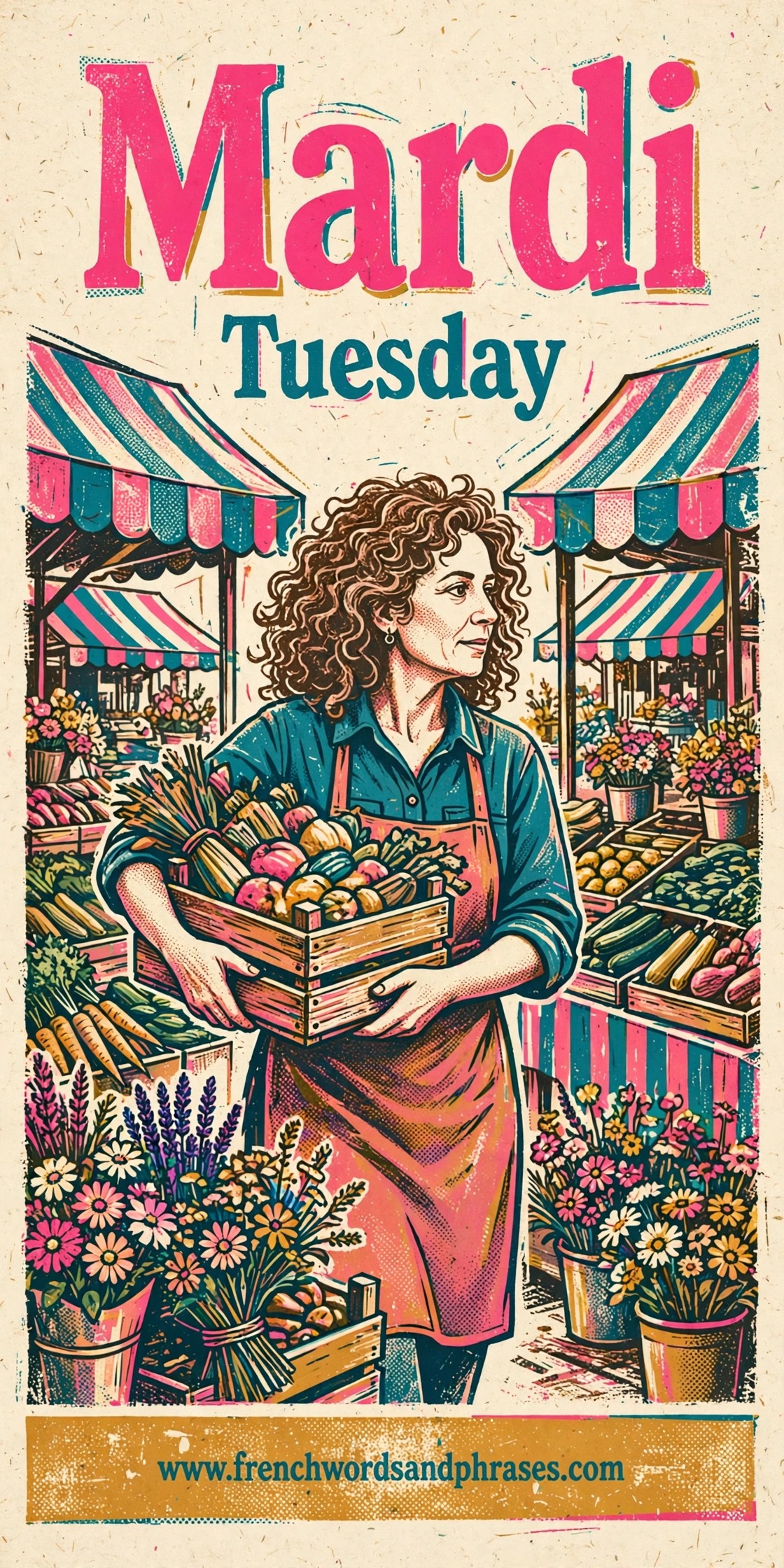
Le mardi means Tuesday.
The week is launched, the Monday fog has lifted, and the diary turns its page to mardi — Tuesday, the week’s most ordinary day, until carnival turns it into a feast.
In this guide, you’ll learn what mardi means in English, how to use it with its articles, how to form its plural, and how it appears in everyday French. Explore French examples, English translations, and practice quizzes.
Understanding the French Noun Mardi
Mardi is a masculine French noun, learned with its article: le mardi. Like every French day, it takes no capital letter, and it follows the great day rule: on its own — mardi prochain — it names one specific Tuesday; with le — le mardi — it means every Tuesday, Tuesdays as a habit.
It means Tuesday — the second day of the working week, named for Mars, the god of war: you can still see his name at the start of the word, Mar-di. Most of the year mardi is a quiet, hard-working day — except for one glorious exception, mardi gras, Fat Tuesday, the day of carnival and crêpes before Lent begins.
Gender: Masculine
Definite article: le — le mardi (on Tuesdays, every Tuesday); no article for one specific Tuesday
Indefinite article: un — un mardi (one Tuesday, a Tuesday)
Plural: les mardis
Capital letter: None — mardi, with a small m
English equivalents: Tuesday.
One important usage detail: mardi follows the same rhythm as lundi. Mardi, je reste à la maison — this Tuesday, I am staying home. Le mardi, je reste à la maison — on Tuesdays, I stay home. And in February or March, watch for the two words that change everything: mardi gras.
Experience the Word
Mardi is more than a day. Fifty weeks a year it is the week’s quiet engine room — but when carnival comes, mardi puts on a costume and eats crêpes in the street.
Imagine mardi gras in Dunkerque or Nice: drums, confetti, children in disguise, and the smell of hot crêpes and gaufres floating over the crowd.
You have not just named a day. You have tasted Tuesday at its wildest — le mardi gras.
How to Use Mardi in French: Complete Guide
Let’s explore how mardi works in French, beginning with its articles — bare mardi for one Tuesday, le mardi for every Tuesday.
Mardi with the Definite Article (Le, Les)
Bare mardi names one day, le mardi names the weekly habit, les mardis names them all.
| Form | French |
|---|---|
| One specific Tuesday | mardi (no article) |
| Every Tuesday, on Tuesdays | le mardi |
| Plural | les mardis |
Example
Le mardi, nous avons réunion d’équipe à dix heures.
On Tuesdays, we have a team meeting at ten o’clock.
Mardi with the Indefinite Article (Un, Des)
Un mardi picks out one Tuesday among others — very often the famous one, mardi gras.
| Form | French |
|---|---|
| Masculine singular | un mardi |
| Plural | des mardis |
| A Tuesday evening | un mardi soir |
Example
Un mardi soir, nous sommes allés au cinéma en famille.
One Tuesday evening, we went to the cinema as a family.
Mardi with Quantities (Chaque, Tous les…)
Days have no partitive article — you cannot have « some of Tuesday ». French counts Tuesdays with rhythms and quantities instead.
| Quantity | French |
|---|---|
| every Tuesday | chaque mardi |
| every Tuesday (the whole set) | tous les mardis |
| every other Tuesday | un mardi sur deux |
| several Tuesdays | plusieurs mardis |
| the first Tuesday of the month | le premier mardi du mois |
Example
Le club de lecture se réunit le premier mardi du mois.
The book club meets on the first Tuesday of the month.
Quick Quiz 1
Your choir rehearses every Tuesday. Complete the sentence:
______ nous avons répétition de chorale.
Reveal the answer
Le mardi
Le mardi, nous avons répétition de chorale.
On Tuesdays, we have choir practice — le makes it a weekly habit.
The Plural of Mardi
Mardi adds an -s in the plural — les mardis, all the Tuesdays on the calendar.
| Number | French |
|---|---|
| Singular | mardi / le mardi |
| Plural | les mardis |
Example
Les mardis de ce mois-ci sont tous pris.
The Tuesdays of this month are all taken.
Mardi with Possessive Adjectives (Mon, Ton, Son…)
In diary talk, the day can belong to you: mon mardi, my Tuesday, as it stands in your agenda.
| Owner | French |
|---|---|
| my | mon mardi |
| your (tu) | ton mardi |
| his / her | son mardi |
| our | notre mardi |
| your (vous) | votre mardi |
| their | leur mardi |
Example
Mon mardi est libre, on peut déplacer le rendez-vous.
My Tuesday is free, we can move the appointment.
Quick Quiz 2
Complete the sentence:
______ mardi est rempli de rendez-vous. (Our)
Reveal the answer
Notre
Notre mardi est rempli de rendez-vous.
Our Tuesday is full of appointments — the possessive agrees with mardi, masculine.
Mardi with Demonstrative Adjectives (Ce, Ces)
Used to point at the Tuesday you mean: ce mardi, this Tuesday in the diary.
| Form | French |
|---|---|
| Masculine singular | ce mardi |
| Plural | ces mardis |
Example
Ce mardi, la réunion commence plus tôt que d’habitude.
This Tuesday, the meeting starts earlier than usual.
Mardi with Adjectives
Adjectives agree with mardi — masculine: un mardi chargé, and one adjective turns it into a festival: gras.
| Adjective | With Mardi |
|---|---|
| chargé (busy, packed) | un mardi chargé |
| pluvieux (rainy) | un mardi pluvieux |
| ensoleillé (sunny) | un mardi ensoleillé |
| gras (fat — the carnival day) | mardi gras |
| prochain (next) | mardi prochain |
| dernier (last) | mardi dernier |
Example
Pour mardi gras, les enfants se déguisent et mangent des crêpes.
For Mardi Gras, the children dress up and eat crêpes.
Quick Quiz 3
Complete the sentence:
On se téléphone ______ prochain pour décider. (next Tuesday)
Reveal the answer
mardi
On se téléphone mardi prochain pour décider.
We’ll call each other next Tuesday to decide — a specific day takes no article.
Everyday Expressions with Mardi
Carnivals, crêpes and ordinary Tuesdays — the mardi phrases of daily life.
| Expression | In English |
|---|---|
| mardi gras | Mardi Gras, Shrove Tuesday |
| mardi prochain | next Tuesday |
| mardi dernier | last Tuesday |
| à mardi ! | see you on Tuesday! |
| le mardi soir | on Tuesday evening(s) |
| faire des crêpes pour mardi gras | to make crêpes for Mardi Gras |
Example
À mardi ! Et n’oublie pas le dossier.
See you Tuesday! And don’t forget the file.
Words from the Same Family as Mardi
Mars, carnival and crêpes — the words that travel with mardi.
| French | In English |
|---|---|
| Mars | Mars, the god and the planet (mardi is his day) |
| le carnaval | the carnival |
| la crêpe | the crêpe, the thin pancake |
| le déguisement | the costume, the fancy dress |
| le jour | the day |
| la semaine | the week |
Example
Le carnaval se termine toujours par mardi gras.
Carnival always ends with Mardi Gras.
Quick Quiz 4
What is mardi gras?
Reveal the answer
Mardi Gras — Shrove Tuesday, the carnival day of costumes and crêpes, just before Lent.
Pour mardi gras, toute l’école se déguise.
For Mardi Gras, the whole school dresses up.
Mardi in Everyday French: Real-Life Examples
Now that you know the word, let’s see how mardi appears in everyday French.
Example 1 — A weekly meeting
Le mardi, l’équipe se réunit à neuf heures précises.
On Tuesdays, the team meets at nine o’clock sharp.
Example 2 — Making a plan
Tu es libre mardi prochain pour un café ?
Are you free next Tuesday for a coffee?
Example 3 — Carnival time
Pour mardi gras, ma fille se déguise en princesse.
For Mardi Gras, my daughter is dressing up as a princess.
Example 4 — At the market
Le mardi matin, il y a un petit marché sur la place.
On Tuesday mornings, there is a small market on the square.
Example 5 — Saying goodbye
Bon, je te laisse — à mardi !
Right, I’ll let you go — see you Tuesday!
Example 6 — A rainy day
C’était un mardi pluvieux, tout le monde est resté à l’intérieur.
It was a rainy Tuesday, everyone stayed inside.
Beyond Translation: The Meaning of Mardi
Mardi hides a feast inside an ordinary day. For fifty weeks it is the week’s anonymous worker — then comes mardi gras, when Dunkerque sings in the streets, Nice throws flowers, and every French kitchen smells of crêpes and gaufres. The « gras », the fat, is the point: one last rich feast before the lean weeks of Lent, and the crêpe — round, golden, sun-shaped — is its edible flag.
To say mardi is to keep a carnival folded inside the working week.
It evokes Mars, the Roman god whose name it still carries, the school costume tried on the night before, and the ordinary Tuesdays that make the feast possible.
How to Remember the French Noun Mardi
Remember it this way: Mardi is Tuesday — the day of Mars, masculine, small letter, and it obeys the day rule: no article for one Tuesday, le for every Tuesday.
- You mean one Tuesday — mardi prochain, no article at all.
- You mean every Tuesday — le mardi, with le.
- You see costumes and crêpes — mardi gras, the year’s best Tuesday.
The key idea is mardi = one Tuesday; le mardi = every Tuesday.
Test Your Knowledge of Mardi
Let’s see how much you’ve learned. Try answering these questions before revealing the answers.
Question 1
How do you say « on Tuesdays » (every Tuesday)?
Reveal the answer
Le mardi — the definite article turns the day into a habit.
Question 2
Is mardi masculine or feminine?
Reveal the answer
Masculine — le mardi, un mardi. All seven days are masculine.
Question 3
Translate: See you on Tuesday!
Reveal the answer
À mardi !
Question 4
What do French children traditionally eat for mardi gras?
Reveal the answer
Des crêpes — thin pancakes, with gaufres (waffles) and beignets at carnival time.
Question 5
Complete the sentence:
______ nous avons cours de danse. (On Tuesdays)
Reveal the answer
Le mardi
Le mardi, nous avons cours de danse.
On Tuesdays, we have dance class.
Your Final Challenge
Can You Use It?
How would you say this in French?
“For Mardi Gras, we eat crêpes.”
Reveal the answer
Pour mardi gras, on mange des crêpes.
For Mardi Gras, we eat crêpes.
A little French. A little curiosity. A richer everyday life.
LEARN FRENCH ONE WORD AT A TIME