A French Word to Live By
Translate Mercredi to English
/mɛʁ.kʁə.di/
Le mercredi means Wednesday.
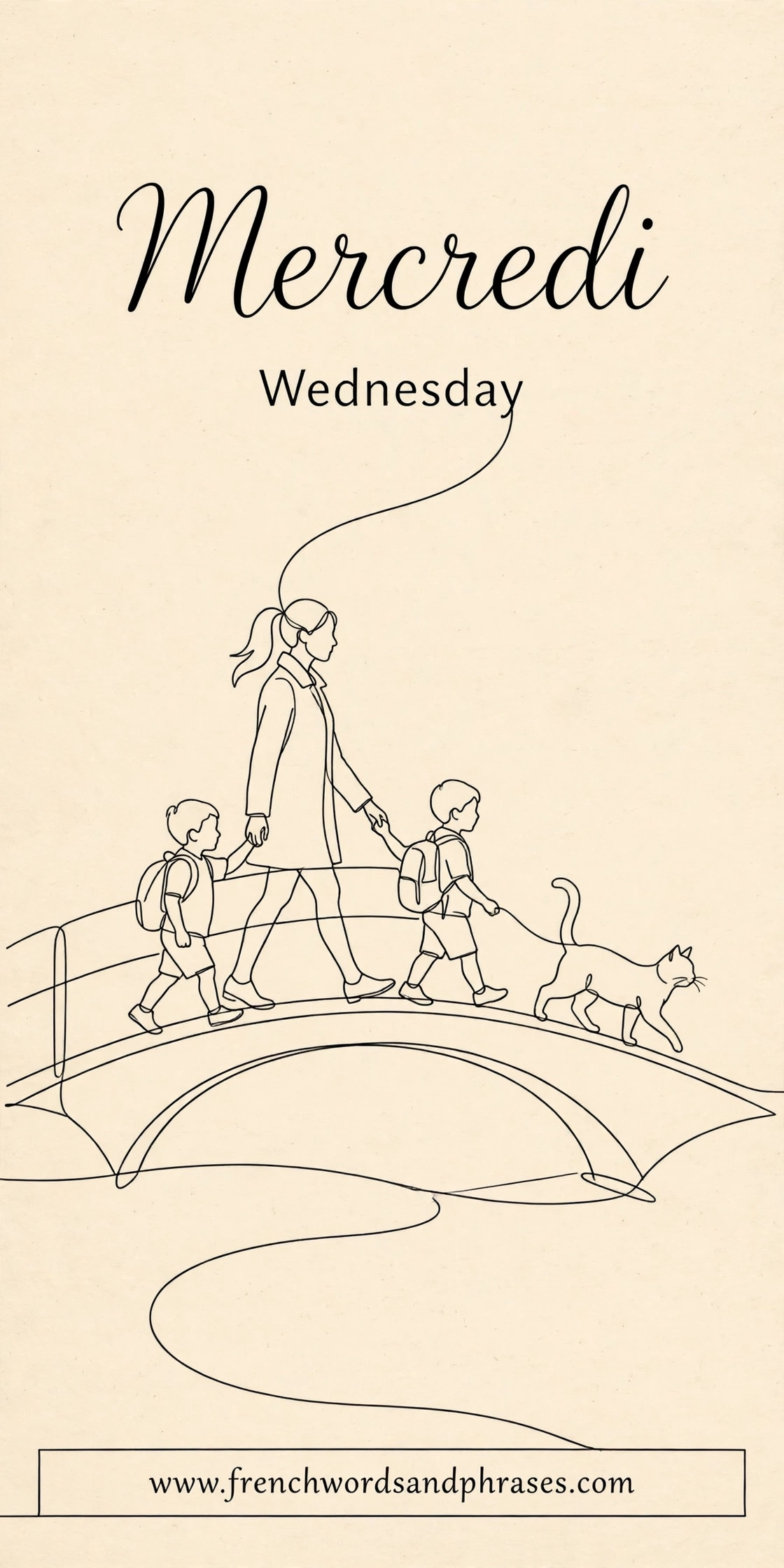
Mid-morning, and the school gates open early: satchels bounce, scooters roll, and the afternoon belongs to football, music and grandparents. It is mercredi — Wednesday, the children’s day.
In this guide, you’ll learn what mercredi means in English, how to use it with its articles, how to form its plural, and how it appears in everyday French. Explore French examples, English translations, and practice quizzes.
Understanding the French Noun Mercredi
Mercredi is a masculine French noun, learned with its article: le mercredi. Like every French day it takes no capital letter, and it follows the great day rule: on its own — mercredi prochain — it names one specific Wednesday; with le — le mercredi — it means every Wednesday, Wednesdays as a habit.
It means Wednesday — the middle of the week, named for Mercury: Mercre-di, the day of the swift messenger god. In France, mercredi has a second identity: it is traditionally the children’s day, when primary schools close or finish early and the afternoon fills with sport, music lessons and the centre de loisirs.
Gender: Masculine
Definite article: le — le mercredi (on Wednesdays, every Wednesday); no article for one specific Wednesday
Indefinite article: un — un mercredi (one Wednesday, a Wednesday)
Plural: les mercredis
Capital letter: None — mercredi, with a small m
English equivalents: Wednesday.
One important usage detail: mercredi is the day French parents organise their week around. Le mercredi après-midi — Wednesday afternoon — is when children are at the club, the conservatoire or their grandparents’. Say le mercredi for the weekly rhythm, bare mercredi for one date: « Mercredi, les enfants n’ont pas école. »
Experience the Word
Mercredi is more than a day. It is the week’s halfway house for children — a small Sunday hidden in the middle of the working week.
Imagine the scene: bikes lined up at the sports hall, a violin case under one small arm, grand-mère waiting at the gate with the goûter in her bag.
You have not just named a day. You have heard the school bell ring early — le mercredi des enfants.
How to Use Mercredi in French: Complete Guide
Let’s explore how mercredi works in French, beginning with its articles — bare mercredi for one Wednesday, le mercredi for every Wednesday.
Mercredi with the Definite Article (Le, Les)
Bare mercredi names one day, le mercredi names the weekly habit, les mercredis names them all.
| Form | French |
|---|---|
| One specific Wednesday | mercredi (no article) |
| Every Wednesday, on Wednesdays | le mercredi |
| Plural | les mercredis |
Example
Le mercredi, les enfants vont au centre de loisirs.
On Wednesdays, the children go to the leisure centre.
Mercredi with the Indefinite Article (Un, Des)
Un mercredi picks out one Wednesday among others — often one that stands out.
| Form | French |
|---|---|
| Masculine singular | un mercredi |
| Plural | des mercredis |
| A Wednesday afternoon | un mercredi après-midi |
Example
Un mercredi après-midi, nous avons visité le musée en famille.
One Wednesday afternoon, we visited the museum as a family.
Mercredi with Quantities (Chaque, Tous les…)
Days have no partitive article — you cannot have « some of Wednesday ». French counts Wednesdays with rhythms and quantities instead.
| Quantity | French |
|---|---|
| every Wednesday | chaque mercredi |
| every Wednesday (the whole set) | tous les mercredis |
| every other Wednesday | un mercredi sur deux |
| several Wednesdays | plusieurs mercredis |
| the last Wednesday of the month | le dernier mercredi du mois |
Example
Elle garde ses petits-enfants un mercredi sur deux.
She looks after her grandchildren every other Wednesday.
Quick Quiz 1
Your son has football training every Wednesday. Complete the sentence:
______ mon fils a entraînement de foot.
Reveal the answer
Le mercredi
Le mercredi, mon fils a entraînement de foot.
On Wednesdays, my son has football training — le makes it a weekly habit.
The Plural of Mercredi
Mercredi adds an -s in the plural — les mercredis, all the Wednesdays of the term.
| Number | French |
|---|---|
| Singular | mercredi / le mercredi |
| Plural | les mercredis |
Example
Tous les mercredis du trimestre sont consacrés au sport.
Every Wednesday of the term is given over to sport.
Mercredi with Possessive Adjectives (Mon, Ton, Son…)
In diary talk, the day can belong to you: mon mercredi, my Wednesday, as it stands in your agenda.
| Owner | French |
|---|---|
| my | mon mercredi |
| your (tu) | ton mercredi |
| his / her | son mercredi |
| our | notre mercredi |
| your (vous) | votre mercredi |
| their | leur mercredi |
Example
Mon mercredi est réservé aux enfants, je ne travaille pas.
My Wednesday is set aside for the children, I don’t work.
Quick Quiz 2
Complete the sentence:
______ mercredi est libre pour le rendez-vous. (Their)
Reveal the answer
Leur
Leur mercredi est libre pour le rendez-vous.
Their Wednesday is free for the appointment — the possessive agrees with mercredi, masculine.
Mercredi with Demonstrative Adjectives (Ce, Ces)
Used to point at the Wednesday you mean: ce mercredi, this Wednesday in the diary.
| Form | French |
|---|---|
| Masculine singular | ce mercredi |
| Plural | ces mercredis |
Example
Ce mercredi, l’école finit à midi.
This Wednesday, school finishes at noon.
Mercredi with Adjectives
Adjectives agree with mercredi — masculine: un mercredi chargé, un mercredi ensoleillé.
| Adjective | With Mercredi |
|---|---|
| chargé (busy, packed) | un mercredi chargé |
| libre (free) | un mercredi libre |
| ensoleillé (sunny) | un mercredi ensoleillé |
| pluvieux (rainy) | un mercredi pluvieux |
| prochain (next) | mercredi prochain |
| dernier (last) | mercredi dernier |
Example
Après un mercredi chargé, les enfants dorment tôt.
After a busy Wednesday, the children sleep early.
Quick Quiz 3
Complete the sentence:
On se voit ______ prochain chez mamie ! (next Wednesday)
Reveal the answer
mercredi
On se voit mercredi prochain chez mamie !
See you next Wednesday at grandma’s! — a specific day takes no article.
Everyday Expressions with Mercredi
Children, Ash Wednesday and midweek plans — the mercredi phrases of daily life.
| Expression | In English |
|---|---|
| le mercredi après-midi | on Wednesday afternoon(s) |
| le mercredi des Cendres | Ash Wednesday |
| mercredi prochain | next Wednesday |
| mercredi dernier | last Wednesday |
| à mercredi ! | see you on Wednesday! |
| le jour des enfants | the children’s day (Wednesday’s nickname) |
Example
Le mercredi des Cendres marque le début du carême.
Ash Wednesday marks the beginning of Lent.
Words from the Same Family as Mercredi
Mercury, children and midweek — the words that travel with mercredi.
| French | In English |
|---|---|
| Mercure | Mercury, the god and the planet (mercredi is his day) |
| l’enfant | the child |
| le centre de loisirs | the leisure centre, the activity club |
| le jour | the day |
| la semaine | the week |
| la mi-semaine | midweek |
Example
La mi-semaine, c’est mercredi : la semaine est à moitié faite.
Midweek is Wednesday: the week is half done.
Quick Quiz 4
What is le mercredi des Cendres?
Reveal the answer
Ash Wednesday — the first day of Lent, the day after mardi gras.
Le carême commence le mercredi des Cendres.
Lent begins on Ash Wednesday.
Mercredi in Everyday French: Real-Life Examples
Now that you know the word, let’s see how mercredi appears in everyday French.
Example 1 — The children’s day
Le mercredi, les enfants n’ont pas école l’après-midi.
On Wednesdays, the children have no school in the afternoon.
Example 2 — Making a plan
On emmène les petits au parc mercredi prochain ?
Shall we take the little ones to the park next Wednesday?
Example 3 — At the sports hall
Son mercredi est partagé entre le judo et la musique.
His Wednesday is split between judo and music.
Example 4 — Saying goodbye
À mercredi ! N’oublie pas ton cartable.
See you Wednesday! Don’t forget your schoolbag.
Example 5 — Grandparents on duty
Le mercredi, mamie garde les enfants jusqu’au soir.
On Wednesdays, grandma looks after the children until the evening.
Example 6 — Midweek feeling
Mercredi déjà ! La semaine passe vite.
Wednesday already! The week is going fast.
Beyond Translation: The Meaning of Mercredi
No day shows French family life better than mercredi. For generations, primary schools closed on Wednesday, and although reforms have shuffled the timetable, the rhythm survives: Wednesday afternoon still belongs to the centre de loisirs, the sports club, the music school — and to grandparents, the week’s reserve army. Working parents plan around it; employers know it; the whole country breathes differently at midweek.
To say mercredi is to hear the school gate open at noon.
It evokes Mercury, the quick god it is named for, the goûter in the schoolbag, and the small midweek Sunday that French children are given and French adults remember.
How to Remember the French Noun Mercredi
Remember it this way: Mercredi is Wednesday — the day of Mercury (Mercure), masculine, small letter, and the children’s day: no article for one Wednesday, le for every Wednesday.
- You mean one Wednesday — mercredi prochain, no article at all.
- You mean every Wednesday — le mercredi, with le.
- You see children everywhere — le mercredi, c’est le jour des enfants.
The key idea is mercredi = one Wednesday; le mercredi = every Wednesday.
Test Your Knowledge of Mercredi
Let’s see how much you’ve learned. Try answering these questions before revealing the answers.
Question 1
How do you say « on Wednesdays » (every Wednesday)?
Reveal the answer
Le mercredi — the definite article turns the day into a habit.
Question 2
Is mercredi masculine or feminine?
Reveal the answer
Masculine — le mercredi, un mercredi. All seven days are masculine.
Question 3
Translate: See you on Wednesday!
Reveal the answer
À mercredi !
Question 4
Why is mercredi called the children’s day in France?
Reveal the answer
Because primary schools traditionally close or finish early on Wednesdays — the afternoon belongs to sport, music and the centre de loisirs.
Question 5
Complete the sentence:
______ les enfants vont chez leurs grands-parents. (On Wednesdays)
Reveal the answer
Le mercredi
Le mercredi, les enfants vont chez leurs grands-parents.
On Wednesdays, the children go to their grandparents’ house.
Your Final Challenge
Can You Use It?
How would you say this in French?
“On Wednesday afternoon, the children have no school.”
Reveal the answer
Le mercredi après-midi, les enfants n’ont pas école.
On Wednesday afternoon, the children have no school.
A little French. A little curiosity. A richer everyday life.
LEARN FRENCH ONE WORD AT A TIME