A French Word to Live By
Translate Lundi to English
/lœ̃.di/
Le lundi means Monday.
The alarm rings too early, the coffee is too weak, and the whole week stretches out ahead: it can only be lundi — Monday, the day everything starts again.
In this guide, you’ll learn what lundi means in English, how to use it with its articles, how to form its plural, and how it appears in everyday French. Explore French examples, English translations, and practice quizzes.
Understanding the French Noun Lundi
Lundi is a masculine French noun, learned with its article: le lundi. But watch how it behaves: used on its own, with no article at all — lundi prochain, next Monday — it names one specific day. With le in front — le lundi — it means every Monday, Mondays in general. And unlike English, French days take no capital letter: lundi, always with a small l.
It means Monday — the first working day of the week in France, when offices reopen, children go back to school and the weekend quietly closes behind you. Lundi comes from the Latin for the day of the Moon — le jour de la lune — and you can still hear the moon inside it: lune, lundi.
Gender: Masculine
Definite article: le — le lundi (on Mondays, every Monday); no article for one specific Monday
Indefinite article: un — un lundi (one Monday, a Monday)
Plural: les lundis
Capital letter: None — French days are written with a small letter: lundi
English equivalents: Monday.
One important usage detail: the little word le changes everything. Lundi, je travaille — this Monday, I am working. Le lundi, je travaille — on Mondays, I work, every week. And to say goodbye until Monday, French uses à: « À lundi ! » — see you on Monday!
Experience the Word
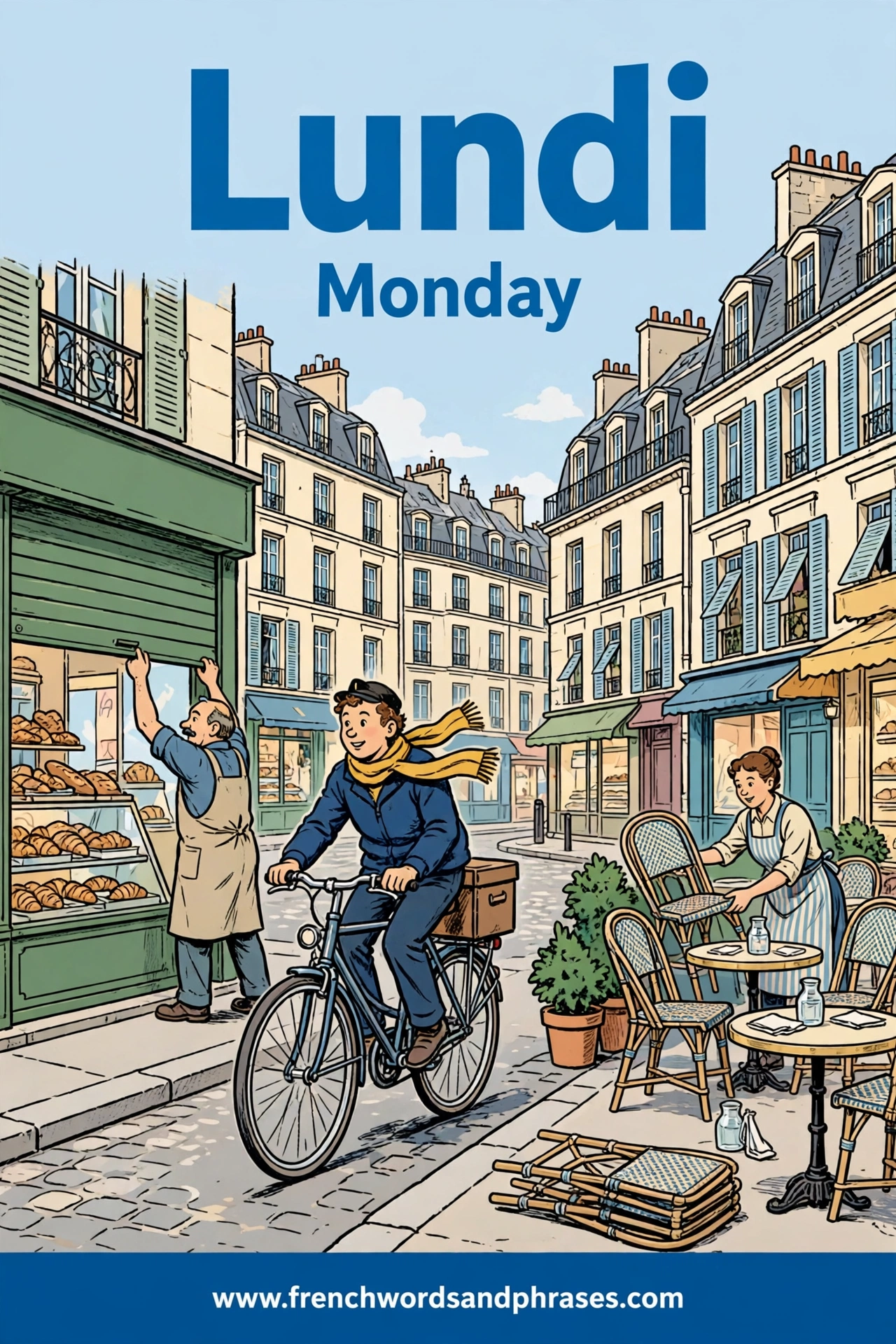
Lundi is more than a day. It is the hinge of the French week — the morning the boulangerie queue reforms, the traffic returns, and a whole country sighs and starts again.
Imagine it: the shutters rattling up, the first café crème at the zinc counter, the diary opening on a page still blank — everything is possible, and everything is due.
You have not just named a day. You have felt the week begin — le lundi, the great restart.
How to Use Lundi in French: Complete Guide
Let’s explore how lundi works in French, beginning with its articles — and the famous trick: no article for one Monday, le for every Monday.
Lundi with the Definite Article (Le, Les)
The article is the whole lesson: bare lundi names one day, le lundi names the habit, les lundis names them all.
| Form | French |
|---|---|
| One specific Monday | lundi (no article) |
| Every Monday, on Mondays | le lundi |
| Plural | les lundis |
Example
Le lundi, le musée est fermé.
On Mondays, the museum is closed.
Lundi with the Indefinite Article (Un, Des)
Un lundi picks out one Monday among others — often with an adjective to describe it.
| Form | French |
|---|---|
| Masculine singular | un lundi |
| Plural | des lundis |
| A Monday morning | un lundi matin |
Example
C’était un lundi pluvieux, parfait pour rester au lit.
It was a rainy Monday, perfect for staying in bed.
Lundi with Quantities (Chaque, Tous les…)
Days have no partitive article — you cannot have « some of Monday ». What French uses instead are rhythms and quantities.
| Quantity | French |
|---|---|
| every Monday | chaque lundi |
| every Monday (the whole set) | tous les lundis |
| every other Monday | un lundi sur deux |
| several Mondays | plusieurs lundis |
| two Mondays a month | deux lundis par mois |
Example
Nous avons cours de français un lundi sur deux.
We have French class every other Monday.
Quick Quiz 1
You swim every Monday, week after week. Complete the sentence:
______ je vais à la piscine.
Reveal the answer
Le lundi
Le lundi, je vais à la piscine.
On Mondays, I go to the pool — le turns one day into a weekly habit.
The Plural of Lundi
Lundi adds an -s in the plural — les lundis, all the Mondays of the month or the year.
| Number | French |
|---|---|
| Singular | lundi / le lundi |
| Plural | les lundis |
Example
Tous les lundis de septembre sont déjà réservés.
Every Monday in September is already booked.
Lundi with Possessive Adjectives (Mon, Ton, Son…)
In diary talk, French happily gives you ownership of your day: mon lundi, my Monday — the day as it appears in your own agenda.
| Owner | French |
|---|---|
| my | mon lundi |
| your (tu) | ton lundi |
| his / her | son lundi |
| our | notre lundi |
| your (vous) | votre lundi |
| their | leur lundi |
Example
Mon lundi est complètement libre, on peut se voir.
My Monday is completely free, we can meet up.
Quick Quiz 2
Complete the sentence:
______ lundi est chargé de réunions. (His)
Reveal the answer
Son
Son lundi est chargé de réunions.
His Monday is packed with meetings — lundi is masculine, so the possessive is son.
Lundi with Demonstrative Adjectives (Ce, Ces)
Used to point at the Monday you mean: ce lundi, this Monday right here in the diary.
| Form | French |
|---|---|
| Masculine singular | ce lundi |
| Plural | ces lundis |
Example
Ce lundi, exceptionnellement, je ne travaille pas.
This Monday, exceptionally, I’m not working.
Lundi with Adjectives
Adjectives agree with lundi — masculine: un lundi chargé, un lundi ensoleillé.
| Adjective | With Lundi |
|---|---|
| chargé (busy, packed) | un lundi chargé |
| libre (free) | un lundi libre |
| ensoleillé (sunny) | un lundi ensoleillé |
| férié (a public holiday) | un lundi férié |
| prochain (next) | lundi prochain |
| dernier (last) | lundi dernier |
Example
Après un lundi chargé, elle aime se reposer le soir.
After a busy Monday, she likes to rest in the evening.
Quick Quiz 3
Complete the sentence:
On se voit ______ prochain ! (next Monday)
Reveal the answer
lundi
On se voit lundi prochain !
See you next Monday! — prochain follows the day, and a specific day takes no article.
Everyday Expressions with Lundi
Restarts, holidays and goodbyes — the lundi phrases of daily life.
| Expression | In English |
|---|---|
| lundi prochain | next Monday |
| lundi dernier | last Monday |
| à lundi ! | see you on Monday! |
| le lundi matin | on Monday morning(s) |
| le lundi de Pâques | Easter Monday |
| en début de semaine | at the start of the week |
Example
Le lundi de Pâques est un jour férié en France.
Easter Monday is a public holiday in France.
Words from the Same Family as Lundi
Weeks, days and diaries — the words that travel with lundi.
| French | In English |
|---|---|
| la lune | the moon (lundi is the Moon’s day) |
| le jour | the day |
| la semaine | the week |
| le lendemain | the following day |
| le week-end | the weekend |
| le calendrier | the calendar |
Example
La semaine commence le lundi et finit le dimanche.
The week begins on Monday and ends on Sunday.
Quick Quiz 4
What does « À lundi ! » mean?
Reveal the answer
See you on Monday! — à plus the day is the standard French goodbye-until-then.
À lundi, passe un bon week-end !
See you Monday, have a good weekend!
Lundi in Everyday French: Real-Life Examples
Now that you know the word, let’s see how lundi appears in everyday French.
Example 1 — Back to work
Le lundi matin, le bureau se remplit dès huit heures.
On Monday morning, the office fills up from eight o’clock.
Example 2 — A weekly habit
Le lundi, je fais du sport après le travail.
On Mondays, I do sport after work.
Example 3 — Making a plan
On se retrouve lundi prochain pour déjeuner ?
Shall we meet next Monday for lunch?
Example 4 — A closed sign
Désolé, la boutique est fermée le lundi.
Sorry, the shop is closed on Mondays.
Example 5 — A long weekend
Lundi est férié, on part trois jours à la campagne.
Monday is a holiday, we’re going away to the countryside for three days.
Example 6 — Saying goodbye
Bon week-end, et à lundi !
Have a good weekend, and see you Monday!
Beyond Translation: The Meaning of Lundi
Lundi carries a quiet French peculiarity: half the country seems to close on it. Many small shops, bakeries and museums take their weekly rest on Monday, so the traveller who plans a Monday outing learns to check the door first. It is the week’s reset button — the day of fresh diaries, new resolutions and the famous question at the office coffee machine: « Tu as passé un bon week-end ? »
To say lundi is to start the week the French way — slowly, with coffee.
It evokes the moon it is named for, the schoolbag by the door on Sunday night, and the small courage everyone needs on the first morning.
How to Remember the French Noun Lundi
Remember it this way: Lundi is Monday — the day of the Moon (la lune), masculine, written with a small letter, and doubled by one tiny rule: no article for one Monday, le for every Monday.
- You mean one Monday — lundi prochain, no article at all.
- You mean every Monday — le lundi, with le.
- You say goodbye until then — à lundi !
The key idea is lundi = one Monday; le lundi = every Monday.
Test Your Knowledge of Lundi
Let’s see how much you’ve learned. Try answering these questions before revealing the answers.
Question 1
How do you say « on Mondays » (every Monday)?
Reveal the answer
Le lundi — the definite article turns the day into a habit.
Question 2
Is lundi masculine or feminine?
Reveal the answer
Masculine — le lundi, un lundi. All seven days are masculine.
Question 3
Translate: See you on Monday!
Reveal the answer
À lundi !
Question 4
Why is there no capital letter in lundi?
Reveal the answer
French days and months are written with a small letter — lundi, mardi, janvier — capitals are for proper names only.
Question 5
Complete the sentence:
______ je ne travaille jamais, c’est mon jour de repos. (On Mondays)
Reveal the answer
Le lundi
Le lundi, je ne travaille jamais, c’est mon jour de repos.
On Mondays I never work, it’s my day of rest.
Your Final Challenge
Can You Use It?
How would you say this in French?
“On Mondays, the museum is closed.”
Reveal the answer
Le lundi, le musée est fermé.
On Mondays, the museum is closed.
A little French. A little curiosity. A richer everyday life.
LEARN FRENCH ONE WORD AT A TIME