A French Word to Live By
How to Conjugate Se emboire in French
/sɑ̃.bwaʁ/
Se emboire means to smear — to get oneself covered and smeared with something wet, sticky or greasy.
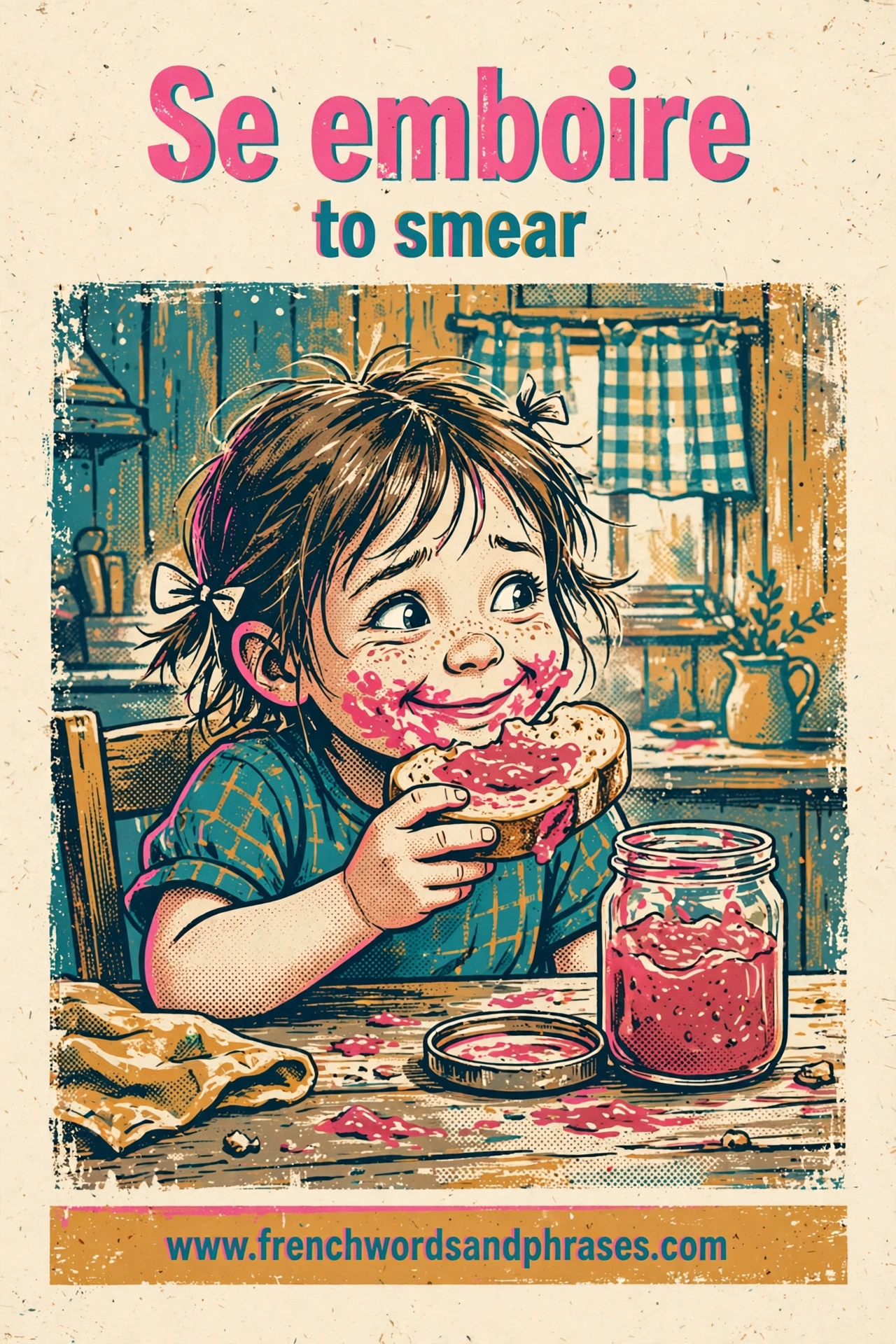
A child at the jam pot, a mechanic under an engine, hands and sleeves dark with grease and sauce — se emboire is a rare, old-fashioned reflexive verb for getting oneself thoroughly smeared: it conjugates exactly like boire, to drink, and survives today mostly as a curiosity of the dictionary.
In this guide, you’ll learn how to conjugate se emboire in all the major French tenses and moods. Explore complete conjugation tables, French examples, English translations, and practice quizzes.
Understanding the French Verb Se emboire
Se emboire is a rare irregular reflexive French verb ending in -oire, conjugated exactly like boire.
It means to smear. It belongs to dictionaries and older texts rather than to conversation; where it appears, its picture is always the same — someone who has been eating, painting or repairing something and ends up wearing a good part of it. Treat it as a boire-family curiosity to recognise, not a verb to reach for.
Verb classification: Irregular (-oire), reflexive
Auxiliary verb: Être
Past participle: embu
Present participle: embuvant
English equivalents: To smear oneself, to get smeared; s’emboire de confiture — to get smeared with jam; s’emboire de graisse — to get covered in grease; s’emboire de boue — to get plastered with mud. A rare verb, conjugated like boire.
One important detail: se emboire is genuinely rare and old-fashioned — most French speakers have never used it, and modern French prefers se barbouiller or s’en mettre partout for a child covered in jam. Its interest is its conjugation, which is exactly that of boire: the stem swings between emboi- and embuv- — je m’embois, nous nous embuvons, ils s’emboivent — with past participle embu. Being reflexive, it takes être and the participle agrees: elle s’est embue de confiture.
Experience the Word
Se emboire is the verb of the meal that ends up on the eater — jam to the elbows, grease to the wrists, sauce everywhere but in the mouth.
Imagine a baby in a high chair a hundred years ago, alone with a pot of plum jam. Two small hands go in, and come out shining. By the time anyone returns, the child s’est embu — face, hair, sleeves — a small, delighted monument to jam, in the days when French had a special verb for exactly this.
Almost nothing was eaten, in the end. It was worn — embu, smeared from head to toe.
How to Conjugate Se emboire: Complete French Conjugation Guide
Let’s explore every major conjugation of se emboire, beginning with the indicative mood.
How to Conjugate Se emboire in the Indicative Mood
The indicative mood is used to express facts, observations, actions, and events.
How to Conjugate Se emboire in the Present Tense (Présent)
Used for actions happening now, habitual actions, and general truths.
| Subject | Conjugation |
|---|---|
| je | m’embois |
| tu | t’embois |
| il / elle | s’emboit |
| nous | nous embuvons |
| vous | vous embuvez |
| ils / elles | s’emboivent |
Example
À chaque goûter, cet enfant s’emboit de confiture jusqu’aux coudes.
At every snack time, that child gets smeared with jam up to his elbows.
Quick Quiz 1
Complete the sentence:
Nous nous ______ de boue sur ce chantier.
Reveal the answer
embuvons
Nous nous embuvons de boue sur ce chantier.
We get plastered with mud on this building site.
How to Conjugate Se emboire in the Passé Composé
Used for completed actions in the past. Se emboire takes the auxiliary verb être.
| Subject | Conjugation |
|---|---|
| je | me suis embu / me suis embue |
| tu | t’es embu / t’es embue |
| il / elle | s’est embu / s’est embue |
| nous | nous sommes embus / nous sommes embues |
| vous | vous êtes embus / vous êtes embues / vous êtes embu / vous êtes embue |
| ils / elles | se sont embus / se sont embues |
Example
Elle s’est embue de graisse en réparant le vieux moteur.
She got covered in grease while repairing the old engine.
How to Conjugate Se emboire in the Imparfait (Imperfect Tense)
Used for habitual past actions, descriptions, and ongoing situations in the past.
| Subject | Conjugation |
|---|---|
| je | m’embuvais |
| tu | t’embuvais |
| il / elle | s’embuvait |
| nous | nous embuvions |
| vous | vous embuviez |
| ils / elles | s’embuvaient |
Example
Le bébé s’embuvait de soupe à presque tous les repas.
The baby used to get smeared with soup at almost every meal.
Quick Quiz 2
Choose the correct form:
She got covered in grease.
Elle ______ de graisse. (s’est embue / a embu)
Reveal the answer
s’est embue
Elle s’est embue de graisse.
Se emboire is reflexive, takes être, and the participle agrees: embue.
How to Conjugate Se emboire in the Plus-que-parfait
Used to describe an action that had already been completed before another past event.
| Subject | Conjugation |
|---|---|
| je | m’étais embu / m’étais embue |
| tu | t’étais embu / t’étais embue |
| il / elle | s’était embu / s’était embue |
| nous | nous étions embus / nous étions embues |
| vous | vous étiez embus / vous étiez embues / vous étiez embu / vous étiez embue |
| ils / elles | s’étaient embus / s’étaient embues |
Example
Il s’était embu de boue bien avant la fin du chantier.
He had got plastered with mud long before the end of the building work.
How to Conjugate Se emboire in the Passé Simple
Primarily used in formal writing, literature, and historical narratives. It is rarely used in everyday conversation.
| Subject | Conjugation |
|---|---|
| je | m’embus |
| tu | t’embus |
| il / elle | s’embut |
| nous | nous embûmes |
| vous | vous embûtes |
| ils / elles | s’emburent |
Example
Le chien s’embut de terre rouge après sa course dans le jardin.
The dog got smeared with red earth after its run in the garden.
How to Conjugate Se emboire in the Passé Antérieur
A literary tense used to express an action completed immediately before another past action, generally in the passé simple.
| Subject | Conjugation |
|---|---|
| je | me fus embu / me fus embue |
| tu | te fus embu / te fus embue |
| il / elle | se fut embu / se fut embue |
| nous | nous fûmes embus / nous fûmes embues |
| vous | vous fûtes embus / vous fûtes embues / vous fûtes embu / vous fûtes embue |
| ils / elles | se furent embus / se furent embues |
Example
Dès qu’elle se fut embue de peinture, elle courut se laver.
As soon as she had got smeared with paint, she ran to wash.
How to Conjugate Se emboire in the Future Tense (Futur Simple)
Used to describe actions that will take place in the future.
| Subject | Conjugation |
|---|---|
| je | m’emboirai |
| tu | t’emboiras |
| il / elle | s’emboira |
| nous | nous emboirons |
| vous | vous emboirez |
| ils / elles | s’emboiront |
Example
Si tu manges comme ça, tu t’emboiras de sauce tomate.
If you eat like that, you will get smeared with tomato sauce.
How to Conjugate Se emboire in the Futur Antérieur (Future Perfect)
Used for an action that will have been completed before a particular point in the future.
| Subject | Conjugation |
|---|---|
| je | me serai embu / me serai embue |
| tu | te seras embu / te seras embue |
| il / elle | se sera embu / se sera embue |
| nous | nous serons embus / nous serons embues |
| vous | vous serez embus / vous serez embues / vous serez embu / vous serez embue |
| ils / elles | se seront embus / se seront embues |
Example
À la fin du repas, le bébé se sera embu de chocolat des pieds à la tête.
By the end of the meal, the baby will have got smeared with chocolate from head to toe.
How to Conjugate Se emboire in the Near Future (Futur Proche)
Used to describe something that is going to happen soon. Formed with aller + infinitive.
| Subject | Conjugation |
|---|---|
| je | vais m’emboire |
| tu | vas t’emboire |
| il / elle | va s’emboire |
| nous | allons nous emboire |
| vous | allez vous emboire |
| ils / elles | vont s’emboire |
Example
Regarde-la, elle va s’emboire de confiture encore une fois.
Look at her, she is going to get smeared with jam once again.
How to Conjugate Se emboire in the Conditional Mood
The conditional mood expresses what would happen under certain circumstances. It is also frequently used to make polite requests or express wishes.
How to Conjugate Se emboire in the Present Conditional
| Subject | Conjugation |
|---|---|
| je | m’emboirais |
| tu | t’emboirais |
| il / elle | s’emboirait |
| nous | nous emboirions |
| vous | vous emboiriez |
| ils / elles | s’emboiraient |
Example
Sans son bavoir, il s’emboirait de soupe à chaque repas.
Without his bib, he would get smeared with soup at every meal.
How to Conjugate Se emboire in the Past Conditional
| Subject | Conjugation |
|---|---|
| je | me serais embu / me serais embue |
| tu | te serais embu / te serais embue |
| il / elle | se serait embu / se serait embue |
| nous | nous serions embus / nous serions embues |
| vous | vous seriez embus / vous seriez embues / vous seriez embu / vous seriez embue |
| ils / elles | se seraient embus / se seraient embues |
Example
Elle se serait embue de peinture sans ses vieux gants.
She would have got smeared with paint without her old gloves.
Se emboire in the Literary Past Conditional Form
This less common literary form uses the imperfect subjunctive of être.
| Subject | Conjugation |
|---|---|
| je | me fusse embu / me fusse embue |
| tu | te fusses embu / te fusses embue |
| il / elle | se fût embu / se fût embue |
| nous | nous fussions embus / nous fussions embues |
| vous | vous fussiez embus / vous fussiez embues / vous fussiez embu / vous fussiez embue |
| ils / elles | se fussent embus / se fussent embues |
Example
Il se fût embu de boue sans ses bottes de caoutchouc.
He would have got plastered with mud without his rubber boots.
How to Conjugate Se emboire in the Subjunctive Mood
The subjunctive is used to express wishes, emotions, doubts, necessity, and uncertainty. It frequently follows expressions such as il faut que (it is necessary that) or bien que (although).
How to Conjugate Se emboire in the Present Subjunctive
| Subject | Conjugation |
|---|---|
| que je | m’emboive |
| que tu | t’emboives |
| qu’il / qu’elle | s’emboive |
| que nous | nous embuvions |
| que vous | vous embuviez |
| qu’ils / qu’elles | s’emboivent |
Example
Il est fort possible que le bébé s’emboive de compote.
It is quite possible the baby will get smeared with stewed fruit.
Quick Quiz 3
Complete the sentence using the subjunctive:
Il est possible que tu ______ de sauce.
Reveal the answer
t’emboives
Il est possible que tu t’emboives de sauce.
It is possible you will get smeared with sauce.
How to Conjugate Se emboire in the Imperfect Subjunctive
A literary tense, rarely encountered in modern spoken French.
| Subject | Conjugation |
|---|---|
| que je | m’embusse |
| que tu | t’embusses |
| qu’il / qu’elle | s’embût |
| que nous | nous embussions |
| que vous | vous embussiez |
| qu’ils / qu’elles | s’embussent |
Example
On craignait que l’enfant s’embût de peinture fraîche.
People feared the child might get smeared with fresh paint.
How to Conjugate Se emboire in the Pluperfect Subjunctive
A literary construction used to express an action completed before another past action.
| Subject | Conjugation |
|---|---|
| que je | me fusse embu / me fusse embue |
| que tu | te fusses embu / te fusses embue |
| qu’il / qu’elle | se fût embu / se fût embue |
| que nous | nous fussions embus / nous fussions embues |
| que vous | vous fussiez embus / vous fussiez embues / vous fussiez embu / vous fussiez embue |
| qu’ils / qu’elles | se fussent embus / se fussent embues |
Example
On racontait qu’il se fût embu de graisse dans l’atelier.
People said he had got covered in grease in the workshop.
How to Conjugate Se emboire in the Past Subjunctive
| Subject | Conjugation |
|---|---|
| que je | me sois embu / me sois embue |
| que tu | te sois embu / te sois embue |
| qu’il / qu’elle | se soit embu / se soit embue |
| que nous | nous soyons embus / nous soyons embues |
| que vous | vous soyez embus / vous soyez embues / vous soyez embu / vous soyez embue |
| qu’ils / qu’elles | se soient embus / se soient embues |
Example
Je suis étonné qu’elle se soit embue de sauce pour sa première soupe.
I am surprised she got smeared with sauce over her first soup.
How to Conjugate Se emboire in the Imperative
The imperative is used to give commands, instructions, invitations, or suggestions. Subject pronouns are omitted.
How to Conjugate Se emboire in the Present Imperative
| Person | Conjugation |
|---|---|
| (tu) | embois-toi |
| (nous) | embuvons-nous |
| (vous) | embuvez-vous |
Example
Ne t’embois pas de chocolat avant le dîner !
Do not get smeared with chocolate before dinner!
Quick Quiz 4
How would you say Do not get smeared with chocolate (tu form)?
Reveal the answer
Ne t’embois pas de chocolat !
French Participles of Se emboire
Participles are verb forms that can be used in compound tenses and other grammatical constructions.
Present Participle of Se emboire
embuvant
En s’embuvant de confiture, le bébé riait aux éclats.
Getting smeared with jam, the baby laughed out loud.
Past Participle of Se emboire
embu
Embue de boue, la fillette est rentrée par la porte de derrière.
Smeared with mud, the little girl came in by the back door.
Se emboire in Everyday French: Real-Life Examples
Now that you know the conjugations, let’s see how se emboire appears in everyday French.
Example 1 — Present
Cet enfant s’emboit de confiture à chaque goûter.
That child gets smeared with jam at every snack.
Example 2 — Passé composé
Elle s’est embue de graisse au garage.
She got covered in grease at the garage.
Example 3 — Imparfait
Le bébé s’embuvait de soupe.
The baby used to get smeared with soup.
Example 4 — Future
Tu t’emboiras de sauce si tu te penches.
You will get smeared with sauce if you lean over.
Example 5 — Conditional
Sans bavoir, il s’emboirait à chaque repas.
Without a bib, he would get smeared at every meal.
Example 6 — Imperative
Ne t’embois pas de chocolat !
Do not get smeared with chocolate!
Beyond Translation: The Meaning of Se emboire
English has no single verb for this; French once did, and built it on boire, to drink — as if the jam and grease had been drunk through the skin.
The verb has faded, but its paradigm is immortal.
Whoever learns je bois, nous buvons, ils boivent has learned se emboire too, for free: it is boire turned reflexive and aimed at a jam pot. Modern French says se barbouiller instead — but the old verb keeps its small, sticky place in the dictionary.
How to Remember the French Verb Se emboire
Remember it this way: Se emboire is about boire turned inside out — the baby wearing the jam instead of eating it.
- It is boire in disguise: je m’embois, nous nous embuvons, ils s’emboivent, participle embu.
- Reflexive, so être and agreement: elle s’est embue de confiture.
- Rare and old-fashioned — recognise it, and say se barbouiller in real life.
The key idea is boire turned inside out — the baby wearing the jam instead of eating it.
Test Your Knowledge of Se emboire
Let’s see how much you’ve learned. Try answering these questions before revealing the answers.
Question 1
Which famous verb does se emboire conjugate exactly like?
Reveal the answer
Boire — je m’embois, nous nous embuvons, ils s’emboivent, past participle embu.
Question 2
How do you say She got covered in grease in French (with this verb)?
Reveal the answer
Elle s’est embue de graisse.
Question 3
Translate: The baby used to get smeared with soup.
Reveal the answer
Le bébé s’embuvait de soupe.
Question 4
What is the past participle of se emboire?
Reveal the answer
Embu — agreeing: embue, embus, embues.
Question 5
Complete the sentence:
Il est possible que le bébé ______ de compote.
Reveal the answer
s’emboive
Il est possible que le bébé s’emboive de compote.
It is possible the baby will get smeared with stewed fruit.
Your Final Challenge
Can You Use It?
How would you say this in French?
The baby got smeared with jam, and the child will have to be washed before dessert.
Reveal the answer
Le bébé s’est embu de confiture, et il faudra laver l’enfant avant le dessert.
The baby got smeared with jam, and the child will have to be washed before dessert.
A little French. A little curiosity. A richer everyday life.
LEARN FRENCH ONE WORD AT A TIME