A French Word to Live By
How to Conjugate Emboîter in French
/ɑ̃.bwa.te/
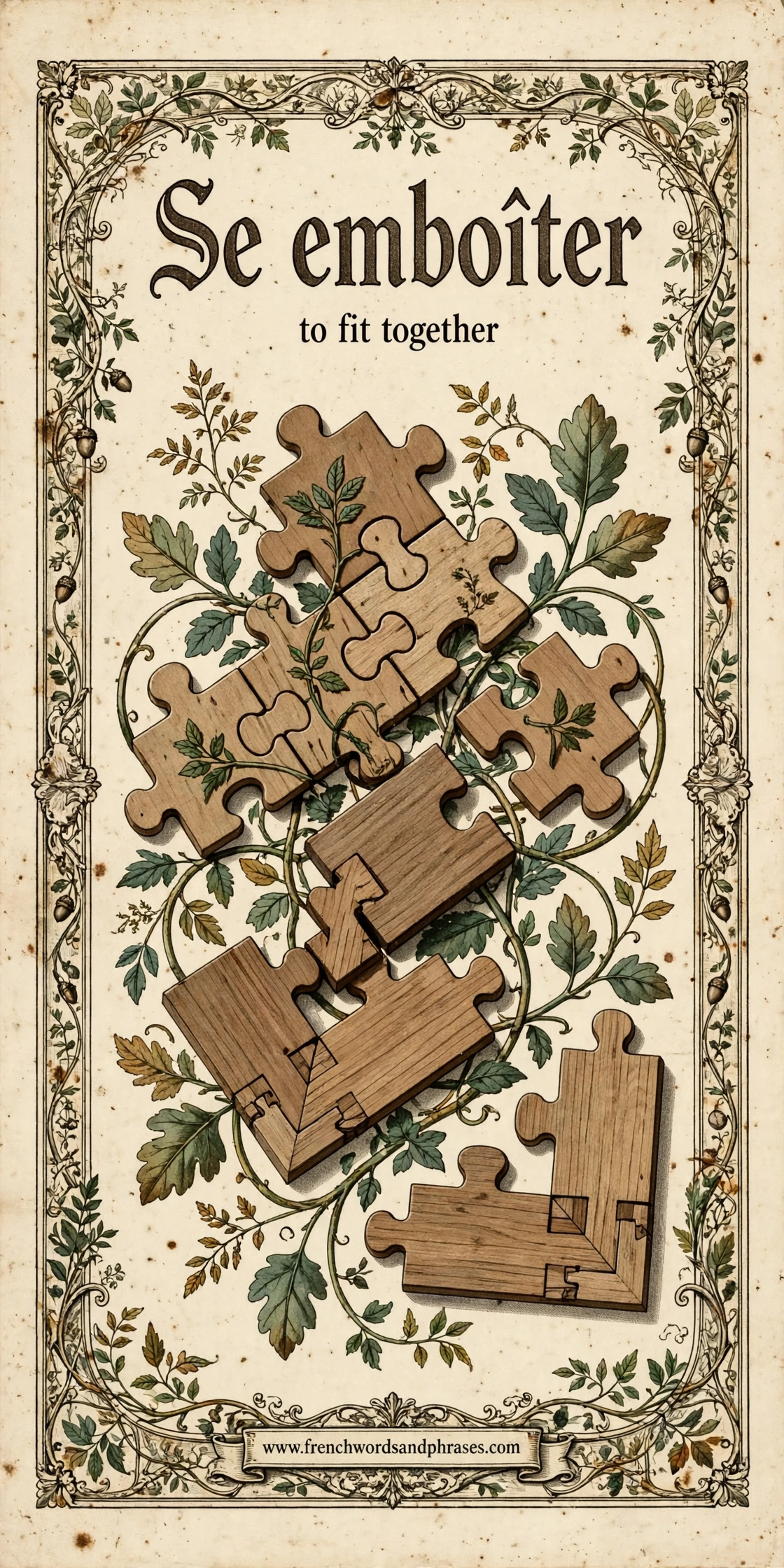
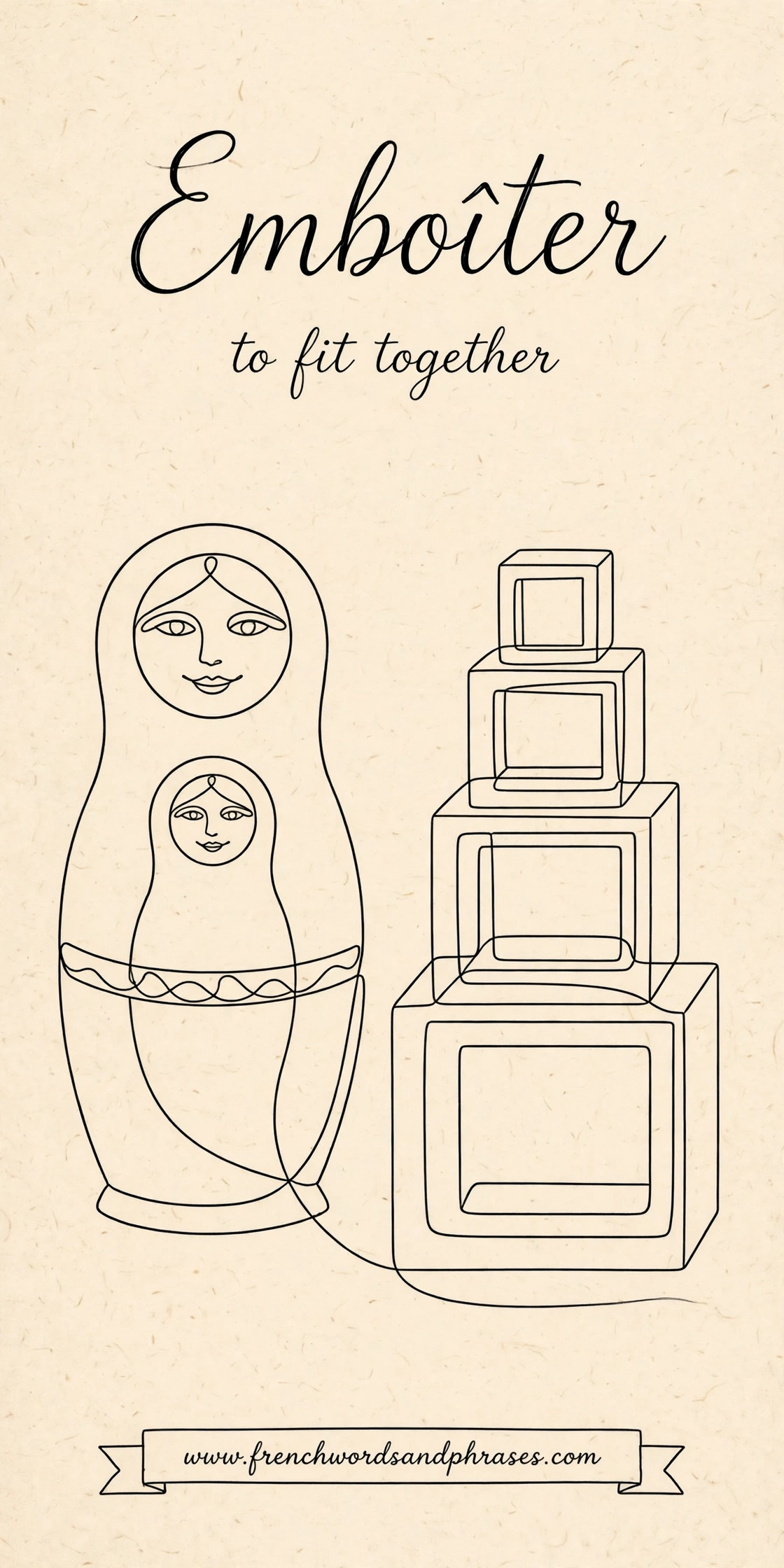
Emboîter means to fit together — to slot one piece snugly inside another so the two hold as one.
A tenon sliding into its mortise, a lid clicking onto its box, the pieces of a flat-pack wardrobe meeting at last — emboîter is the craftsman’s verb for fitting things together: one part shaped to receive, the other shaped to enter, and a small click of satisfaction when they meet.
In this guide, you’ll learn how to conjugate emboîter in all the major French tenses and moods. Explore complete conjugation tables, French examples, English translations, and practice quizzes.
Understanding the French Verb Emboîter
Emboîter is a regular French verb belonging to the first group of verbs, those ending in-er.
It means to fit together. It is commonly used in carpentry, mechanics and toy-making for parts designed to slot together, of bones and sockets in anatomy, and in its set phrase emboîter le pas for walking in someone’s steps — literally, or as a disciple follows a master.
Verb classification: First group (-er)
Auxiliary verb: Avoir
Past participle: emboîté
Present participle: emboîtant
English equivalents: To fit together, to slot in, to nest; emboîter deux pièces — to fit two pieces together; emboîter le pas à quelqu’un — to follow in someone’s footsteps, to fall into step behind someone; un emboîtement — a socket, a joint where one part fits into another; une boîte — a box.
One important detail: emboîter is built on une boîte, a box — to emboîter is to box one thing into another, and the î of boîte survives in the verb: je emboîte, nous emboîtons, ils emboîtent. Its most famous phrase leaves the workshop entirely: emboîter le pas à quelqu’un means to fall into step right behind someone, to follow in their footsteps — le petit frère emboîte le pas de son aîné. For the pieces fitting each other by themselves, French turns reflexive: les pièces s’emboîtent.
Experience the Word
Emboîter is the verb of the perfect fit — the moment two separate pieces stop being two and start being one thing.
Imagine an old joiner finishing a drawer without a single nail. He lifts the side panel, offers the tenon to the mortise, and pushes — slowly, then with the flat of his hand. The wood slides home with a soft knock: il a emboîté les deux pièces, and the drawer will outlive everyone in the room.
No glue, no screws, no force. The pieces have been fitted — emboîtées, made for each other.
How to Conjugate Emboîter: Complete French Conjugation Guide
Let’s explore every major conjugation of emboîter, beginning with the indicative mood.
How to Conjugate Emboîter in the Indicative Mood
The indicative mood is used to express facts, observations, actions, and events.
How to Conjugate Emboîter in the Present Tense (Présent)
Used for actions happening now, habitual actions, and general truths.
| Subject | Conjugation |
|---|---|
| je | emboîte |
| tu | emboîtes |
| il / elle | emboîte |
| nous | emboîtons |
| vous | emboîtez |
| ils / elles | emboîtent |
Example
Le menuisier emboîte les planches avec une précision d’horloger.
The carpenter fits the boards together with a watchmaker’s precision.
Quick Quiz 1
Complete the sentence:
Nous ______ les pièces dans le bon ordre.
Reveal the answer
emboîtons
Nous emboîtons les pièces dans le bon ordre.
We fit the pieces together in the right order.
How to Conjugate Emboîter in the Passé Composé
Used for completed actions in the past. Emboîter takes the auxiliary verb avoir.
| Subject | Conjugation |
|---|---|
| j’ | ai emboîté |
| tu | as emboîté |
| il / elle | a emboîté |
| nous | avons emboîté |
| vous | avez emboîté |
| ils / elles | ont emboîté |
Example
Il a emboîté toutes les pièces du meuble sans une seule vis.
He fitted all the pieces of the furniture together without a single screw.
How to Conjugate Emboîter in the Imparfait (Imperfect Tense)
Used for habitual past actions, descriptions, and ongoing situations in the past.
| Subject | Conjugation |
|---|---|
| je | emboîtais |
| tu | emboîtais |
| il / elle | emboîtait |
| nous | emboîtions |
| vous | emboîtiez |
| ils / elles | emboîtaient |
Example
Elle emboîtait les tuyaux les uns dans les autres.
She used to fit the pipes one inside another.
Quick Quiz 2
Choose the correct form:
He fitted the lid on.
Il ______ le couvercle. (a emboîté / est emboîté)
Reveal the answer
a emboîté
Il a emboîté le couvercle.
Emboîter takes avoir.
How to Conjugate Emboîter in the Plus-que-parfait
Used to describe an action that had already been completed before another past event.
| Subject | Conjugation |
|---|---|
| j’ | avais emboîté |
| tu | avais emboîté |
| il / elle | avait emboîté |
| nous | avions emboîté |
| vous | aviez emboîté |
| ils / elles | avaient emboîté |
Example
Nous avions emboîté les deux parties avant de passer la colle.
We had fitted the two parts together before applying the glue.
How to Conjugate Emboîter in the Passé Simple
Primarily used in formal writing, literature, and historical narratives. It is rarely used in everyday conversation.
| Subject | Conjugation |
|---|---|
| je | emboîtai |
| tu | emboîtas |
| il / elle | emboîta |
| nous | emboîtâmes |
| vous | emboîtâtes |
| ils / elles | emboîtèrent |
Example
L’ouvrier emboîta le tenon dans la mortaise d’un geste sûr.
The workman fitted the tenon into the mortise with a sure hand.
How to Conjugate Emboîter in the Passé Antérieur
A literary tense used to express an action completed immediately before another past action, generally in the passé simple.
| Subject | Conjugation |
|---|---|
| j’ | eus emboîté |
| tu | eus emboîté |
| il / elle | eut emboîté |
| nous | eûmes emboîté |
| vous | eûtes emboîté |
| ils / elles | eurent emboîté |
Example
Quand il eut emboîté la dernière pièce, l’armoire tenait debout toute seule.
When he had fitted the last piece in, the wardrobe stood up all by itself.
How to Conjugate Emboîter in the Future Tense (Futur Simple)
Used to describe actions that will take place in the future.
| Subject | Conjugation |
|---|---|
| je | emboîterai |
| tu | emboîteras |
| il / elle | emboîtera |
| nous | emboîterons |
| vous | emboîterez |
| ils / elles | emboîteront |
Example
Tu emboîteras ce couvercle sans forcer, tu verras.
You will fit this lid on without forcing it, you will see.
How to Conjugate Emboîter in the Futur Antérieur (Future Perfect)
Used for an action that will have been completed before a particular point in the future.
| Subject | Conjugation |
|---|---|
| j’ | aurai emboîté |
| tu | auras emboîté |
| il / elle | aura emboîté |
| nous | aurons emboîté |
| vous | aurez emboîté |
| ils / elles | auront emboîté |
Example
À la fin de l’après-midi, ils auront emboîté tous les éléments du jeu.
By the end of the afternoon, they will have fitted all the pieces of the game together.
How to Conjugate Emboîter in the Near Future (Futur Proche)
Used to describe something that is going to happen soon. Formed with aller + infinitive.
| Subject | Conjugation |
|---|---|
| je | vais emboîter |
| tu | vas emboîter |
| il / elle | va emboîter |
| nous | allons emboîter |
| vous | allez emboîter |
| ils / elles | vont emboîter |
Example
Je vais emboîter ces deux pièces, regarde bien.
I am going to fit these two pieces together, watch closely.
How to Conjugate Emboîter in the Conditional Mood
The conditional mood expresses what would happen under certain circumstances. It is also frequently used to make polite requests or express wishes.
How to Conjugate Emboîter in the Present Conditional
| Subject | Conjugation |
|---|---|
| je | emboîterais |
| tu | emboîterais |
| il / elle | emboîterait |
| nous | emboîterions |
| vous | emboîteriez |
| ils / elles | emboîteraient |
Example
On emboîterait mieux ces pièces avec un petit maillet.
We would fit these pieces together better with a small mallet.
How to Conjugate Emboîter in the Past Conditional
| Subject | Conjugation |
|---|---|
| j’ | aurais emboîté |
| tu | aurais emboîté |
| il / elle | aurait emboîté |
| nous | aurions emboîté |
| vous | auriez emboîté |
| ils / elles | auraient emboîté |
Example
Tu aurais emboîté le pas du guide sans hésiter.
You would have fallen into step behind the guide without hesitating.
Emboîter in the Literary Past Conditional Form
This less common literary form uses the imperfect subjunctive of avoir.
| Subject | Conjugation |
|---|---|
| j’ | eusse emboîté |
| tu | eusses emboîté |
| il / elle | eût emboîté |
| nous | eussions emboîté |
| vous | eussiez emboîté |
| ils / elles | eussent emboîté |
Example
Il eût emboîté le pas de son maître en silence.
He would have followed in his master’s footsteps in silence.
How to Conjugate Emboîter in the Subjunctive Mood
The subjunctive is used to express wishes, emotions, doubts, necessity, and uncertainty. It frequently follows expressions such as il faut que (it is necessary that) or bien que (although).
How to Conjugate Emboîter in the Present Subjunctive
| Subject | Conjugation |
|---|---|
| que je | emboîte |
| que tu | emboîtes |
| qu’il / qu’elle | emboîte |
| que nous | emboîtions |
| que vous | emboîtiez |
| qu’ils / qu’elles | emboîtent |
Example
Il faut que vous emboîtiez les pièces dans le bon ordre.
You must fit the pieces together in the right order.
Quick Quiz 3
Complete the sentence using the subjunctive:
Il faut que tu ______ le couvercle correctement.
Reveal the answer
emboîtes
Il faut que tu emboîtes le couvercle correctement.
You must fit the lid on properly.
How to Conjugate Emboîter in the Imperfect Subjunctive
A literary tense, rarely encountered in modern spoken French.
| Subject | Conjugation |
|---|---|
| que je | emboîtasse |
| que tu | emboîtasses |
| qu’il / qu’elle | emboîtât |
| que nous | emboîtassions |
| que vous | emboîtassiez |
| qu’ils / qu’elles | emboîtassent |
Example
Il voulait que l’apprenti emboîtât les planches tout seul.
He wanted the apprentice to fit the boards together on his own.
How to Conjugate Emboîter in the Pluperfect Subjunctive
A literary construction used to express an action completed before another past action.
| Subject | Conjugation |
|---|---|
| que j’ | eusse emboîté |
| que tu | eusses emboîté |
| qu’il / qu’elle | eût emboîté |
| que nous | eussions emboîté |
| que vous | eussiez emboîté |
| qu’ils / qu’elles | eussent emboîté |
Example
On admirait qu’il eût emboîté tout le mécanisme à la main.
People admired that he had fitted the whole mechanism together by hand.
How to Conjugate Emboîter in the Past Subjunctive
| Subject | Conjugation |
|---|---|
| que j’ | aie emboîté |
| que tu | aies emboîté |
| qu’il / qu’elle | ait emboîté |
| que nous | ayons emboîté |
| que vous | ayez emboîté |
| qu’ils / qu’elles | aient emboîté |
Example
Je suis content que tu aies emboîté le couvercle correctement.
I am glad you fitted the lid on properly.
How to Conjugate Emboîter in the Imperative
The imperative is used to give commands, instructions, invitations, or suggestions. Subject pronouns are omitted.
How to Conjugate Emboîter in the Present Imperative
| Person | Conjugation |
|---|---|
| (tu) | emboîte |
| (nous) | emboîtons |
| (vous) | emboîtez |
Example
Emboîte le pas de ton grand frère et ne traîne pas !
Fall into step behind your big brother and do not dawdle!
Quick Quiz 4
How would you say Fall into step behind your brother (tu form)?
Reveal the answer
Emboîte le pas de ton frère !
French Participles of Emboîter
Participles are verb forms that can be used in compound tenses and other grammatical constructions.
Present Participle of Emboîter
emboîtant
En emboîtant les pièces une à une, on forme un cube parfait.
By fitting the pieces together one by one, you form a perfect cube.
Past Participle of Emboîter
emboîté
Emboîtées avec soin, ces planches ne bougeront plus jamais.
Fitted together with care, those boards will never move again.
Emboîter in Everyday French: Real-Life Examples
Now that you know the conjugations, let’s see how emboîter appears in everyday French.
Example 1 — Present
Le menuisier emboîte les planches.
The carpenter fits the boards together.
Example 2 — Passé composé
Il a emboîté toutes les pièces.
He fitted all the pieces together.
Example 3 — Imparfait
Elle emboîtait les tuyaux un à un.
She used to fit the pipes one by one.
Example 4 — Future
Tu emboîteras le couvercle sans forcer.
You will fit the lid on without forcing it.
Example 5 — Conditional
On emboîterait mieux avec un maillet.
We would fit it better with a mallet.
Example 6 — Imperative
Emboîte le pas de ton frère !
Fall into step behind your brother!
Beyond Translation: The Meaning of Emboîter
English to fit together is a plain description; French emboîter carries its box inside it — une boîte — so every joint is a little act of boxing one thing into another.
And then the word walks out of the workshop.
Emboîter le pas — to fit your step into someone else’s — is how French describes disciples, ducklings and younger brothers: walking exactly where the one in front has just walked.
How to Remember the French Verb Emboîter
Remember it this way: Emboîter is about the tenon sliding into the mortise — and the little brother stepping in your footprints.
- Une boîte (a box) is inside the verb — and the î never leaves: je emboîte, nous emboîtons.
- Emboîter le pas à quelqu’un — to fall into step behind someone, to follow in their footsteps.
- Regular -er: je emboîte, nous emboîtons, past participle emboîté.
The key idea is the tenon sliding into the mortise — and the little brother stepping in your footprints.
Test Your Knowledge of Emboîter
Let’s see how much you’ve learned. Try answering these questions before revealing the answers.
Question 1
What does emboîter le pas à quelqu’un mean?
Reveal the answer
To fall into step behind someone — to follow in their footsteps.
Question 2
How do you say The carpenter fits the boards together in French?
Reveal the answer
Le menuisier emboîte les planches.
Question 3
Translate: He fitted all the pieces together without a screw.
Reveal the answer
Il a emboîté toutes les pièces sans une seule vis.
Question 4
What is the past participle of emboîter?
Reveal the answer
Emboîté.
Question 5
Complete the sentence:
Il faut que vous ______ les pièces dans le bon ordre.
Reveal the answer
emboîtiez
Il faut que vous emboîtiez les pièces dans le bon ordre.
You must fit the pieces together in the right order.
Your Final Challenge
Can You Use It?
How would you say this in French?
He fits the last piece in, and the piece of furniture suddenly becomes a single thing.
Reveal the answer
Il emboîte la dernière pièce, et le meuble devient soudain une seule chose.
He fits the last piece in, and the piece of furniture suddenly becomes a single thing.
A little French. A little curiosity. A richer everyday life.
LEARN FRENCH ONE WORD AT A TIME