A French Word to Live By
How to Conjugate Se embêter in French
/sɑ̃.be.te/
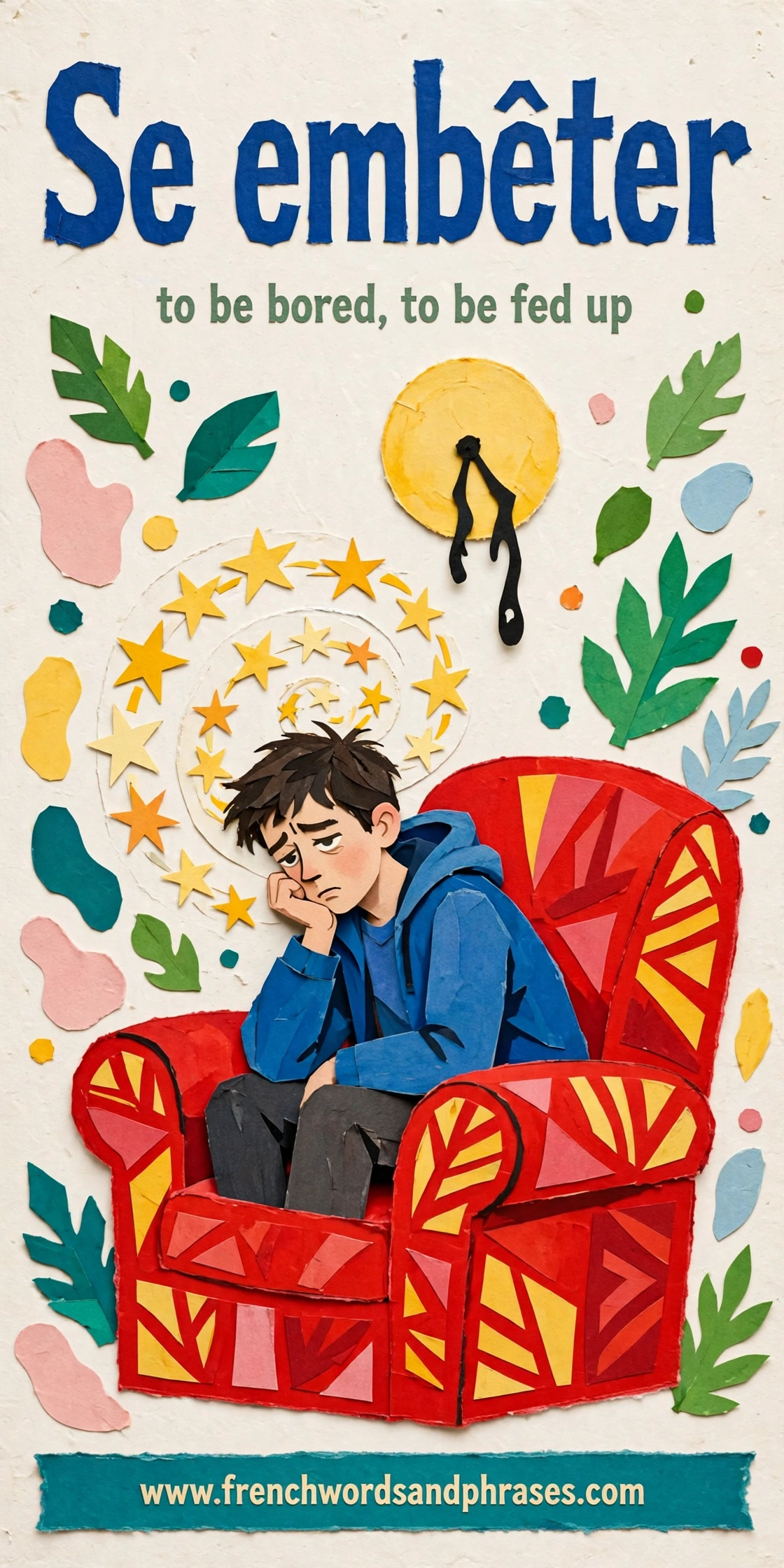
Se embêter means to be bored, to be fed up — to have nothing to do and to feel every minute of it.
A rainy Sunday in a small flat, a long speech in a hot hall, a holiday village where the rain never stops — se embêter is the familiar French verb for being bored stiff: time slows down, the clock stops moving, and you are thoroughly fed up.
In this guide, you’ll learn how to conjugate se embêter in all the major French tenses and moods. Explore complete conjugation tables, French examples, English translations, and practice quizzes.
Understanding the French Verb Se embêter
Se embêter is a regular French verb belonging to the first group of verbs, those ending in-er.
It means to be bored, to be fed up. It is commonly used by children on rainy afternoons, by anyone trapped in a dull meeting or a long journey, and in its famous intensifiers — s’embêter à mourir, s’embêter comme un rat mort. The non-reflexive embêter means to bother someone else; the reflexive turns the bother inward, onto oneself.
Verb classification: First group (-er), reflexive
Auxiliary verb: Être
Past participle: embêté
Present participle: embêtant
English equivalents: To be bored, to be fed up; s’embêter à mourir — to be bored to death; s’embêter comme un rat mort — to be bored stiff (literally, like a dead rat); ne t’embête pas ! — do not bother!, do not go to any trouble!; s’embêter avec des détails — to bother oneself with details.
One important detail: se embêter, in this bored and fed-up sense, belongs to familiar, spoken French — the (fam.) of the dictionaries. In careful writing, s’ennuyer is the neutral verb for being bored; je m’embête is what people actually say. Being reflexive, it takes être and the participle agrees: elle s’est embêtée, ils se sont embêtés. Watch the second life of the same form: ne t’embête pas ! usually means ‘do not go to any trouble!’, not ‘do not be bored!’.
Experience the Word
Se embêter is the verb of the stopped clock — the meeting, the journey, the Sunday afternoon that simply refuses to end.
Imagine a village fête rained off by noon. Under the marquee, the band has stopped, the sandwiches are finished, and a row of teenagers stares at the wet grass. Nobody is unhappy, exactly — but everyone s’embête, deeply, completely, in the particular way only a rained-off fête can produce.
There is nothing to do and nowhere to go. They are bored — embêtés, fed up, waiting for time itself to move.
How to Conjugate Se embêter: Complete French Conjugation Guide
Let’s explore every major conjugation of se embêter, beginning with the indicative mood.
How to Conjugate Se embêter in the Indicative Mood
The indicative mood is used to express facts, observations, actions, and events.
How to Conjugate Se embêter in the Present Tense (Présent)
Used for actions happening now, habitual actions, and general truths.
| Subject | Conjugation |
|---|---|
| je | m’embête |
| tu | t’embêtes |
| il / elle | s’embête |
| nous | nous embêtons |
| vous | vous embêtez |
| ils / elles | s’embêtent |
Example
Les enfants s’embêtent à la maison quand il pleut.
The children get bored at home when it rains.
Quick Quiz 1
Complete the sentence:
Nous nous ______ pendant les vacances.
Reveal the answer
embêtons
Nous nous embêtons pendant les vacances.
We are bored during the holidays.
How to Conjugate Se embêter in the Passé Composé
Used for completed actions in the past. Se embêter takes the auxiliary verb être.
| Subject | Conjugation |
|---|---|
| je | me suis embêté / me suis embêtée |
| tu | t’es embêté / t’es embêtée |
| il / elle | s’est embêté / s’est embêtée |
| nous | nous sommes embêtés / nous sommes embêtées |
| vous | vous êtes embêtés / vous êtes embêtées / vous êtes embêté / vous êtes embêtée |
| ils / elles | se sont embêtés / se sont embêtées |
Example
Elle s’est embêtée pendant tout le spectacle.
She was bored during the whole show.
How to Conjugate Se embêter in the Imparfait (Imperfect Tense)
Used for habitual past actions, descriptions, and ongoing situations in the past.
| Subject | Conjugation |
|---|---|
| je | m’embêtais |
| tu | t’embêtais |
| il / elle | s’embêtait |
| nous | nous embêtions |
| vous | vous embêtiez |
| ils / elles | s’embêtaient |
Example
Nous nous embêtions ferme dans ce petit village.
We used to be thoroughly bored in that little village.
Quick Quiz 2
Choose the correct form:
She was bored during the show.
Elle ______ pendant le spectacle. (s’est embêtée / a embêté)
Reveal the answer
s’est embêtée
Elle s’est embêtée pendant le spectacle.
Se embêter is reflexive, takes être, and the participle agrees: embêtée.
How to Conjugate Se embêter in the Plus-que-parfait
Used to describe an action that had already been completed before another past event.
| Subject | Conjugation |
|---|---|
| je | m’étais embêté / m’étais embêtée |
| tu | t’étais embêté / t’étais embêtée |
| il / elle | s’était embêté / s’était embêtée |
| nous | nous étions embêtés / nous étions embêtées |
| vous | vous étiez embêtés / vous étiez embêtées / vous étiez embêté / vous étiez embêtée |
| ils / elles | s’étaient embêtés / s’étaient embêtées |
Example
Ils s’étaient embêtés toute la semaine dans cet hôtel désert.
They had been bored all week in that deserted hotel.
How to Conjugate Se embêter in the Passé Simple
Primarily used in formal writing, literature, and historical narratives. It is rarely used in everyday conversation.
| Subject | Conjugation |
|---|---|
| je | m’embêtai |
| tu | t’embêtas |
| il / elle | s’embêta |
| nous | nous embêtâmes |
| vous | vous embêtâtes |
| ils / elles | s’embêtèrent |
Example
Ce dimanche-là, elle s’embêta comme un rat mort.
That Sunday, she was bored stiff.
How to Conjugate Se embêter in the Passé Antérieur
A literary tense used to express an action completed immediately before another past action, generally in the passé simple.
| Subject | Conjugation |
|---|---|
| je | me fus embêté / me fus embêtée |
| tu | te fus embêté / te fus embêtée |
| il / elle | se fut embêté / se fut embêtée |
| nous | nous fûmes embêtés / nous fûmes embêtées |
| vous | vous fûtes embêtés / vous fûtes embêtées / vous fûtes embêté / vous fûtes embêtée |
| ils / elles | se furent embêtés / se furent embêtées |
Example
Dès qu’il se fut embêté une heure dans la file, il inventa une excuse pour partir.
As soon as he had been bored for an hour in the queue, he invented an excuse to leave.
How to Conjugate Se embêter in the Future Tense (Futur Simple)
Used to describe actions that will take place in the future.
| Subject | Conjugation |
|---|---|
| je | m’embêterai |
| tu | t’embêteras |
| il / elle | s’embêtera |
| nous | nous embêterons |
| vous | vous embêterez |
| ils / elles | s’embêteront |
Example
Sans un bon livre, vous vous embêterez pendant le voyage.
Without a good book, you will be bored during the journey.
How to Conjugate Se embêter in the Futur Antérieur (Future Perfect)
Used for an action that will have been completed before a particular point in the future.
| Subject | Conjugation |
|---|---|
| je | me serai embêté / me serai embêtée |
| tu | te seras embêté / te seras embêtée |
| il / elle | se sera embêté / se sera embêtée |
| nous | nous serons embêtés / nous serons embêtées |
| vous | vous serez embêtés / vous serez embêtées / vous serez embêté / vous serez embêtée |
| ils / elles | se seront embêtés / se seront embêtées |
Example
À la fin des vacances, ils se seront embêtés plus d’une fois.
By the end of the holidays, they will have been bored more than once.
How to Conjugate Se embêter in the Near Future (Futur Proche)
Used to describe something that is going to happen soon. Formed with aller + infinitive.
| Subject | Conjugation |
|---|---|
| je | vais m’embêter |
| tu | vas t’embêter |
| il / elle | va s’embêter |
| nous | allons nous embêter |
| vous | allez vous embêter |
| ils / elles | vont s’embêter |
Example
Tu vas t’embêter si tu restes seul ici tout l’après-midi.
You are going to be bored if you stay here alone all afternoon.
How to Conjugate Se embêter in the Conditional Mood
The conditional mood expresses what would happen under certain circumstances. It is also frequently used to make polite requests or express wishes.
How to Conjugate Se embêter in the Present Conditional
| Subject | Conjugation |
|---|---|
| je | m’embêterais |
| tu | t’embêterais |
| il / elle | s’embêterait |
| nous | nous embêterions |
| vous | vous embêteriez |
| ils / elles | s’embêteraient |
Example
Je m’embêterais vite dans un bureau sans fenêtre.
I would quickly get bored in an office with no window.
How to Conjugate Se embêter in the Past Conditional
| Subject | Conjugation |
|---|---|
| je | me serais embêté / me serais embêtée |
| tu | te serais embêté / te serais embêtée |
| il / elle | se serait embêté / se serait embêtée |
| nous | nous serions embêtés / nous serions embêtées |
| vous | vous seriez embêtés / vous seriez embêtées / vous seriez embêté / vous seriez embêtée |
| ils / elles | se seraient embêtés / se seraient embêtées |
Example
Elle se serait moins embêtée avec un bon roman.
She would have been less bored with a good novel.
Se embêter in the Literary Past Conditional Form
This less common literary form uses the imperfect subjunctive of être.
| Subject | Conjugation |
|---|---|
| je | me fusse embêté / me fusse embêtée |
| tu | te fusses embêté / te fusses embêtée |
| il / elle | se fût embêté / se fût embêtée |
| nous | nous fussions embêtés / nous fussions embêtées |
| vous | vous fussiez embêtés / vous fussiez embêtées / vous fussiez embêté / vous fussiez embêtée |
| ils / elles | se fussent embêtés / se fussent embêtées |
Example
Il se fût embêté à mourir sans ses amis.
He would have been bored to death without his friends.
How to Conjugate Se embêter in the Subjunctive Mood
The subjunctive is used to express wishes, emotions, doubts, necessity, and uncertainty. It frequently follows expressions such as il faut que (it is necessary that) or bien que (although).
How to Conjugate Se embêter in the Present Subjunctive
| Subject | Conjugation |
|---|---|
| que je | m’embête |
| que tu | t’embêtes |
| qu’il / qu’elle | s’embête |
| que nous | nous embêtions |
| que vous | vous embêtiez |
| qu’ils / qu’elles | s’embêtent |
Example
Il est normal que les enfants s’embêtent un peu, parfois.
It is normal for children to be a bit bored sometimes.
Quick Quiz 3
Complete the sentence using the subjunctive:
Il est normal que tu ______ un peu parfois.
Reveal the answer
t’embêtes
Il est normal que tu t’embêtes un peu parfois.
It is normal for you to be a bit bored sometimes.
How to Conjugate Se embêter in the Imperfect Subjunctive
A literary tense, rarely encountered in modern spoken French.
| Subject | Conjugation |
|---|---|
| que je | m’embêtasse |
| que tu | t’embêtasses |
| qu’il / qu’elle | s’embêtât |
| que nous | nous embêtassions |
| que vous | vous embêtassiez |
| qu’ils / qu’elles | s’embêtassent |
Example
Elle avait peur que sa fille s’embêtât pendant les vacances.
She was afraid her daughter might be bored during the holidays.
How to Conjugate Se embêter in the Pluperfect Subjunctive
A literary construction used to express an action completed before another past action.
| Subject | Conjugation |
|---|---|
| que je | me fusse embêté / me fusse embêtée |
| que tu | te fusses embêté / te fusses embêtée |
| qu’il / qu’elle | se fût embêté / se fût embêtée |
| que nous | nous fussions embêtés / nous fussions embêtées |
| que vous | vous fussiez embêtés / vous fussiez embêtées / vous fussiez embêté / vous fussiez embêtée |
| qu’ils / qu’elles | se fussent embêtés / se fussent embêtées |
Example
On racontait qu’ils se fussent embêtés durant tout le séjour.
People said they had been bored throughout the whole stay.
How to Conjugate Se embêter in the Past Subjunctive
| Subject | Conjugation |
|---|---|
| que je | me sois embêté / me sois embêtée |
| que tu | te sois embêté / te sois embêtée |
| qu’il / qu’elle | se soit embêté / se soit embêtée |
| que nous | nous soyons embêtés / nous soyons embêtées |
| que vous | vous soyez embêtés / vous soyez embêtées / vous soyez embêté / vous soyez embêtée |
| qu’ils / qu’elles | se soient embêtés / se soient embêtées |
Example
Je suis surpris qu’il se soit embêté, lui qui adore pêcher.
I am surprised he was bored, he who loves fishing.
How to Conjugate Se embêter in the Imperative
The imperative is used to give commands, instructions, invitations, or suggestions. Subject pronouns are omitted.
How to Conjugate Se embêter in the Present Imperative
| Person | Conjugation |
|---|---|
| (tu) | embête-toi |
| (nous) | embêtons-nous |
| (vous) | embêtez-vous |
Example
Ne t’embête pas avec ces détails, je m’en occupe !
Do not bother with those details, I will take care of them!
Quick Quiz 4
How would you say Do not bother with that (tu form)?
Reveal the answer
Ne t’embête pas avec ça !
French Participles of Se embêter
Participles are verb forms that can be used in compound tenses and other grammatical constructions.
Present Participle of Se embêter
embêtant
En s’embêtant ferme, il regardait l’horloge toutes les cinq minutes.
Bored stiff, he looked at the clock every five minutes.
Past Participle of Se embêter
embêté
Embêtée par cette longue attente, elle est partie avant la fin.
Fed up with the long wait, she left before the end.
Se embêter in Everyday French: Real-Life Examples
Now that you know the conjugations, let’s see how se embêter appears in everyday French.
Example 1 — Present
Les enfants s’embêtent quand il pleut.
The children get bored when it rains.
Example 2 — Passé composé
Elle s’est embêtée pendant le spectacle.
She was bored during the show.
Example 3 — Imparfait
Nous nous embêtions dans ce village.
We used to be bored in that village.
Example 4 — Future
Tu t’embêteras sans un livre.
You will be bored without a book.
Example 5 — Conditional
Je m’embêterais dans un bureau sans fenêtre.
I would be bored in an office with no window.
Example 6 — Imperative
Ne t’embête pas avec ça !
Do not bother with that!
Beyond Translation: The Meaning of Se embêter
English bored stiff has a French twin with a stranger image: s’embêter comme un rat mort — to be bored like a dead rat.
Nobody knows quite why the rat died of boredom.
But the phrase tells you the register: this is the boredom of the playground and the family kitchen, warm and exaggerated, not the grey ennui of literature — for that, French keeps s’ennuyer and the great word l’ennui.
How to Remember the French Verb Se embêter
Remember it this way: Se embêter is about the rainy Sunday and the stopped clock — bored like a dead rat.
- Familiar register: je m’embête is what people say; s’ennuyer is the neutral written verb.
- Reflexive, so être and agreement: elle s’est embêtée, ils se sont embêtés.
- Ne t’embête pas ! usually means ‘do not go to any trouble!’ — context decides.
The key idea is the rainy Sunday and the stopped clock — bored like a dead rat.
Test Your Knowledge of Se embêter
Let’s see how much you’ve learned. Try answering these questions before revealing the answers.
Question 1
What register does s’embêter belong to in its ‘bored’ sense?
Reveal the answer
Familiar, spoken French — the neutral written verb is s’ennuyer.
Question 2
How do you say The children get bored when it rains in French?
Reveal the answer
Les enfants s’embêtent quand il pleut.
Question 3
Translate: She was bored during the whole show.
Reveal the answer
Elle s’est embêtée pendant tout le spectacle.
Question 4
What is the past participle of se embêter?
Reveal the answer
Embêté — agreeing: embêtée, embêtés, embêtées.
Question 5
Complete the sentence:
Il est normal que les enfants ______ un peu, parfois.
Reveal the answer
s’embêtent
Il est normal que les enfants s’embêtent un peu, parfois.
It is normal for children to be a bit bored sometimes.
Your Final Challenge
Can You Use It?
How would you say this in French?
We are bored stiff under the rain, then the sun comes back and all is forgiven.
Reveal the answer
On s’embête comme un rat mort sous la pluie, puis le soleil revient et tout est pardonné.
We are bored stiff under the rain, then the sun comes back and all is forgiven.
A little French. A little curiosity. A richer everyday life.
LEARN FRENCH ONE WORD AT A TIME