A French Word to Live By
How to Conjugate Se élaborer in French
/sə e.la.bɔ.ʁe/
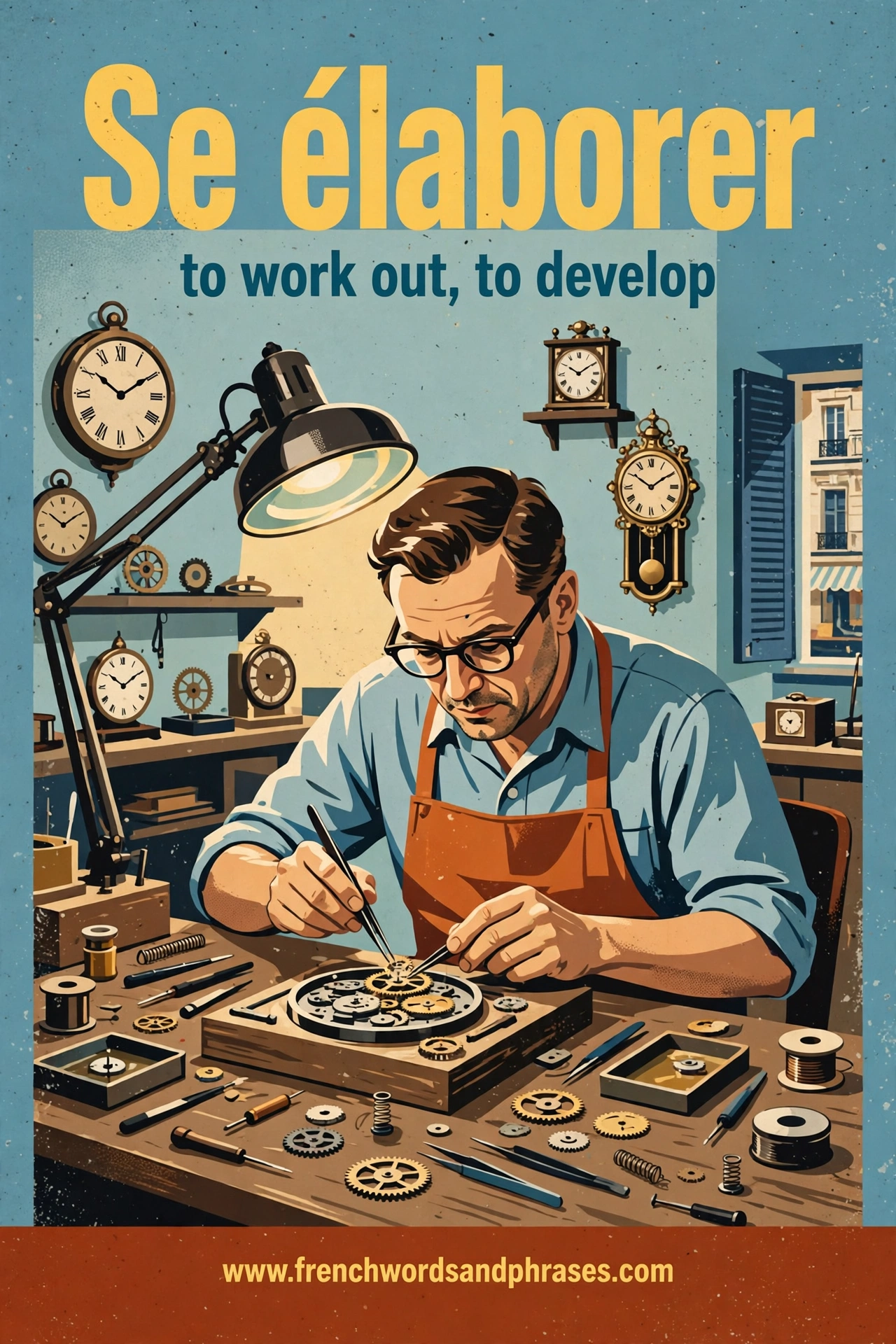
Se élaborer means to work out, to develop — said of a plan, an idea or a law itself as it gradually takes shape, the way a photograph develops in a tray.
A law emerging from months of committee work, an idea slowly forming in a writer’s mind, a wine becoming itself in the cellar — s’élaborer is élaborer seen from inside the thing being made: the work happening, gradually, until the shape appears.
In this guide, you’ll learn how to conjugate se élaborer in all the major French tenses and moods. Explore complete conjugation tables, French examples, English translations, and practice quizzes.
Understanding the French Verb Se élaborer
Se élaborer is a regular French verb belonging to the first group of verbs, those ending in-er.
It means to work out, to develop. It is the natural choice when the maker stays in the background: laws s’élaborent in parliament, strategies s’élaborent over months of meetings, ideas s’élaborent in a mind, and Champagne s’élabore in the cellar. Where English uses a passive — the plan was worked out — French very often prefers this reflexive.
Verb classification: First group (-er), reflexive
Auxiliary verb: Être
Past participle: élaboré
Present participle: élaborant
English equivalents: To take shape, to be worked out, to develop; un plan qui s’élabore — a plan that is taking shape; la loi s’élabore au parlement — the law is being drafted in parliament; une idée s’élabore lentement — an idea develops slowly; le vin s’élabore en cave — the wine is made in the cellar.
One important detail: s’élaborer turns the camera around. Élaborer is what people do to a plan; s’élaborer is what the plan itself does — it takes shape, it is worked out, usually slowly and with no single author named. Being reflexive, it takes être in every compound tense, and the past participle agrees with its subject: la stratégie s’est élaborée au fil des réunions. The verb is otherwise the regular élaborer wearing its pronoun: il s’élabore, les plans s’élaborent, nous nous élaborons.
Experience the Word
Se élaborer is the verb of things taking shape — no single pair of hands, just the slow appearance of a form.
Imagine a great Champagne house in winter. Down in the chalk cellars, far from any committee, the new wine s’élabore in silence — fermenting, settling, becoming. Nobody down there is giving orders; the wine itself is doing the work of becoming wine, and the cellar master simply watches over the shape as it appears.
It was not made in a day. It developed — s’est élaboré, slowly, in the dark.
How to Conjugate Se élaborer: Complete French Conjugation Guide
Let’s explore every major conjugation of se élaborer, beginning with the indicative mood.
How to Conjugate Se élaborer in the Indicative Mood
The indicative mood is used to express facts, observations, actions, and events.
How to Conjugate Se élaborer in the Present Tense (Présent)
Used for actions happening now, habitual actions, and general truths.
| Subject | Conjugation |
|---|---|
| je | m’élabore |
| tu | t’élabores |
| il / elle | s’élabore |
| nous | nous élaborons |
| vous | vous élaborez |
| ils / elles | s’élaborent |
Example
La loi s’élabore au parlement depuis des mois.
The law has been taking shape in parliament for months.
Quick Quiz 1
Complete the sentence:
Les grandes idées ______ lentement.
Reveal the answer
s’élaborent
Les grandes idées s’élaborent lentement.
Great ideas develop slowly.
How to Conjugate Se élaborer in the Passé Composé
Used for completed actions in the past. Se élaborer takes the auxiliary verb être.
| Subject | Conjugation |
|---|---|
| je | me suis élaboré / me suis élaborée |
| tu | t’es élaboré / t’es élaborée |
| il / elle | s’est élaboré / s’est élaborée |
| nous | nous sommes élaborés / nous sommes élaborées |
| vous | vous êtes élaborés / vous êtes élaborées / vous êtes élaboré / vous êtes élaborée |
| ils / elles | se sont élaborés / se sont élaborées |
Example
Le plan s’est élaboré au fil des réunions.
The plan took shape over the course of the meetings.
How to Conjugate Se élaborer in the Imparfait (Imperfect Tense)
Used for habitual past actions, descriptions, and ongoing situations in the past.
| Subject | Conjugation |
|---|---|
| je | m’élaborais |
| tu | t’élaborais |
| il / elle | s’élaborait |
| nous | nous élaborions |
| vous | vous élaboriez |
| ils / elles | s’élaboraient |
Example
Une idée s’élaborait lentement dans son esprit.
An idea was slowly developing in his mind.
Quick Quiz 2
Choose the correct form:
The strategy was worked out during the winter.
La stratégie ______ pendant l’hiver. (s’est élaborée / a élaboré)
Reveal the answer
s’est élaborée
La stratégie s’est élaborée pendant l’hiver.
S’élaborer is reflexive: être, and the participle agrees — élaborée.
How to Conjugate Se élaborer in the Plus-que-parfait
Used to describe an action that had already been completed before another past event.
| Subject | Conjugation |
|---|---|
| je | m’étais élaboré / m’étais élaborée |
| tu | t’étais élaboré / t’étais élaborée |
| il / elle | s’était élaboré / s’était élaborée |
| nous | nous étions élaborés / nous étions élaborées |
| vous | vous étiez élaborés / vous étiez élaborées / vous étiez élaboré / vous étiez élaborée |
| ils / elles | s’étaient élaborés / s’étaient élaborées |
Example
La stratégie s’était élaborée pendant l’hiver.
The strategy had been worked out during the winter.
How to Conjugate Se élaborer in the Passé Simple
Primarily used in formal writing, literature, and historical narratives. It is rarely used in everyday conversation.
| Subject | Conjugation |
|---|---|
| je | m’élaborai |
| tu | t’élaboras |
| il / elle | s’élabora |
| nous | nous élaborâmes |
| vous | vous élaborâtes |
| ils / elles | s’élaborèrent |
Example
Le texte s’élabora au cours de longues nuits de travail.
The text took shape over long nights of work.
How to Conjugate Se élaborer in the Passé Antérieur
A literary tense used to express an action completed immediately before another past action, generally in the passé simple.
| Subject | Conjugation |
|---|---|
| je | me fus élaboré / me fus élaborée |
| tu | te fus élaboré / te fus élaborée |
| il / elle | se fut élaboré / se fut élaborée |
| nous | nous fûmes élaborés / nous fûmes élaborées |
| vous | vous fûtes élaborés / vous fûtes élaborées / vous fûtes élaboré / vous fûtes élaborée |
| ils / elles | se furent élaborés / se furent élaborées |
Example
Quand le programme se fut élaboré, on le publia enfin.
When the programme had been worked out, it was finally published.
How to Conjugate Se élaborer in the Future Tense (Futur Simple)
Used to describe actions that will take place in the future.
| Subject | Conjugation |
|---|---|
| je | m’élaborerai |
| tu | t’élaboreras |
| il / elle | s’élaborera |
| nous | nous élaborerons |
| vous | vous élaborerez |
| ils / elles | s’élaboreront |
Example
La réforme s’élaborera étape par étape.
The reform will take shape step by step.
How to Conjugate Se élaborer in the Futur Antérieur (Future Perfect)
Used for an action that will have been completed before a particular point in the future.
| Subject | Conjugation |
|---|---|
| je | me serai élaboré / me serai élaborée |
| tu | te seras élaboré / te seras élaborée |
| il / elle | se sera élaboré / se sera élaborée |
| nous | nous serons élaborés / nous serons élaborées |
| vous | vous serez élaborés / vous serez élaborées / vous serez élaboré / vous serez élaborée |
| ils / elles | se seront élaborés / se seront élaborées |
Example
À la fin de l’année, le plan se sera élaboré complètement.
By the end of the year, the plan will have been fully worked out.
How to Conjugate Se élaborer in the Near Future (Futur Proche)
Used to describe something that is going to happen soon. Formed with aller + infinitive.
| Subject | Conjugation |
|---|---|
| je | vais m’élaborer |
| tu | vas t’élaborer |
| il / elle | va s’élaborer |
| nous | allons nous élaborer |
| vous | allez vous élaborer |
| ils / elles | vont s’élaborer |
Example
Regarde : une solution va s’élaborer d’elle-même.
Look: a solution is going to work itself out.
How to Conjugate Se élaborer in the Conditional Mood
The conditional mood expresses what would happen under certain circumstances. It is also frequently used to make polite requests or express wishes.
How to Conjugate Se élaborer in the Present Conditional
| Subject | Conjugation |
|---|---|
| je | m’élaborerais |
| tu | t’élaborerais |
| il / elle | s’élaborerait |
| nous | nous élaborerions |
| vous | vous élaboreriez |
| ils / elles | s’élaboreraient |
Example
Sans ces réunions, le projet s’élaborerait beaucoup plus lentement.
Without these meetings, the project would take shape much more slowly.
How to Conjugate Se élaborer in the Past Conditional
| Subject | Conjugation |
|---|---|
| je | me serais élaboré / me serais élaborée |
| tu | te serais élaboré / te serais élaborée |
| il / elle | se serait élaboré / se serait élaborée |
| nous | nous serions élaborés / nous serions élaborées |
| vous | vous seriez élaborés / vous seriez élaborées / vous seriez élaboré / vous seriez élaborée |
| ils / elles | se seraient élaborés / se seraient élaborées |
Example
Le texte se serait élaboré plus vite avec un meilleur rédacteur.
The text would have taken shape faster with a better drafter.
Se élaborer in the Literary Past Conditional Form
This less common literary form uses the imperfect subjunctive of être.
| Subject | Conjugation |
|---|---|
| je | me fusse élaboré / me fusse élaborée |
| tu | te fusses élaboré / te fusses élaborée |
| il / elle | se fût élaboré / se fût élaborée |
| nous | nous fussions élaborés / nous fussions élaborées |
| vous | vous fussiez élaborés / vous fussiez élaborées / vous fussiez élaboré / vous fussiez élaborée |
| ils / elles | se fussent élaborés / se fussent élaborées |
Example
La loi se fût élaborée sans débat sans la presse.
The law would have been drafted without debate if not for the press.
How to Conjugate Se élaborer in the Subjunctive Mood
The subjunctive is used to express wishes, emotions, doubts, necessity, and uncertainty. It frequently follows expressions such as il faut que (it is necessary that) or bien que (although).
How to Conjugate Se élaborer in the Present Subjunctive
| Subject | Conjugation |
|---|---|
| que je | m’élabore |
| que tu | t’élabores |
| qu’il / qu’elle | s’élabore |
| que nous | nous élaborions |
| que vous | vous élaboriez |
| qu’ils / qu’elles | s’élaborent |
Example
Il est important que le plan s’élabore sans précipitation.
It is important that the plan be worked out without haste.
Quick Quiz 3
Complete the sentence using the subjunctive:
Il est important que la loi ______ avec soin.
Reveal the answer
s’élabore
Il est important que la loi s’élabore avec soin.
It is important that the law be drafted with care.
How to Conjugate Se élaborer in the Imperfect Subjunctive
A literary tense, rarely encountered in modern spoken French.
| Subject | Conjugation |
|---|---|
| que je | m’élaborasse |
| que tu | t’élaborasses |
| qu’il / qu’elle | s’élaborât |
| que nous | nous élaborassions |
| que vous | vous élaborassiez |
| qu’ils / qu’elles | s’élaborassent |
Example
On ne pensait pas que la réforme s’élaborât si vite.
Nobody thought the reform would take shape so quickly.
How to Conjugate Se élaborer in the Pluperfect Subjunctive
A literary construction used to express an action completed before another past action.
| Subject | Conjugation |
|---|---|
| que je | me fusse élaboré / me fusse élaborée |
| que tu | te fusses élaboré / te fusses élaborée |
| qu’il / qu’elle | se fût élaboré / se fût élaborée |
| que nous | nous fussions élaborés / nous fussions élaborées |
| que vous | vous fussiez élaborés / vous fussiez élaborées / vous fussiez élaboré / vous fussiez élaborée |
| qu’ils / qu’elles | se fussent élaborés / se fussent élaborées |
Example
On doutait que le projet se fût élaboré en une semaine.
People doubted the project had been worked out in one week.
How to Conjugate Se élaborer in the Past Subjunctive
| Subject | Conjugation |
|---|---|
| que je | me sois élaboré / me sois élaborée |
| que tu | te sois élaboré / te sois élaborée |
| qu’il / qu’elle | se soit élaboré / se soit élaborée |
| que nous | nous soyons élaborés / nous soyons élaborées |
| que vous | vous soyez élaborés / vous soyez élaborées / vous soyez élaboré / vous soyez élaborée |
| qu’ils / qu’elles | se soient élaborés / se soient élaborées |
Example
Je suis étonné que la solution se soit élaborée si simplement.
I am surprised the solution worked itself out so simply.
How to Conjugate Se élaborer in the Imperative
The imperative is used to give commands, instructions, invitations, or suggestions. Subject pronouns are omitted.
How to Conjugate Se élaborer in the Present Imperative
| Person | Conjugation |
|---|---|
| (tu) | élabore-toi |
| (nous) | élaborons-nous |
| (vous) | élaborez-vous |
Example
Élabore-toi lentement, petit plan, nous avons le temps !
Take shape slowly, little plan, we have time!
Quick Quiz 4
How would you say Take shape slowly (tu form)?
Reveal the answer
Élabore-toi lentement !
French Participles of Se élaborer
Participles are verb forms that can be used in compound tenses and other grammatical constructions.
Present Participle of Se élaborer
élaborant
En s’élaborant, le vin perd son agressivité.
As it develops, the wine loses its harshness.
Past Participle of Se élaborer
élaboré
Élaborée en cave pendant trois ans, la cuvée est enfin prête.
Developed in the cellar for three years, the cuvée is finally ready.
Se élaborer in Everyday French: Real-Life Examples
Now that you know the conjugations, let’s see how se élaborer appears in everyday French.
Example 1 — Present
La loi s’élabore au parlement.
The law is taking shape in parliament.
Example 2 — Passé composé
Le plan s’est élaboré au fil des réunions.
The plan took shape over the meetings.
Example 3 — Imparfait
Une idée s’élaborait dans son esprit.
An idea was developing in his mind.
Example 4 — Future
La réforme s’élaborera étape par étape.
The reform will take shape step by step.
Example 5 — Conditional
Le projet s’élaborerait plus lentement sans ces réunions.
The project would take shape more slowly without these meetings.
Example 6 — Imperative
Élaborez-vous en silence, idées nouvelles !
Take shape in silence, new ideas!
Beyond Translation: The Meaning of Se élaborer
English must choose between a passive — the plan was worked out — and a metaphor — the plan took shape; French s’élaborer does both jobs with one reflexive.
The thing makes itself, slowly.
That is the reflexive’s quiet philosophy: behind every law, wine and idea there was work, but s’élaborer lets the work belong to the thing itself, appearing gradually, like a photograph in its tray.
How to Remember the French Verb Se élaborer
Remember it this way: Se élaborer is about the photograph in the developing tray — the shape appearing slowly.
- The camera turned around: people élaborent a plan; the plan s’élabore — it takes shape.
- Être in compound tenses, participle agreeing: la stratégie s’est élaborée.
- Favourites: la loi s’élabore au parlement; le vin s’élabore en cave; une idée s’élabore lentement.
The key idea is the photograph in the developing tray — the shape appearing slowly.
Test Your Knowledge of Se élaborer
Let’s see how much you’ve learned. Try answering these questions before revealing the answers.
Question 1
What is the difference between élaborer and s’élaborer?
Reveal the answer
The viewpoint — people élaborent a plan (they work it out); the plan s’élabore (it takes shape).
Question 2
How do you say The plan took shape over the meetings in French?
Reveal the answer
Le plan s’est élaboré au fil des réunions.
Question 3
Translate: The law is taking shape in parliament.
Reveal the answer
La loi s’élabore au parlement.
Question 4
What is the past participle of s’élaborer, and how does it agree?
Reveal the answer
Élaboré — agreeing with the subject: la stratégie s’est élaborée.
Question 5
Complete the sentence:
Il est important que le plan ______ sans précipitation.
Reveal the answer
s’élabore
Il est important que le plan s’élabore sans précipitation.
It is important that the plan be worked out without haste.
Your Final Challenge
Can You Use It?
How would you say this in French?
In the chalk cellars, far from prying eyes, the great wine develops in silence.
Reveal the answer
Dans les caves de craie, loin des regards, le grand vin s’élabore en silence.
In the chalk cellars, far from prying eyes, the great wine develops in silence.
A little French. A little curiosity. A richer everyday life.
LEARN FRENCH ONE WORD AT A TIME