A French Word to Live By
How to Conjugate Élaguer in French
/e.la.ɡe/
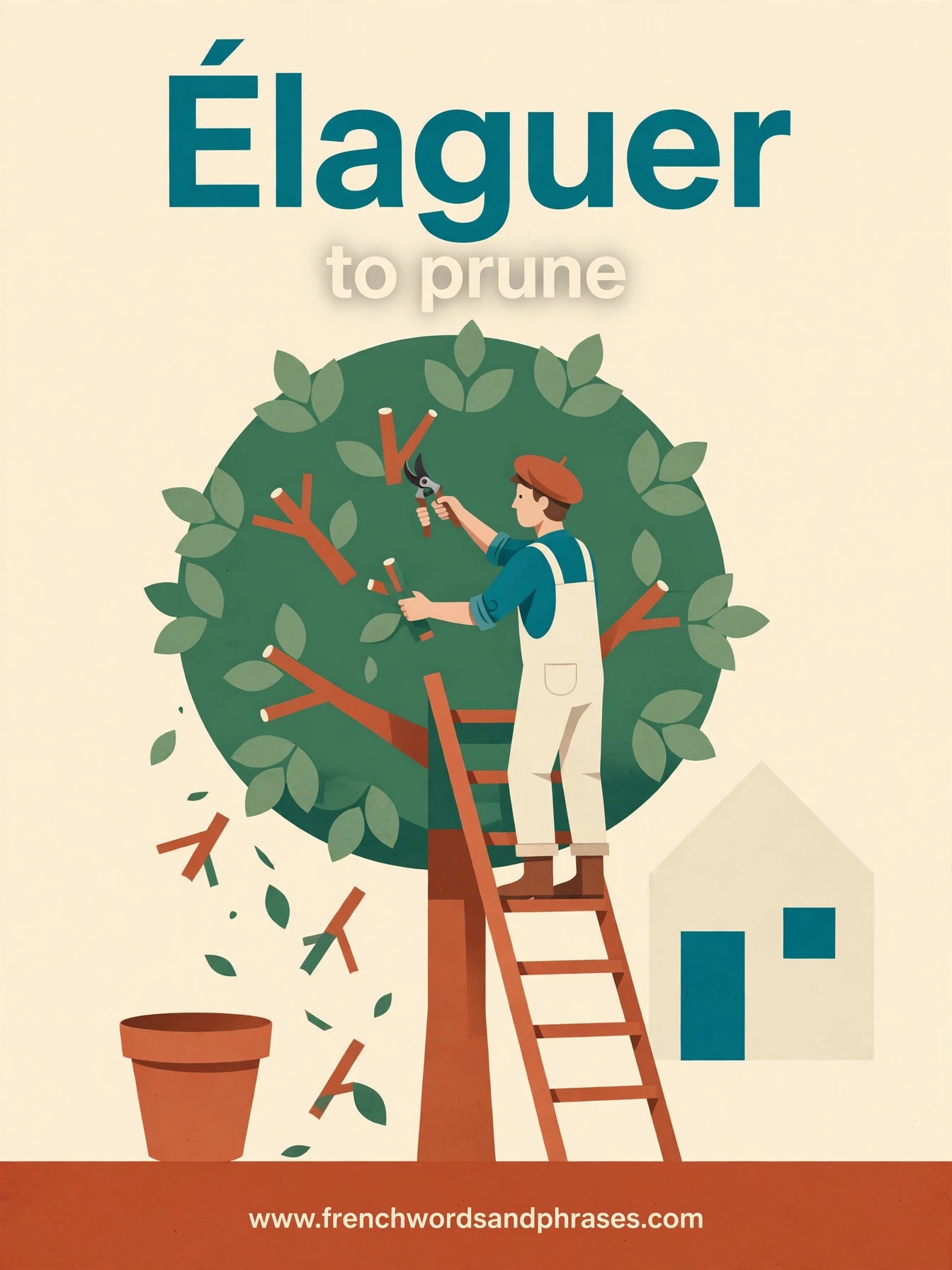
Élaguer means to prune — to cut back the dead, crowded or dangerous branches of a tree, and by extension to trim anything overgrown down to its essentials.
A gardener on a ladder with a saw, a plane tree losing its winter tangle of branches, an editor cutting three pages from a chapter — élaguer is the verb of the skilful cut: remove what chokes, and the whole thing breathes again.
In this guide, you’ll learn how to conjugate élaguer in all the major French tenses and moods. Explore complete conjugation tables, French examples, English translations, and practice quizzes.
Understanding the French Verb Élaguer
Élaguer is a regular French verb belonging to the first group of verbs, those ending in-er.
It means to prune. It is used literally for trees, hedges and vines — especially the great plane trees of French avenues, élagués every winter — and figuratively for anything overgrown: texts, budgets, staff and speeches are élagués when someone cuts them back to what matters. It is stronger and more expert than tailler, the everyday trim.
Verb classification: First group (-er)
Auxiliary verb: Avoir
Past participle: élagué
Present participle: élaguant
English equivalents: To prune, to trim, to cut back; élaguer un arbre — to prune a tree; élaguer les branches mortes — to cut out the dead wood; élaguer un texte — to prune a text, to cut it down; élaguer un budget — to trim a budget; l’élagage (m.) — pruning, tree surgery.
One important detail: élaguer is a -guer verb, and the u is untouchable — it stays in every single form so the g never hardens wrongly or softens: j’élague, nous élaguons, j’élaguais, en élaguant, past participle élagué. Like fatiguer and naviguer, it never drops the u. The professional who does this work is un élagueur, a tree surgeon, and his work is l’élagage — the word on the side of his van.
Experience the Word
Élaguer is the verb of the intelligent cut — knowing which branch must go so the tree can live.
Imagine a plane tree on a village square in November. The élagueur climbs into its crown with his ropes and saw, and all morning the branches fall — dead ones, crossing ones, the one reaching for the café roof — il élague, calmly, reading the tree like a text, until the square is full of light again and the tree stands cleaner than it has for years.
He has not diminished the tree. He has pruned it — élagué — and given it back its shape.
How to Conjugate Élaguer: Complete French Conjugation Guide
Let’s explore every major conjugation of élaguer, beginning with the indicative mood.
How to Conjugate Élaguer in the Indicative Mood
The indicative mood is used to express facts, observations, actions, and events.
How to Conjugate Élaguer in the Present Tense (Présent)
Used for actions happening now, habitual actions, and general truths.
| Subject | Conjugation |
|---|---|
| je | élague |
| tu | élagues |
| il / elle | élague |
| nous | élaguons |
| vous | élaguez |
| ils / elles | élaguent |
Example
Le jardinier élague les rosiers en mars.
The gardener prunes the rose bushes in March.
Quick Quiz 1
Complete the sentence:
Nous ______ les tilleuls de l’avenue.
Reveal the answer
élaguons
Nous élaguons les tilleuls de l’avenue.
We prune the lime trees along the avenue.
How to Conjugate Élaguer in the Passé Composé
Used for completed actions in the past. Élaguer takes the auxiliary verb avoir.
| Subject | Conjugation |
|---|---|
| j’ | ai élagué |
| tu | as élagué |
| il / elle | a élagué |
| nous | avons élagué |
| vous | avez élagué |
| ils / elles | ont élagué |
Example
Ils ont élagué les platanes de la place.
They pruned the plane trees on the square.
How to Conjugate Élaguer in the Imparfait (Imperfect Tense)
Used for habitual past actions, descriptions, and ongoing situations in the past.
| Subject | Conjugation |
|---|---|
| je | élaguais |
| tu | élaguais |
| il / elle | élaguait |
| nous | élaguions |
| vous | élaguiez |
| ils / elles | élaguaient |
Example
Chaque hiver, on élaguait les tilleuls de l’avenue.
Every winter, they used to prune the lime trees along the avenue.
Quick Quiz 2
Choose the correct form:
They pruned the plane trees.
Ils ______ les platanes. (ont élagué / sont élagués)
Reveal the answer
ont élagué
Ils ont élagué les platanes.
Élaguer takes avoir.
How to Conjugate Élaguer in the Plus-que-parfait
Used to describe an action that had already been completed before another past event.
| Subject | Conjugation |
|---|---|
| j’ | avais élagué |
| tu | avais élagué |
| il / elle | avait élagué |
| nous | avions élagué |
| vous | aviez élagué |
| ils / elles | avaient élagué |
Example
Elle avait élagué le pommier avant le printemps.
She had pruned the apple tree before spring.
How to Conjugate Élaguer in the Passé Simple
Primarily used in formal writing, literature, and historical narratives. It is rarely used in everyday conversation.
| Subject | Conjugation |
|---|---|
| je | élaguai |
| tu | élaguas |
| il / elle | élagua |
| nous | élaguâmes |
| vous | élaguâtes |
| ils / elles | élaguèrent |
Example
Le bûcheron élaguea le grand chêne en une journée.
The woodcutter pruned the great oak in a single day.
How to Conjugate Élaguer in the Passé Antérieur
A literary tense used to express an action completed immediately before another past action, generally in the passé simple.
| Subject | Conjugation |
|---|---|
| j’ | eus élagué |
| tu | eus élagué |
| il / elle | eut élagué |
| nous | eûmes élagué |
| vous | eûtes élagué |
| ils / elles | eurent élagué |
Example
Quand il eut élagué la haie, il brûla les branches.
When he had pruned the hedge, he burned the branches.
How to Conjugate Élaguer in the Future Tense (Futur Simple)
Used to describe actions that will take place in the future.
| Subject | Conjugation |
|---|---|
| je | élaguerai |
| tu | élagueras |
| il / elle | élaguera |
| nous | élaguerons |
| vous | élaguerez |
| ils / elles | élagueront |
Example
L’entreprise élaguera les branches dangereuses demain.
The company will cut back the dangerous branches tomorrow.
How to Conjugate Élaguer in the Futur Antérieur (Future Perfect)
Used for an action that will have been completed before a particular point in the future.
| Subject | Conjugation |
|---|---|
| j’ | aurai élagué |
| tu | auras élagué |
| il / elle | aura élagué |
| nous | aurons élagué |
| vous | aurez élagué |
| ils / elles | auront élagué |
Example
À la fin de la semaine, nous aurons élagué tout le verger.
By the end of the week, we will have pruned the whole orchard.
How to Conjugate Élaguer in the Near Future (Futur Proche)
Used to describe something that is going to happen soon. Formed with aller + infinitive.
| Subject | Conjugation |
|---|---|
| je | vais élaguer |
| tu | vas élaguer |
| il / elle | va élaguer |
| nous | allons élaguer |
| vous | allez élaguer |
| ils / elles | vont élaguer |
Example
Je vais élaguer ce texte, il est trop long.
I am going to prune this text, it is too long.
How to Conjugate Élaguer in the Conditional Mood
The conditional mood expresses what would happen under certain circumstances. It is also frequently used to make polite requests or express wishes.
How to Conjugate Élaguer in the Present Conditional
| Subject | Conjugation |
|---|---|
| je | élaguerais |
| tu | élaguerais |
| il / elle | élaguerait |
| nous | élaguerions |
| vous | élagueriez |
| ils / elles | élagueraient |
Example
Un bon éditeur élaguerait ce chapitre de moitié.
A good editor would cut this chapter down by half.
How to Conjugate Élaguer in the Past Conditional
| Subject | Conjugation |
|---|---|
| j’ | aurais élagué |
| tu | aurais élagué |
| il / elle | aurait élagué |
| nous | aurions élagué |
| vous | auriez élagué |
| ils / elles | auraient élagué |
Example
Tu aurais élagué l’arbre plus tôt si tu avais eu une échelle.
You would have pruned the tree earlier if you had had a ladder.
Élaguer in the Literary Past Conditional Form
This less common literary form uses the imperfect subjunctive of avoir.
| Subject | Conjugation |
|---|---|
| j’ | eusse élagué |
| tu | eusses élagué |
| il / elle | eût élagué |
| nous | eussions élagué |
| vous | eussiez élagué |
| ils / elles | eussent élagué |
Example
Le jardinier eût élagué les rosiers avant la gelée.
The gardener would have pruned the roses before the frost.
How to Conjugate Élaguer in the Subjunctive Mood
The subjunctive is used to express wishes, emotions, doubts, necessity, and uncertainty. It frequently follows expressions such as il faut que (it is necessary that) or bien que (although).
How to Conjugate Élaguer in the Present Subjunctive
| Subject | Conjugation |
|---|---|
| que je | élague |
| que tu | élagues |
| qu’il / qu’elle | élague |
| que nous | élaguions |
| que vous | élaguiez |
| qu’ils / qu’elles | élaguent |
Example
Il faut que tu élagues le cerisier cette année.
You must prune the cherry tree this year.
Quick Quiz 3
Complete the sentence using the subjunctive:
Il faut que vous ______ la haie avant l’hiver.
Reveal the answer
élaguiez
Il faut que vous élaguiez la haie avant l’hiver.
You must prune the hedge before winter.
How to Conjugate Élaguer in the Imperfect Subjunctive
A literary tense, rarely encountered in modern spoken French.
| Subject | Conjugation |
|---|---|
| que je | élaguasse |
| que tu | élaguasses |
| qu’il / qu’elle | élaguât |
| que nous | élaguassions |
| que vous | élaguassiez |
| qu’ils / qu’elles | élaguassent |
Example
Elle voulait qu’on élaguât les arbres avant l’hiver.
She wanted the trees pruned before winter.
How to Conjugate Élaguer in the Pluperfect Subjunctive
A literary construction used to express an action completed before another past action.
| Subject | Conjugation |
|---|---|
| que j’ | eusse élagué |
| que tu | eusses élagué |
| qu’il / qu’elle | eût élagué |
| que nous | eussions élagué |
| que vous | eussiez élagué |
| qu’ils / qu’elles | eussent élagué |
Example
On disait qu’il eût élagué les plus vieux chênes du parc.
People said he had pruned the oldest oaks in the park.
How to Conjugate Élaguer in the Past Subjunctive
| Subject | Conjugation |
|---|---|
| que j’ | aie élagué |
| que tu | aies élagué |
| qu’il / qu’elle | ait élagué |
| que nous | ayons élagué |
| que vous | ayez élagué |
| qu’ils / qu’elles | aient élagué |
Example
Je suis content qu’ils aient élagué les platanes à temps.
I am glad they pruned the plane trees in time.
How to Conjugate Élaguer in the Imperative
The imperative is used to give commands, instructions, invitations, or suggestions. Subject pronouns are omitted.
How to Conjugate Élaguer in the Present Imperative
| Person | Conjugation |
|---|---|
| (tu) | élague |
| (nous) | élaguons |
| (vous) | élaguez |
Example
Élaguez les branches mortes, laissez les autres !
Prune the dead branches, leave the others!
Quick Quiz 4
How would you say Prune the dead branches (tu form)?
Reveal the answer
Élague les branches mortes !
French Participles of Élaguer
Participles are verb forms that can be used in compound tenses and other grammatical constructions.
Present Participle of Élaguer
élaguant
En élaguant le texte, elle l’a rendu deux fois plus clair.
By pruning the text, she made it twice as clear.
Past Participle of Élaguer
élagué
Élagué avec soin, le vieux pommier a refleuri.
Carefully pruned, the old apple tree flowered again.
Élaguer in Everyday French: Real-Life Examples
Now that you know the conjugations, let’s see how élaguer appears in everyday French.
Example 1 — Present
Le jardinier élague les rosiers en mars.
The gardener prunes the rose bushes in March.
Example 2 — Passé composé
Ils ont élagué les platanes de la place.
They pruned the plane trees on the square.
Example 3 — Imparfait
On élaguait les tilleuls chaque hiver.
They used to prune the lime trees every winter.
Example 4 — Future
Nous élaguerons tout le verger cette semaine.
We will prune the whole orchard this week.
Example 5 — Conditional
Un bon éditeur élaguerait ce texte de moitié.
A good editor would cut this text down by half.
Example 6 — Imperative
Élague les branches mortes !
Prune the dead branches!
Beyond Translation: The Meaning of Élaguer
English prune covers the garden, but French élaguer marches further — into the office and the library.
Anything overgrown can be élagué.
A minister élagues a budget, an editor élagues a manuscript, a director élagues a team. The image is always the same: dead wood out, light in — the tree surgeon’s saw applied to words and numbers, with the same calm expertise.
How to Remember the French Verb Élaguer
Remember it this way: Élaguer is about the tree surgeon in the plane tree — dead wood out, light in.
- A -guer verb: the u never leaves — j’élague, nous élaguons, j’élaguais, élagué.
- The professional is un élagueur (tree surgeon); his work is l’élagage — the word on his van.
- Figurative life: élaguer un texte, un budget, une équipe — cut back to what matters.
The key idea is the tree surgeon in the plane tree — dead wood out, light in.
Test Your Knowledge of Élaguer
Let’s see how much you’ve learned. Try answering these questions before revealing the answers.
Question 1
What happens to the u of élaguer in nous élaguons?
Reveal the answer
It stays — -guer verbs keep the u in every form: j’élague, nous élaguons, élagué.
Question 2
How do you say They pruned the plane trees on the square in French?
Reveal the answer
Ils ont élagué les platanes de la place.
Question 3
Translate: I am going to prune this text, it is too long.
Reveal the answer
Je vais élaguer ce texte, il est trop long.
Question 4
What is the past participle of élaguer?
Reveal the answer
Élagué.
Question 5
Complete the sentence:
Il faut que tu ______ le cerisier cette année.
Reveal the answer
élagues
Il faut que tu élagues le cerisier cette année.
You must prune the cherry tree this year.
Your Final Challenge
Can You Use It?
How would you say this in French?
He pruned the old apple tree without mercy, and in spring the tree thanked him in blossom.
Reveal the answer
Il a élagué le vieux pommier sans pitié, et au printemps, l’arbre l’a remercié en fleurs.
He pruned the old apple tree without mercy, and in spring the tree thanked him in blossom.
A little French. A little curiosity. A richer everyday life.
LEARN FRENCH ONE WORD AT A TIME