A French Word to Live By
How to Conjugate Se égrainer in French
/se.ɡʁɛ.ne/
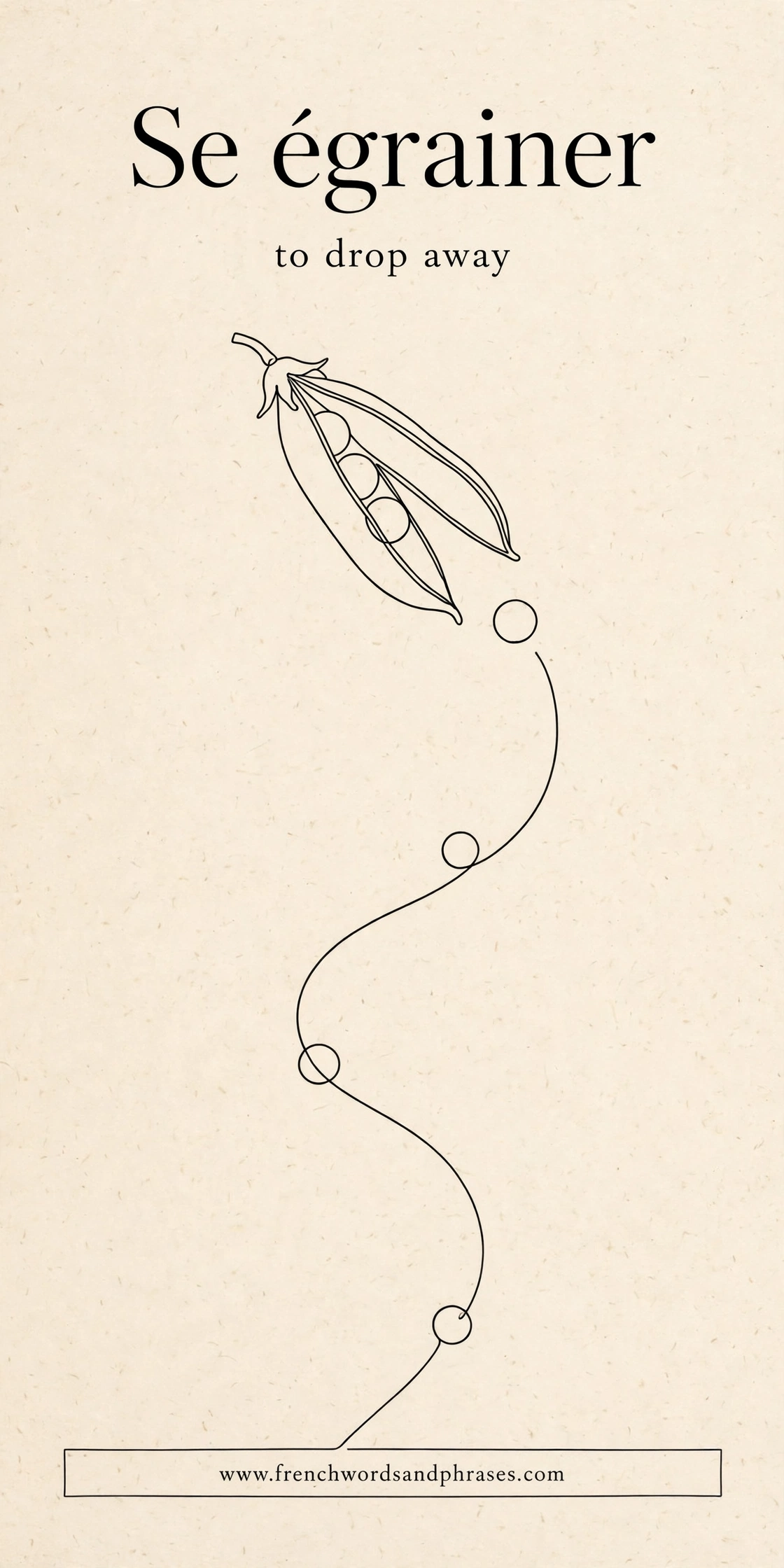
Se égrainer means to drop away — to fall off or drift off one by one, grain after grain, until what held together is gone.
Berries falling from an overripe bunch at the slightest touch, grains spilling from a torn sack, guests leaving a party one by one without a word — se égrainer is the verb of things that come away singly: not a collapse, but a slow, grain-by-grain disappearance.
In this guide, you’ll learn how to conjugate se égrainer in all the major French tenses and moods. Explore complete conjugation tables, French examples, English translations, and practice quizzes.
Understanding the French Verb Se égrainer
Se égrainer is a regular French verb belonging to the first group of verbs, those ending in-er.
It means to drop away. Its first world is the harvest — overripe berries, loose grain, anything that detaches singly — and its second is any group that quietly thins: a crowd after a concert, a class over a long afternoon, guests after midnight. The movement is always one by one, never all at once.
Verb classification: First group (-er), reflexive
Auxiliary verb: Être
Past participle: égrainé
Present participle: égrainant
English equivalents: To drop away one by one, to fall off singly; les baies s’égrainent — the berries drop off; les invités s’égrainent — the guests drift away one by one; s’égrainer lentement — to drop away slowly; la grappe s’égraine — the bunch sheds its berries.
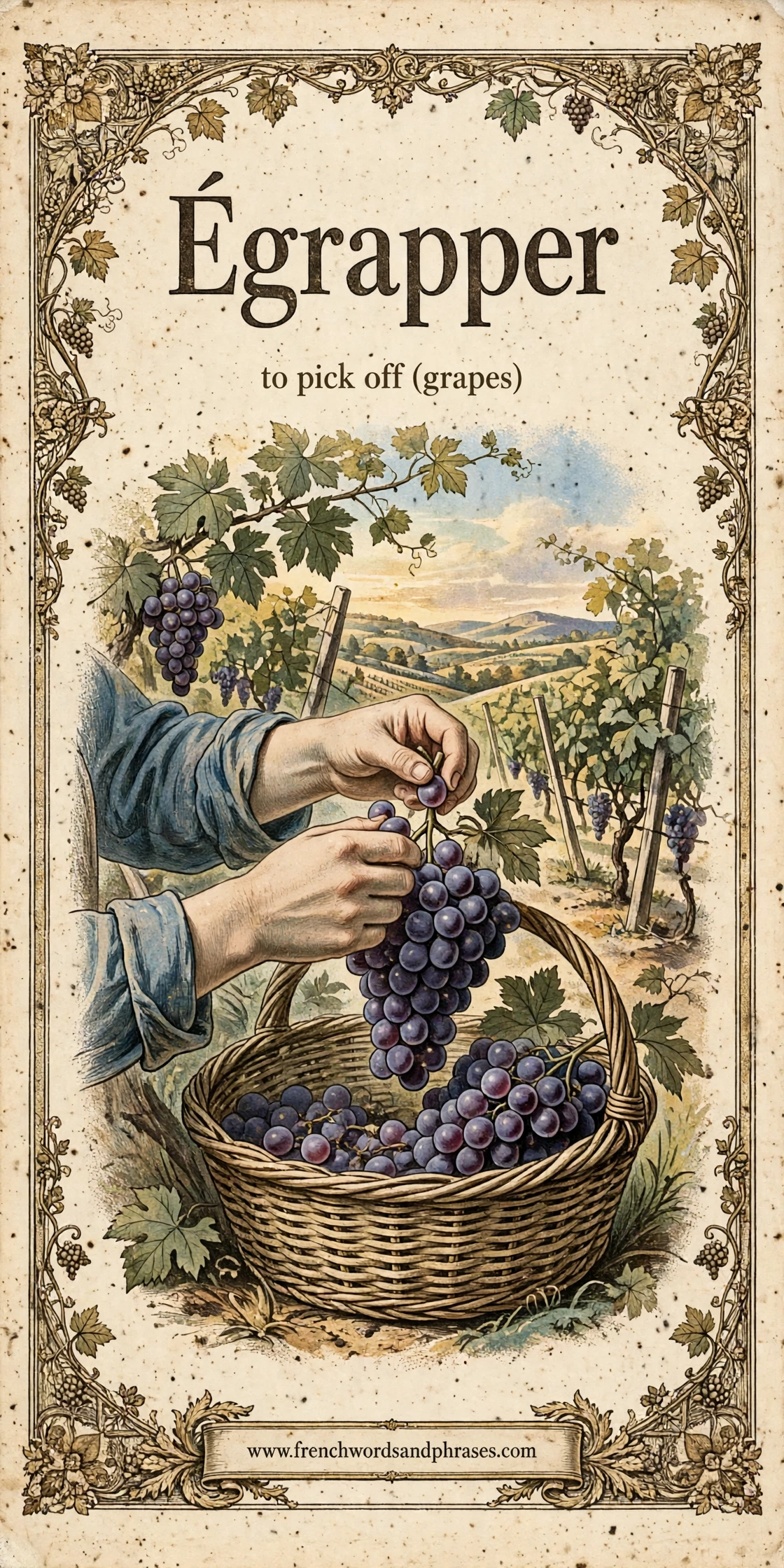
One important detail: se égrainer is the mirror of the plain verb. You égrainer a bunch of grapes on purpose, with your thumbs; but left alone, the bunch s’égraine — the berries fall by themselves, one by one. People do it too, figuratively: guests, members and supporters s’égrainent when they slip away singly instead of leaving in a body. Being reflexive, it takes être and the participle agrees: les baies se sont égrainées, les invités se sont égrainés.
Experience the Word
Se égrainer is the verb of the slow leak — nothing breaks, nothing falls; things simply come away one at a time until you notice how few are left.
Imagine the end of a village fête. The music has stopped, the lights are still up, and nobody announces the end. A couple leaves, then a family, then two old men finish their glasses and go. Les invités s’égrainent — and suddenly the square is empty, without the evening ever having officially finished.
No one stormed out. They dropped away — égrainés, one by one, like berries from a ripe bunch.
How to Conjugate Se égrainer: Complete French Conjugation Guide
Let’s explore every major conjugation of se égrainer, beginning with the indicative mood.
How to Conjugate Se égrainer in the Indicative Mood
The indicative mood is used to express facts, observations, actions, and events.
How to Conjugate Se égrainer in the Present Tense (Présent)
Used for actions happening now, habitual actions, and general truths.
| Subject | Conjugation |
|---|---|
| je | m’égraine |
| tu | t’égraines |
| il / elle | s’égraine |
| nous | nous égrainons |
| vous | vous égrainez |
| ils / elles | s’égrainent |
Example
Les baies trop mûres s’égrainent au moindre toucher.
The overripe berries drop off at the slightest touch.
Quick Quiz 1
Complete the sentence:
Les baies ______ au moindre toucher.
Reveal the answer
s’égrainent
Les baies s’égrainent au moindre toucher.
The berries drop off at the slightest touch.
How to Conjugate Se égrainer in the Passé Composé
Used for completed actions in the past. Se égrainer takes the auxiliary verb être.
| Subject | Conjugation |
|---|---|
| je | me suis égrainé / me suis égrainée |
| tu | t’es égrainé / t’es égrainée |
| il / elle | s’est égrainé / s’est égrainée |
| nous | nous sommes égrainés / nous sommes égrainées |
| vous | vous êtes égrainés / vous êtes égrainées / vous êtes égrainé / vous êtes égrainée |
| ils / elles | se sont égrainés / se sont égrainées |
Example
Les invités se sont égrainés avant minuit.
The guests drifted away before midnight.
How to Conjugate Se égrainer in the Imparfait (Imperfect Tense)
Used for habitual past actions, descriptions, and ongoing situations in the past.
| Subject | Conjugation |
|---|---|
| je | m’égrainais |
| tu | t’égrainais |
| il / elle | s’égrainait |
| nous | nous égrainions |
| vous | vous égrainiez |
| ils / elles | s’égrainaient |
Example
Le raisin s’égrainait dans le panier pendant le transport.
The grapes kept dropping off in the basket during transport.
Quick Quiz 2
Choose the correct form:
The guests drifted away before midnight.
Les invités ______ avant minuit. (se sont égrainés / ont égrainé)
Reveal the answer
se sont égrainés
Les invités se sont égrainés avant minuit.
Se égrainer is reflexive and takes être.
How to Conjugate Se égrainer in the Plus-que-parfait
Used to describe an action that had already been completed before another past event.
| Subject | Conjugation |
|---|---|
| je | m’étais égrainé / m’étais égrainée |
| tu | t’étais égrainé / t’étais égrainée |
| il / elle | s’était égrainé / s’était égrainée |
| nous | nous étions égrainés / nous étions égrainées |
| vous | vous étiez égrainés / vous étiez égrainées / vous étiez égrainé / vous étiez égrainée |
| ils / elles | s’étaient égrainés / s’étaient égrainées |
Example
La moitié des grains s’était égrainée sur le chemin.
Half the grains had dropped off along the way.
How to Conjugate Se égrainer in the Passé Simple
Primarily used in formal writing, literature, and historical narratives. It is rarely used in everyday conversation.
| Subject | Conjugation |
|---|---|
| je | m’égrainai |
| tu | t’égrainas |
| il / elle | s’égraina |
| nous | nous égrainâmes |
| vous | vous égrainâtes |
| ils / elles | s’égrainèrent |
Example
Les convives s’égrainèrent un à un dans la nuit.
The guests dropped away one by one into the night.
How to Conjugate Se égrainer in the Passé Antérieur
A literary tense used to express an action completed immediately before another past action, generally in the passé simple.
| Subject | Conjugation |
|---|---|
| je | me fus égrainé / me fus égrainée |
| tu | te fus égrainé / te fus égrainée |
| il / elle | se fut égrainé / se fut égrainée |
| nous | nous fûmes égrainés / nous fûmes égrainées |
| vous | vous fûtes égrainés / vous fûtes égrainées / vous fûtes égrainé / vous fûtes égrainée |
| ils / elles | se furent égrainés / se furent égrainées |
Example
Dès que les grains se furent égrainés, il ne resta que la rafle.
As soon as the grapes had dropped off, only the stalk remained.
How to Conjugate Se égrainer in the Future Tense (Futur Simple)
Used to describe actions that will take place in the future.
| Subject | Conjugation |
|---|---|
| je | m’égrainerai |
| tu | t’égraineras |
| il / elle | s’égrainera |
| nous | nous égrainerons |
| vous | vous égrainerez |
| ils / elles | s’égraineront |
Example
Si tu secoues la grappe, les baies s’égraineront.
If you shake the bunch, the berries will drop off.
How to Conjugate Se égrainer in the Futur Antérieur (Future Perfect)
Used for an action that will have been completed before a particular point in the future.
| Subject | Conjugation |
|---|---|
| je | me serai égrainé / me serai égrainée |
| tu | te seras égrainé / te seras égrainée |
| il / elle | se sera égrainé / se sera égrainée |
| nous | nous serons égrainés / nous serons égrainées |
| vous | vous serez égrainés / vous serez égrainées / vous serez égrainé / vous serez égrainée |
| ils / elles | se seront égrainés / se seront égrainées |
Example
À la fin de la soirée, les invités se seront égrainés.
By the end of the evening, the guests will have drifted away.
How to Conjugate Se égrainer in the Near Future (Futur Proche)
Used to describe something that is going to happen soon. Formed with aller + infinitive.
| Subject | Conjugation |
|---|---|
| je | vais m’égrainer |
| tu | vas t’égrainer |
| il / elle | va s’égrainer |
| nous | allons nous égrainer |
| vous | allez vous égrainer |
| ils / elles | vont s’égrainer |
Example
Regarde, les grains vont s’égrainer si tu portes le panier ainsi.
Look, the grains are going to drop off if you carry the basket like that.
How to Conjugate Se égrainer in the Conditional Mood
The conditional mood expresses what would happen under certain circumstances. It is also frequently used to make polite requests or express wishes.
How to Conjugate Se égrainer in the Present Conditional
| Subject | Conjugation |
|---|---|
| je | m’égrainerais |
| tu | t’égrainerais |
| il / elle | s’égrainerait |
| nous | nous égrainerions |
| vous | vous égraineriez |
| ils / elles | s’égraineraient |
Example
Les invités s’égraineraient plus tôt sans la musique.
The guests would drift away earlier without the music.
How to Conjugate Se égrainer in the Past Conditional
| Subject | Conjugation |
|---|---|
| je | me serais égrainé / me serais égrainée |
| tu | te serais égrainé / te serais égrainée |
| il / elle | se serait égrainé / se serait égrainée |
| nous | nous serions égrainés / nous serions égrainées |
| vous | vous seriez égrainés / vous seriez égrainées / vous seriez égrainé / vous seriez égrainée |
| ils / elles | se seraient égrainés / se seraient égrainées |
Example
Les grains se seraient égrainés si le panier avait été secoué.
The grains would have dropped off if the basket had been shaken.
Se égrainer in the Literary Past Conditional Form
This less common literary form uses the imperfect subjunctive of être.
| Subject | Conjugation |
|---|---|
| je | me fusse égrainé / me fusse égrainée |
| tu | te fusses égrainé / te fusses égrainée |
| il / elle | se fût égrainé / se fût égrainée |
| nous | nous fussions égrainés / nous fussions égrainées |
| vous | vous fussiez égrainés / vous fussiez égrainées / vous fussiez égrainé / vous fussiez égrainée |
| ils / elles | se fussent égrainés / se fussent égrainées |
Example
Les convives se fussent égrainés avant l’aube.
The guests would have dropped away before dawn.
How to Conjugate Se égrainer in the Subjunctive Mood
The subjunctive is used to express wishes, emotions, doubts, necessity, and uncertainty. It frequently follows expressions such as il faut que (it is necessary that) or bien que (although).
How to Conjugate Se égrainer in the Present Subjunctive
| Subject | Conjugation |
|---|---|
| que je | m’égraine |
| que tu | t’égraines |
| qu’il / qu’elle | s’égraine |
| que nous | nous égrainions |
| que vous | vous égrainiez |
| qu’ils / qu’elles | s’égrainent |
Example
Il est normal que les baies mûres s’égrainent un peu.
It is normal for ripe berries to drop off a little.
Quick Quiz 3
Complete the sentence using the subjunctive:
Il est normal que les grains ______ un peu.
Reveal the answer
s’égrainent
Il est normal que les grains s’égrainent un peu.
It is normal for the grains to drop off a little.
How to Conjugate Se égrainer in the Imperfect Subjunctive
A literary tense, rarely encountered in modern spoken French.
| Subject | Conjugation |
|---|---|
| que je | m’égrainasse |
| que tu | t’égrainasses |
| qu’il / qu’elle | s’égrainât |
| que nous | nous égrainassions |
| que vous | vous égrainassiez |
| qu’ils / qu’elles | s’égrainassent |
Example
Elle portait le panier doucement, de peur que les grains ne s’égrainassent.
She carried the basket gently, for fear the grains might drop off.
How to Conjugate Se égrainer in the Pluperfect Subjunctive
A literary construction used to express an action completed before another past action.
| Subject | Conjugation |
|---|---|
| que je | me fusse égrainé / me fusse égrainée |
| que tu | te fusses égrainé / te fusses égrainée |
| qu’il / qu’elle | se fût égrainé / se fût égrainée |
| que nous | nous fussions égrainés / nous fussions égrainées |
| que vous | vous fussiez égrainés / vous fussiez égrainées / vous fussiez égrainé / vous fussiez égrainée |
| qu’ils / qu’elles | se fussent égrainés / se fussent égrainées |
Example
On remarqua que les invités se fussent égrainés tôt.
People noticed the guests had drifted away early.
How to Conjugate Se égrainer in the Past Subjunctive
| Subject | Conjugation |
|---|---|
| que je | me sois égrainé / me sois égrainée |
| que tu | te sois égrainé / te sois égrainée |
| qu’il / qu’elle | se soit égrainé / se soit égrainée |
| que nous | nous soyons égrainés / nous soyons égrainées |
| que vous | vous soyez égrainés / vous soyez égrainées / vous soyez égrainé / vous soyez égrainée |
| qu’ils / qu’elles | se soient égrainés / se soient égrainées |
Example
Je suis surpris que les baies se soient égrainées si vite.
I am surprised the berries dropped off so quickly.
How to Conjugate Se égrainer in the Imperative
The imperative is used to give commands, instructions, invitations, or suggestions. Subject pronouns are omitted.
How to Conjugate Se égrainer in the Present Imperative
| Person | Conjugation |
|---|---|
| (tu) | égraine-toi |
| (nous) | égrainons-nous |
| (vous) | égrainez-vous |
Example
Ne vous égrainez pas un à un, restez groupés !
Do not drop away one by one, stay together!
Quick Quiz 4
How would you say Do not drop away on the way (tu form)?
Reveal the answer
Ne t’égraine pas en route !
French Participles of Se égrainer
Participles are verb forms that can be used in compound tenses and other grammatical constructions.
Present Participle of Se égrainer
égrainant
En s’égrainant, la grappe laissait des baies sur la table.
As it shed its berries, the bunch left them scattered on the table.
Past Participle of Se égrainer
égrainé
Égrainées sur le chemin, les baies marquaient le passage du panier.
Dropped along the path, the berries marked the basket’s passage.
Se égrainer in Everyday French: Real-Life Examples
Now that you know the conjugations, let’s see how se égrainer appears in everyday French.
Example 1 — Present
Les baies mûres s’égrainent facilement.
Ripe berries drop off easily.
Example 2 — Passé composé
Les invités se sont égrainés avant minuit.
The guests drifted away before midnight.
Example 3 — Imparfait
Le raisin s’égrainait dans le panier.
The grapes kept dropping off in the basket.
Example 4 — Future
Les grains s’égraineront si tu secoues la grappe.
The grains will drop off if you shake the bunch.
Example 5 — Conditional
Les invités s’égraineraient plus tôt sans musique.
The guests would drift away earlier without music.
Example 6 — Imperative
Ne vous égrainez pas, restez groupés !
Do not drop away, stay together!
Beyond Translation: The Meaning of Se égrainer
The image inside the word is exact: a bunch of grapes is a society of berries held by one stalk, and se égrainer is what that society does when the holding weakens.
One by one is the whole meaning.
A crowd that s’égraine has not fled and has not been dismissed — it has thinned, person by person, the way ripe fruit leaves the bunch: each departure small, the total unmistakable.
How to Remember the French Verb Se égrainer
Remember it this way: Se égrainer is about guests leaving a party one by one, like berries off a ripe bunch.
- The bunch does it to itself: les baies s’égrainent — and guests do it too, one by one.
- Reflexive, so être and agreement: les invités se sont égrainés.
- Regular -er with the ai of grain kept: ils s’égrainent, ils s’égrainaient, past participle égrainé.
The key idea is guests leaving a party one by one, like berries off a ripe bunch.
Test Your Knowledge of Se égrainer
Let’s see how much you’ve learned. Try answering these questions before revealing the answers.
Question 1
Which auxiliary does se égrainer use, and why?
Reveal the answer
Être — it is a reflexive verb: les invités se sont égrainés.
Question 2
How do you say The guests drifted away before midnight in French?
Reveal the answer
Les invités se sont égrainés avant minuit.
Question 3
Translate: The overripe berries drop off at the slightest touch.
Reveal the answer
Les baies trop mûres s’égrainent au moindre toucher.
Question 4
What is the past participle of se égrainer?
Reveal the answer
Égrainé — agreeing: égrainée, égrainés, égrainées.
Question 5
Complete the sentence:
Il est normal que les baies mûres ______ un peu.
Reveal the answer
s’égrainent
Il est normal que les baies mûres s’égrainent un peu.
It is normal for ripe berries to drop off a little.
Your Final Challenge
Can You Use It?
How would you say this in French?
The guests drop away into the night, one by one, like the berries of an overripe bunch.
Reveal the answer
Les invités s’égrainent dans la nuit, un à un, comme les grains d’une grappe trop mûre.
The guests drop away into the night, one by one, like the berries of an overripe bunch.
A little French. A little curiosity. A richer everyday life.
LEARN FRENCH ONE WORD AT A TIME