A French Word to Live By
How to Conjugate Égrainer in French
/e.ɡʁɛ.ne/
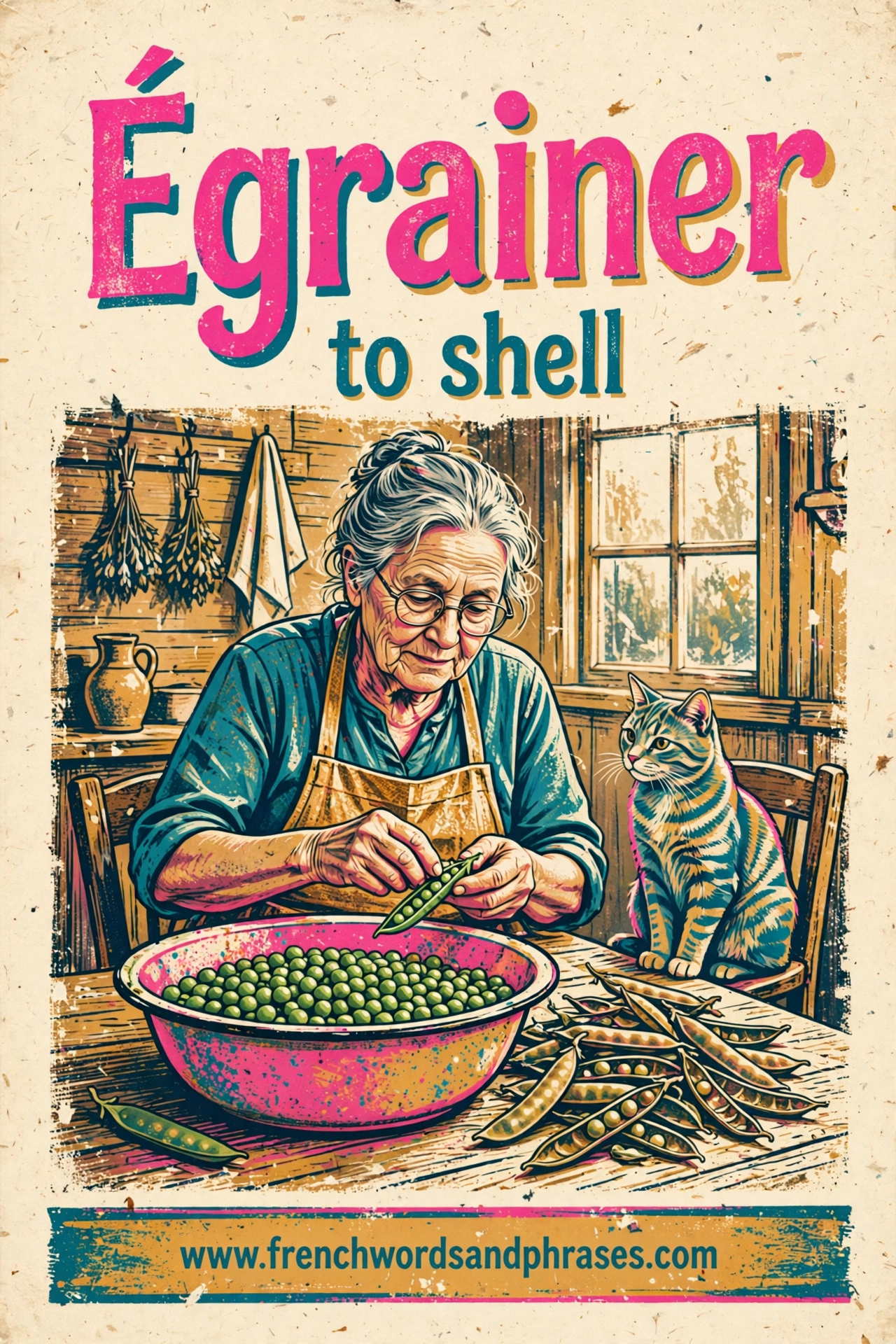
Égrainer means to shell — to take the grains and seeds out of their pod, husk or cob, one thumbful at a time.
A bowl of peas on a kitchen table, an ear of corn stripped kernel by kernel, a pomegranate opened over a salad — égrainer is the slow, satisfying handwork of separating the grain from everything that holds it: pod, cob, husk and skin.
In this guide, you’ll learn how to conjugate égrainer in all the major French tenses and moods. Explore complete conjugation tables, French examples, English translations, and practice quizzes.
Understanding the French Verb Égrainer
Égrainer is a regular French verb belonging to the first group of verbs, those ending in-er.
It means to shell. It is the verb of unhurried kitchen work — shelling peas for soup, stripping corn for a salad, seeding a pomegranate — usually done sitting down, bowl on the knees, often while talking. What is égrainé goes in the pot; what held it goes to the compost.
Verb classification: First group (-er)
Auxiliary verb: Avoir
Past participle: égrainé
Present participle: égrainant
English equivalents: To shell, to remove the grains; égrainer les petits pois — to shell the peas; égrainer le maïs — to strip the corn kernels; égrainer une grenade — to seed a pomegranate; un grain — a grain, a seed, a kernel.
One important detail: égrainer has a near-twin, égrener, and the two are easy to confuse. Égrainer — with ai, like its parent word un grain — is the practical kitchen and garden verb: you égrainer peas, corn and pomegranates, taking the grains out. Keep the ai in every form: j’égraine, nous égrainons, j’égrainais, égrainé. The verb is perfectly regular once the spelling is fixed in your mind.
Experience the Word
Égrainer is the verb of the full bowl — grain after grain, the pile of treasure grows and the pile of husks grows beside it.
Imagine a farmhouse kitchen in June. The peas arrive in a basket straight from the garden, and the whole family sits down around the table. Thumbs split the pods — pop, pop, pop — and the green pearls rain into the bowl. On égrainait autrefois en écoutant les histoires; the work is so gentle that conversation does it half the job.
No machine, no hurry. The peas have been shelled — égrainés, one pod at a time.
How to Conjugate Égrainer: Complete French Conjugation Guide
Let’s explore every major conjugation of égrainer, beginning with the indicative mood.
How to Conjugate Égrainer in the Indicative Mood
The indicative mood is used to express facts, observations, actions, and events.
How to Conjugate Égrainer in the Present Tense (Présent)
Used for actions happening now, habitual actions, and general truths.
| Subject | Conjugation |
|---|---|
| je | égraine |
| tu | égraines |
| il / elle | égraine |
| nous | égrainons |
| vous | égrainez |
| ils / elles | égrainent |
Example
Elle égraine les petits pois dans un saladier.
She shells the peas into a bowl.
Quick Quiz 1
Complete the sentence:
Nous ______ les petits pois.
Reveal the answer
égrainons
Nous égrainons les petits pois.
We are shelling the peas.
How to Conjugate Égrainer in the Passé Composé
Used for completed actions in the past. Égrainer takes the auxiliary verb avoir.
| Subject | Conjugation |
|---|---|
| j’ | ai égrainé |
| tu | as égrainé |
| il / elle | a égrainé |
| nous | avons égrainé |
| vous | avez égrainé |
| ils / elles | ont égrainé |
Example
Nous avons égrainé le maïs pour la soupe.
We stripped the corn for the soup.
How to Conjugate Égrainer in the Imparfait (Imperfect Tense)
Used for habitual past actions, descriptions, and ongoing situations in the past.
| Subject | Conjugation |
|---|---|
| je | égrainais |
| tu | égrainais |
| il / elle | égrainait |
| nous | égrainions |
| vous | égrainiez |
| ils / elles | égrainaient |
Example
Ma grand-mère égrainait les haricots sur le pas de la porte.
My grandmother used to shell beans on the doorstep.
Quick Quiz 2
Choose the correct form:
She stripped the corn.
Elle ______ le maïs. (a égrainé / est égrainée)
Reveal the answer
a égrainé
Elle a égrainé le maïs.
Égrainer takes avoir.
How to Conjugate Égrainer in the Plus-que-parfait
Used to describe an action that had already been completed before another past event.
| Subject | Conjugation |
|---|---|
| j’ | avais égrainé |
| tu | avais égrainé |
| il / elle | avait égrainé |
| nous | avions égrainé |
| vous | aviez égrainé |
| ils / elles | avaient égrainé |
Example
Il avait égrainé la grenade avant l’arrivée des invités.
He had seeded the pomegranate before the guests arrived.
How to Conjugate Égrainer in the Passé Simple
Primarily used in formal writing, literature, and historical narratives. It is rarely used in everyday conversation.
| Subject | Conjugation |
|---|---|
| je | égrainai |
| tu | égrainas |
| il / elle | égraina |
| nous | égrainâmes |
| vous | égrainâtes |
| ils / elles | égrainèrent |
Example
Les enfants égrainèrent les épis en chantant.
The children stripped the ears of corn, singing.
How to Conjugate Égrainer in the Passé Antérieur
A literary tense used to express an action completed immediately before another past action, generally in the passé simple.
| Subject | Conjugation |
|---|---|
| j’ | eus égrainé |
| tu | eus égrainé |
| il / elle | eut égrainé |
| nous | eûmes égrainé |
| vous | eûtes égrainé |
| ils / elles | eurent égrainé |
Example
Quand elle eut égrainé les pois, elle les mit à cuire.
When she had shelled the peas, she put them on to cook.
How to Conjugate Égrainer in the Future Tense (Futur Simple)
Used to describe actions that will take place in the future.
| Subject | Conjugation |
|---|---|
| je | égrainerai |
| tu | égraineras |
| il / elle | égrainera |
| nous | égrainerons |
| vous | égrainerez |
| ils / elles | égraineront |
Example
Demain, nous égrainerons les grenades pour la salade.
Tomorrow, we will seed the pomegranates for the salad.
How to Conjugate Égrainer in the Futur Antérieur (Future Perfect)
Used for an action that will have been completed before a particular point in the future.
| Subject | Conjugation |
|---|---|
| j’ | aurai égrainé |
| tu | auras égrainé |
| il / elle | aura égrainé |
| nous | aurons égrainé |
| vous | aurez égrainé |
| ils / elles | auront égrainé |
Example
À midi, j’aurai égrainé tous les épis.
By noon, I will have stripped all the ears of corn.
How to Conjugate Égrainer in the Near Future (Futur Proche)
Used to describe something that is going to happen soon. Formed with aller + infinitive.
| Subject | Conjugation |
|---|---|
| je | vais égrainer |
| tu | vas égrainer |
| il / elle | va égrainer |
| nous | allons égrainer |
| vous | allez égrainer |
| ils / elles | vont égrainer |
Example
Je vais égrainer les petits pois, assieds-toi.
I am going to shell the peas, sit down.
How to Conjugate Égrainer in the Conditional Mood
The conditional mood expresses what would happen under certain circumstances. It is also frequently used to make polite requests or express wishes.
How to Conjugate Égrainer in the Present Conditional
| Subject | Conjugation |
|---|---|
| je | égrainerais |
| tu | égrainerais |
| il / elle | égrainerait |
| nous | égrainerions |
| vous | égraineriez |
| ils / elles | égraineraient |
Example
Avec un peu d’aide, nous égrainerions ce panier en dix minutes.
With a little help, we would shell this basketful in ten minutes.
How to Conjugate Égrainer in the Past Conditional
| Subject | Conjugation |
|---|---|
| j’ | aurais égrainé |
| tu | aurais égrainé |
| il / elle | aurait égrainé |
| nous | aurions égrainé |
| vous | auriez égrainé |
| ils / elles | auraient égrainé |
Example
Elle aurait égrainé le maïs si on le lui avait demandé.
She would have stripped the corn if she had been asked.
Égrainer in the Literary Past Conditional Form
This less common literary form uses the imperfect subjunctive of avoir.
| Subject | Conjugation |
|---|---|
| j’ | eusse égrainé |
| tu | eusses égrainé |
| il / elle | eût égrainé |
| nous | eussions égrainé |
| vous | eussiez égrainé |
| ils / elles | eussent égrainé |
Example
Il eût égrainé les pois lui-même sans sa blessure à la main.
He would have shelled the peas himself without his injured hand.
How to Conjugate Égrainer in the Subjunctive Mood
The subjunctive is used to express wishes, emotions, doubts, necessity, and uncertainty. It frequently follows expressions such as il faut que (it is necessary that) or bien que (although).
How to Conjugate Égrainer in the Present Subjunctive
| Subject | Conjugation |
|---|---|
| que je | égraine |
| que tu | égraines |
| qu’il / qu’elle | égraine |
| que nous | égrainions |
| que vous | égrainiez |
| qu’ils / qu’elles | égrainent |
Example
Il faut que tu égraines les grenades sans les écraser.
You must seed the pomegranates without crushing them.
Quick Quiz 3
Complete the sentence using the subjunctive:
Il faut que tu ______ les grenades.
Reveal the answer
égraines
Il faut que tu égraines les grenades.
You must seed the pomegranates.
How to Conjugate Égrainer in the Imperfect Subjunctive
A literary tense, rarely encountered in modern spoken French.
| Subject | Conjugation |
|---|---|
| que je | égrainasse |
| que tu | égrainasses |
| qu’il / qu’elle | égrainât |
| que nous | égrainassions |
| que vous | égrainassiez |
| qu’ils / qu’elles | égrainassent |
Example
On voulait qu’elle égrainât les haricots avant midi.
They wanted her to shell the beans before noon.
How to Conjugate Égrainer in the Pluperfect Subjunctive
A literary construction used to express an action completed before another past action.
| Subject | Conjugation |
|---|---|
| que j’ | eusse égrainé |
| que tu | eusses égrainé |
| qu’il / qu’elle | eût égrainé |
| que nous | eussions égrainé |
| que vous | eussiez égrainé |
| qu’ils / qu’elles | eussent égrainé |
Example
On admirait qu’il eût égrainé tout le panier en une heure.
People admired that he had shelled the whole basketful in an hour.
How to Conjugate Égrainer in the Past Subjunctive
| Subject | Conjugation |
|---|---|
| que j’ | aie égrainé |
| que tu | aies égrainé |
| qu’il / qu’elle | ait égrainé |
| que nous | ayons égrainé |
| que vous | ayez égrainé |
| qu’ils / qu’elles | aient égrainé |
Example
Je suis content que vous ayez égrainé les pois à temps.
I am glad you shelled the peas in time.
How to Conjugate Égrainer in the Imperative
The imperative is used to give commands, instructions, invitations, or suggestions. Subject pronouns are omitted.
How to Conjugate Égrainer in the Present Imperative
| Person | Conjugation |
|---|---|
| (tu) | égraine |
| (nous) | égrainons |
| (vous) | égrainez |
Example
Égraine les petits pois pendant que je prépare la casserole.
Shell the peas while I get the pan ready.
Quick Quiz 4
How would you say Shell the peas (tu form)?
Reveal the answer
Égraine les petits pois !
French Participles of Égrainer
Participles are verb forms that can be used in compound tenses and other grammatical constructions.
Present Participle of Égrainer
égrainant
En égrainant le maïs, il écoutait la radio.
While stripping the corn, he listened to the radio.
Past Participle of Égrainer
égrainé
Égrainés à la main, les pois gardent toute leur douceur.
Shelled by hand, the peas keep all their sweetness.
Égrainer in Everyday French: Real-Life Examples
Now that you know the conjugations, let’s see how égrainer appears in everyday French.
Example 1 — Present
Elle égraine les petits pois.
She shells the peas.
Example 2 — Passé composé
Nous avons égrainé le maïs.
We stripped the corn.
Example 3 — Imparfait
Ma grand-mère égrainait les haricots.
My grandmother used to shell beans.
Example 4 — Future
J’égrainerai les grenades demain.
I will seed the pomegranates tomorrow.
Example 5 — Conditional
Nous égrainerions ce panier en dix minutes.
We would shell this basketful in ten minutes.
Example 6 — Imperative
Égrainez les pois, les enfants !
Shell the peas, children!
Beyond Translation: The Meaning of Égrainer
The word is transparent once you see un grain inside it — a grain, a seed, a kernel, even a single berry of a bunch of grapes.
Égrainer is un-graining: freeing the grain from its container.
The same root gives une graine, a seed for sowing, and le grain, corn and wheat as a crop — so the verb belongs to the oldest kitchen work there is, older than the pot it feeds.
How to Remember the French Verb Égrainer
Remember it this way: Égrainer is about a bowl of peas and busy thumbs at the kitchen table.
- Think of un grain: égrainer takes the grains out — peas from the pod, kernels from the cob.
- The ai of grain stays in every form: j’égraine, nous égrainons, égrainé.
- Regular -er, auxiliary avoir: elle a égrainé les pois.
The key idea is a bowl of peas and busy thumbs at the kitchen table.
Test Your Knowledge of Égrainer
Let’s see how much you’ve learned. Try answering these questions before revealing the answers.
Question 1
Which auxiliary does égrainer use?
Reveal the answer
Avoir — nous avons égrainé le maïs.
Question 2
How do you say She shells the peas in French?
Reveal the answer
Elle égraine les petits pois.
Question 3
Translate: We stripped the corn for the soup.
Reveal the answer
Nous avons égrainé le maïs pour la soupe.
Question 4
What is the past participle of égrainer?
Reveal the answer
Égrainé.
Question 5
Complete the sentence:
Il faut que tu ______ les grenades sans les écraser.
Reveal the answer
égraines
Il faut que tu égraines les grenades sans les écraser.
You must seed the pomegranates without crushing them.
Your Final Challenge
Can You Use It?
How would you say this in French?
She shells the peas slowly, and the evening soup begins between her hands.
Reveal the answer
Elle égraine les pois lentement, et la soupe du soir commence entre ses mains.
She shells the peas slowly, and the evening soup begins between her hands.
A little French. A little curiosity. A richer everyday life.
LEARN FRENCH ONE WORD AT A TIME