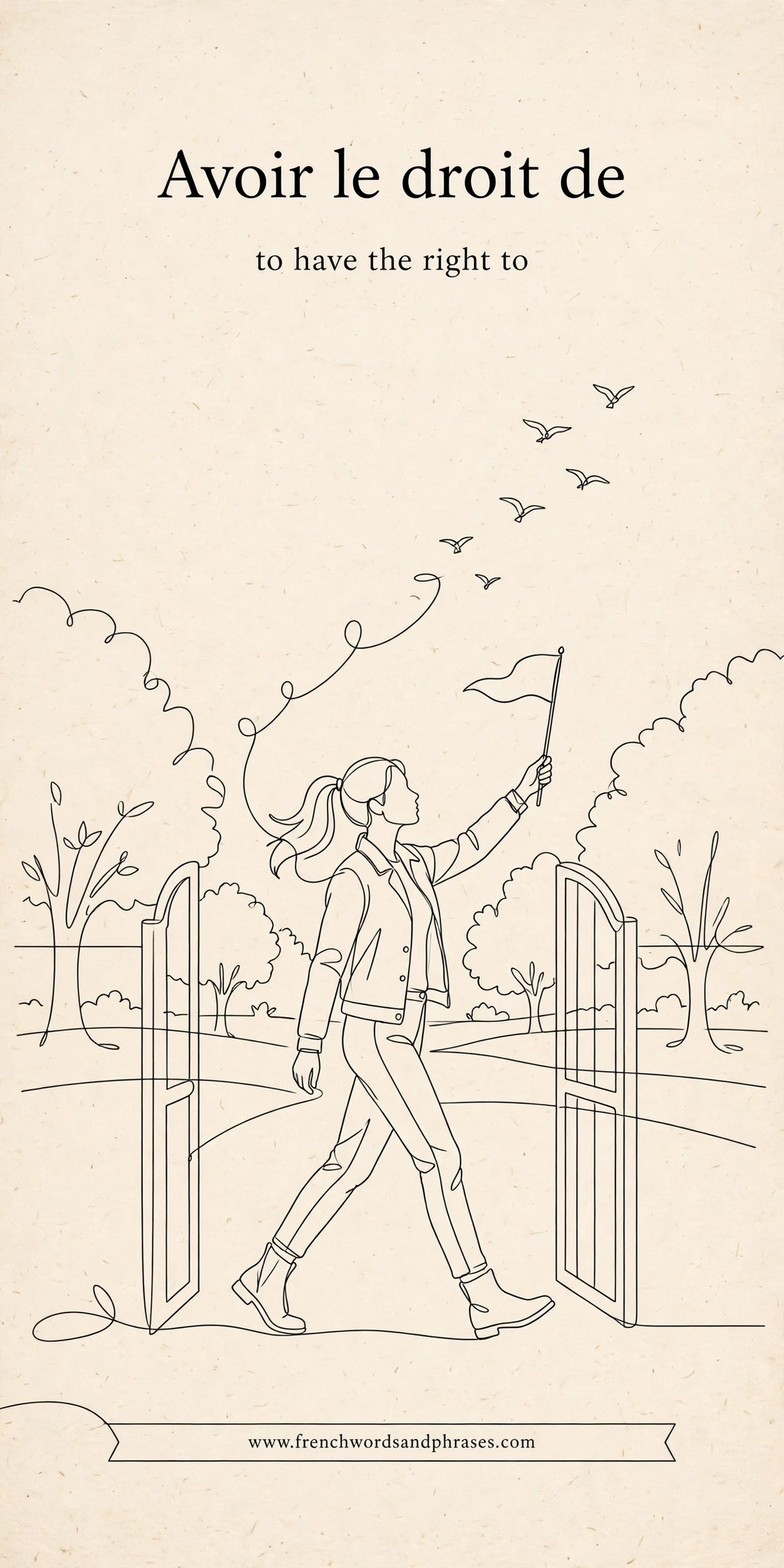
A French Word to Live By
Translate Avoir le droit de to English
/a.vwaʁ lə dʁwa də/
Avoir le droit de means to have the right to — to be allowed to do something, by law, by rule or by fairness.
A classroom in Marseille, last lesson of the day. A pupil looks at the clock, then at the teacher, and states it like a lawyer presenting a case: « Madame, on a le droit de poser des questions. »
Let’s explore how avoir le droit de works in French, beginning with the whole phrase on one card.
Understanding the French Phrase Avoir le droit de
Avoir le droit de is a French expression built from avoir (to have), le droit (the right — a masculine noun, also the word for law itself) and de (to). Where pouvoir asks whether something is possible, this phrase asks whether it is permitted — it speaks the language of rules, laws and fairness.
It means to have the right to do something — to be allowed, entitled, within your rights. Nobody is merely able: the phrase claims a permission that stands on something solid — a law, a rule, a contract, or simple justice. Children learn it early, and use it with total confidence.
Type: Everyday expression — rights and permission (avoir + le droit + de + infinitive)
Answers the need: Saying something is allowed, or claiming a right
Register: Neutral — from the playground argument to the courtroom
Strength: Firm — it appeals to a rule, not to someone’s goodwill
One important usage detail: an infinitive follows de — avoir le droit de voter, de partir, de se taire. The negative is a complete little sentence of its own: tu n’as pas le droit de faire ça, you are not allowed to do that — the sentence every French parent has said and every French child has tested.
Experience the Word
Avoir le droit de is the phrase of the small citizen — the moment a person stops asking permission and starts citing the rules.
Imagine the tenant with the lease in her hand, the worker with the contract, the schoolgirl with the rulebook. Each one is saying the same thing in this phrase: this is not a favour I am begging — this is written down, and it protects me.
French is a country that writes its rights on walls. This phrase is how ordinary people carry those walls in their pockets.
How to Use Avoir le droit de in French: Complete Guide
Let’s explore how avoir le droit de works in French, beginning with the whole phrase on one card.
Avoir le droit de at a Glance
The Whole Phrase on One Card
Real meaning, literal picture, English twin and register — avoir le droit de in five lines.
| Point | Avoir le droit de |
|---|---|
| What it really means | to have the right to — to be allowed, entitled |
| Word for word | to have the right of — le droit is also law itself |
| English equivalent | to have the right to / to be allowed to |
| Register | neutral — playground to courtroom |
| Use it for | rights, permissions, rules — and polite but firm refusals |
Example
Tout le monde a le droit de donner son avis.
Everyone has the right to give their opinion.
Word by Word: Building the Right
Three small pieces — take them one by one and the rulebook opens.
| Word | Literal meaning | Its job in the phrase |
|---|---|---|
| avoir | to have | the verb that holds the right — j’ai, tu as, il a |
| le droit | the right; law | a masculine noun: a right you hold, and the whole system of law |
| de | of, to | the little link that introduces the infinitive: de voter, de partir |
Example
Elle a le droit de refuser cette offre.
She has the right to refuse this offer.
Quick Quiz 1
What follows de in avoir le droit de?
Reveal the answer
An infinitive — de voter, de partir, de se taire: the action the right protects.
Vous avez le droit de garder le silence.
You have the right to remain silent.
When You Say It: The Rights Moments
Avoir le droit de fires at moments like these — wherever a rule is claimed, quoted or tested.
| Situation | Example |
|---|---|
| Citizens | avoir le droit de voter — to have the right to vote |
| At work | les employés ont le droit de faire grève — employees have the right to strike |
| Children | j’ai le droit de jouer dehors — I am allowed to play outside |
| A firm refusal | tu n’as pas le droit de lire mon journal — you have no right to read my diary |
| Tenants | le locataire a le droit de recevoir des invités — the tenant has the right to have guests |
Example
À dix-huit ans, on a le droit de voter.
At eighteen, you have the right to vote.
Make It Yours: The Right for Every Person
Avoir conjugates — the right belongs to each person in turn.
| Form | French | In English |
|---|---|---|
| I have the right | j’ai le droit de partir | I have the right to leave |
| You have the right | tu as le droit de répondre | you have the right to answer |
| He has the right | il a le droit de choisir | he has the right to choose |
| We have the right | nous avons le droit de savoir | we have the right to know |
| No right | tu n’as pas le droit de toucher | you are not allowed to touch |
| The question | ai-je le droit de… ? | do I have the right to…? |
Example
Nous avons le droit de connaître la vérité.
We have the right to know the truth.
Quick Quiz 2
A mother says: tu n’as pas le droit de faire ça. Is she talking about ability or permission?
Reveal the answer
Permission — le droit is about what is allowed, not what is possible. The child certainly CAN do it; that is the problem.
Tu n’as pas le droit de faire ça, c’est dangereux.
You are not allowed to do that, it is dangerous.
Everyday Expressions: Building on the Right
Avoir le droit de slots into these everyday frames — each one ready to use as it stands.
| Frame | In English |
|---|---|
| avoir le droit de faire quelque chose | to have the right to do something |
| ne pas avoir le droit de | to not be allowed to — the everyday prohibition |
| avoir tous les droits | to have every right — complete entitlement |
| les droits de l’homme | human rights — the grand, historical plural |
| c’est mon droit | it is my right — the short, firm claim |
Example
C’est mon droit, et je compte bien l’utiliser.
It is my right, and I fully intend to use it.
Close Cousins: The Other Ways to Be Allowed
French has a whole shelf of permission phrases — avoir le droit de is the rights one; its cousins ask, allow or simply can.
| Expression | The difference |
|---|---|
| avoir le droit de | to have the right to — grounded in law, rules or fairness |
| pouvoir | to be able to, may — the everyday verb of permission and ability together |
| être autorisé à | to be authorised to — official, written, administrative |
| avoir la permission de | to have permission to — granted by a person, like a parent or a teacher |
| il est interdit de | it is forbidden to — the opposite wall of the same rulebook |
Example
Les élèves ont la permission de sortir à midi.
The pupils have permission to go out at noon.
Quick Quiz 3
A sign on a door states who may enter. Avoir le droit de or être autorisé à?
Reveal the answer
Être autorisé à — the sign speaks administration: les personnes autorisées. Avoir le droit de is the citizen’s claim, not the sign’s wording.
Seules les personnes autorisées ont accès au laboratoire.
Only authorised persons have access to the laboratory.
Avoir le droit de and Its Neighbours
The rulebook shelf around the phrase — rights, laws and duties.
| French | In English |
|---|---|
| une loi | a law |
| un devoir | a duty — the other side of every right |
| la liberté | freedom, liberty |
| voter | to vote |
| un avocat | a lawyer |
| juste | fair, just |
Example
Chaque droit vient avec un devoir, dit l’avocat.
Every right comes with a duty, says the lawyer.
Watch Out: The Traps Around Avoir le droit de
The traps: a noun with three lives, and a confusion between can and may that French keeps cleaner than English.
| Trap | The truth |
|---|---|
| droit’s three lives | le droit is a right and the law; l’endroit and à droite (to the right) are different words that merely sound close |
| can vs may | pouvoir covers both; le droit de is strictly permission — use it when a rule is doing the allowing |
| de + infinitive | avoir le droit de voter — never de followed by a conjugated verb |
| the negative is total | tu n’as pas le droit de… is a complete prohibition, stronger than a polite please don’t |
Example
Tournez à droite, puis lisez le panneau : vous avez le droit d’entrer.
Turn right, then read the sign: you have the right to enter.
Quick Quiz 4
True or false: le droit in this phrase is the same word as à droite, ‘to the right’.
Reveal the answer
False — le droit is the right, the law; droite is direction. Similar sound, different worlds.
Le droit protège tout le monde, à gauche comme à droite.
The law protects everyone, on the left as on the right.
Avoir le droit de in Everyday French: Real-Life Examples
Now that you know the word, let’s see how avoir le droit de appears in everyday French.
Example 1 — In the classroom
Madame, on a le droit de poser une question ?
Miss, are we allowed to ask a question?
Example 2 — The voter
À dix-huit ans, elle a le droit de voter.
At eighteen, she has the right to vote.
Example 3 — The parent’s line
Tu n’as pas le droit de toucher à ça.
You are not allowed to touch that.
Example 4 — At work
Les employés ont le droit de prendre des pauses.
Employees have the right to take breaks.
Example 5 — The tenant
J’ai le droit de recevoir des amis chez moi.
I have the right to have friends over at my place.
Example 6 — Firm and calm
Vous avez le droit de refuser, c’est la loi.
You have the right to refuse, it is the law.
Beyond Translation: The Meaning of Avoir le droit de
English separates its words — a right here, the law there, permission somewhere else. French gathers them into one solid noun, le droit, and hands it to every citizen as a possession: something you have, like a house key, like a name.
To avoir le droit de is to hold a small piece of the republic in your pocket.
That is why the phrase rings the same in a courtroom and a kitchen: the schoolchild citing it against a parent is rehearsing, perfectly seriously, for citizenship.
How to Remember the French Phrase Avoir le droit de
Remember it this way: Avoir le droit de is the rulebook in your pocket — a right is something you have, and de opens it onto the action it protects.
- You follow de with an infinitive — de voter, de partir, de se taire.
- You hear the claim inside it — le droit appeals to rules and law, not to anyone’s kindness.
- You know the negative by heart — tu n’as pas le droit de faire ça, the complete prohibition.
The key idea is avoir le droit de means to have the right to — permission grounded in rules and law.
Test Your Knowledge of Avoir le droit de
Let’s see how much you’ve learned. Try answering these questions before revealing the answers.
Question 1
What does tu n’as pas le droit de faire ça mean?
Reveal the answer
You are not allowed to do that — a complete prohibition, in the parent’s classic wording.
Question 2
What follows de in avoir le droit de?
Reveal the answer
An infinitive — de voter, de choisir, de refuser.
Question 3
How do you say ‘everyone has the right to speak’?
Reveal the answer
Tout le monde a le droit de parler — the right held by everyone.
Question 4
What is the difference between avoir le droit de and avoir la permission de?
Reveal the answer
Le droit stands on law, rules or fairness; la permission is granted by a person — a parent, a teacher, a boss.
Question 5
Complete the sentence:
À dix-huit ans, on ______ le droit de voter. (At eighteen, you have the right to vote.)
Reveal the answer
a
À dix-huit ans, on a le droit de voter.
At eighteen, you have the right to vote.
Your Final Challenge
Can You Use It?
How would you say this in French?
“You have the right to say no.”
Reveal the answer
Tu as le droit de dire non.
You have the right to say no.
A little French. A little curiosity. A richer everyday life.
LEARN FRENCH ONE WORD AT A TIME