A French Word to Live By
Translate Arrêt de Bus to English
/a.ʁɛ də bys/
L’Arrêt de Bus means the bus stop.
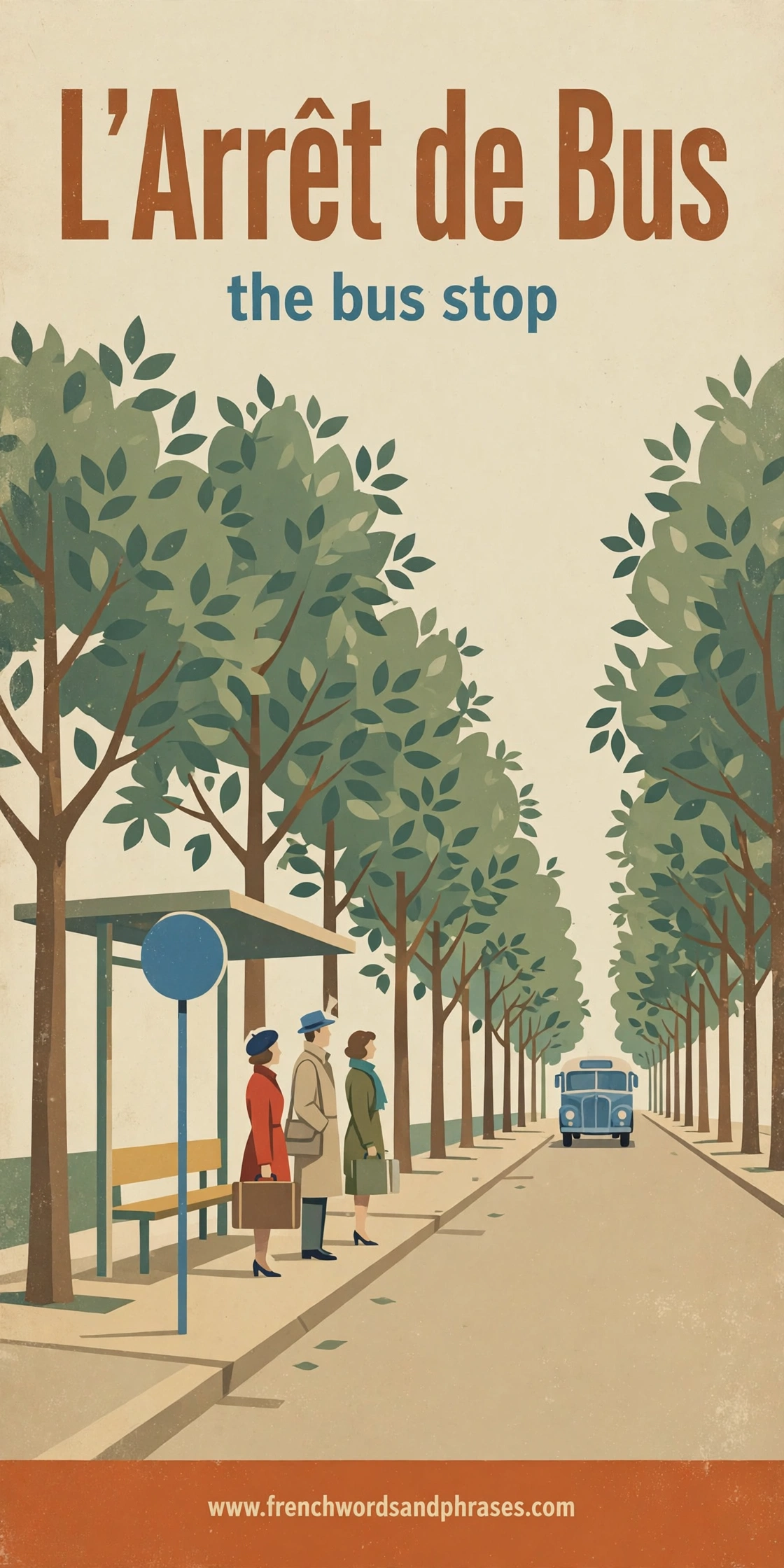
A pole, a timetable under glass and three people pretending not to watch the road: l’arrêt de bus, the bus stop — the smallest station in the world, where every town journey begins with waiting.
In this guide, you’ll learn what arrêt de bus means in English, how to use it with its articles, how to form its plural, and how it appears in everyday French. Explore French examples, English translations, and practice quizzes.
Understanding the French Noun Arrêt de Bus
Arrêt de bus is a masculine French noun phrase, learned with its article: l’arrêt de bus, un arrêt de bus. Arrêt comes from the verb arrêter, to stop — the arrêt is simply the stopping place. It begins with a vowel, so the article melts: l’arrêt. The same word serves the whole transport family: un arrêt de tram, un arrêt de car, and in the métro the stops are called stations instead.
It means a bus stop — the marked place where buses stop for passengers: attendre à l’arrêt de bus, to wait at the bus stop, l’arrêt de bus le plus proche, the nearest bus stop. Its furniture is minimal and universal: le poteau or the sign, l’abribus, the bus shelter, les horaires, the timetables, and sometimes un banc, a bench. Some stops are served only on request — arrêt facultatif — where you must signal the driver: faire signe au conducteur.
Gender: Masculine — l’arrêt de bus
Definite article: l’ — l’arrêt de bus (the bus stop), melted before the vowel
Indefinite article: un — un arrêt de bus (a bus stop)
Plural: les arrêts de bus — arrêt takes the s, bus never changes
Spelling note: from arrêter, to stop — the arrêt is the stopping place
The shelter: l’abribus — the little roof that makes waiting bearable
English equivalents: The bus stop.
You wait à l’arrêt — je t’attends à l’arrêt de bus, I’ll wait for you at the bus stop. To ask for your stop on board: vous descendez à quel arrêt ? — and the button that requests it is pressed with demander l’arrêt. Remember the split: buses and trams stop at un arrêt; the métro and trains stop at une station or une gare.
Experience the Word
Arrêt de bus is democracy’s waiting room: the schoolboy, the nurse, the grandfather with his baguette, all equal before the timetable.
Imagine the arrêt on a rainy morning — six umbrellas in a row under the abribus, six strangers watching the same corner, and the small shared cheer when the bus finally rounds it.
You have not just named a signpost. You have named the journey’s true beginning — l’arrêt de bus, the bus stop, where the town queues for its day.
How to Use Arrêt de Bus in French: Complete Guide
Let’s explore how arrêt de bus works in French, beginning with its articles — l’arrêt de bus, un arrêt de bus, attendre à l’arrêt.
Arrêt de Bus with the Definite Article (L’, Les)
Used for a specific stop — yours, the one by the bakery. The vowel opening makes le melt into l’.
| Form | French |
|---|---|
| Masculine singular | l’arrêt de bus |
| Plural | les arrêts de bus |
Example
L’arrêt de bus se trouve devant la boulangerie.
The bus stop is in front of the bakery.
Arrêt de Bus with the Indefinite Article (Un, Des)
Used for a bus stop in general — any stopping place on the route.
| Form | French |
|---|---|
| Masculine singular | un arrêt de bus |
| Plural | des arrêts de bus |
Example
Il y a un arrêt de bus au bout de la rue.
There is a bus stop at the end of the street.
At the Arrêt de Bus (Abribus, Horaires, Banc…)
Shelters, timetables and benches — the stop’s modest furniture.
| Thing | French |
|---|---|
| the bus shelter | l’abribus |
| the timetable | les horaires |
| a bench | un banc |
| the sign, the post | le poteau |
| a request stop | un arrêt facultatif |
Example
Les voyageurs attendent sous l’abribus.
The passengers are waiting under the bus shelter.
Quick Quiz 1
Complete the sentence:
______ arrêt de bus de notre rue a un nouvel abribus. (the)
Reveal the answer
L’
L’arrêt de bus de notre rue a un nouvel abribus.
Our street’s bus stop has a new shelter — le melts into l’ before the vowel.
The Plural of Arrêt de Bus
Only arrêt takes the plural s: les arrêts de bus — bus itself never changes.
| Number | French |
|---|---|
| Singular | l’arrêt de bus |
| Plural | les arrêts de bus |
Example
Les arrêts de bus sont indiqués sur le plan.
The bus stops are shown on the map.
Arrêt de Bus with Possessive Adjectives (Mon, Ton, Son…)
Possessives agree with arrêt: masculine, so mon, ton, son in the singular.
| Owner | French |
|---|---|
| my | mon arrêt de bus |
| your (tu) | ton arrêt de bus |
| his / her | son arrêt de bus |
| our | notre arrêt de bus |
| your (vous) | votre arrêt de bus |
| their | leur arrêt de bus |
Example
Mon arrêt de bus est à deux minutes de chez moi.
My bus stop is two minutes from my home.
Quick Quiz 2
Complete the sentence:
Elle descend à ______ arrêt, devant l’école. (her)
Reveal the answer
son
Elle descend à son arrêt, devant l’école.
She gets off at her stop, in front of the school — son, because arrêt is masculine.
Arrêt de Bus with Demonstrative Adjectives (Cet, Ces)
Used to point: cet arrêt de bus, this bus stop — cet, because the noun begins with a vowel.
| Form | French |
|---|---|
| Masculine singular | cet arrêt de bus |
| Plural | ces arrêts de bus |
Example
Cet arrêt de bus dessert le marché.
This bus stop serves the market.
Arrêt de Bus with Adjectives
Adjectives agree with arrêt — masculine singular: un arrêt de bus proche, le prochain arrêt.
| Adjective | With Arrêt de Bus |
|---|---|
| proche (nearby) | un arrêt de bus proche |
| prochain (next) | le prochain arrêt de bus |
| nouveau (new) | un nouvel arrêt de bus |
| dernier (last) | le dernier arrêt de bus |
| facultatif (request) | un arrêt facultatif |
Example
Le prochain arrêt de bus est celui de la gare.
The next bus stop is the station one.
Quick Quiz 3
Complete the sentence:
C’est un arrêt ______, il faut faire signe au conducteur. (request)
Reveal the answer
facultatif
C’est un arrêt facultatif, il faut faire signe au conducteur.
It’s a request stop, you have to signal the driver — facultatif, masculine, to agree with arrêt.
Everyday Expressions with Arrêt de Bus
Waiting, signalling and getting off — the arrêt phrases of daily life.
| Expression | In English |
|---|---|
| attendre à l’arrêt de bus | to wait at the bus stop |
| descendre à l’arrêt | to get off at the stop |
| demander l’arrêt | to request the stop |
| faire signe au conducteur | to signal the driver |
| l’arrêt le plus proche | the nearest stop |
Example
Je descends à l’arrêt de la mairie.
I get off at the town hall stop.
Words from the Same Family as Arrêt de Bus
Stops and waiting — the words that travel with arrêt de bus.
| French | In English |
|---|---|
| arrêter | to stop (the verb) |
| un abribus | a bus shelter |
| le bus | the bus — it has its own page |
| les horaires | the timetables |
| une station | a métro or tram station |
Example
Le bus s’arrête à tous les arrêts.
The bus stops at every stop.
Quick Quiz 4
What is un abribus?
Reveal the answer
A bus shelter — the little roofed shelter at the stop.
Il pleut, attendons sous l’abribus.
It’s raining, let’s wait under the bus shelter.
Arrêt de Bus in Everyday French: Real-Life Examples
Now that you know the word, let’s see how arrêt de bus appears in everyday French.
Example 1 — Waiting
J’attends le bus à l’arrêt depuis dix minutes.
I have been waiting for the bus at the stop for ten minutes.
Example 2 — Finding it
L’arrêt de bus le plus proche est rue des Lilas.
The nearest bus stop is in Rue des Lilas.
Example 3 — On board
Vous descendez à quel arrêt ?
Which stop are you getting off at?
Example 4 — Requesting
Appuie sur le bouton pour demander l’arrêt.
Press the button to request the stop.
Example 5 — The shelter
Les enfants s’abritent sous l’abribus.
The children are sheltering under the bus shelter.
Example 6 — The last stop
C’est le dernier arrêt avant la gare.
It’s the last stop before the station.
Beyond Translation: The Meaning of Arrêt de Bus
The arrêt de bus is the most modest piece of street furniture in France, and one of the most democratic: the same pole serves the minister and the schoolchild. Its shelter, the abribus, even became a design icon — and a canvas: towns commission artists to paint them, and villages defend theirs like monuments. Every great journey by bus begins in this small republic of waiting.
To say arrêt de bus is to join the queue of the whole town.
It evokes the timetable under glass, the shelter in the rain and the bus rounding the corner at last.
How to Remember the French Noun Arrêt de Bus
Remember it this way: Arrêt de bus is the bus stop — masculine with a melted article: l’arrêt de bus, from arrêter, to stop.
- Masculine, vowel first — l’arrêt de bus, un arrêt de bus, cet arrêt.
- The waiting phrase — attendre à l’arrêt de bus.
- The shelter — l’abribus; and métro stops are stations, not arrêts.
The key idea is l’arrêt de bus — the bus stop, masculine; l’abribus = the shelter.
Test Your Knowledge of Arrêt de Bus
Let’s see how much you’ve learned. Try answering these questions before revealing the answers.
Question 1
Is arrêt de bus masculine or feminine?
Reveal the answer
Masculine — l’arrêt de bus, un arrêt de bus.
Question 2
How do you say to wait at the bus stop?
Reveal the answer
Attendre à l’arrêt de bus.
Question 3
Translate: The bus stop is in front of the bakery.
Reveal the answer
L’arrêt de bus se trouve devant la boulangerie.
Question 4
What is un arrêt facultatif?
Reveal the answer
A request stop — the bus stops only if you signal the driver.
Question 5
Complete the sentence:
______ arrêts de bus sont indiqués sur le plan. (the)
Reveal the answer
Les
Les arrêts de bus sont indiqués sur le plan.
The bus stops are shown on the map.
Your Final Challenge
Can You Use It?
How would you say this in French?
“The bus stop is in front of the bakery.”
Reveal the answer
L’arrêt de bus se trouve devant la boulangerie.
The bus stop is in front of the bakery.
A little French. A little curiosity. A richer everyday life.
LEARN FRENCH ONE WORD AT A TIME