A French Word to Live By
How to Conjugate Apporter in French
/a.pɔʁ.te/
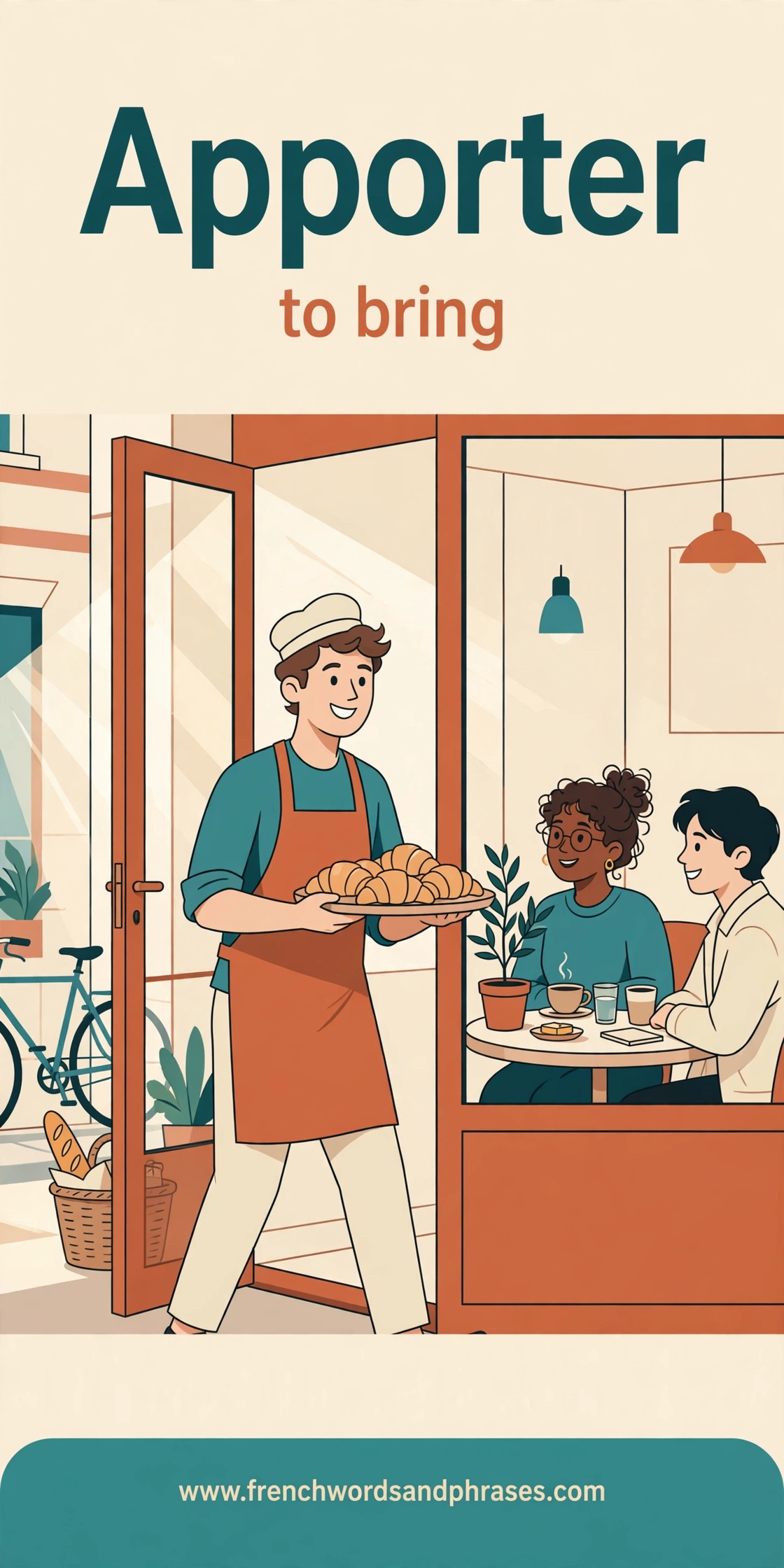
Apporter means to bring — to carry something with you to the place you are going, and to leave it there when you arrive.
A neighbour arriving with a cake still warm from her oven, a child carrying a drawing across the classroom to his teacher, a guest turning up at the door with a bottle under one arm — apporter is the verb of bringing: whatever travels with a person and arrives where that person arrives has been apporté.
In this guide, you’ll learn how to conjugate apporter in all the major French tenses and moods. Explore complete conjugation tables, French examples, English translations, and practice quizzes.
Understanding the French Verb Apporter
Apporter is a regular French verb belonging to the first group of verbs, those ending in-er.
It means to bring. Beyond cakes and bottles, apporter is the verb of contributions: apporter son soutien (to lend one’s support), apporter une réponse (to provide an answer), apporter la preuve (to furnish proof). Whatever arrives because someone carried it — an object, an idea, a change — has been apporté.
Verb classification: First group (-er)
Auxiliary verb: Avoir
Past participle: apporté
Present participle: apportant
English equivalents: To bring, to carry here; apporter quelque chose à quelqu’un — to bring someone something; apporter un cadeau — to bring a present; apporter son aide — to bring one’s help, to lend a hand; apporter une preuve — to produce a proof; apporter un soin particulier à quelque chose — to take particular care over something.
One important detail: French splits English bring and take by direction. Apporter brings a thing towards the place you are heading for or speaking from: j’apporte le vin, tu apportes le pain. Its opposite, emporter, carries a thing away. And apporter is for things — people and animals are led, so they are amenés: one amène un ami, but one apporte un gâteau. The verb itself is perfectly regular: j’apporte, nous apportons, j’ai apporté.
Experience the Word
Apporter is the verb of full hands — nobody apporte empty-handed; something always travels with the person.
Imagine a Sunday lunch in a small French town. The doorbell rings, and there is the cousin from Lyon, a tarte aux pommes balanced on one hand and flowers in the other. She never simply arrives; wherever she goes, something good comes with her — elle apporte, and the table is richer for it.
The cake, the flowers, the news from Lyon. She has brought them all — apportés, carried in with her, on purpose.
How to Conjugate Apporter: Complete French Conjugation Guide
Let’s explore every major conjugation of apporter, beginning with the indicative mood.
How to Conjugate Apporter in the Indicative Mood
The indicative mood is used to express facts, observations, actions, and events.
How to Conjugate Apporter in the Present Tense (Présent)
Used for actions happening now, habitual actions, and general truths.
| Subject | Conjugation |
|---|---|
| je | apporte |
| tu | apportes |
| il / elle | apporte |
| nous | apportons |
| vous | apportez |
| ils / elles | apportent |
Example
Elle apporte toujours un gâteau chez ses parents.
She always brings a cake to her parents’ house.
Quick Quiz 1
Complete the sentence:
Nous ______ un gâteau chez nos parents.
Reveal the answer
apportons
Nous apportons un gâteau chez nos parents.
We bring a cake to our parents’ house.
How to Conjugate Apporter in the Passé Composé
Used for completed actions in the past. Apporter takes the auxiliary verb avoir.
| Subject | Conjugation |
|---|---|
| j’ | ai apporté |
| tu | as apporté |
| il / elle | a apporté |
| nous | avons apporté |
| vous | avez apporté |
| ils / elles | ont apporté |
Example
J’ai apporté les documents que vous m’aviez demandés.
I brought the documents you had asked me for.
How to Conjugate Apporter in the Imparfait (Imperfect Tense)
Used for habitual past actions, descriptions, and ongoing situations in the past.
| Subject | Conjugation |
|---|---|
| je | apportais |
| tu | apportais |
| il / elle | apportait |
| nous | apportions |
| vous | apportiez |
| ils / elles | apportaient |
Example
Autrefois, le facteur apportait le courrier à vélo.
In the old days, the postman used to bring the mail by bicycle.
Quick Quiz 2
Choose the correct form:
I brought the keys.
J’______ les clés. (ai apporté / suis apporté)
Reveal the answer
ai apporté
J’ai apporté les clés.
Apporter takes avoir.
How to Conjugate Apporter in the Plus-que-parfait
Used to describe an action that had already been completed before another past event.
| Subject | Conjugation |
|---|---|
| j’ | avais apporté |
| tu | avais apporté |
| il / elle | avait apporté |
| nous | avions apporté |
| vous | aviez apporté |
| ils / elles | avaient apporté |
Example
Ils avaient apporté leurs propres chaises pour la fête.
They had brought their own chairs for the party.
How to Conjugate Apporter in the Passé Simple
Primarily used in formal writing, literature, and historical narratives. It is rarely used in everyday conversation.
| Subject | Conjugation |
|---|---|
| je | apportai |
| tu | apportas |
| il / elle | apporta |
| nous | apportâmes |
| vous | apportâtes |
| ils / elles | apportèrent |
Example
Le messager apporta la nouvelle au château avant la nuit.
The messenger brought the news to the castle before nightfall.
How to Conjugate Apporter in the Passé Antérieur
A literary tense used to express an action completed immediately before another past action, generally in the passé simple.
| Subject | Conjugation |
|---|---|
| j’ | eus apporté |
| tu | eus apporté |
| il / elle | eut apporté |
| nous | eûmes apporté |
| vous | eûtes apporté |
| ils / elles | eurent apporté |
Example
Dès qu’il eut apporté le bois, on alluma le feu.
As soon as he had brought the wood, they lit the fire.
How to Conjugate Apporter in the Future Tense (Futur Simple)
Used to describe actions that will take place in the future.
| Subject | Conjugation |
|---|---|
| je | apporterai |
| tu | apporteras |
| il / elle | apportera |
| nous | apporterons |
| vous | apporterez |
| ils / elles | apporteront |
Example
Demain, j’apporterai les clés au bureau.
Tomorrow, I will bring the keys to the office.
How to Conjugate Apporter in the Futur Antérieur (Future Perfect)
Used for an action that will have been completed before a particular point in the future.
| Subject | Conjugation |
|---|---|
| j’ | aurai apporté |
| tu | auras apporté |
| il / elle | aura apporté |
| nous | aurons apporté |
| vous | aurez apporté |
| ils / elles | auront apporté |
Example
À ton arrivée, j’aurai apporté toutes les valises dans la chambre.
By the time you arrive, I will have brought all the suitcases up to the bedroom.
How to Conjugate Apporter in the Near Future (Futur Proche)
Used to describe something that is going to happen soon. Formed with aller + infinitive.
| Subject | Conjugation |
|---|---|
| je | vais apporter |
| tu | vas apporter |
| il / elle | va apporter |
| nous | allons apporter |
| vous | allez apporter |
| ils / elles | vont apporter |
Example
Tu vas apporter quoi, pour le pique-nique ?
What are you going to bring for the picnic?
How to Conjugate Apporter in the Conditional Mood
The conditional mood expresses what would happen under certain circumstances. It is also frequently used to make polite requests or express wishes.
How to Conjugate Apporter in the Present Conditional
| Subject | Conjugation |
|---|---|
| je | apporterais |
| tu | apporterais |
| il / elle | apporterait |
| nous | apporterions |
| vous | apporteriez |
| ils / elles | apporteraient |
Example
J’apporterais volontiers un dessert, si tu veux.
I would gladly bring a dessert, if you like.
How to Conjugate Apporter in the Past Conditional
| Subject | Conjugation |
|---|---|
| j’ | aurais apporté |
| tu | aurais apporté |
| il / elle | aurait apporté |
| nous | aurions apporté |
| vous | auriez apporté |
| ils / elles | auraient apporté |
Example
Elle aurait apporté des fleurs, mais le magasin était fermé.
She would have brought flowers, but the shop was closed.
Apporter in the Literary Past Conditional Form
This less common literary form uses the imperfect subjunctive of avoir.
| Subject | Conjugation |
|---|---|
| j’ | eusse apporté |
| tu | eusses apporté |
| il / elle | eût apporté |
| nous | eussions apporté |
| vous | eussiez apporté |
| ils / elles | eussent apporté |
Example
Il eût apporté son aide sans hésiter, en ces temps-là.
He would have brought his help without hesitating, in those days.
How to Conjugate Apporter in the Subjunctive Mood
The subjunctive is used to express wishes, emotions, doubts, necessity, and uncertainty. It frequently follows expressions such as il faut que (it is necessary that) or bien que (although).
How to Conjugate Apporter in the Present Subjunctive
| Subject | Conjugation |
|---|---|
| que je | apporte |
| que tu | apportes |
| qu’il / qu’elle | apporte |
| que nous | apportions |
| que vous | apportiez |
| qu’ils / qu’elles | apportent |
Example
Il faut que tu apportes ton passeport demain.
You must bring your passport tomorrow.
Quick Quiz 3
Complete the sentence using the subjunctive:
Il faut que vous ______ les documents signés.
Reveal the answer
apportiez
Il faut que vous apportiez les documents signés.
You must bring the signed documents.
How to Conjugate Apporter in the Imperfect Subjunctive
A literary tense, rarely encountered in modern spoken French.
| Subject | Conjugation |
|---|---|
| que je | apportasse |
| que tu | apportasses |
| qu’il / qu’elle | apportât |
| que nous | apportassions |
| que vous | apportassiez |
| qu’ils / qu’elles | apportassent |
Example
Elle voulait que j’apportasse les plans à la réunion.
She wanted me to bring the plans to the meeting.
How to Conjugate Apporter in the Pluperfect Subjunctive
A literary construction used to express an action completed before another past action.
| Subject | Conjugation |
|---|---|
| que j’ | eusse apporté |
| que tu | eusses apporté |
| qu’il / qu’elle | eût apporté |
| que nous | eussions apporté |
| que vous | eussiez apporté |
| qu’ils / qu’elles | eussent apporté |
Example
On doutait qu’il eût apporté la moindre preuve.
People doubted that he had produced the slightest proof.
How to Conjugate Apporter in the Past Subjunctive
| Subject | Conjugation |
|---|---|
| que j’ | aie apporté |
| que tu | aies apporté |
| qu’il / qu’elle | ait apporté |
| que nous | ayons apporté |
| que vous | ayez apporté |
| qu’ils / qu’elles | aient apporté |
Example
Je suis ravi que tu aies apporté ce vin.
I am delighted that you brought this wine.
How to Conjugate Apporter in the Imperative
The imperative is used to give commands, instructions, invitations, or suggestions. Subject pronouns are omitted.
How to Conjugate Apporter in the Present Imperative
| Person | Conjugation |
|---|---|
| (tu) | apporte |
| (nous) | apportons |
| (vous) | apportez |
Example
Apportez vos livres demain, s’il vous plaît !
Bring your books tomorrow, please!
Quick Quiz 4
How would you say Bring your passport (tu form)?
Reveal the answer
Apporte ton passeport !
French Participles of Apporter
Participles are verb forms that can be used in compound tenses and other grammatical constructions.
Present Participle of Apporter
apportant
En apportant un gâteau, elle a fait plaisir à tout le monde.
By bringing a cake, she pleased everyone.
Past Participle of Apporter
apporté
Apportées par les invités, les fleurs emplissaient la table.
Brought by the guests, the flowers filled the table.
Apporter in Everyday French: Real-Life Examples
Now that you know the conjugations, let’s see how apporter appears in everyday French.
Example 1 — Present
Elle apporte un gâteau chez ses parents.
She brings a cake to her parents’ house.
Example 2 — Passé composé
J’ai apporté les documents demandés.
I brought the documents that were asked for.
Example 3 — Imparfait
Le facteur apportait le courrier à vélo.
The postman used to bring the mail by bicycle.
Example 4 — Future
J’apporterai les clés au bureau demain.
I will bring the keys to the office tomorrow.
Example 5 — Conditional
J’apporterais volontiers un dessert.
I would gladly bring a dessert.
Example 6 — Imperative
Apporte ton passeport demain !
Bring your passport tomorrow!
Beyond Translation: The Meaning of Apporter
Apporter is porter (to carry, from Latin portare) with the prefix a-, towards: to carry towards a destination.
The whole family travels.
Emporter carries away, importer carries in from abroad, exporter carries out, supporter carries from below — and English keeps the same travellers in portable, porter, import and support.
How to Remember the French Verb Apporter
Remember it this way: Apporter is about the guest at the door, a cake in one hand and flowers in the other.
- Apporter brings things HERE, towards the destination; emporter takes them away.
- Things are apportées, people are amenés: one apporte un gâteau, one amène un ami.
- Regular -er: j’apporte, nous apportons, past participle apporté.
The key idea is the guest at the door, a cake in one hand and flowers in the other.
Test Your Knowledge of Apporter
Let’s see how much you’ve learned. Try answering these questions before revealing the answers.
Question 1
What is the difference between apporter and emporter?
Reveal the answer
Direction — apporter brings a thing towards the destination (j’apporte le vin), emporter carries it away.
Question 2
How do you say She always brings a cake in French?
Reveal the answer
Elle apporte toujours un gâteau.
Question 3
Translate: I brought the documents you asked for.
Reveal the answer
J’ai apporté les documents que vous m’aviez demandés.
Question 4
What is the past participle of apporter?
Reveal the answer
Apporté.
Question 5
Complete the sentence:
Il faut que tu ______ ton passeport demain.
Reveal the answer
apportes
Il faut que tu apportes ton passeport demain.
You must bring your passport tomorrow.
Your Final Challenge
Can You Use It?
How would you say this in French?
She brings the bread, he brings the wine, and Sunday begins.
Reveal the answer
Elle apporte le pain, il apporte le vin, et le dimanche commence.
She brings the bread, he brings the wine, and Sunday begins.
A little French. A little curiosity. A richer everyday life.
LEARN FRENCH ONE WORD AT A TIME