A French Word to Live By
Translate Éléphant to English
/e.le.fɑ̃/
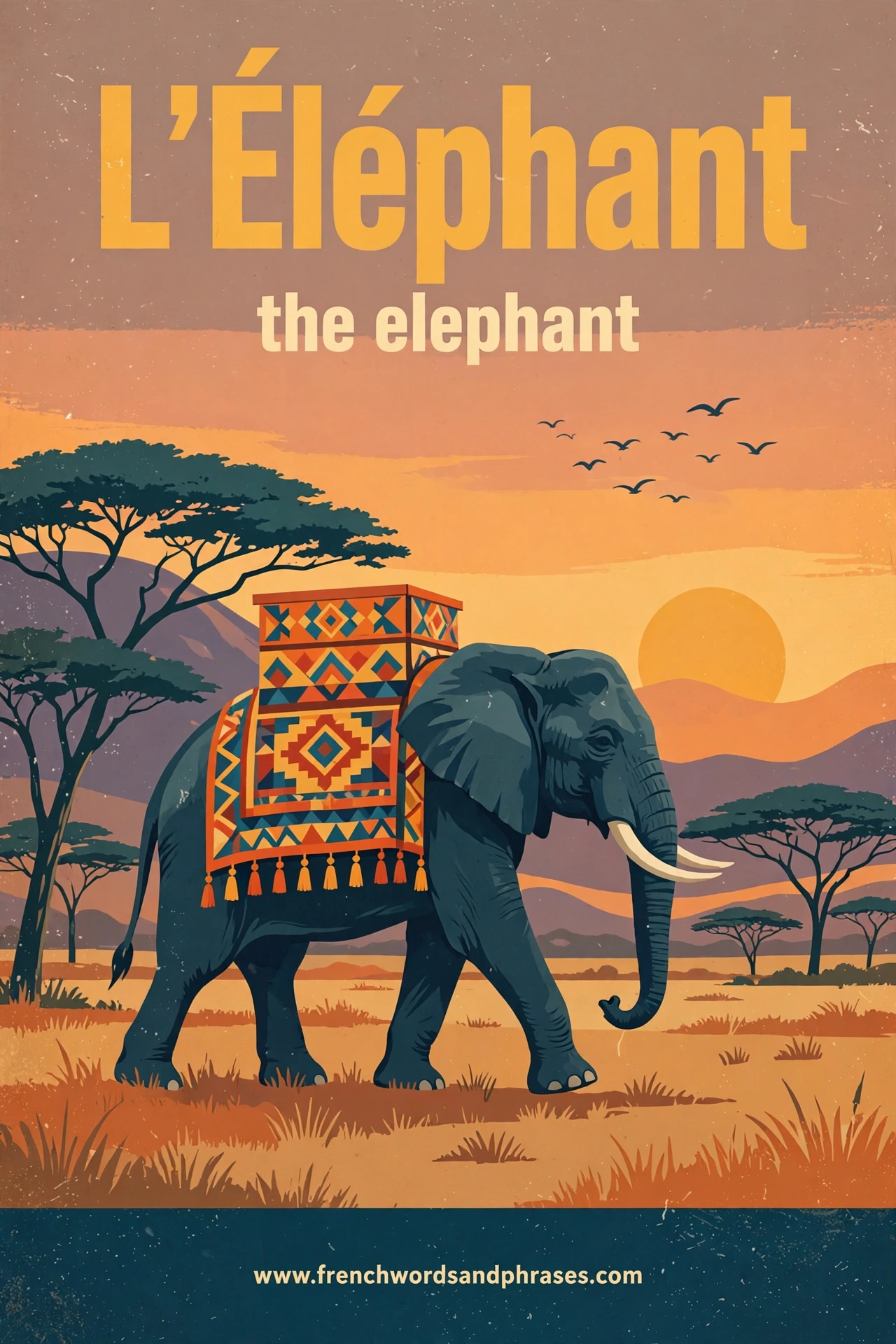
L’éléphant means the elephant.
At the zoo, the children press against the fence as the great grey shape comes forward, ears fanning, trunk swinging: « Regardez, l’éléphant arrive ! » Nothing on land is bigger — l’éléphant.
In this guide, you’ll learn what éléphant means in English, how to use it with its articles, how to form its plural, and how it appears in everyday French. Explore French examples, English translations, and practice quizzes.
Understanding the French Noun Éléphant
Éléphant is a masculine French noun. Because it begins with a vowel, the article shrinks: l’éléphant, un éléphant. The female is l’éléphante — same l’, different ending — and the plural is les éléphants.
It means the elephant — the largest land animal on earth, with its trompe (trunk), its défenses (tusks) and its famous memory. French celebrates that memory in a compliment: avoir une mémoire d’éléphant, to have a memory like an elephant’s — to forget nothing.
Gender: Masculine — l’éléphant, un éléphant
Article: l’ — the word begins with a vowel, so le becomes l’
Feminine: l’éléphante — une éléphante (a female elephant)
Plural: les éléphants
Body words: la trompe (the trunk), les défenses (the tusks), les oreilles (the ears)
English equivalents: The elephant.
One charming usage detail: French puts its clumsy intruder in a china shop as un éléphant dans un magasin de porcelaine — where English uses a bull, French uses the elephant, and the breakage is just as total. And the animal lends its name to size itself: something enormous can be called éléphantesque.
Experience the Word
Éléphant is the word for gentle enormity. Everything about it is outsized — the ears, the appetite, the memory, the slow and careful step of an animal that could crush anything and chooses, mostly, not to.
Imagine the herd at the waterhole at dusk: the old matriarch in front, calves tucked between great grey legs, trunks rising and falling like slow fountains — five tonnes of patience, repeated twenty times.
You have not just seen an animal. You have met l’éléphant — the mountain that remembers everything.
How to Use Éléphant in French: Complete Guide
Let’s explore how éléphant works in French, beginning with its articles — and watch le shrink to l’ before the opening vowel.
Éléphant with the Definite Article (L’, Les)
Éléphant begins with a vowel, so le and la both shrink to l’ — the ending of the noun tells you male or female.
| Form | French |
|---|---|
| Masculine singular | l’éléphant |
| Feminine singular | l’éléphante |
| Plural | les éléphants |
Example
L’éléphant avance lentement vers le point d’eau.
The elephant walks slowly towards the waterhole.
Éléphant with the Indefinite Article (Un, Une, Des)
Used for an elephant in general — un éléphant, une éléphante.
| Form | French |
|---|---|
| Masculine singular | un éléphant |
| Feminine singular | une éléphante |
| Plural | des éléphants |
Example
Un éléphant adulte peut peser plus de cinq tonnes.
An adult elephant can weigh more than five tonnes.
Éléphant with Quantities (Un troupeau d’…)
Éléphants are countable and live in herds, so French counts and herds them rather than taking « some » of them.
| Quantity | French |
|---|---|
| some elephants | des éléphants |
| a herd of elephants | un troupeau d’éléphants |
| many elephants | beaucoup d’éléphants |
| a single elephant | un seul éléphant |
| about twenty elephants | une vingtaine d’éléphants |
Example
Un troupeau d’éléphants traverse la savane au coucher du soleil.
A herd of elephants crosses the savannah at sunset.
Quick Quiz 1
Complete the sentence:
______ éléphant utilise sa trompe pour boire. (The)
Reveal the answer
L’
L’éléphant utilise sa trompe pour boire.
The elephant uses its trunk to drink — l’, because éléphant begins with a vowel.
The Plural of Éléphant
Éléphant adds an -s in the plural — les éléphants, the herd in full.
| Number | French |
|---|---|
| Singular | l’éléphant |
| Plural | les éléphants |
Example
Les éléphants se retrouvent au point d’eau à la tombée de la nuit.
The elephants gather at the waterhole at nightfall.
Éléphant with Possessive Adjectives (Mon, Ton, Son…)
A vowel-start bonus: even the feminine takes mon, ton, son — mon éléphante, never « ma éléphante ».
| Owner | French |
|---|---|
| my | mon éléphant / mon éléphante |
| your (tu) | ton éléphant / ton éléphante |
| his / her | son éléphant / son éléphante |
| our | notre éléphant / notre éléphante |
| your (vous) | votre éléphant / votre éléphante |
| their | leur éléphant / leur éléphante |
Example
Le gardien connaît son éléphant depuis vingt ans.
The keeper has known his elephant for twenty years.
Quick Quiz 2
Complete the sentence:
______ éléphants mangent des feuilles toute la journée. (Our)
Reveal the answer
Nos
Nos éléphants mangent des feuilles toute la journée.
Our elephants eat leaves all day long.
Éléphant with Demonstrative Adjectives (Cet, Ces)
Used to point: cet éléphant — cet, the special form for masculine nouns beginning with a vowel.
| Form | French |
|---|---|
| Masculine singular | cet éléphant |
| Feminine singular | cette éléphante |
| Plural | ces éléphants |
Example
Cet éléphant est le plus vieux du troupeau.
This elephant is the oldest in the herd.
Éléphant with Adjectives
Adjectives agree with éléphant — watch énorme stay the same while vieux becomes vieille for the female.
| Adjective | With Éléphant |
|---|---|
| énorme (enormous) | un éléphant énorme |
| vieux (old) | un vieil éléphant / une vieille éléphante |
| jeune (young) | un jeune éléphant |
| gris (grey) | un éléphant gris / une éléphante grise |
| doux (gentle) | un éléphant doux / une éléphante douce |
Example
C’est un vieil éléphant doux et patient avec les petits.
He is an old elephant, gentle and patient with the little ones.
Quick Quiz 3
Complete the sentence:
______ éléphant là-bas est le mâle du troupeau. (That)
Reveal the answer
Cet
Cet éléphant là-bas est le mâle du troupeau.
That elephant over there is the male of the herd — cet before a vowel.
Everyday Expressions with Éléphant
China shops, great memories and white elephants — the éléphant phrases of daily life.
| Expression | In English |
|---|---|
| un éléphant dans un magasin de porcelaine | a bull in a china shop (French uses the elephant) |
| avoir une mémoire d’éléphant | to have a memory like an elephant’s |
| un éléphant blanc | a white elephant — a costly, useless possession |
| la trompe de l’éléphant | the elephant’s trunk |
| éléphantesque | elephantine, enormous |
| un troupeau d’éléphants | a herd of elephants |
Example
Avec ses grosses bottes dans le magasin de vases, c’était un éléphant dans un magasin de porcelaine.
With his big boots in the vase shop, he was an elephant in a china shop.
Words from the Same Family as Éléphant
Trunks, tusks and ivory — the words that travel with éléphant.
| French | In English |
|---|---|
| l’éléphanteau | the baby elephant |
| la trompe | the trunk |
| les défenses | the tusks |
| l’ivoire | ivory |
| le cornac | the mahout, the elephant driver |
| la savane | the savannah |
Example
L’éléphanteau reste toujours près de sa mère dans le troupeau.
The baby elephant always stays close to its mother in the herd.
Quick Quiz 4
What does « avoir une mémoire d’éléphant » mean?
Reveal the answer
To have an exceptional memory — to forget nothing.
Ma grand-mère a une mémoire d’éléphant, elle se souvient de tout.
My grandmother has a memory like an elephant’s; she remembers everything.
Éléphant in Everyday French: Real-Life Examples
Now that you know the word, let’s see how éléphant appears in everyday French.
Example 1 — At the zoo
Les enfants regardent l’éléphant avec de grands yeux.
The children watch the elephant with wide eyes.
Example 2 — In the savannah
Un troupeau d’éléphants se dirige vers la rivière.
A herd of elephants is heading for the river.
Example 3 — A compliment
Tu as une vraie mémoire d’éléphant !
You have a real elephant’s memory!
Example 4 — Clumsiness
Doucement ! Tu es comme un éléphant dans un magasin de porcelaine.
Careful! You’re like an elephant in a china shop.
Example 5 — A baby
L’éléphanteau est né hier au zoo.
The baby elephant was born yesterday at the zoo.
Example 6 — Body parts
L’éléphant attrape les feuilles avec sa trompe.
The elephant grabs the leaves with its trunk.
Beyond Translation: The Meaning of Éléphant
The éléphant walked into French from Greek by way of Latin, carrying ivory and legend with it: Hannibal’s elephants crossing the Alps, the royal white elephants of the East, Babar — the little elephant in the green suit who taught generations of French children their manners. France has no wild elephants, yet the animal is everywhere in its imagination: in its zoos, its idioms, and its highest compliment for a memory.
To say éléphant is to think big — and to forget nothing.
It evokes the savannah at dusk and the china shop in peril, five tonnes of gentleness, and the slow, certain memory of the herd’s old matriarch.
How to Remember the French Noun Éléphant
Remember it this way: Éléphant is masculine and begins with a vowel — l’éléphant — with l’éléphante for the female.
- You see the animal — l’éléphant, un éléphant énorme.
- You see the female — l’éléphante, une vieille éléphante.
- You remember everything — une mémoire d’éléphant.
The key idea is l’éléphant, l’éléphante — the l’ hides the gender.
Test Your Knowledge of Éléphant
Let’s see how much you’ve learned. Try answering these questions before revealing the answers.
Question 1
Is éléphant masculine or feminine?
Reveal the answer
Masculine — l’éléphant, un éléphant; the female is l’éléphante.
Question 2
Why do we say mon éléphante and not ma éléphante?
Reveal the answer
Because éléphante begins with a vowel sound — feminine nouns starting with a vowel take mon, ton, son.
Question 3
Translate: The elephants are drinking at the waterhole.
Reveal the answer
Les éléphants boivent au point d’eau.
Question 4
What is la trompe?
Reveal the answer
The trunk — the elephant’s long nose, used for drinking, grabbing and trumpeting.
Question 5
Complete the sentence:
______ éléphant est énorme. (This)
Reveal the answer
Cet
Cet éléphant est énorme.
This elephant is enormous — cet, the form used before a masculine vowel.
Your Final Challenge
Can You Use It?
How would you say this in French?
“The elephant never forgets anything.”
Reveal the answer
L’éléphant n’oublie jamais rien.
The elephant never forgets anything.
A little French. A little curiosity. A richer everyday life.
LEARN FRENCH ONE WORD AT A TIME