A French Word to Live By
Translate Ours to English
/uʁs/
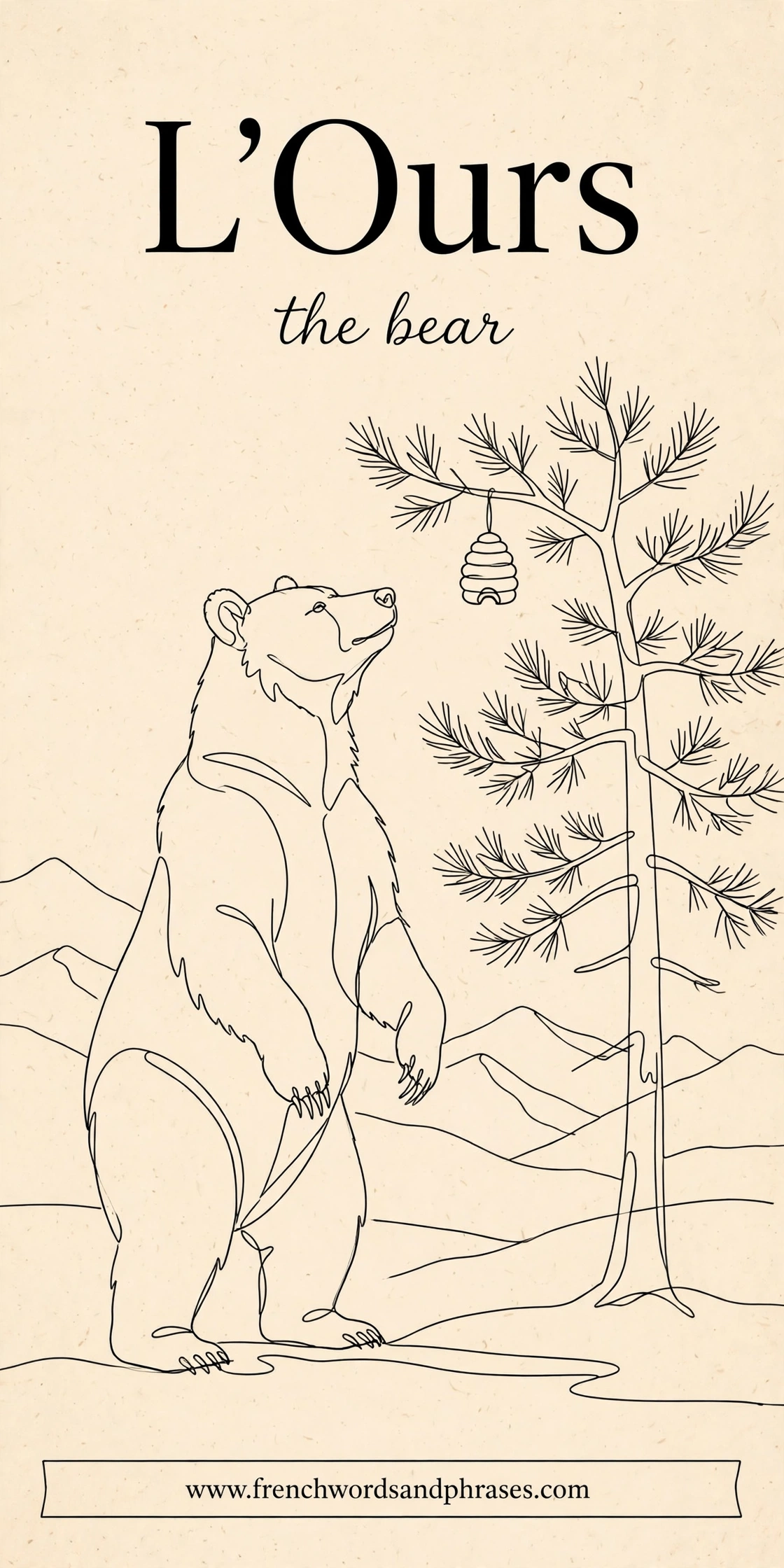
L’ours means the bear.
High in the Pyrenees, the forest goes quiet: a branch cracks, the birds stop, and between the pines a huge brown shape moves without hurry. Everyone in the valley knows who it is — l’ours, the bear, the mountain’s true owner.
In this guide, you’ll learn what ours means in English, how to use it with its articles, how to form its plural, and how it appears in everyday French. Explore French examples, English translations, and practice quizzes.
Understanding the French Noun Ours
Ours is a masculine French noun, learned with its article: l’ours, un ours — the definite article elides before the opening vowel sound. The word is written with a final -s in the singular and the plural alike: un ours, des ours, the spelling never changes. The female is l’ourse, and the cub is l’ourson.
It means the bear — the great wild mammal of the forests and mountains, brown in the Pyrenees, white at the pole (l’ours polaire), and soft in every child’s bedroom as un ours en peluche, a teddy bear. Applied to a person, un ours paints a gruff, solitary character who growls rather than chats.
Gender: Masculine — l’ours, un ours
Plural: les ours — the -s is there in the singular already
The female: l’ourse — the she-bear
The young: l’ourson — the bear cub
In the sky: la Grande Ourse — the Great Bear constellation
English equivalents: The bear; a teddy bear is un ours en peluche
One usage detail: French sells the bear’s skin in its most famous warning — vendre la peau de l’ours avant de l’avoir tué, to sell the bear’s skin before killing it, the exact twin of counting your chickens before they hatch. Never celebrate, says the ours, before the work is done.
Experience the Word
Ours is wild France itself. Reintroduced to the Pyrenees and guarded fiercely, the bear is the animal French nature lovers argue about at every café table — shepherds against protectors, everyone passionate.
Imagine a child’s bedroom in Grenoble: the mountain dark outside, and on the pillow the oldest inhabitant of the house, un ours en peluche with one ear loved half away, standing guard against the night.
You have not just named an animal. You have named strength that minds its own business.
How to Use Ours in French: Complete Guide
Let’s explore how ours works in French, beginning with its articles — l’ours, because the word opens with a vowel sound.
Ours with the Definite Article (L’, Les)
Before a vowel sound, le becomes l’ — l’ours in the singular, les ours in the plural.
| Form | French |
|---|---|
| Masculine singular | l’ours |
| Plural | les ours |
Example
L’ours dort dans sa tanière pendant l’hiver.
The bear sleeps in its den during the winter.
Ours with the Indefinite Article (Un, Des)
Used for a bear in general — un ours, a bear; des ours, bears, spelled identically.
| Form | French |
|---|---|
| Masculine singular | un ours |
| Plural | des ours |
Example
Un ours a traversé la route devant la voiture.
A bear crossed the road in front of the car.
Ours with the Partitive and Quantities (Des, Un ours en peluche…)
Bears are counted one by one — and in the nursery, by the armful.
| Quantity | French |
|---|---|
| a teddy bear | un ours en peluche |
| a bear cub | un ourson |
| several bears | des ours |
| a polar bear | un ours polaire |
Example
Elle serre son ours en peluche contre elle pour dormir.
She hugs her teddy bear to sleep.
Quick Quiz 1
Complete the sentence:
______ ours brun vit dans ces montagnes. (The)
Reveal the answer
L’
L’ours brun vit dans ces montagnes.
The brown bear lives in these mountains — l’, because ours begins with a vowel sound.
The Plural of Ours
Ours keeps its -s in both numbers: the spelling never changes, only the article moves.
| Number | French |
|---|---|
| Singular | l’ours |
| Plural | les ours |
Example
Les ours des Pyrénées sont protégés.
The bears of the Pyrenees are protected.
Ours with Possessive Adjectives (Mon, Ton, Son…)
Possessives agree with the noun — ours is masculine, so it takes mon, ton, son.
| Owner | French |
|---|---|
| my | mon ours |
| your (tu) | ton ours |
| his / her | son ours |
| our | notre ours |
| your (vous) | votre ours |
| their | leur ours |
Example
Mon ours en peluche a perdu un œil.
My teddy bear has lost an eye.
Quick Quiz 2
Complete the sentence:
Il ne faut pas vendre la peau de ______ avant de l’avoir tué.
Reveal the answer
l’ours
Il ne faut pas vendre la peau de l’ours avant de l’avoir tué.
Don’t count your chickens before they hatch — literally, don’t sell the bear’s skin before killing it.
Ours with Demonstrative Adjectives (Cet, Ces)
Before a masculine word starting with a vowel sound, ce becomes cet — cet ours, ces ours.
| Form | French |
|---|---|
| Masculine singular | cet ours |
| Plural | ces ours |
Example
Cet ours en peluche appartient à ma fille.
This teddy bear belongs to my daughter.
Ours with Adjectives
Adjectives agree with ours — masculine forms, and most follow the noun.
| Adjective | With Ours |
|---|---|
| brun (brown) | un ours brun |
| polaire (polar) | un ours polaire |
| grand (big) | un grand ours |
| dangereux (dangerous) | un ours dangereux |
| endormi (asleep) | un ours endormi |
Example
Un grand ours brun pêche dans la rivière.
A big brown bear is fishing in the river.
Quick Quiz 3
Complete the sentence:
______ ours dort dans la grotte. (This)
Reveal the answer
Cet
Cet ours dort dans la grotte.
This bear is sleeping in the cave — cet, the special form of ce before a vowel sound.
Everyday Expressions with Ours
Skins sold too soon and bears badly licked — the ours phrases of daily life.
| Expression | In English |
|---|---|
| vendre la peau de l’ours avant de l’avoir tué | to count your chickens before they hatch |
| un ours mal léché | a gruff, uncouth person |
| un ours en peluche | a teddy bear |
| l’ours polaire | the polar bear |
| fort comme un ours | as strong as a bear |
| la Grande Ourse | the Great Bear (constellation) |
Example
Ne vends pas la peau de l’ours, le contrat n’est pas signé !
Don’t count your chickens, the contract isn’t signed!
Words from the Same Family as Ours
Cubs, dens and winter sleep — the words that travel with ours.
| French | In English |
|---|---|
| l’ourse | the she-bear |
| l’ourson | the bear cub |
| la tanière | the den, the lair |
| hiberner | to hibernate |
| la patte | the paw |
| le miel | the honey |
Example
L’ourse protège ses oursons près de la tanière.
The she-bear protects her cubs near the den.
Quick Quiz 4
What is un ours mal léché?
Reveal the answer
A gruff, rough-mannered person — literally ‘a badly licked bear’, from the old belief that a mother bear licks her cubs into shape.
Le matin, avant son café, c’est un ours mal léché.
In the morning, before his coffee, he’s a real grouch.
Ours in Everyday French: Real-Life Examples
Now that you know the word, let’s see how ours appears in everyday French.
Example 1 — In the mountains
On a vu un ours près du refuge, de loin.
We saw a bear near the refuge, from far away.
Example 2 — A child’s bedtime
Elle ne dort jamais sans son ours en peluche.
She never sleeps without her teddy bear.
Example 3 — A warning
Le match n’est pas fini, ne vends pas la peau de l’ours !
The match isn’t over, don’t count your chickens!
Example 4 — Describing a colleague
Il parle peu et grogne beaucoup, un vrai ours.
He talks little and grumbles a lot, a real bear.
Example 5 — At the zoo
Les enfants regardent l’ours polaire nager.
The children are watching the polar bear swim.
Example 6 — Looking at the sky
La Grande Ourse brille au-dessus de la montagne.
The Great Bear shines above the mountain.
Beyond Translation: The Meaning of Ours
The ours has walked through French imagination for centuries: the beast of the Pyrenees, the heraldic bear of old coats of arms, and — strangest journey of all — the teddy bear on every child’s bed, named ours en peluche, the bear in plush. Above them all turns la Grande Ourse, the Great Bear of the night sky, the constellation by which travellers have steered since before France had a name.
To say ours is to name the wild on four paws.
It evokes deep forest and deep sleep, honey and danger, a mother’s fierceness and a child’s softest comfort — one word from the mountain den to the nursery.
How to Remember the French Noun Ours
Remember it this way: Ours is the bear — masculine, l’ours — written with its -s in the singular and the plural alike, and never to be sold before its time.
- One bear — l’ours, un ours brun.
- Many bears — les ours, the -s never moves.
- Too soon — vendre la peau de l’ours, and you have counted your chickens.
The key idea is l’ours — the bear whose skin is sold too soon.
Test Your Knowledge of Ours
Let’s see how much you’ve learned. Try answering these questions before revealing the answers.
Question 1
Is ours masculine or feminine?
Reveal the answer
Masculine — l’ours, un ours. The she-bear is l’ourse.
Question 2
What changes between un ours and des ours?
Reveal the answer
Only the article — ours is written with its -s in the singular and the plural alike.
Question 3
Translate: Don’t count your chickens before they hatch.
Reveal the answer
Il ne faut pas vendre la peau de l’ours avant de l’avoir tué.
Question 4
What is un ourson?
Reveal the answer
A bear cub — the young of l’ours and l’ourse.
Question 5
Complete the sentence:
______ ours polaire chasse sur la glace.
Reveal the answer
L’
L’ours polaire chasse sur la glace.
The polar bear hunts on the ice.
Your Final Challenge
Can You Use It?
How would you say this in French?
“The bear sleeps in its den all winter.”
Reveal the answer
L’ours dort dans sa tanière tout l’hiver.
The bear sleeps in its den all winter.
A little French. A little curiosity. A richer everyday life.
LEARN FRENCH ONE WORD AT A TIME