A French Word to Live By
Translate Nez to English
/ne/
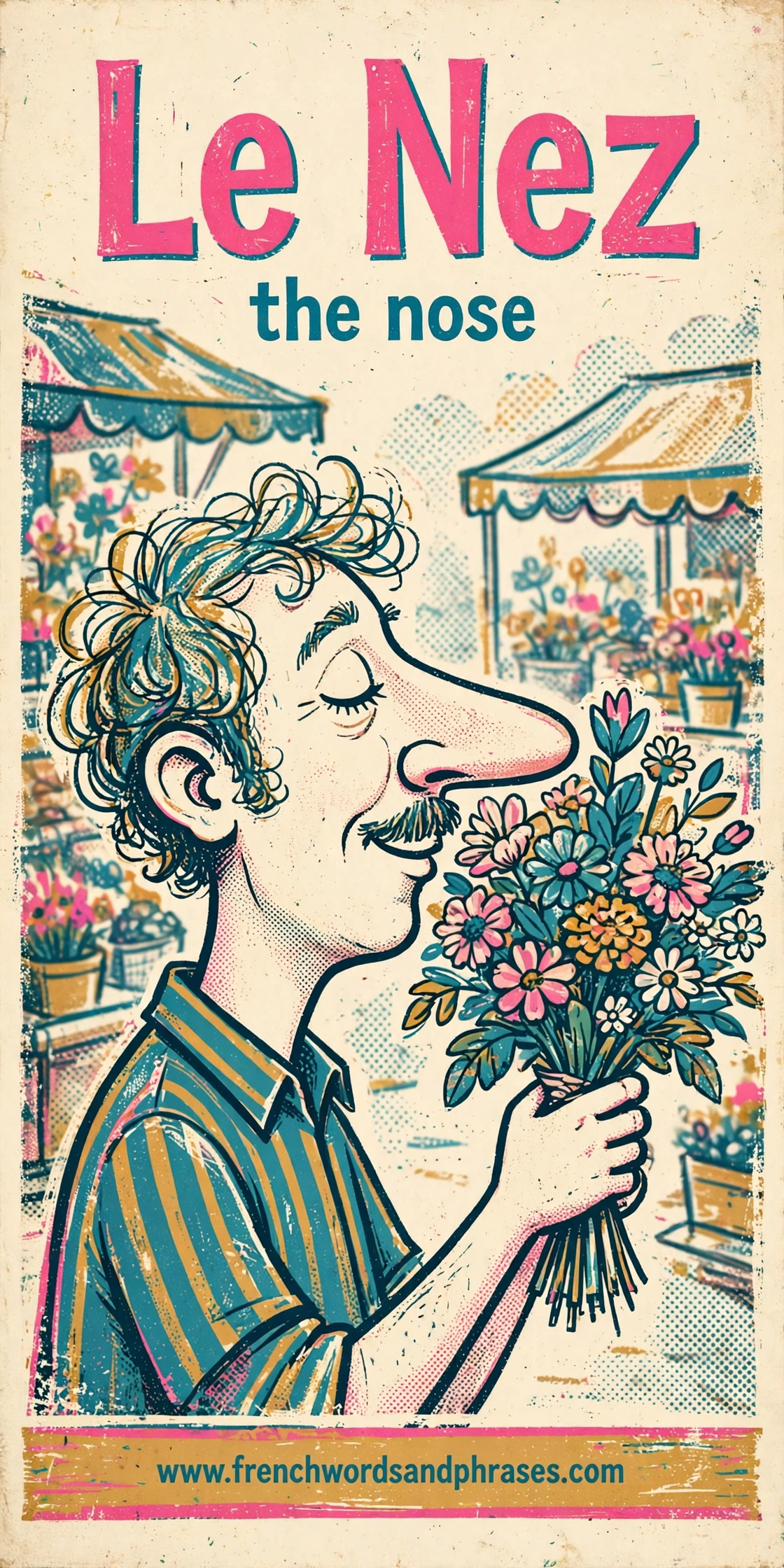
Le nez means the nose.
The baker opens the oven door and the whole street knows it: warm bread, butter, a hint of caramel. Before the eyes see anything, the news arrives by le nez — the nose, the body’s first reporter.
In this guide, you’ll learn what nez means in English, how to use it with its articles, how to form its plural, and how it appears in everyday French. Explore French examples, English translations, and practice quizzes.
Understanding the French Noun Nez
Nez is a masculine French noun, learned with its article: le nez, un nez. It holds a famous record among body words: its plural is written exactly like its singular — un nez, des nez — because the word already ends in a silent -z.
It means the nose — the feature at the centre of the face and the organ of smell. French uses it constantly, literally for breathing, colds and kisses nez à nez, and figuratively for instinct: avoir du nez is to have flair, a gift for sensing what others miss, and a professional taster or perfumer is quite simply called un nez.
Gender: Masculine — le nez, un nez
Plural: les nez — the spelling never changes
The tip: le bout du nez — the end of the nose
A professional: un nez — a perfumer, a gifted nose
Having flair: avoir du nez — to have a good instinct
English equivalents: The nose; a flair, a scent (figurative)
One usage detail: the plural of nez is a gift to learners — since the word ends in -z, nothing is added and nothing changes, un nez, des nez. Watch the spelling in the other direction too: nez is short, and the -z is silent, so the word sounds exactly like the little word né (born) — context does all the work.
Experience the Word
Nez is the most honest of the senses. Eyes can be fooled and ears deceived, but the nez reports rain coming, bread baking, a storm over the sea, long before anything is seen.
Imagine the perfume workshops of Grasse: rows of tiny bottles, and at the bench a master perfumer — un nez — who can name two hundred scents blindfold and build a perfume the way a composer builds a chord.
You have not just named a feature of the face. You have named the sense that remembers everything.
How to Use Nez in French: Complete Guide
Let’s explore how nez works in French, beginning with its articles — and its plural, the easiest in the language, because it never changes.
Nez with the Definite Article (Le, Les)
The nose is masculine: le in the singular, les in the plural.
| Form | French |
|---|---|
| Masculine singular | le nez |
| Plural | les nez |
Example
Le nez du bébé est tout petit.
The baby’s nose is tiny.
Nez with the Indefinite Article (Un, Des)
Used for a nose in general — un nez, a nose; des nez, noses, with no change in spelling.
| Form | French |
|---|---|
| Masculine singular | un nez |
| Plural | des nez |
Example
Un bon chien a un nez extraordinaire.
A good dog has an extraordinary nose.
Nez with the Partitive and Quantities (Des, Le bout du…)
A nose is one per face, so French talks about its parts and its states instead of amounts.
| Quantity | French |
|---|---|
| the tip of the nose | le bout du nez |
| a blocked nose | le nez bouché |
| a runny nose | le nez qui coule |
| nose to nose | nez à nez |
Example
Elle a le nez bouché à cause de son rhume.
Her nose is blocked because of her cold.
Quick Quiz 1
Complete the sentence:
Il a ______ nez très fin, il sent tout. (a)
Reveal the answer
un
Il a un nez très fin, il sent tout.
He has a very fine nose, he smells everything — un, the indefinite article for one nose.
The Plural of Nez
Nez is invariable: it ends in -z, so the plural is written exactly the same — des nez.
| Number | French |
|---|---|
| Singular | le nez |
| Plural | les nez |
Example
Les enfants ont collé leurs nez à la vitrine.
The children pressed their noses to the shop window.
Nez with Possessive Adjectives (Mon, Ton, Son…)
Possessives agree with the noun — nez is masculine, so it takes mon, ton, son.
| Owner | French |
|---|---|
| my | mon nez |
| your (tu) | ton nez |
| his / her | son nez |
| our | notre nez |
| your (vous) | votre nez |
| their | leur nez |
Example
Mon nez est rouge à cause du froid.
My nose is red from the cold.
Quick Quiz 2
Complete the sentence:
Elle mène son frère par le bout ______ nez.
Reveal the answer
du
Elle mène son frère par le bout du nez.
She leads her brother by the nose — mener quelqu’un par le bout du nez, to have someone completely under your thumb.
Nez with Demonstrative Adjectives (Ce, Ces)
Used to point: ce nez, this nose; ces nez, these noses — the article changes, the word does not.
| Form | French |
|---|---|
| Masculine singular | ce nez |
| Plural | ces nez |
Example
Ce nez de clown est rouge et rond.
This clown’s nose is red and round.
Nez with Adjectives
Adjectives agree with nez — masculine forms, and most follow the noun.
| Adjective | With Nez |
|---|---|
| long (long) | un nez long |
| pointu (pointed) | un nez pointu |
| rouge (red) | un nez rouge |
| bouché (blocked) | un nez bouché |
| fin (fine, keen) | un nez fin |
Example
Cyrano est célèbre pour son nez long et pointu.
Cyrano is famous for his long, pointed nose.
Quick Quiz 3
Complete the sentence:
Un parfumeur de talent, c’est ______ vrai nez. (a)
Reveal the answer
un
Un parfumeur de talent, c’est un vrai nez.
A talented perfumer is a real nose — un nez is the profession’s proudest title.
Everyday Expressions with Nez
Flair, colds and being led around — the nez phrases of daily life.
| Expression | In English |
|---|---|
| mener quelqu’un par le bout du nez | to lead someone by the nose |
| avoir du nez | to have flair, a good instinct |
| mettre le nez dehors | to set foot outside, to show your face |
| le nez qui coule | a runny nose |
| nez à nez | nose to nose, face to face |
| se casser le nez | to find the door shut, to come away empty-handed |
Example
Elle a du nez pour les bonnes affaires.
She has a real flair for good deals.
Words from the Same Family as Nez
Nostrils, sneezes and sniffing — the words that travel with nez.
| French | In English |
|---|---|
| la narine | the nostril |
| nasal | nasal |
| renifler | to sniff |
| éternuer | to sneeze |
| sentir | to smell, to feel |
| le mouchoir | the handkerchief |
Example
Il renifle puis éternue trois fois de suite.
He sniffs and then sneezes three times in a row.
Quick Quiz 4
What does avoir du nez mean?
Reveal the answer
To have flair — a sharp instinct for what is coming or what is good.
Pour les affaires, elle a vraiment du nez.
When it comes to business, she really has flair.
Nez in Everyday French: Real-Life Examples
Now that you know the word, let’s see how nez appears in everyday French.
Example 1 — Winter morning
J’ai le nez rouge et les mains gelées.
My nose is red and my hands are frozen.
Example 2 — At the bakery
Le nez sent le pain chaud avant même d’entrer.
Your nose smells the warm bread before you even go in.
Example 3 — With a cold
Il a le nez bouché et il parle du nez.
His nose is blocked and he talks through his nose.
Example 4 — Complimenting instinct
Tu as du nez, ce quartier va devenir très cher.
You have flair, this neighbourhood is going to become very expensive.
Example 5 — Children at a window
Les enfants collent leur nez à la vitre du train.
The children press their noses to the train window.
Example 6 — Being managed
Son petit frère la mène par le bout du nez.
Her little brother leads her by the nose.
Beyond Translation: The Meaning of Nez
The nez holds a place in French philosophy itself. Pascal wrote that if Cleopatra’s nose had been shorter, the whole face of the earth would have changed — le nez de Cléopâtre — making this small word the hinge of world history. A century of literature followed: Cyrano’s magnificent nez, Pinocchio’s growing one in translation, and the perfumers of Grasse who turned the word into a title of honour.
To say nez is to point at the centre of the face — and of instinct.
It evokes winter colds and bakery doors, bloodhounds and perfume benches — and a plural so lazy it refuses to change at all.
How to Remember the French Noun Nez
Remember it this way: Nez is the nose — masculine, le nez — and the champion of easy plurals, because un nez and des nez are written exactly the same.
- One nose — le nez, le bout du nez.
- Many noses — les nez, not a letter changes.
- Good instinct — avoir du nez, to have flair.
The key idea is le nez, les nez — the plural that never changes.
Test Your Knowledge of Nez
Let’s see how much you’ve learned. Try answering these questions before revealing the answers.
Question 1
Is nez masculine or feminine?
Reveal the answer
Masculine — le nez, un nez.
Question 2
What is the plural of nez?
Reveal the answer
Nez — exactly the same spelling: un nez, des nez. The word ends in -z, so nothing is added.
Question 3
Translate: She leads him by the nose.
Reveal the answer
Elle le mène par le bout du nez.
Question 4
What is un nez in the perfume world?
Reveal the answer
A master perfumer — the expert whose sense of smell creates perfumes.
Question 5
Complete the sentence:
J’ai le ______ bouché, je suis enrhumé.
Reveal the answer
nez
J’ai le nez bouché, je suis enrhumé.
My nose is blocked, I have a cold.
Your Final Challenge
Can You Use It?
How would you say this in French?
“The dog follows the smell with its nose in the air.”
Reveal the answer
Le chien suit l’odeur, le nez en l’air.
The dog follows the smell with its nose in the air.
A little French. A little curiosity. A richer everyday life.
LEARN FRENCH ONE WORD AT A TIME