A French Word to Live By
Translate Peau to English
/po/
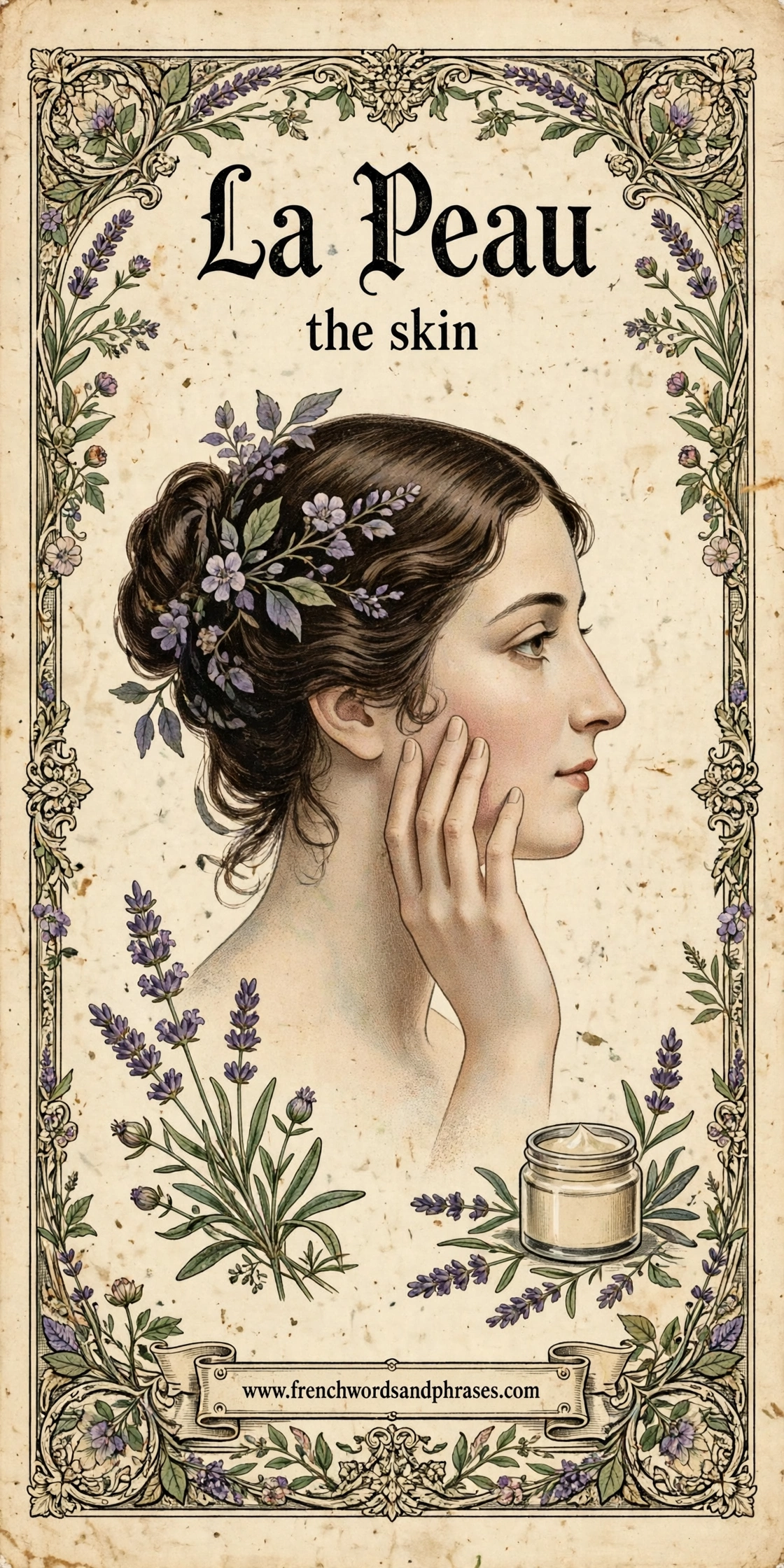
La peau means the skin.
The baby reaches out and closes a whole fist around one finger, and the grandmother marvels at the softness against her own weathered hand: two lives, touching peau contre peau — skin, the first thing we ever feel with.
In this guide, you’ll learn what peau means in English, how to use it with its articles, how to form its plural, and how it appears in everyday French. Explore French examples, English translations, and practice quizzes.
Understanding the French Noun Peau
Peau is a feminine French noun, learned with its article: la peau, une peau. Its plural follows the -eau rule and adds an -x: les peaux. One word covers the skin of a person, of an animal, and of a fruit.
It means the skin — the covering of the body, from la peau douce of a child to the tanned peau bronzée of summer. The same word names an animal’s hide and the peel of a fruit: la peau d’une pomme, la peau de banane — the banana skin of a thousand jokes. To be well or ill at ease with yourself is to be bien or mal dans sa peau.
Gender: Feminine — la peau, une peau
Plural: les peaux — the -eau ending takes an -x
Three territories: the skin of a body, a hide, the peel of a fruit
At ease: être bien dans sa peau — comfortable in your own skin
In danger: sauver sa peau — to save your skin
English equivalents: The skin; the hide; the peel
One usage detail: peau works in a celebrated warning from the bear family — vendre la peau de l’ours, to sell the bear’s skin before the hunt is over. And in the kitchen, mind the fruit: la peau d’une orange is its peel, and glisser sur une peau de banane is to slip on a banana skin, in life as in cartoons.
Experience the Word
Peau is the border between you and the world. It feels the first cold of autumn, the heat of a summer wall, the exact difference between a stranger’s handshake and a friend’s embrace.
Imagine a market in Provence: peaches with velvet peaux, oranges glowing, a tanner’s stall at the edge of town with hides stacked like books — one word carrying fruit, beast and human in a single syllable.
You have not just named a surface. You have named the place where the world touches you.
How to Use Peau in French: Complete Guide
Let’s explore how peau works in French, beginning with its articles — la for the skin, and an -x waiting in the plural.
Peau with the Definite Article (La, Les)
The skin is feminine: la in the singular, les in the plural.
| Form | French |
|---|---|
| Feminine singular | la peau |
| Plural | les peaux |
Example
La peau du bébé est très douce.
The baby’s skin is very soft.
Peau with the Indefinite Article (Une, Des)
Used for a skin or a hide in general — une peau, a skin; des peaux, skins.
| Form | French |
|---|---|
| Feminine singular | une peau |
| Plural | des peaux |
Example
Le marchand vend des peaux de mouton.
The merchant sells sheepskins.
Peau with the Partitive and Quantities (De la, Un morceau de…)
As a material, skin takes the partitive — de la peau; as a thing, it is measured in pieces.
| Quantity | French |
|---|---|
| some skin (as material) | de la peau |
| a piece of skin | un morceau de peau |
| the skin of an apple | la peau d’une pomme |
| banana skins | des peaux de banane |
Example
Enlève la peau de la pomme avant de la croquer.
Remove the apple’s skin before biting into it.
Quick Quiz 1
Complete the sentence:
Elle a ______ peau très sensible au soleil.
Reveal the answer
la
Elle a la peau très sensible au soleil.
She has skin that is very sensitive to the sun — la peau, the skin one has, stated as a fact of the body.
The Plural of Peau
Peau ends in -eau, so the plural takes an -x, not an -s — les peaux.
| Number | French |
|---|---|
| Singular | la peau |
| Plural | les peaux |
Example
Les peaux de banane vont au compost.
The banana skins go in the compost.
Peau with Possessive Adjectives (Ma, Ta, Sa…)
Possessives agree with the noun — peau is feminine, so it takes ma, ta, sa.
| Owner | French |
|---|---|
| my | ma peau |
| your (tu) | ta peau |
| his / her | sa peau |
| our | notre peau |
| your (vous) | votre peau |
| their | leur peau |
Example
Ma peau est sèche en hiver.
My skin is dry in winter.
Quick Quiz 2
Complete the sentence:
Il est bien dans ______ peau. (his)
Reveal the answer
sa
Il est bien dans sa peau.
He is comfortable in his own skin — être bien dans sa peau, one of French’s happiest expressions.
Peau with Demonstrative Adjectives (Cette, Ces)
Used to point: cette peau, this skin; ces peaux, these skins.
| Form | French |
|---|---|
| Feminine singular | cette peau |
| Plural | ces peaux |
Example
Cette peau de cuir est très souple.
This leather skin is very supple.
Peau with Adjectives
Adjectives agree with peau — feminine forms, and most follow the noun.
| Adjective | With Peau |
|---|---|
| douce (soft) | une peau douce |
| sèche (dry) | une peau sèche |
| sensible (sensitive) | une peau sensible |
| bronzée (tanned) | une peau bronzée |
| épaisse (thick) | une peau épaisse |
Example
Après l’été, elle a une peau bronzée et douce.
After the summer, she has soft, tanned skin.
Quick Quiz 3
Complete the sentence:
Il a sauvé ______ peau de justesse. (his)
Reveal the answer
sa
Il a sauvé sa peau de justesse.
He saved his skin, just barely — sauver sa peau, to escape by the skin of your teeth.
Everyday Expressions with Peau
Comfort, danger and banana skins — the peau phrases of daily life.
| Expression | In English |
|---|---|
| être bien dans sa peau | to be comfortable in your own skin |
| sauver sa peau | to save your skin |
| vendre la peau de l’ours | to sell the bear’s skin (count your chickens) |
| la peau d’une pomme | the skin of an apple |
| une peau de banane | a banana skin |
| avoir la peau douce | to have soft skin |
Example
Depuis son nouveau travail, elle est bien dans sa peau.
Since her new job, she is comfortable in her own skin.
Words from the Same Family as Peau
Peeling, leather and skin care — the words that travel with peau.
| French | In English |
|---|---|
| peler | to peel |
| la pelure | the peel, the peeling |
| le cuir | the leather |
| cutané | skin-related (medical) |
| la crème | the cream (for skin) |
| bronzer | to tan |
Example
Elle pèle la pomme et jette la pelure.
She peels the apple and throws away the peel.
Quick Quiz 4
What does être bien dans sa peau mean?
Reveal the answer
To be comfortable in your own skin — at ease with who you are.
À cinquante ans, il est enfin bien dans sa peau.
At fifty, he is finally comfortable in his own skin.
Peau in Everyday French: Real-Life Examples
Now that you know the word, let’s see how peau appears in everyday French.
Example 1 — Summer care
Mets de la crème, tu as la peau fragile.
Put some cream on, your skin is delicate.
Example 2 — In the kitchen
La peau de ce poulet est bien dorée.
This chicken’s skin is nicely golden.
Example 3 — A compliment
Tu es rayonnante, bien dans ta peau.
You’re glowing, comfortable in your own skin.
Example 4 — Fruit at lunch
Il mange la pomme avec la peau.
He eats the apple with its skin on.
Example 5 — A narrow escape
L’alpiniste a sauvé sa peau de justesse.
The climber saved his skin, just barely.
Example 6 — A warning
Ne vends pas la peau de l’ours avant de l’avoir tué !
Don’t sell the bear’s skin before you’ve killed it!
Beyond Translation: The Meaning of Peau
Peau is one of those words where French trusts a single syllable with a whole philosophy. Être bien dans sa peau — to be well in your skin — is perhaps the most quietly ambitious compliment the language owns: not beauty, not success, just the deep comfort of fitting yourself. Its opposite, être mal dans sa peau, names a discomfort every teenager knows.
To say peau is to talk about the fit between a person and their life.
It evokes tanners and fruit stalls, summer tans and winter dryness — and the bear whose peau must never, ever be sold in advance.
How to Remember the French Noun Peau
Remember it this way: Peau is the skin — feminine, la peau — of bodies, of animals and of fruit, with the -eau family’s -x in the plural.
- Your own skin — la peau, être bien dans sa peau.
- Many skins — les peaux, with an -x, never an -s.
- The bear’s skin — la peau de l’ours, never sold in advance.
The key idea is la peau, les peaux — be well in yours.
Test Your Knowledge of Peau
Let’s see how much you’ve learned. Try answering these questions before revealing the answers.
Question 1
Is peau masculine or feminine?
Reveal the answer
Feminine — la peau, une peau.
Question 2
What is the plural of peau?
Reveal the answer
Les peaux — words ending in -eau add an -x in the plural.
Question 3
Translate: He is comfortable in his own skin.
Reveal the answer
Il est bien dans sa peau.
Question 4
What is la peau d’une pomme?
Reveal the answer
The skin of an apple — peau covers fruit peel as well as body skin.
Question 5
Complete the sentence:
Elle a la ______ douce et bronzée.
Reveal the answer
peau
Elle a la peau douce et bronzée.
She has soft, tanned skin.
Your Final Challenge
Can You Use It?
How would you say this in French?
“After the beach, her skin is soft and tanned.”
Reveal the answer
Après la plage, sa peau est douce et bronzée.
After the beach, her skin is soft and tanned.
A little French. A little curiosity. A richer everyday life.
LEARN FRENCH ONE WORD AT A TIME