A French Word to Live By
Translate Veuf to English
/vœf/
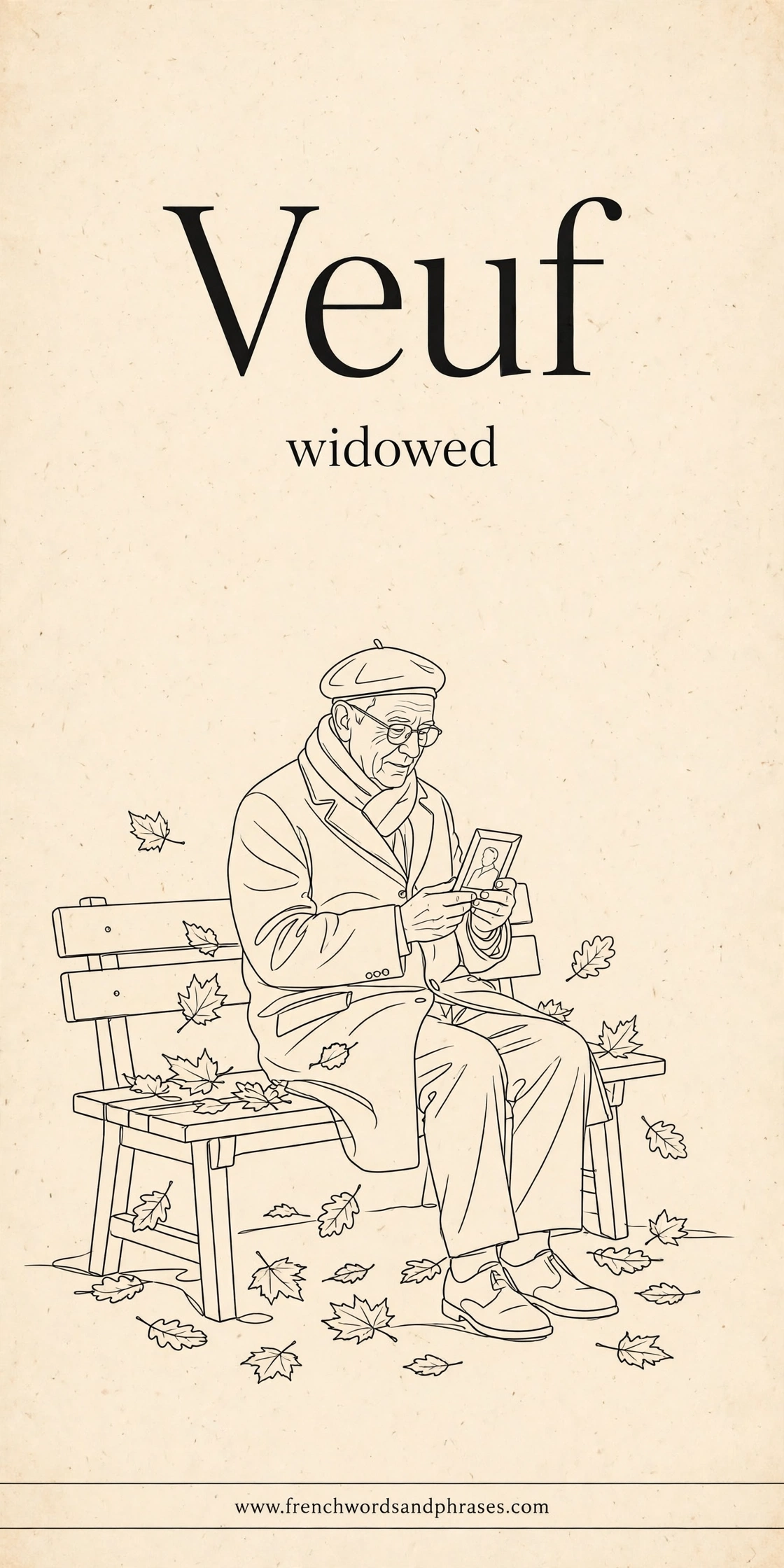
Veuf means widowed.
An old house in a village in Provence, where a man of eighty still sets two cups on the table every morning — one from habit, one from love — before he remembers, and smiles sadly, and drinks his coffee alone. His wife of fifty years is gone. French calls him, with plain tenderness, veuf.
In this guide, you’ll learn what veuf means in English, how veuf and veuve form a pair of their own, where the words stand in the sentence, and how they work as nouns — a widower and a widow. Explore French examples, English translations, and practice quizzes.
Understanding the French Adjective Veuf
Veuf is a French adjective of state — the adjective of a marriage ended by death. Its feminine is not formed by simply adding an e: veuf becomes veuve, with the f softening to v. Both words are also nouns: un veuf is a widower, une veuve is a widow.
It means widowed — whose husband or wife has died. It describes men and women with complete simplicity (un homme veuf, a widowed man; une femme veuve, a widowed woman) and it is the word of forms, family trees and village news. It states a fact of love and loss in a single syllable.
Type: Adjective of state — marital status; also a noun
Answers the question: What is his or her situation? — widowed
Changes form: Yes, and the feminine is different — veuf, veuve, veufs, veuves
English equivalents: Widowed; a widower (noun), a widow (noun).
One important usage detail: watch the pair — un homme veuf but une femme veuve. The feminine changes the f to v: never ‘veufe’. As nouns, un veuf is a widower and une veuve is a widow — the two words every learner should learn together, as one item.
Experience the Word
Veuf is the adjective of the empty chair — a word that carries fifty years of marriage inside the fact of being alone.
Imagine a widow in black at the market, choosing peaches with the same care as always, telling the stallholder about her grandchildren. Her state has a name, veuve, and she wears it the way she wears everything: with dignity, and without asking for pity.
You have not just described someone alone. You have described someone who loved, and lost, and continues.
How to Use Veuf in French: Complete Guide
Let’s explore how Veuf works in French, beginning with the whole word on one card.
Veuf at a Glance
Before the details, here is the whole word on one card.
The Whole Word on One Card
Meaning, type, position and forms — veuf in four lines.
| Point | Veuf |
|---|---|
| Meaning | widowed |
| Type | Adjective of state — marital status; also a noun |
| Usual position | after the noun — un homme veuf, une femme veuve |
| Form | veuf / veuve / veufs / veuves — the f becomes v in the feminine |
Example
C’est un homme veuf.
He is a widowed man.
The Four Forms of Veuf
Veuf and veuve form a pair apart: the feminine changes the f into a v, so learn the four forms as a set — veuf, veuve, veufs, veuves.
| Form | Veuf | Example |
|---|---|---|
| Masculine singular | veuf | un homme veuf — a widowed man, a widower |
| Feminine singular | veuve | une femme veuve — a widowed woman, a widow |
| Masculine plural | veufs | des hommes veufs — widowed men |
| Feminine plural | veuves | des femmes veuves — widowed women |
Example
Il est veuf et elle est veuve, ils se comprennent.
He is widowed and she is widowed, they understand each other.
Quick Quiz 1
What is the feminine of veuf?
Reveal the answer
veuve
Une femme veuve.
A widowed woman — the f changes to v.
Veuve: The Feminine Changes f to v
Veuf does not take a simple e. The feminine is veuve: the f softens into v before the added e, exactly as in neuf → neuve (new). The sound changes too — listen for the v.
| Situation | Example |
|---|---|
| The rule | f becomes v, then add e — veuf → veuve |
| The sound | veuf /vœf/, veuve /vœv/ — the v is heard |
| The same family | neuf → neuve (new) follows the same pattern |
| Feminine plural | veuves — des veuves du village |
Example
La veuve du boulanger vit près de l’église.
The baker’s widow lives near the church.
Where Veuf Goes: After the Noun
Veuf follows the noun it describes, like most French adjectives, and it is perfectly at home after être.
| Pattern | Example |
|---|---|
| After the noun | une femme veuve — a widowed woman |
| After être | il est veuf — he is widowed |
| As a noun (masc.) | un veuf — a widower |
| As a noun (fem.) | une veuve — a widow |
Example
Un veuf et une veuve se sont rencontrés au club des aînés.
A widower and a widow met at the seniors’ club.
Quick Quiz 2
How do you say ‘a widow’ — une veufe or une veuve?
Reveal the answer
une veuve
There is no word ‘veufe’ — the f becomes v.
A widow.
More Veuf: Comparing with Veuf
Veuf compares the regular way, with plus, moins and aussi.
| Degree | Example |
|---|---|
| As widowed as | aussi veuf que — as widowed as |
| More widowed | plus veuf — more widowed |
| Less widowed | moins veuf — less widowed |
Example
Elle est veuve depuis plus longtemps que lui.
She has been widowed for longer than he has.
Everyday Expressions with Veuf
The phrases French actually reaches for when veuf comes up in conversation.
| Expression | In English |
|---|---|
| un veuf | a widower (noun) |
| une veuve | a widow (noun) |
| être veuf depuis cinq ans | to have been widowed for five years |
| une jeune veuve | a young widow |
| le veuvage | widowhood — the noun for the state |
| rester veuf | to remain widowed, not to remarry |
Example
Veuve depuis cinq ans, elle a refait sa vie doucement.
Widowed for five years, she has gently rebuilt her life.
Quick Quiz 3
What does le veuvage mean?
Reveal the answer
Widowhood
Le veuvage est une épreuve difficile.
Widowhood is a difficult trial.
Veuf and Its Neighbours
The words that live closest to veuf — near-synonyms, partners and opposites.
| French | In English |
|---|---|
| marié | married — the state that came before |
| divorcé | divorced — a marriage ended by law, not by death |
| séparé | separated — apart, but both partners living |
| célibataire | single — the broad state, without the history |
| remarié | remarried — married again after widowhood or divorce |
| époux défunt | late husband — the husband who has died |
Example
Veuve à soixante ans, elle s’est remariée à soixante-cinq ans.
Widowed at sixty, she remarried at sixty-five.
Watch Out: The Traps Around Veuf
The mistakes learners make with veuf — each one easy to avoid once seen.
| Trap | The truth |
|---|---|
| Never ‘veufe’ | the feminine is veuve — the f always becomes v |
| Two nouns, two people | un veuf = a widower (man); une veuve = a widow (woman) |
| Not divorcé | divorcé ends a marriage by law; veuf ends it by death — never swap them |
| The sound | veuve ends in a clear v sound — /vœv/, unlike veuf |
Example
Elle est veuve, pas divorcée : son mari est mort l’an dernier.
She is widowed, not divorced: her husband died last year.
Quick Quiz 4
How do you say ‘a widower’?
Reveal the answer
un veuf
And a widow is une veuve.
A widower.
Veuf in Everyday French: Real-Life Examples
Now that you know the word, let’s see how veuf appears in everyday French.
Example 1 — Family
Mon grand-père est veuf depuis trois ans.
My grandfather has been widowed for three years.
Example 2 — In the village
La veuve Martin habite la maison près de la fontaine.
The widow Martin lives in the house near the fountain.
Example 3 — A form
Sur le formulaire, elle a coché la case « veuve ».
On the form, she ticked the ‘widowed’ box.
Example 4 — Support
Les veuves du village se retrouvent le jeudi pour jouer aux cartes.
The widows of the village meet on Thursdays to play cards.
Example 5 — A love story
Veuf à quatre-vingts ans, il parle encore de sa femme chaque jour.
Widowed at eighty, he still talks about his wife every day.
Example 6 — Remarriage
Elle est restée veuve dix ans avant de se remarier.
She remained widowed for ten years before remarrying.
Beyond Translation: The Meaning of Veuf
English says widowed for the meaning of veuf — but where English splits the pair into widower and widow, French keeps one root and lets a single letter, the softening of f to v, carry the difference between him and her.
To learn veuf without veuve is to learn only half a word.
The pair belongs to the oldest layer of the language of family — the words of the état civil, the register of births, marriages and deaths, where a whole life can be summarised in three adjectives: célibataire, marié, veuf.
How to Remember the French Adjective Veuf
Remember it this way: Veuf is the bereaved adjective — learned always as a pair, veuf and veuve, with the f softening to v for her.
- You learn the pair together — veuf for him, veuve for her.
- You change the f to v — never ‘veufe’, always veuve.
- You keep death and law apart — veuf by death, divorcé by law.
The key idea is veuf (widower) pairs with veuve (widow) — the f becomes v in the feminine.
Test Your Knowledge of Veuf
Let’s see how much you’ve learned. Try answering these questions before revealing the answers.
Question 1
What does veuf mean?
Reveal the answer
Widowed — whose husband or wife has died.
Question 2
What is the feminine of veuf?
Reveal the answer
veuve — the f changes to v; there is no word ‘veufe’.
Question 3
Translate: a widow.
Reveal the answer
Une veuve.
Question 4
Complete the sentence:
Elle est ______ depuis la mort de son mari.
Reveal the answer
veuve
Elle est veuve depuis la mort de son mari.
She has been widowed since her husband’s death.
Question 5
What is the difference between veuf and divorcé?
Reveal the answer
Veuf means the marriage ended by death; divorcé means it ended by law.
Your Final Challenge
Can You Use It?
How would you say this in French?
My grandfather is widowed, but he is never alone: the whole family surrounds him.
Reveal the answer
Mon grand-père est veuf, mais il n’est jamais seul : toute la famille l’entoure.
My grandfather is widowed, but he is never alone: the whole family surrounds him.
A little French. A little curiosity. A richer everyday life.
LEARN FRENCH ONE WORD AT A TIME