A French Word to Live By
Translate Aîné to English
/ɛne/
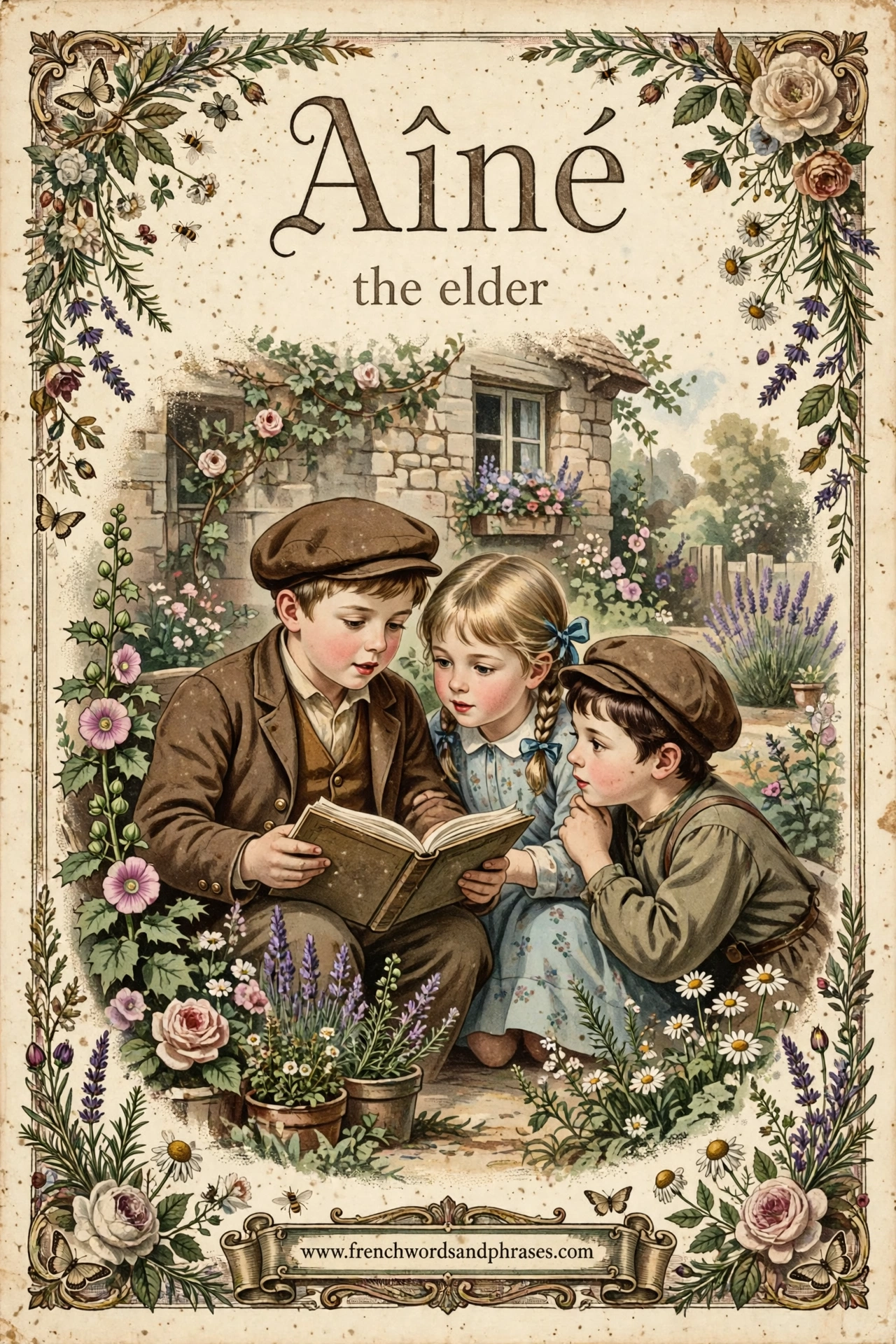
Aîné means elder.
A family photograph on a sideboard: four children in a row, tallest to smallest, and the eldest girl with her hand resting protectively on the shoulder of the little one. She was changing nappies at ten and giving orders at twelve. In every French family, she has a title of her own: l’aînée.
In this guide, you’ll learn what aîné means in English, how it forms a pair with cadet, where it stands in the sentence, and how l’aîné becomes the noun for the eldest child. Explore French examples, English translations, and practice quizzes.
Understanding the French Adjective Aîné
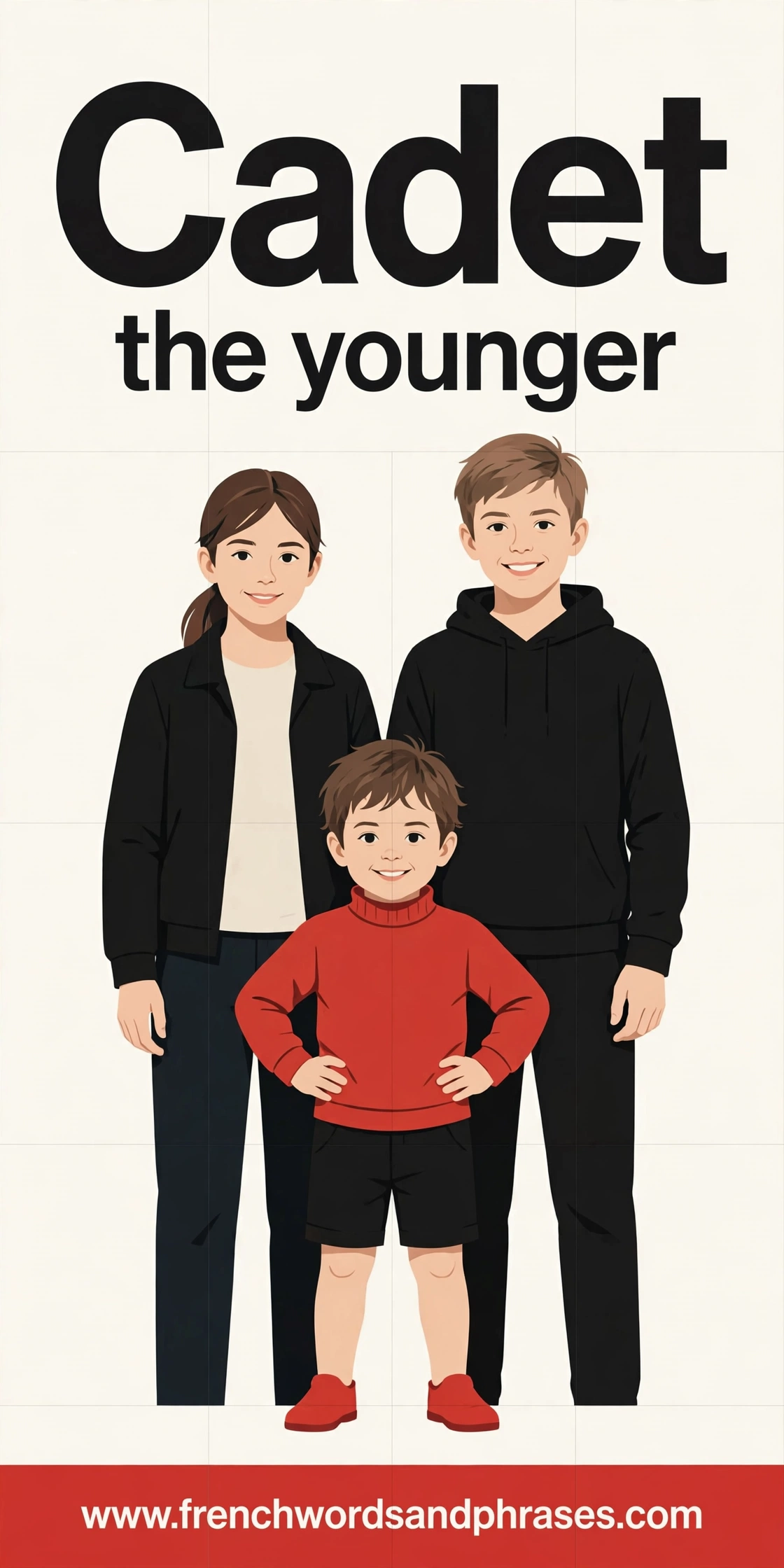
Aîné is a French adjective of family order — the adjective of the firstborn and the elder. It agrees in the regular -é way: aîné, aînée, aînés, aînées. It forms a famous pair with cadet: l’aîné is the eldest or elder one, le cadet the youngest or younger one. As a noun, l’aîné (or l’aînée) names the eldest child outright.
It means elder or eldest — the older of two, or the oldest of a family. It describes brothers and sisters (mon frère aîné, my elder brother; la sœur aînée, the eldest sister) and, as a noun, the firstborn child: l’aîné de la famille. Where English hesitates between elder and older, French reaches for aîné whenever family order is the point.
Type: Adjective of family order — birth order; also a noun
Answers the question: Which one in the family? — the elder, the eldest
Changes form: Yes — aîné, aînée, aînés, aînées
English equivalents: Elder; eldest; older (of siblings).
One important usage detail: aîné almost always travels with its family — le fils aîné, la fille aînée, or the noun l’aîné. And its partner is never far away: the moment a family has un aîné, the youngest is le cadet. Learn the pair together.
Experience the Word
Aîné is the adjective of the first in line — the child who tested the parents first, wore the new clothes first, and handed everything down, knowledge included.
Imagine a brother of twenty teaching his little sister to tie her shoes the way he once learned, in the same hallway. He is patient because he remembers. That is the quiet authority of l’aîné: he has simply been here longer.
You have not just described an age. You have named a rank, a duty and a head start, all in one word.
How to Use Aîné in French: Complete Guide
Let’s explore how Aîné works in French, beginning with the whole word on one card.
Aîné at a Glance
Before the details, here is the whole word on one card.
The Whole Word on One Card
Meaning, type, position and forms — aîné in four lines.
| Point | Aîné |
|---|---|
| Meaning | elder |
| Type | Adjective of family order — birth order; also a noun |
| Usual position | after the noun — le fils aîné; as a noun — l’aîné |
| Form | aîné / aînée / aînés / aînées |
Example
C’est la fille aînée de la famille.
She is the eldest daughter of the family.
The Four Forms of Aîné
Aîné agrees with the person it describes, following the regular pattern of adjectives in -é: the feminine adds an e, the plurals add an s.
| Form | Aîné | Example |
|---|---|---|
| Masculine singular | aîné | le fils aîné — the eldest son |
| Feminine singular | aînée | la fille aînée — the eldest daughter |
| Masculine plural | aînés | les frères aînés — the elder brothers |
| Feminine plural | aînées | les sœurs aînées — the elder sisters |
Example
Mon frère aîné habite à Paris et ma sœur aînée à Lyon.
My elder brother lives in Paris and my eldest sister in Lyon.
Quick Quiz 1
Which form of aîné goes with fille (feminine)?
Reveal the answer
aînée
La fille aînée.
The eldest daughter.
Aînée: The Regular Feminine in -ée
The feminine of aîné is formed by adding a single e. The spelling changes only — aîné and aînée sound exactly alike.
| Situation | Example |
|---|---|
| The rule | just add -e — aîné → aînée |
| The sound | aîné and aînée sound exactly the same: /ɛne/ |
| Masculine plural | aînés — les enfants aînés |
| Feminine plural | aînées — les filles aînées |
Example
La sœur aînée garde les plus petits.
The eldest sister looks after the little ones.
Where Aîné Goes: After the Noun
Aîné follows the noun it describes, like most French adjectives, and it is perfectly at home after être.
| Pattern | Example |
|---|---|
| After the noun | le fils aîné — the eldest son |
| As a noun (masc.) | l’aîné — the eldest (boy or man) |
| As a noun (fem.) | l’aînée — the eldest (girl or woman) |
| Before the noun | l’aîné fils — not in everyday French |
Example
L’aîné de la famille a trente ans.
The eldest of the family is thirty.
Quick Quiz 2
Who is le cadet in a family with un aîné?
Reveal the answer
The youngest
L’aîné is the eldest; le cadet is the youngest.
The pair always goes together.
More Aîné: Comparing with Aîné
Aîné compares the regular way, with plus, moins and aussi.
| Degree | Example |
|---|---|
| As elder as | aussi aîné que — as elder as |
| More elder | plus aîné — more elder |
| Less elder | moins aîné — less elder |
Example
C’est le plus aîné des quatre enfants.
He is the eldest of the four children.
Everyday Expressions with Aîné
The phrases French actually reaches for when aîné comes up in conversation.
| Expression | In English |
|---|---|
| le fils aîné | the eldest son |
| la fille aînée | the eldest daughter |
| mon frère aîné | my elder brother |
| l’aîné de la famille | the eldest of the family |
| les enfants aînés | the elder children |
| le droit d’aînesse | the right of the firstborn — primogeniture |
Example
Le fils aîné a repris la ferme de son père.
The eldest son took over his father’s farm.
Quick Quiz 3
What does l’aîné de la famille mean?
Reveal the answer
The eldest of the family
L’aîné de la famille s’appelle Hugo.
The eldest of the family is called Hugo.
Aîné and Its Neighbours
The words that live closest to aîné — near-synonyms, partners and opposites.
| French | In English |
|---|---|
| cadet | the youngest, the younger one — the inseparable partner |
| aînée (noun) | the eldest daughter or sister, as a noun |
| premier-né | firstborn — the formal synonym |
| grand frère | big brother — the everyday phrase for frère aîné |
| grande sœur | big sister — the everyday phrase for sœur aînée |
| benjamin | the youngest child — another word for le cadet |
Example
L’aîné a vingt ans et le cadet en a huit.
The eldest is twenty and the youngest is eight.
Watch Out: The Traps Around Aîné
The mistakes learners make with aîné — each one easy to avoid once seen.
| Trap | The truth |
|---|---|
| elder, not old | aîné compares siblings; for old age French says âgé or vieux — un frère aîné may be six years old |
| The pair | aîné calls for cadet: eldest ↔ youngest — learn them as one item |
| As a noun | l’aîné and l’aînée name the child directly: c’est l’aînée |
| Spelling | the î keeps its circumflex in every form — aîné, aînée, aînés |
Example
Mon frère aîné n’a que dix ans, ce n’est pas un vieillard.
My elder brother is only ten, he is not an old man.
Quick Quiz 4
How do you say ‘my elder brother’?
Reveal the answer
mon frère aîné
Aîné follows the noun and agrees with it.
My elder brother.
Aîné in Everyday French: Real-Life Examples
Now that you know the word, let’s see how aîné appears in everyday French.
Example 1 — Family
Mon frère aîné est médecin à Bordeaux.
My elder brother is a doctor in Bordeaux.
Example 2 — The eldest
C’est la fille aînée, elle a quinze ans.
She is the eldest daughter, she is fifteen.
Example 3 — Responsibility
La sœur aînée garde ses frères le mercredi.
The eldest sister looks after her brothers on Wednesdays.
Example 4 — Order
L’aîné passe toujours le premier à table.
The eldest always sits down at the table first.
Example 5 — A pair
Entre l’aîné et le cadet, il y a dix ans d’écart.
Between the eldest and the youngest, there are ten years’ difference.
Example 6 — Heritage
Le fils aîné a hérité de la maison de famille.
The eldest son inherited the family house.
Beyond Translation: The Meaning of Aîné
English says elder for the meaning of aîné — but French builds a whole family architecture on the word: l’aîné at the top of the stairs, le cadet at the bottom, and every child knowing exactly where they stand.
To call a child l’aîné is to give them a title, not just an age.
History echoes in it too: le droit d’aînesse, the right of the firstborn, once decided who inherited the farm, the shop and the name — which is why the eldest still, in many families, feels the weight of going first.
How to Remember the French Adjective Aîné
Remember it this way: Aîné is the firstborn adjective — a regular -é agreement, a noun in its own right, and one half of the pair aîné / cadet.
- You pair it at once — l’aîné the eldest, le cadet the youngest.
- You add an e for her — la fille aînée, the eldest daughter.
- You use it as a noun — c’est l’aîné, he is the eldest.
The key idea is aîné means the elder/eldest, pairs with cadet (the youngest), and works as a noun: l’aîné.
Test Your Knowledge of Aîné
Let’s see how much you’ve learned. Try answering these questions before revealing the answers.
Question 1
What does aîné mean?
Reveal the answer
Elder, eldest — the older or oldest child in a family.
Question 2
What is the opposite of aîné in a family?
Reveal the answer
cadet — le cadet is the youngest or younger one.
Question 3
Translate: the eldest daughter.
Reveal the answer
La fille aînée.
Question 4
Complete the sentence:
______ de la famille a vingt ans.
Reveal the answer
L’aîné
L’aîné de la famille a vingt ans.
The eldest of the family is twenty.
Question 5
What is the feminine plural of aîné?
Reveal the answer
aînées — add e for the feminine, then s for the plural.
Your Final Challenge
Can You Use It?
How would you say this in French?
My eldest sister is ten years older than the youngest.
Reveal the answer
Ma sœur aînée a dix ans de plus que le cadet.
My eldest sister is ten years older than the youngest.
A little French. A little curiosity. A richer everyday life.
LEARN FRENCH ONE WORD AT A TIME