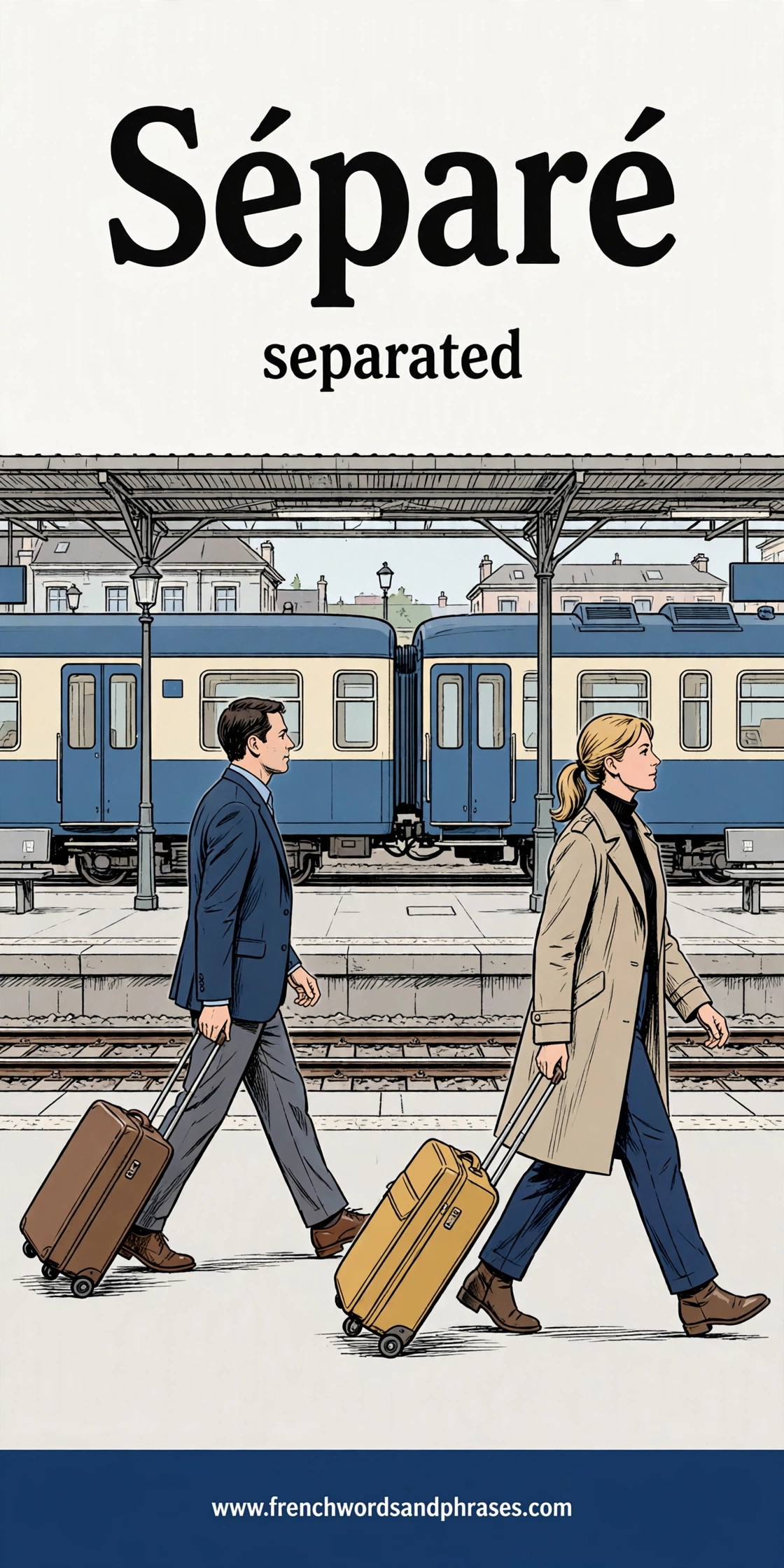
A French Word to Live By
Translate Séparé to English
/sepaʁe/
Séparé means separated.
Two flats now, one street apart, and a little boy with a schoolbag who knows both front doors by heart. His parents no longer share a home, but they still share him — birthdays, homework, holidays. French describes their state, exactly and without drama, as séparés.
In this guide, you’ll learn what séparé means in English, how its regular feminine is formed, where it stands in the sentence, and why it is not the same as divorcé. Explore French examples, English translations, and practice quizzes.
Understanding the French Adjective Séparé
Séparé is a French adjective of state — the adjective of living apart. It is the past participle of séparer, and it agrees in the regular -é way: séparé, séparée, séparés, séparées. Beyond couples, it also means separate in general: des chambres séparées, separate rooms.
It means separated — a couple no longer living together, with the marriage not yet (or not ever) legally ended. It describes husbands and wives (un couple séparé, a separated couple), and in its wider sense anything kept apart: des entrées séparées, separate entrances. For couples, it is the in-between state, before divorcé or instead of it.
Type: Adjective of state — marital status; also ‘separate’ in general
Answers the question: What is his or her situation? — separated
Changes form: Yes — séparé, séparée, séparés, séparées
English equivalents: Separated; apart.
One important usage detail: séparé stands AFTER the noun — un couple séparé — and after être: ils sont séparés. To say who someone is separated from, French uses de: elle est séparée de son mari, she is separated from her husband.
Experience the Word
Séparé is the adjective of the two addresses — the state between together and finished, where a couple has stopped sharing a home but not yet, perhaps, a history.
Imagine a father teaching his daughter to ride a bicycle in the park of a town where he no longer lives. She runs to him every other weekend with her whole week to tell. Séparés, her parents say of themselves — apart, and still bound by everything that matters.
You have not just described a broken home. You have named a pause that may become an ending, or a new arrangement.
How to Use Séparé in French: Complete Guide
Let’s explore how Séparé works in French, beginning with the whole word on one card.
Séparé at a Glance
Before the details, here is the whole word on one card.
The Whole Word on One Card
Meaning, type, position and forms — séparé in four lines.
| Point | Séparé |
|---|---|
| Meaning | separated |
| Type | Adjective of state — marital status; also ‘separate’ in general |
| Usual position | after the noun — un couple séparé |
| Form | séparé / séparée / séparés / séparées |
Example
C’est un couple séparé.
They are a separated couple.
The Four Forms of Séparé
Séparé agrees with the person or thing it describes, following the regular pattern of adjectives in -é: the feminine adds an e, the plurals add an s.
| Form | Séparé | Example |
|---|---|---|
| Masculine singular | séparé | un homme séparé — a separated man |
| Feminine singular | séparée | une femme séparée — a separated woman |
| Masculine plural | séparés | un couple séparé, ils sont séparés — a separated couple |
| Feminine plural | séparées | des chambres séparées — separate rooms |
Example
Ils sont séparés depuis le printemps.
They have been separated since the spring.
Quick Quiz 1
Which form of séparé goes with femme (feminine)?
Reveal the answer
séparée
Une femme séparée.
A separated woman.
Séparée: The Regular Feminine in -ée
The feminine of séparé is formed by adding a single e. The spelling changes only — séparé and séparée sound exactly alike.
| Situation | Example |
|---|---|
| The rule | just add -e — séparé → séparée |
| The sound | séparé and séparée sound exactly the same |
| Masculine plural | séparés — des parents séparés |
| Feminine plural | séparées — des vies séparées, separate lives |
Example
Elle est séparée de son mari depuis un an.
She has been separated from her husband for a year.
Where Séparé Goes: After the Noun
Séparé follows the noun it describes, like most French adjectives, and it is perfectly at home after être.
| Pattern | Example |
|---|---|
| After the noun | des parents séparés — separated parents |
| After être | ils sont séparés — they are separated |
| Separated from | séparée de son mari — separated from her husband |
| Before the noun | une séparée vie — not in everyday French |
Example
Des parents séparés peuvent rester une équipe.
Separated parents can remain a team.
Quick Quiz 2
Does séparé mean the divorce is final?
Reveal the answer
No
Séparé means living apart; divorcé means the marriage is legally ended.
Ils sont séparés, pas encore divorcés.
More Séparé: Comparing with Séparé
Séparé compares the regular way, with plus, moins and aussi.
| Degree | Example |
|---|---|
| As separated as | aussi séparé que — as separated as |
| More separated | plus séparé — more separated |
| Less separated | moins séparé — less separated |
Example
Leurs vies sont plus séparées qu’avant.
Their lives are more separate than before.
Everyday Expressions with Séparé
The phrases French actually reaches for when séparé comes up in conversation.
| Expression | In English |
|---|---|
| un couple séparé | a separated couple |
| des parents séparés | separated parents |
| séparé de quelqu’un | separated from someone |
| des chambres séparées | separate rooms |
| vivre séparés | to live apart |
| séparés mais amis | separated but still friends |
Example
Ils vivent séparés mais ils élèvent leurs enfants ensemble.
They live apart but they raise their children together.
Quick Quiz 3
What does des chambres séparées mean?
Reveal the answer
Separate rooms
Nous avons réservé des chambres séparées.
We booked separate rooms.
Séparé and Its Neighbours
The words that live closest to séparé — near-synonyms, partners and opposites.
| French | In English |
|---|---|
| divorcé | divorced — the legal end that may follow separation |
| marié | married — the state a separated couple is leaving |
| célibataire | single — separated people are not usually called célibataire |
| éloigné | distant, estranged — separated in feeling |
| séparation | separation — the noun: une séparation difficile |
| ensemble | together — the opposite |
Example
Une séparation difficile les a rendus éloignés.
A difficult separation made them estranged.
Watch Out: The Traps Around Séparé
The mistakes learners make with séparé — each one easy to avoid once seen.
| Trap | The truth |
|---|---|
| séparé or divorcé | séparé = living apart; divorcé = legally divorced — do not swap them |
| de, not avec | séparé de quelqu’un — separated from someone |
| Wider sense | séparé also means separate in general — des entrées séparées |
| The verb | se séparer de quelqu’un — to separate from someone |
Example
Ils se sont séparés en janvier, mais ils ne sont pas divorcés.
They separated in January, but they are not divorced.
Quick Quiz 4
How do you say ‘separated parents’?
Reveal the answer
des parents séparés
Séparé follows the noun and agrees with it.
Separated parents.
Séparé in Everyday French: Real-Life Examples
Now that you know the word, let’s see how séparé appears in everyday French.
Example 1 — Family
Mes parents sont séparés mais ils s’entendent bien.
My parents are separated but they get along well.
Example 2 — News
Elle est séparée de son mari depuis le printemps.
She has been separated from her husband since the spring.
Example 3 — Children
L’enfant de parents séparés passe Noël chez sa mère.
The child of separated parents spends Christmas at his mother’s.
Example 4 — At a hotel
Nous voudrions deux chambres séparées, s’il vous plaît.
We would like two separate rooms, please.
Example 5 — A couple
Ils sont séparés mais ils déjeunent ensemble le dimanche.
They are separated but they have lunch together on Sundays.
Example 6 — In general
Les deux bureaux sont séparés par un long couloir.
The two offices are separated by a long corridor.
Beyond Translation: The Meaning of Séparé
English says separated for the meaning of séparé — and French uses the word with a lawyer’s precision and a novelist’s tact: it states the fact of two homes while leaving the future unwritten.
To say a couple is séparé is to describe a door that is closed, but not yet locked.
That is why French keeps séparé and divorcé so carefully apart — one is geography, two addresses and a shared calendar; the other is law, a signature and an end.
How to Remember the French Adjective Séparé
Remember it this way: Séparé is the living-apart adjective — a regular -é agreement, the partner named with de, and a meaning wider than marriage alone.
- You add an e for her — séparée, and an s for the plural — séparés.
- You keep the sequence straight — séparé is apart, divorcé is legally finished.
- You remember the wide sense — des chambres séparées, separate rooms.
The key idea is séparé means living apart (not yet divorced) and also simply ‘separate’ for things.
Test Your Knowledge of Séparé
Let’s see how much you’ve learned. Try answering these questions before revealing the answers.
Question 1
What does séparé mean?
Reveal the answer
Separated — living apart; also separate in general.
Question 2
What is the difference between séparé and divorcé?
Reveal the answer
Séparé means the couple lives apart; divorcé means the marriage is legally ended.
Question 3
Translate: separated parents.
Reveal the answer
Des parents séparés.
Question 4
Complete the sentence:
Elle est séparée ______ son mari.
Reveal the answer
de
Elle est séparée de son mari.
She is separated from her husband.
Question 5
How do you say ‘separate rooms’?
Reveal the answer
des chambres séparées — séparé agrees with the feminine plural noun.
Your Final Challenge
Can You Use It?
How would you say this in French?
They are separated, but they raise their children together.
Reveal the answer
Ils sont séparés, mais ils élèvent leurs enfants ensemble.
They are separated, but they raise their children together.
A little French. A little curiosity. A richer everyday life.
LEARN FRENCH ONE WORD AT A TIME