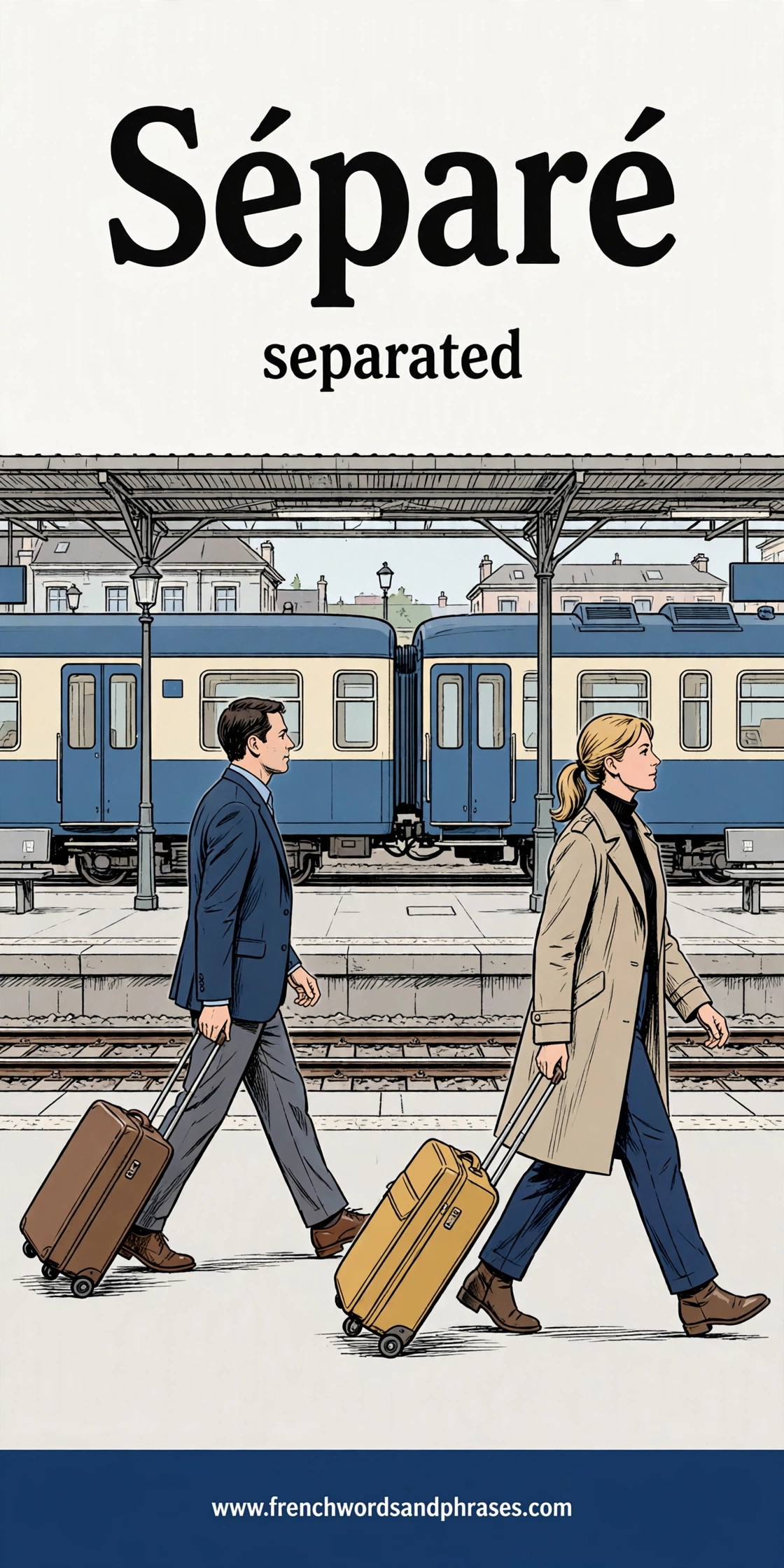
A French Word to Live By
Translate Divorcé to English
/divɔʁse/
Divorcé means divorced.
A lawyer’s office, a quiet signature, and two people who stand up, shake hands almost politely, and walk out into different afternoons. No slammed doors, no shouting — just the end of one story and, eventually, the start of two others. French marks the state with one word: divorcé.
In this guide, you’ll learn what divorcé means in English, how its regular feminine is formed, where it stands in the sentence, and how it differs from séparé, the step that often comes before it. Explore French examples, English translations, and practice quizzes.
Understanding the French Adjective Divorcé
Divorcé is a French adjective of state — the adjective of a marriage legally ended. It is the past participle of divorcer, and it agrees in the regular -é way: divorcé, divorcée, divorcés, divorcées. It also works as a noun: un divorcé, une divorcée — a divorced person.
It means divorced — no longer married because the marriage has been legally dissolved. It describes men and women alike (un homme divorcé, une femme divorcée) and it is the precise word of forms and family news: it says the divorce is complete, not merely planned or under way.
Type: Adjective of state — marital status
Answers the question: What is his or her situation? — divorced
Changes form: Yes — divorcé, divorcée, divorcés, divorcées
English equivalents: Divorced.
One important usage detail: divorcé stands AFTER the noun — une femme divorcée — and after être: ils sont divorcés. To name the former partner, French uses de: elle est divorcée de son premier mari, she is divorced from her first husband.
Experience the Word
Divorcé is the adjective of the closed chapter — a word that looks backwards at a marriage that ended and forwards, often with relief, at everything still to come.
Imagine two parents at their daughter’s school play, sitting three seats apart, applauding at the same moments. The marriage is finished; the family, in a new shape, is not. Divorcés, yes — and still, in their way, a team.
You have not just described a failure. You have named a legal fact, and often a fresh start.
How to Use Divorcé in French: Complete Guide
Let’s explore how Divorcé works in French, beginning with the whole word on one card.
Divorcé at a Glance
Before the details, here is the whole word on one card.
The Whole Word on One Card
Meaning, type, position and forms — divorcé in four lines.
| Point | Divorcé |
|---|---|
| Meaning | divorced |
| Type | Adjective of state — marital status |
| Usual position | after the noun — une femme divorcée |
| Form | divorcé / divorcée / divorcés / divorcées |
Example
C’est une femme divorcée.
She is a divorced woman.
The Four Forms of Divorcé
Divorcé agrees with the person it describes, following the regular pattern of adjectives in -é: the feminine adds an e, the plurals add an s.
| Form | Divorcé | Example |
|---|---|---|
| Masculine singular | divorcé | un homme divorcé — a divorced man |
| Feminine singular | divorcée | une femme divorcée — a divorced woman |
| Masculine plural | divorcés | des hommes divorcés — divorced men |
| Feminine plural | divorcées | des femmes divorcées — divorced women |
Example
Ils sont divorcés depuis trois ans.
They have been divorced for three years.
Quick Quiz 1
Which form of divorcé goes with mère (feminine)?
Reveal the answer
divorcée
Une mère divorcée.
A divorced mother.
Divorcée: The Regular Feminine in -ée
The feminine of divorcé is formed by adding a single e. The spelling changes only — divorcé and divorcée sound exactly alike.
| Situation | Example |
|---|---|
| The rule | just add -e — divorcé → divorcée |
| The sound | divorcé and divorcée sound exactly the same |
| Masculine plural | divorcés — des pères divorcés |
| Feminine plural | divorcées — des mères divorcées |
Example
Ma tante est divorcée et elle vit à Lyon.
My aunt is divorced and she lives in Lyon.
Where Divorcé Goes: After the Noun
Divorcé follows the noun it describes, like most French adjectives, and it is perfectly at home after être.
| Pattern | Example |
|---|---|
| After the noun | un père divorcé — a divorced father |
| After être | elle est divorcée — she is divorced |
| Divorced from | divorcé de sa première femme — divorced from his first wife |
| Before the noun | une divorcée femme — not in everyday French |
Example
Il est divorcé de sa première femme.
He is divorced from his first wife.
Quick Quiz 2
Where does divorcé stand — before or after the noun?
Reveal the answer
After
Un homme divorcé, une femme divorcée.
A divorced man, a divorced woman.
More Divorcé: Comparing with Divorcé
Divorcé compares the regular way, with plus, moins and aussi.
| Degree | Example |
|---|---|
| As divorced as | aussi divorcé que — as divorced as |
| More divorced | plus divorcé — more divorced |
| Less divorced | moins divorcé — less divorced |
Example
Elle se sent plus libre depuis qu’elle est divorcée.
She feels freer since she has been divorced.
Everyday Expressions with Divorcé
The phrases French actually reaches for when divorcé comes up in conversation.
| Expression | In English |
|---|---|
| un père divorcé | a divorced father |
| une mère divorcée | a divorced mother |
| divorcé de quelqu’un | divorced from someone |
| être divorcé depuis deux ans | to have been divorced for two years |
| un couple divorcé | a divorced couple |
| fraîchement divorcé | freshly divorced, newly divorced |
Example
Fraîchement divorcé, il a déménagé à Paris.
Freshly divorced, he moved to Paris.
Quick Quiz 3
What does fraîchement divorcé mean?
Reveal the answer
Freshly divorced
Fraîchement divorcée, elle recommence une nouvelle vie.
Freshly divorced, she is starting a new life.
Divorcé and Its Neighbours
The words that live closest to divorcé — near-synonyms, partners and opposites.
| French | In English |
|---|---|
| séparé | separated — apart, but the divorce is not yet final |
| marié | married — the state that came before |
| célibataire | single — the broad state a divorced person returns to |
| remarié | remarried — married again after a divorce |
| veuf | widowed — a marriage ended by death, not by law |
| époux / épouse | spouse — the former partner is un ex-mari or une ex-femme |
Example
Séparés d’abord, puis divorcés, ils sont amis aujourd’hui.
Separated first, then divorced, they are friends today.
Watch Out: The Traps Around Divorcé
The mistakes learners make with divorcé — each one easy to avoid once seen.
| Trap | The truth |
|---|---|
| séparé or divorcé | séparé means living apart; divorcé means the law has ended the marriage |
| de, not avec | divorcé de quelqu’un — divorced from someone |
| As a noun | un divorcé, une divorcée — a divorced man, a divorced woman |
| The verb | divorcer is regular: ils divorcent, they are getting divorced |
Example
Ils sont séparés mais pas encore divorcés.
They are separated but not yet divorced.
Quick Quiz 4
How do you say ‘a divorced woman’?
Reveal the answer
une femme divorcée
Divorcé follows the noun and agrees with it.
A divorced woman.
Divorcé in Everyday French: Real-Life Examples
Now that you know the word, let’s see how divorcé appears in everyday French.
Example 1 — Family
Mes parents sont divorcés depuis mon enfance.
My parents have been divorced since my childhood.
Example 2 — News
Elle est divorcée et elle élève ses enfants seule.
She is divorced and she is raising her children alone.
Example 3 — A form
Sur le formulaire, il a écrit « divorcé ».
On the form, he wrote ‘divorced’.
Example 4 — A fresh start
Divorcée depuis un an, elle a ouvert son propre café.
Divorced for a year, she has opened her own café.
Example 5 — Children
Les enfants de parents divorcés passent un week-end sur deux chez leur père.
The children of divorced parents spend every other weekend at their father’s.
Example 6 — Remarriage
Il est divorcé mais il veut se remarier un jour.
He is divorced but he wants to remarry one day.
Beyond Translation: The Meaning of Divorcé
English says divorced for the meaning of divorcé — and French keeps the word scrupulously neutral: a state on a form, between marié and célibataire, carrying no sermon and no scandal.
To say someone is divorcé in French is to close a file, not to pass a verdict.
The word also keeps its sense of sequence: séparé is the parting, divorcé is the signature, and remarié — remarried — is the proof that the story can begin again.
How to Remember the French Adjective Divorcé
Remember it this way: Divorcé is the ended-marriage adjective — a regular -é agreement, the former partner named with de, and a clear line between séparé and divorcé.
- You add an e for her — divorcée, and an s for the plural — divorcés.
- You separate the steps — séparé first, divorcé when the law has finished.
- You name the ex with de — divorcé de sa première femme.
The key idea is divorcé agrees like a regular -é adjective and means the divorce is legally complete, unlike séparé.
Test Your Knowledge of Divorcé
Let’s see how much you’ve learned. Try answering these questions before revealing the answers.
Question 1
What does divorcé mean?
Reveal the answer
Divorced — a marriage legally ended.
Question 2
What is the difference between séparé and divorcé?
Reveal the answer
Séparé means living apart; divorcé means the divorce is final in law.
Question 3
Translate: a divorced father.
Reveal the answer
Un père divorcé.
Question 4
Complete the sentence:
Elle est ______ de son premier mari.
Reveal the answer
divorcée
Elle est divorcée de son premier mari.
She is divorced from her first husband.
Question 5
What is the feminine plural of divorcé?
Reveal the answer
divorcées — add e for the feminine, then s for the plural.
Your Final Challenge
Can You Use It?
How would you say this in French?
“My parents are divorced, but they remain good friends.”
Reveal the answer
Mes parents sont divorcés, mais ils restent de bons amis.
My parents are divorced, but they remain good friends.
A little French. A little curiosity. A richer everyday life.
LEARN FRENCH ONE WORD AT A TIME