A French Word to Live By
Translate Y to English
/i/
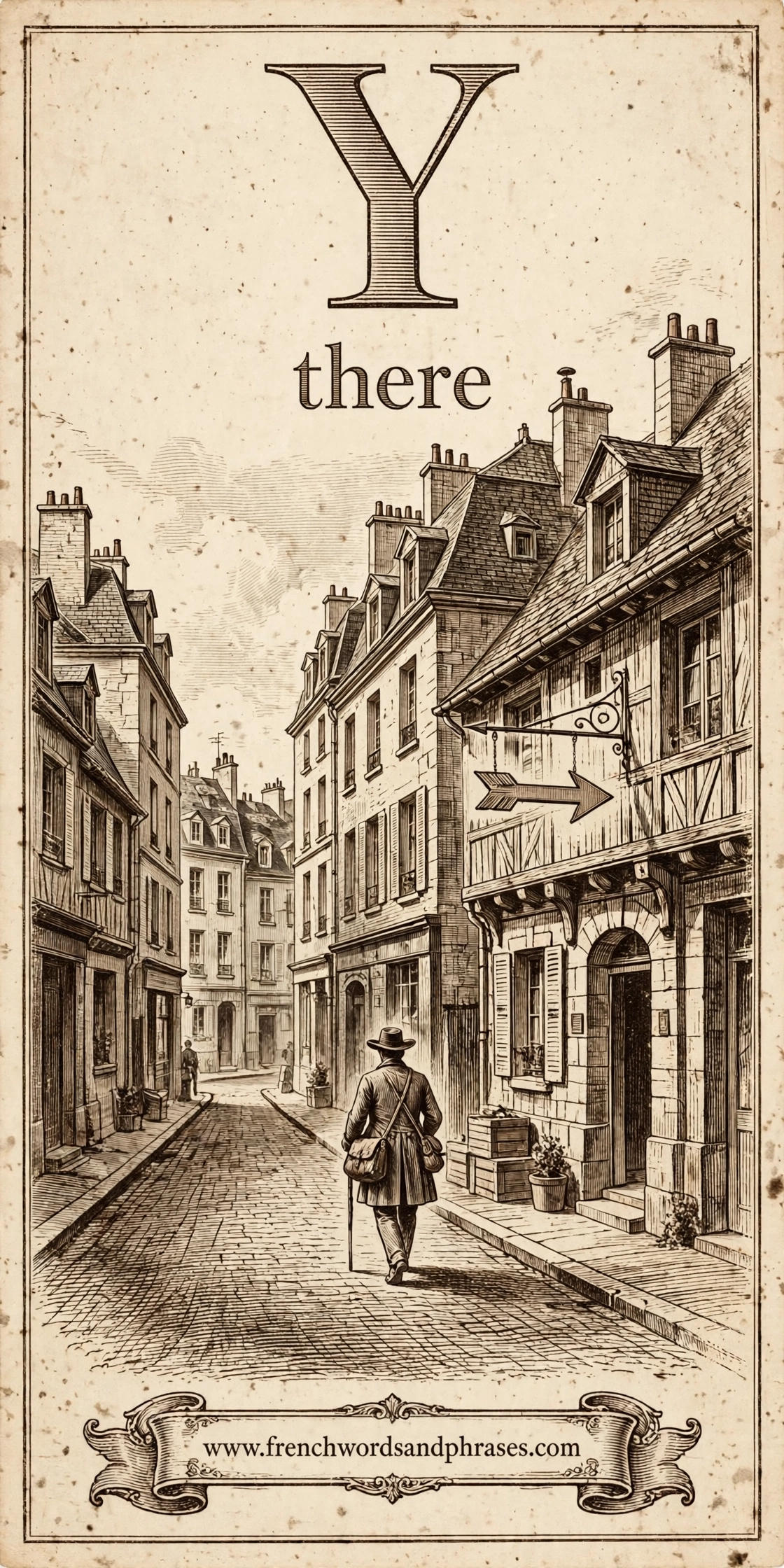
Y means there / to it / about it.
The train is already humming on the platform. « Tu vas à Lyon, alors ? — Oui, j’y vais, mon train part dans dix minutes. » — You are going to Lyon, then? — Yes, I am going there, my train leaves in ten minutes. In that tiny answer, the whole city of Lyon has folded itself into a single letter: y, the smallest pronoun in French.
Let’s explore how y works in French, beginning with the whole word on one card.
Understanding the French Pronoun Y
Y is a French adverbial pronoun — one single letter that stands in for a whole phrase beginning with à: a place (à Paris, à la gare, au bord de la mer) or a thing (à son avenir, à cette question). It is the great space-saver of French: the à-phrase is said once, and afterwards y carries it.
It means there when it points to a place — Tu vas à la bibliothèque ? J’y vais. — and to it, about it or in it when it points to a thing: Tu penses à ton discours ? J’y pense jour et nuit. Its most famous home is the fixed phrase il y a, there is / there are, whose question form y a-t-il turns the whole thing inside out.
Type: Adverbial pronoun — one letter, the smallest pronoun in French
Answers the question: Où ? À quoi ? — Where? About what? (Tu vas où ? — J’y vais. Tu penses à quoi ? — J’y pense.)
What it replaces: à + a place or à + a thing — à Paris → y, à son examen → y
Watch the pair: y (for à…) vs en (for de…) — j’y pense = I think about it; j’en parle = I talk about it
One important usage detail: y never replaces a person. For à + a person, French switches tools — je lui réponds (I answer him), je pense à elle (I am thinking of her). And y always stands before its verb — j’y vais, je vais y aller — except in the affirmative imperative, where it glues itself behind with a hyphen: Vas-y !
Experience the Word
Y is the pronoun of the already-said — it exists for everything the conversation has already placed on the table: the town you both know, the plan you both made, the question hanging in the air.
Imagine two old friends at a kitchen table, talking about the little house in Provence they visited years ago. « Tu y retournes, cet été ? — Chaque été. Je m’y sens chez moi. » The house is never named again — y carries it through the whole conversation like a postcard passed from hand to hand.
You have not just saved a few words. You have pointed backwards — and the whole phrase you meant stands there again, in a single letter.
How to Use Y in French: Complete Guide
Let’s explore how y works in French, beginning with the whole word on one card.
Y at a Glance
The Whole Word on One Card
Meaning, job, pattern and family — y in four lines.
| Point | Y |
|---|---|
| Meaning | there — and to it / about it / in it |
| Job | stands in for a phrase beginning with à, so it never has to be repeated |
| What it stands for | a place (à la gare) or a thing (à cette question) — never a person |
| Its own forms | only one form: y never changes — and it lives full-time inside il y a (there is / there are) |
Example
Tu vas à la fête ? — Oui, j’y vais !
Are you going to the party? — Yes, I am going!
The Pattern in Action: One Letter for a Whole Phrase
Y connects a sentence to a place or a thing that is already on the table — and quietly takes its place.
| Pattern | Example |
|---|---|
| à + place | tu vas à Bordeaux ? — j’y vais demain — are you going to Bordeaux? — I am going there tomorrow |
| à + thing (penser à) | tu penses à ton voyage ? — j’y pense tout le temps — are you thinking about your trip? — I think about it all the time |
| à + thing (répondre à) | je réponds à sa lettre → j’y réponds ce soir — I am answering her letter → I am answering it tonight |
| à + activity (jouer à) | vous jouez au tennis ? — oui, nous y jouons le samedi — do you play tennis? — yes, we play it on Saturdays |
Example
Il s’intéresse à cette question — il s’y intéresse vraiment.
He is interested in this question — he is really interested in it.
Quick Quiz 1
What has disappeared into y in « — Tu penses à ton examen ? — J’y pense »?
Reveal the answer
à ton examen — y stands in for the whole à-phrase, so j’y pense means I am thinking about it.
J’y pense jour et nuit.
I think about it day and night.
The Tricky Bit: Places and Things Yes — People No
Y is generous with places and things, but it refuses people: for à + a person, French reaches for other pronouns.
| What follows à | What French uses |
|---|---|
| a place | y — à Lyon → j’y habite (I live there) |
| a thing | y — à cette idée → j’y crois (I believe in it) |
| a person, with penser / rêver | the stressed pronoun — à Marie → je pense à elle (I am thinking of her) |
| a person, with téléphoner / répondre / écrire | lui / leur — à Paul → je lui réponds (I answer him) |
Example
Tu téléphones à ta sœur ? — Oui, je lui téléphone ce soir.
Are you phoning your sister? — Yes, I am phoning her tonight.
Where It Goes: Just Before the Verb
Y is a clinger: it sticks to the front of its verb — except in one famous case, the order, where it jumps behind with a hyphen.
| Position / pattern | Example |
|---|---|
| before the conjugated verb | je n’y vais pas — I am not going there |
| before the infinitive it belongs to | je vais y aller — I am going to go there; tu dois y penser — you must think about it |
| affirmative imperative: after the verb, with a hyphen | Vas-y ! Allons-y ! — Go on! Let’s go! |
| before the auxiliary in the passé composé | j’y suis allé hier — I went there yesterday |
Example
On y va ? Le film commence dans cinq minutes.
Shall we go? The film starts in five minutes.
Quick Quiz 2
In « Je vais ______ aller », does y go before vais or before aller?
Reveal the answer
Before aller — y travels with the verb it belongs to, the infinitive.
Je vais y aller demain matin.
I am going to go there tomorrow morning.
Everyday Expressions with Y
Y turns up in some of the most useful phrases in the language — starting with the giant, il y a.
| Expression | In English |
|---|---|
| il y a — il y avait — il y aura | there is / there are — there was — there will be |
| on y va ! | let’s go! / here we go! |
| ça y est ! | that’s it! / done! / got it! |
| je n’y arrive pas | I can’t manage it / I just can’t do it |
| il faut y aller | we have to go / time to go |
| vas-y ! | go ahead! / go on! |
Example
Ça y est, j’ai fini mes devoirs !
That’s it, I have finished my homework!
Close Cousins: Y, En, Lui, Là
Four small words that all point backwards — here is who does what.
| Word | The difference |
|---|---|
| en | the de-twin: en replaces de + a thing or a quantity — tu parles de ton voyage ? j’en parle ; tu veux du café ? j’en veux |
| lui / leur | the people words: they replace à + a person — je parle à Paul → je lui parle |
| là / là-bas | the free adverbs: là points and stands where it likes — on se retrouve là (we will meet there); y does the same job quietly, glued before the verb |
| où | the relative: où joins two clauses — la ville où j’habite (the town where I live); y alone gives j’y habite (I live there) |
Example
Tu penses à ton départ ? — J’y pense, et j’en parle à tout le monde.
Are you thinking about leaving? — I think about it, and I talk about it to everyone.
Quick Quiz 3
« Tu parles de ton voyage ? » — do you answer with y or with en?
Reveal the answer
en — parler takes de, and de-phrases are replaced by en; y is only for à-phrases.
Oui, j’en parle tout le temps.
Yes, I talk about it all the time.
Y and Its Neighbours: The Little Words Before the Verb
The object-pronoun shelf: the small words that queue up in front of a French verb, each with its own job.
| French | In English |
|---|---|
| y | there / to it — for à + a place or a thing: j’y vais |
| en | of it / some — for de + a thing or quantities: j’en veux deux |
| le / la / les | him, her, it, them — direct objects: je le vois |
| lui / leur | to him / to them — for à + people: je lui écris |
| il y a | there is / there are — the fixed phrase where y never leaves |
Example
Je le vois, je lui parle, et je lui dis qu’on y va.
I see him, I speak to him, and I tell him that we are going there.
Watch Out: The Traps Around Y
The traps: the person who sneaks in, the wandering y, and the il y a that must never be split.
| Trap | The truth |
|---|---|
| using y for a person | je pense à Sophie → je pense à elle — never y for people; verbs like répondre take lui: je lui réponds |
| putting y after the verb in a statement | y goes before: j’y vais — only orders flip it behind: Vas-y ! |
| dropping y and repeating the place | French carries the place with y: tu vas au bureau ? — oui, j’y vais |
| splitting il y a | il y a is one block — il y a un problème; the question turns it inside out: y a-t-il un problème ? |
Example
Y a-t-il encore du café ? — Oui, il y en a.
Is there any coffee left? — Yes, there is some.
Quick Quiz 4
Complete: Tu réponds à la directrice ? — Oui, ______ réponds tout de suite.
Reveal the answer
je lui — la directrice is a person, so à + a person takes lui, not y.
Oui, je lui réponds tout de suite.
Yes, I am answering her right away.
Y in Everyday French: Real-Life Examples
Now that you know the word, let’s see how y appears in everyday French.
Example 1 — Travel
On arrive à Marseille demain ; on y reste trois jours.
We arrive in Marseille tomorrow; we are staying there for three days.
Example 2 — Thinking ahead
Je pense à mon entretien de demain — j’y pense sans arrêt.
I am thinking about my interview tomorrow — I think about it non-stop.
Example 3 — Meeting friends
Tu viens au marché avec nous ? — Oui, j’y vais dans cinq minutes.
Are you coming to the market with us? — Yes, I will be there in five minutes.
Example 4 — Encouragement
Vas-y, tu peux le faire !
Go on, you can do it!
Example 5 — At home
Il y a du pain frais sur la table.
There is fresh bread on the table.
Example 6 — Getting used to it
Le nouvel horaire est dur au début, mais on s’y fait.
The new schedule is hard at first, but you get used to it.
Beyond Translation: The Meaning of Y
English needs a whole little phrase to do what y does in one letter — there, to it, about it, in it — and even then it often drops the words completely: « Are you going? — Yes, I am. » French refuses to drop them: the à-phrase always leaves a footprint, and the footprint is y.
To say y is to trust the conversation — everything already said stays present, folded into a single letter.
And y has one immortal address: il y a, there is, the phrase that opens descriptions, lists and stories — il y a un chat sur le toit, il y avait une fois… Every French tale that begins « once upon a time » begins, quietly, with y.
How to Remember the French Pronoun Y
Remember it this way: Y is the one-letter echo of à — wherever a sentence has said à + a place or à + a thing, y can step in and say it again, shorter.
- You follow the à — à Paris → j’y vais, à ton idée → j’y pense.
- You keep people out — for à + a person, French switches tools: je lui réponds, je pense à elle.
- You put it before the verb — je vais y aller — and glue it behind only in orders: Vas-y !
The key idea is y replaces à + a place or a thing (never a person), stands before the verb, and lives inside il y a.
Test Your Knowledge of Y
Let’s see how much you’ve learned. Try answering these questions before revealing the answers.
Question 1
What does y replace in « Tu vas à Nice ? — Oui, j’y vais »?
Reveal the answer
The place phrase à Nice — y means there, and the town never has to be named twice.
Question 2
Can y replace à + a person, as in « Je réponds à Paul »?
Reveal the answer
No — people take lui or leur: Je lui réponds. Y is only for places and things.
Question 3
Translate: I am thinking about it. (about my decision)
Reveal the answer
J’y pense.
Question 4
What does il y a mean, and what is its past form?
Reveal the answer
There is / there are — in the past, il y avait (there was / there were).
Question 5
Complete the sentence:
Tu connais ce quartier ? — Oui, ______ habite depuis dix ans. (I have lived there for ten years)
Reveal the answer
j’y
Oui, j’y habite depuis dix ans.
Yes, I have lived there for ten years.
Your Final Challenge
Can You Use It?
How would you say this in French?
“Let’s go there — there is a train in ten minutes!”
Reveal the answer
On y va — il y a un train dans dix minutes !
Let’s go there — there is a train in ten minutes!
A little French. A little curiosity. A richer everyday life.
LEARN FRENCH ONE WORD AT A TIME