
A French Word to Live By
Translate Volant to English
/vɔ.lɑ̃/
Le volant means the steering wheel.
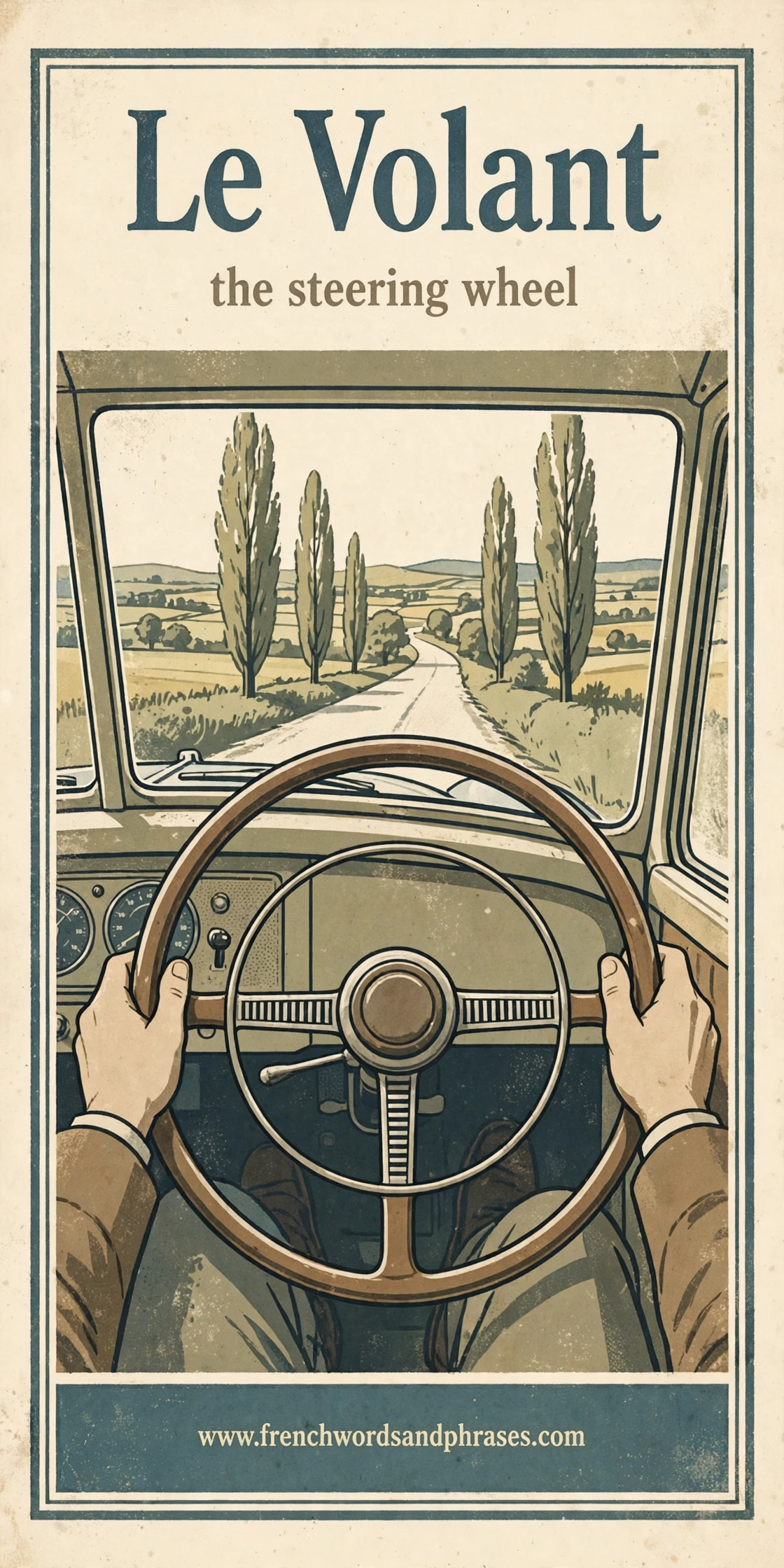
First driving lesson: the instructor settles into the passenger seat, you slide in on the left, and both hands close around the big round wheel in front of you — le volant, the steering wheel, the part of the car that answers to your hands.
In this guide, you’ll learn what volant means in English, how to use it with its articles, how to form its plural, and how it appears in everyday French. Explore French examples, English translations, and practice quizzes.
Understanding the French Noun Volant
Volant is a masculine French noun. It is learned together with its article: le volant, un volant. It is the round wheel the driver turns to steer the car — and the word reaches further than the car: a badminton shuttlecock is also un volant, and so is the flywheel of an engine.
It means the steering wheel — the wheel in front of the driver, turned left and right to direct the car. Whoever holds it is in charge of the journey, which is why French says être au volant, to be at the wheel, simply to mean to be the one driving. Modern volants carry buttons, airbags and sometimes heating, but the idea has not changed since the first cars: hands here, road ahead.
Gender: Masculine
Definite article: le — le volant (the steering wheel)
Indefinite article: un — un volant (a steering wheel)
Plural: les volants
English equivalents: The steering wheel; un volant is also a badminton shuttlecock.
One important usage detail: être au volant means to be at the wheel — to be the driver. C’est elle qui est au volant ce soir: she is driving tonight. And prendre le volant is to take the wheel, to start driving: on a long journey, the drivers se relaient au volant, they take turns at the wheel.
Experience the Word
Volant is more than a car part. It is the place of responsibility in the car — the seat behind it is where journeys are decided, turn by turn.
Imagine the first lesson again: hands at ten and two, the instructor calm beside you, the car rolling slowly forward as the wheel turns under your palms for the very first time.
You have not just steered a car. You have taken the wheel — pris le volant — and the road is yours.
How to Use Volant in French: Complete Guide
Let’s explore how volant works in French, beginning with its articles.
Volant with the Definite Article (Le, Les)
Used for the steering wheel everyone in the conversation knows — the one in front of the driver.
| Number | French |
|---|---|
| Singular | le volant |
| Plural | les volants |
Example
Le volant est entre ses mains, la route est libre.
The steering wheel is in his hands, the road is clear.
Volant with the Indefinite Article (Un, Des)
Used for a steering wheel in general — the one on the car you are describing, the spare in the catalogue.
| Number | French |
|---|---|
| Singular | un volant |
| Plural | des volants |
Example
Cette voiture a un volant en cuir très agréable.
This car has a very pleasant leather steering wheel.
Volant with the Partitive Article (Du, Des)
The partitive du appears with volant in set phrases of place — du volant au siège, from the wheel to the seat — rather than for a quantity of wheel.
| Number | French |
|---|---|
| Singular | du volant |
| Plural | des volants |
Example
Du volant au tableau de bord, tout est neuf dans cette voiture.
From the steering wheel to the dashboard, everything is new in this car.
Quick Quiz 1
« C’est moi qui suis au volant ce soir. » Who is driving tonight?
Reveal the answer
I am — être au volant means to be at the wheel, to be the driver.
Tu peux dormir, c’est moi qui suis au volant.
You can sleep, I am the one driving.
The Plural of Volant
Volant adds an -s in the plural — les volants, one for every car on the road.
| Number | French |
|---|---|
| Singular | le volant |
| Plural | les volants |
Example
Dans le garage, des volants de toutes les époques sont exposés.
In the garage, steering wheels from every era are on display.
Volant with Possessive Adjectives (Mon, Ton, Son…)
Possessives agree with the noun, not with the owner — and volant is masculine, so it takes mon, ton, son.
| Owner | French |
|---|---|
| my | mon volant |
| your (tu) | ton volant |
| his / her | son volant |
| our | notre volant |
| your (vous) | votre volant |
| their | leur volant |
Example
Elle tient son volant à deux mains, toujours.
She holds her steering wheel with both hands, always.
Quick Quiz 2
Complete the sentence:
Tiens bien ______ volant sur l’autoroute ! (your)
Reveal the answer
ton
Tiens bien ton volant sur l’autoroute !
Hold your steering wheel properly on the motorway!
Volant with Demonstrative Adjectives (Ce, Ces)
Used to point: this steering wheel here, those steering wheels there.
| Number | French |
|---|---|
| Singular | ce volant |
| Plural | ces volants |
Example
Ce volant est trop grand pour mes petites mains.
This steering wheel is too big for my small hands.
Volant with Adjectives
Adjectives agree with volant, masculine — chauffant, réglable, sportif.
| Adjective | With Volant |
|---|---|
| en cuir (leather) | un volant en cuir |
| chauffant (heated) | un volant chauffant |
| réglable (adjustable) | un volant réglable |
| sportif (sporty) | un volant sportif |
| rond (round) | un volant rond |
Example
En hiver, un volant chauffant est un vrai luxe.
In winter, a heated steering wheel is a real luxury.
Quick Quiz 3
Complete the sentence:
Je voudrais un volant bien ______. (adjustable)
Reveal the answer
réglable
Je voudrais un volant bien réglable.
I would like a properly adjustable steering wheel.
Everyday Expressions with Volant
Taking the wheel, holding it, swerving — the volant phrases of daily life.
| Expression | In English |
|---|---|
| être au volant | to be at the wheel, to be driving |
| prendre le volant | to take the wheel, to start driving |
| tenir le volant à deux mains | to hold the wheel with both hands |
| un coup de volant | a swerve, a sharp turn of the wheel |
| lâcher le volant | to let go of the wheel |
| se relayer au volant | to take turns at the wheel |
Example
Un chat traverse — il donne un coup de volant pour l’éviter.
A cat runs across — he swerves to avoid it.
Words from the Same Family as Volant
Driving, steering and the driver — the words that travel with volant.
| French | In English |
|---|---|
| conduire | to drive |
| le conducteur / la conductrice | the driver |
| la conduite | driving |
| la direction | the steering (mechanism) |
| tourner | to turn |
| le guidon | the handlebars (of a bike) |
Example
Le conducteur tourne le volant et la voiture suit la courbe.
The driver turns the wheel and the car follows the bend.
Quick Quiz 4
The instructor shouts: « Donne un coup de volant ! » What does he want?
Reveal the answer
A swerve — a quick, sharp turn of the wheel, usually to avoid something.
Donne un coup de volant, il y a un trou dans la route !
Swerve, there is a hole in the road!
Volant in Everyday French: Real-Life Examples
Now that you know the word, let’s see how volant appears in everyday French.
Example 1 — Driving lesson
Tiens le volant à deux mains et regarde loin devant.
Hold the steering wheel with both hands and look far ahead.
Example 2 — On the motorway
Elle est au volant depuis trois heures, il faut une pause.
She has been at the wheel for three hours, we need a break.
Example 3 — Parking
Tourne le volant à fond pour entrer dans la place.
Turn the steering wheel fully to get into the space.
Example 4 — A long journey
Sur la route des vacances, ils se relaient au volant.
On the holiday drive, they take turns at the wheel.
Example 5 — Handing over
Tu es fatigué, laisse-moi prendre le volant.
You are tired, let me take the wheel.
Example 6 — Safety first
Ne lâche jamais le volant sur l’autoroute !
Never let go of the steering wheel on the motorway!
See le volant in a story: The Car: French Vocabulary (La Voiture) — a family road trip.
Beyond Translation: The Meaning of Volant
The volant is where the driver meets the machine, and French gives the meeting its due: the person au volant is, for the length of the journey, the captain of the car. The same word flies off the road, too — un volant is the feathered shuttlecock of badminton, light as the wheel is solid, and le volant moteur, the flywheel, keeps the engine turning smoothly.
To say volant is to put your hands on the journey.
It evokes the first driving lesson, the long holiday road, and the small swerve — le coup de volant — that every driver knows.
How to Remember the French Noun Volant
Remember it this way: Volant is the steering wheel — masculine, with le and un, and the seat of power in every car.
- You drive — être au volant, to be at the wheel, masculine with le.
- You take over — prendre le volant, to take the wheel.
- You swerve — un coup de volant, one sharp turn of it.
The key idea is le volant you hold — au volant, you are in charge.
Test Your Knowledge of Volant
Let’s see how much you’ve learned. Try answering these questions before revealing the answers.
Question 1
Is volant masculine or feminine?
Reveal the answer
Masculine — le volant, un volant.
Question 2
What does être au volant mean?
Reveal the answer
To be at the wheel — to be the one driving.
Question 3
Translate: She holds the steering wheel with both hands.
Reveal the answer
Elle tient le volant à deux mains.
Question 4
What else can un volant be, away from the car?
Reveal the answer
A badminton shuttlecock — and, as le volant moteur, an engine’s flywheel.
Question 5
Complete the sentence:
Tiens bien ______ volant ! (your)
Reveal the answer
ton
Tiens bien ton volant !
Hold your steering wheel properly!
Your Final Challenge
Can You Use It?
How would you say this in French?
“She holds the steering wheel with both hands on the motorway.”
Reveal the answer
Elle tient le volant à deux mains sur l’autoroute.
She holds the steering wheel with both hands on the motorway.
A little French. A little curiosity. A richer everyday life.
LEARN FRENCH ONE WORD AT A TIME




