
A French Word to Live By
Translate Siège to English
/sjɛʒ/
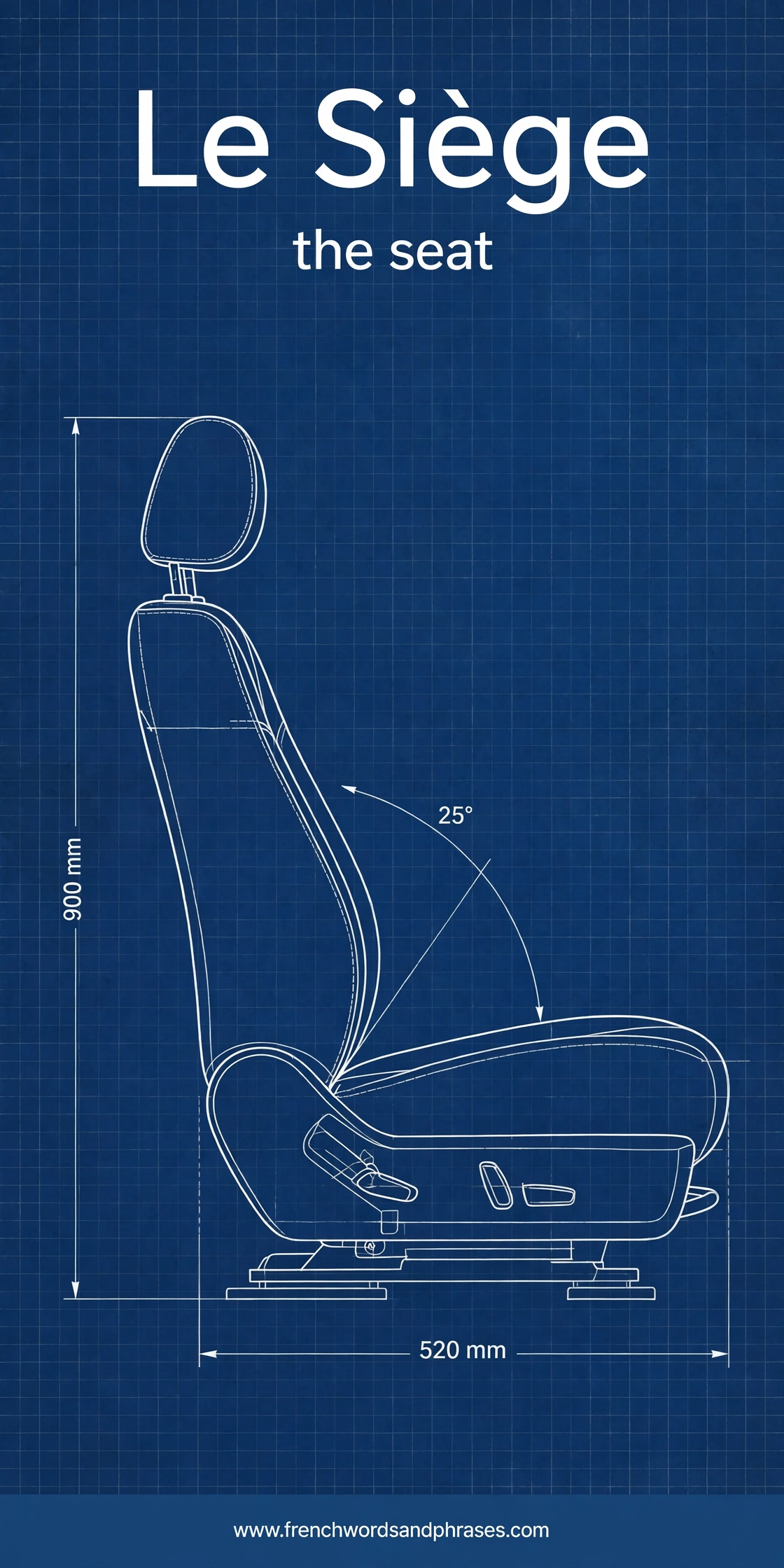
Le siège means the seat.
A long drive ahead: before the engine even starts, everyone adjusts something — the driver slides hers forward, the passenger leans his back, and the children argue over the window places — le siège, the seat, everyone’s own small territory in the car.
In this guide, you’ll learn what siège means in English, how to use it with its articles, how to form its plural, and how it appears in everyday French. Explore French examples, English translations, and practice quizzes.
Understanding the French Noun Siège
Siège is a masculine French noun. It is learned together with its article: le siège, un siège. In the car it names the seat you sit on — driver, passenger or back seat. The same word works far beyond the car: the headquarters of a company is its siège, and a town under attack in old stories is under un siège, a siege.
It means the seat — in the car, the fitted seat with its backrest, le dossier, its headrest, l’appuie-tête, and its belt. Every car place has its name: le siège conducteur for the driver, le siège passager beside it, les sièges arrière behind, and un siège enfant or un siège auto for the smallest travellers, required by law.
Gender: Masculine
Definite article: le — le siège (the seat)
Indefinite article: un — un siège (a seat)
Plural: les sièges
English equivalents: The seat; le siège is also a company’s headquarters.
One important usage detail: before driving someone else’s car, you règles ton siège — you adjust your seat: avancer le siège to slide it forward, reculer le siège to slide it back, incliner le dossier to lean the backrest. And for babies there is no choice at all: un siège enfant is compulsory, attached at the back.
Experience the Word
Siège is more than a car part. It is your personal place in the car — adjusted to your legs, your back, your habits, and defended against all comers on family journeys.
Imagine the holiday departure at dawn: the driver’s seat set just so, the passenger’s reclined for the long road, and in the back, two children and a dog negotiating the geography of the sièges arrière.
You have not just sat down. You have claimed your siège — your seat, your place, your corner of the journey.
How to Use Siège in French: Complete Guide
Let’s explore how siège works in French, beginning with its articles.
Siège with the Definite Article (Le, Les)
Used for the seat everyone in the conversation knows — the driver’s seat, the one by the window.
| Number | French |
|---|---|
| Singular | le siège |
| Plural | les sièges |
Example
Le siège du conducteur est réglé pour ses longues jambes.
The driver’s seat is adjusted for his long legs.
Siège with the Indefinite Article (Un, Des)
Used for a seat in general — a free one, a comfortable one, one for the baby.
| Number | French |
|---|---|
| Singular | un siège |
| Plural | des sièges |
Example
Il reste un siège libre à l’arrière.
There is one free seat left in the back.
Siège with the Partitive Article (Du, Des)
The partitive du meets siège mostly in phrases of material and place — un revêtement du siège, the covering of the seat — rather than for a quantity of seat.
| Number | French |
|---|---|
| Singular | du siège |
| Plural | des sièges |
Example
Le tissu du siège est usé par les années.
The fabric of the seat is worn by the years.
Quick Quiz 1
What is un siège enfant?
Reveal the answer
A child seat — the special seat, compulsory for young children, fixed in the back of the car.
Installe le siège enfant avant de partir.
Fit the child seat before leaving.
The Plural of Siège
Siège adds an -s in the plural — les sièges, five of them in most cars.
| Number | French |
|---|---|
| Singular | le siège |
| Plural | les sièges |
Example
Les sièges de cette voiture sont en cuir noir.
The seats of this car are in black leather.
Siège with Possessive Adjectives (Mon, Ton, Son…)
Possessives agree with the noun, not with the owner — and siège is masculine, so it takes mon, ton, son.
| Owner | French |
|---|---|
| my | mon siège |
| your (tu) | ton siège |
| his / her | son siège |
| our | notre siège |
| your (vous) | votre siège |
| their | leur siège |
Example
Règle ton siège avant de démarrer.
Adjust your seat before setting off.
Quick Quiz 2
Complete the sentence:
Recule ______ siège, tu es trop près du volant. (your)
Reveal the answer
ton
Recule ton siège, tu es trop près du volant.
Slide your seat back, you are too close to the wheel.
Siège with Demonstrative Adjectives (Ce, Ces)
Used to point: this seat here, those seats there.
| Number | French |
|---|---|
| Singular | ce siège |
| Plural | ces sièges |
Example
Ce siège est réservé au passager le plus âgé.
This seat is reserved for the oldest passenger.
Siège with Adjectives
Adjectives agree with siège, masculine — confortable, chauffant, arrière.
| Adjective | With Siège |
|---|---|
| confortable (comfortable) | un siège confortable |
| chauffant (heated) | un siège chauffant |
| arrière (back, rear) | un siège arrière |
| en cuir (leather) | un siège en cuir |
| réglable (adjustable) | un siège réglable |
Example
Un siège confortable change tout sur un long trajet.
A comfortable seat changes everything on a long journey.
Quick Quiz 3
Complete the sentence:
Les enfants sont sur les sièges ______. (back)
Reveal the answer
arrière
Les enfants sont sur les sièges arrière.
The children are on the back seats.
Everyday Expressions with Siège
Adjusting, sliding and strapping in — the siège phrases of daily life.
| Expression | In English |
|---|---|
| le siège conducteur | the driver’s seat |
| le siège passager | the passenger seat |
| les sièges arrière | the back seats |
| avancer / reculer le siège | to slide the seat forward / back |
| un siège enfant (un siège auto) | a child seat (a car seat) |
| incliner le dossier | to recline the backrest |
Example
Avance ton siège, tu n’atteins pas les pédales.
Slide your seat forward, you cannot reach the pedals.
Words from the Same Family as Siège
Sitting, backs and headrests — the words that travel with siège.
| French | In English |
|---|---|
| s’asseoir | to sit down |
| le dossier | the backrest |
| l’appuie-tête | the headrest |
| la banquette | the bench seat (back seat) |
| le fauteuil | the armchair |
| la place | the place, the seat (a place to sit) |
Example
Appuie ta tête sur l’appuie-tête et repose-toi.
Rest your head on the headrest and relax.
Quick Quiz 4
A company’s « siège » is in Lyon, but nobody sits on it. What is it?
Reveal the answer
Its headquarters — le siège social is a company’s registered head office, the seat of the business.
Le siège de l’entreprise est à Lyon.
The company’s headquarters are in Lyon.
Siège in Everyday French: Real-Life Examples
Now that you know the word, let’s see how siège appears in everyday French.
Example 1 — Before departure
Règle ton siège et tes rétroviseurs avant de partir.
Adjust your seat and your mirrors before leaving.
Example 2 — In the back
Les enfants, attachez vos ceintures sur les sièges arrière !
Children, fasten your belts on the back seats!
Example 3 — Comfort
Ce siège est si confortable que je m’endors.
This seat is so comfortable that I am falling asleep.
Example 4 — The baby
Le siège enfant est bien attaché, on peut partir.
The child seat is properly fastened, we can go.
Example 5 — Borrowing a car
Recule un peu le siège, j’ai de longues jambes.
Slide the seat back a little, I have long legs.
Example 6 — The window seat
Je prends le siège près de la fenêtre, comme toujours.
I am taking the seat by the window, as always.
See le siège in a story: The Car: French Vocabulary (La Voiture) — a family road trip.
Beyond Translation: The Meaning of Siège
Siège is one of those French words that climbs: from the seat of a car it rises to the seat of power — le siège social of a company, the siège of a bishop, the siège of government. Place yourself in a siège and you are placed in the world. In the car the meaning stays humble and practical: five places, each adjusted, each claimed, and the eternal family negotiation over who sits where.
To say siège is to take your place.
It evokes the slide and click of the adjustment rail, the child’s special seat, and the small diplomacy of the back row.
How to Remember the French Noun Siège
Remember it this way: Siège is the seat — masculine, with le and un, adjusted before every journey and claimed by every passenger.
- You adjust it — régler son siège before driving, masculine with le.
- You slide it — avancer or reculer le siège, forward or back.
- You rise with it — le siège social is a company’s headquarters.
The key idea is le siège you sit on — le siège where the boss sits.
Test Your Knowledge of Siège
Let’s see how much you’ve learned. Try answering these questions before revealing the answers.
Question 1
Is siège masculine or feminine?
Reveal the answer
Masculine — le siège, un siège.
Question 2
How do you say the back seats in French?
Reveal the answer
Les sièges arrière — the seats at the back of the car.
Question 3
Translate: Adjust your seat before setting off.
Reveal the answer
Règle ton siège avant de démarrer.
Question 4
What is le siège social?
Reveal the answer
A company’s headquarters — its registered head office.
Question 5
Complete the sentence:
Il reste ______ siège libre à l’arrière. (a)
Reveal the answer
un
Il reste un siège libre à l’arrière.
There is one free seat left in the back.
Your Final Challenge
Can You Use It?
How would you say this in French?
“The children are sitting on the back seats.”
Reveal the answer
Les enfants sont assis sur les sièges arrière.
The children are sitting on the back seats.
A little French. A little curiosity. A richer everyday life.
LEARN FRENCH ONE WORD AT A TIME




