A French Word to Live By
Translate Turc to English
/tyʁk/
Turc means Turkish.
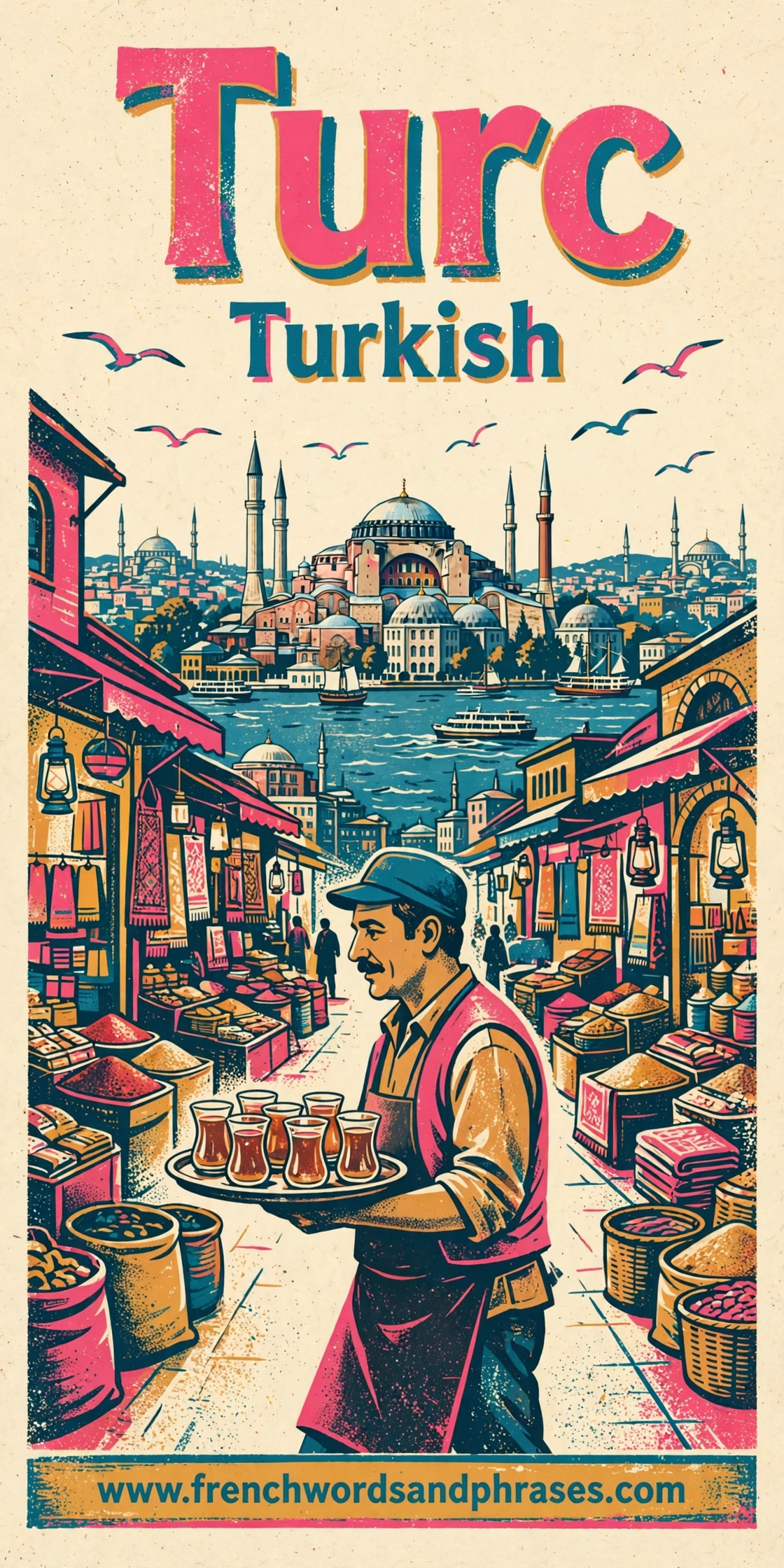
A ferry crossing the Bosphorus at sunset, seagulls wheeling over the wake, minarets on one shore and the hills of Asia on the other. Tea in tulip glasses, a city on two continents — French calls it turc.
In this guide, you’ll learn what turc means in English, why its feminine turque is irregular — the c becomes qu — why Turkish people take a capital letter while the adjective never does, and how the same word names the language of Istanbul. Explore French examples, English translations, and practice quizzes.
Understanding the French Adjective Turc
Turc is a French nationality adjective — it says where someone or something comes from: Turkey. Its feminine is irregular: masculine turc, feminine turque, masculine plural turcs, feminine plural turques. The c becomes qu to keep its hard /k/ sound.
It means Turkish — from Turkey, or in the Turkish way. It describes people (un marchand turc, a Turkish merchant; une famille turque, a Turkish family), things (le café turc, Turkish coffee; un tapis turc, a Turkish carpet) and, as a masculine noun, the language itself: le turc, Turkish.
Type: Nationality adjective — origin and language
Answers the question: Where is it from? — Turkish, from Turkey
Feminine: turque — irregular: the c becomes qu to keep the hard /k/ sound
Changes form: Yes — turc, turque, turcs, turques
English equivalents: Turkish.
One important usage detail: as a noun naming a person, turc takes a capital letter — un Turc, une Turque. But the adjective stays lower-case — un tapis turc — and so does the language: elle parle turc, she speaks Turkish.
Experience the Word
Turc is the adjective of the crossroads — of bazaars and ferries, of coffee cooked in copper and a bridge between Europe and Asia that you can walk across.
Imagine the Grand Bazaar in Istanbul at opening time: five hundred years of merchants raising their shutters, the smell of leather, spices and strong tea rolling down the vaulted lanes. Everything here has been traded, argued over and carried between two continents — tout est turc, et tout est du monde entier: everything is Turkish, and everything is from everywhere.
You have not just named a country of origin. You have pointed at the place where two continents shake hands.
How to Use Turc in French: Complete Guide
Let’s explore how turc works in French, beginning with the whole word on one card.
Turc at a Glance
Before the details, here is the whole word on one card.
The Whole Word on One Card
Meaning, type, position and forms — turc in four lines.
| Point | Turc |
|---|---|
| Meaning | Turkish |
| Type | nationality adjective — Turkey |
| Usual position | after the noun — un tapis turc |
| Form | turc / turque / turcs / turques |
Example
C’est un tapis turc.
It’s a Turkish carpet.
The Four Forms of Turc
Turc agrees with the noun it describes — but its feminine is irregular: the c turns into qu, turque, so the hard /k/ sound survives. Turc and turque are pronounced exactly alike.
| Form | Turc | Example |
|---|---|---|
| Masculine singular | turc | un marchand turc — a Turkish merchant |
| Feminine singular | turque | une famille turque — a Turkish family |
| Masculine plural | turcs | des marchands turcs — Turkish merchants |
| Feminine plural | turques | des familles turques — Turkish families |
Example
Un marchand turc et une famille turque vivent dans cette rue.
A Turkish merchant and a Turkish family live on this street.
Quick Quiz 1
Which form of turc goes with famille (feminine)?
Reveal the answer
turque
Une famille turque.
A Turkish family.
Turque: The Irregular Feminine in -que
To add the feminine e to turc, French rewrites the c as qu — turque — because a plain ‘turce’ would soften the c into an s sound. It is the same family of spelling as grec → grecque.
| Situation | Example |
|---|---|
| The rule | c becomes qu before the e — turc → turque |
| The sound | turc and turque sound exactly the same: /tyʁk/ |
| Masculine plural | turcs — des bains turcs |
| Feminine plural | turques — des villes turques |
Example
Elle est turque, elle vient d’Ankara.
She is Turkish, she comes from Ankara.
Where Turc Goes: After the Noun
Nationality adjectives follow the noun they describe, and turc sits comfortably after être.
| Pattern | Example |
|---|---|
| After the noun | un café turc — a Turkish coffee |
| After être | il est turc — he is Turkish |
| With an adverb | un quartier très turc — a very Turkish neighbourhood |
| Before the noun | un turc café — not in French |
Example
Nous buvons un café turc dans ce petit restaurant.
We’re drinking a Turkish coffee in this little restaurant.
Quick Quiz 2
How do you spell the feminine: turce, turcque or turque?
Reveal the answer
turque
The c becomes qu to protect the hard sound.
Une famille turque — a Turkish family.
Turc as a Noun: People Take a Capital
The same word works as a noun. For a person it takes a capital letter — un Turc, une Turque — and in the masculine it also names the language, in lower-case.
| Use | Example |
|---|---|
| A man | un Turc — a Turk, a Turkish man |
| A woman | une Turque — a Turkish woman |
| People | les Turcs — the Turks, the Turkish people |
| The language | le turc — elle apprend le turc, she is learning Turkish |
Example
Les Turcs sont célèbres pour leur hospitalité.
The Turks are famous for their hospitality.
Everyday Expressions with Turc
Turc lives at the café and the hammam — and in one very famous expression about strength.
| Expression | In English |
|---|---|
| un café turc | a Turkish coffee — small, strong, unfiltered |
| un bain turc | a Turkish bath — a hammam |
| un tapis turc | a Turkish carpet |
| fort comme un Turc | strong as a Turk — very strong indeed |
| les délices turcs | Turkish delight — les loukoums |
| à la turque | in the Turkish way, Turkish-style |
Example
Le café turc se prépare dans une petite casserole de cuivre.
Turkish coffee is made in a small copper pot.
Quick Quiz 3
What does fort comme un Turc mean?
Reveal the answer
Strong as a Turk
An old expression for great strength.
Il porte deux valises, fort comme un Turc.
Turc and Its Neighbours
Around turc stand the country noun la Turquie and the nationalities across its many borders.
| French | In English |
|---|---|
| la Turquie | Turkey — the country |
| grec | Greek — the neighbour across the Aegean |
| bulgare | Bulgarian — the European neighbour |
| géorgien | Georgian — the Caucasus neighbour |
| iranien | Iranian — the eastern neighbour |
| stambouliote | of Istanbul — un Stambouliote, an Istanbul resident |
Example
La Turquie s’étend sur deux continents, l’Europe et l’Asie.
Turkey stretches across two continents, Europe and Asia.
Watch Out: The Traps Around Turc
The traps here are the spelling of the feminine, the capital letter — and a bird that has nothing to do with any of it.
| Trap | The truth |
|---|---|
| The feminine | turque with qu — never ‘turce’, which would sound soft |
| The capital | people take a capital — un Turc; the adjective and the language do not — un café turc, parler turc |
| The country | Turkey is la Turquie — feminine: en Turquie, to/in Turkey |
| The bird | the turkey on the table is une dinde — its name blames India, not Turkey |
Example
Un Turc d’Istanbul m’a servi un café turc.
A Turk from Istanbul served me a Turkish coffee.
Quick Quiz 4
Which sentence has the capital letter right: Une Turque parle turc or Une turque parle Turc?
Reveal the answer
Une Turque parle turc
The person takes a capital; the language stays lower-case.
A Turkish woman speaks Turkish.
Turc in Everyday French: Real-Life Examples
Now that you know the word, let’s see how turc appears in everyday French.
Example 1 — Travel
Nous prenons le bateau pour une île turque.
We’re taking the boat to a Turkish island.
Example 2 — Coffee
Le matin, il boit un café turc très fort.
In the morning, he drinks a very strong Turkish coffee.
Example 3 — People
Nos voisins sont turcs, ils viennent d’Izmir.
Our neighbours are Turkish, they come from Izmir.
Example 4 — Language
Je commence à apprendre le turc cette année.
I’m starting to learn Turkish this year.
Example 5 — Shopping
Elle a acheté un tapis turc au marché.
She bought a Turkish carpet at the market.
Example 6 — Baths
Après le voyage, un bain turc fait du bien.
After the journey, a Turkish bath does you good.
Beyond Translation: The Meaning of Turc
English says Turkish for the meaning of turc — and keeps its own souvenir of the country in the word turquoise, the ‘Turkish stone’ that reached Europe through Turkish trade. French keeps its souvenir in an expression: fort comme un Turc, strong as a Turk, a compliment left over from the centuries when Europe measured itself against the Ottoman world.
Turc is the adjective of the bridge between Europe and Asia.
Mind the spelling of its feminine — turque, with qu standing guard over the hard c — and remember that only the people, un Turc and une Turque, earn the capital letter.
How to Remember the French Adjective Turc
Remember it this way: Turc is the Turkey adjective — an irregular feminine in -que, a capital for the people, and a lower-case for the language.
- You turn the c into qu in the feminine — turc becomes turque, and the sound never changes.
- You give the person a capital — un Turc, une Turque — but never the adjective or the language.
- You keep the compliment — fort comme un Turc, strong as a Turk.
The key idea is turc makes its feminine turque — c becomes qu — and only the people take a capital.
Test Your Knowledge of Turc
Let’s see how much you’ve learned. Try answering these questions before revealing the answers.
Question 1
What does turc mean?
Reveal the answer
Turkish — from Turkey, or in the Turkish way.
Question 2
What is the feminine of turc?
Reveal the answer
turque — irregular: the c becomes qu to keep the hard /k/ sound.
Question 3
Translate: a Turkish coffee.
Reveal the answer
Un café turc.
Question 4
Complete the sentence:
Elle est ______ , elle vient d’Istanbul, et elle parle ______ .
Reveal the answer
turque, turc
Elle est turque, elle vient d’Istanbul, et elle parle turc.
She is Turkish, she comes from Istanbul, and she speaks Turkish.
Question 5
What does ‘fort comme un Turc’ mean?
Reveal the answer
Strong as a Turk — an old French expression for great strength.
Your Final Challenge
Can You Use It?
How would you say this in French?
“He is Turkish and he drinks a Turkish coffee every morning.”
Reveal the answer
Il est turc et il boit un café turc chaque matin.
He is Turkish and he drinks a Turkish coffee every morning.
A little French. A little curiosity. A richer everyday life.
LEARN FRENCH ONE WORD AT A TIME