A French Word to Live By
Translate Russe to English
/ʁys/
Russe means Russian.
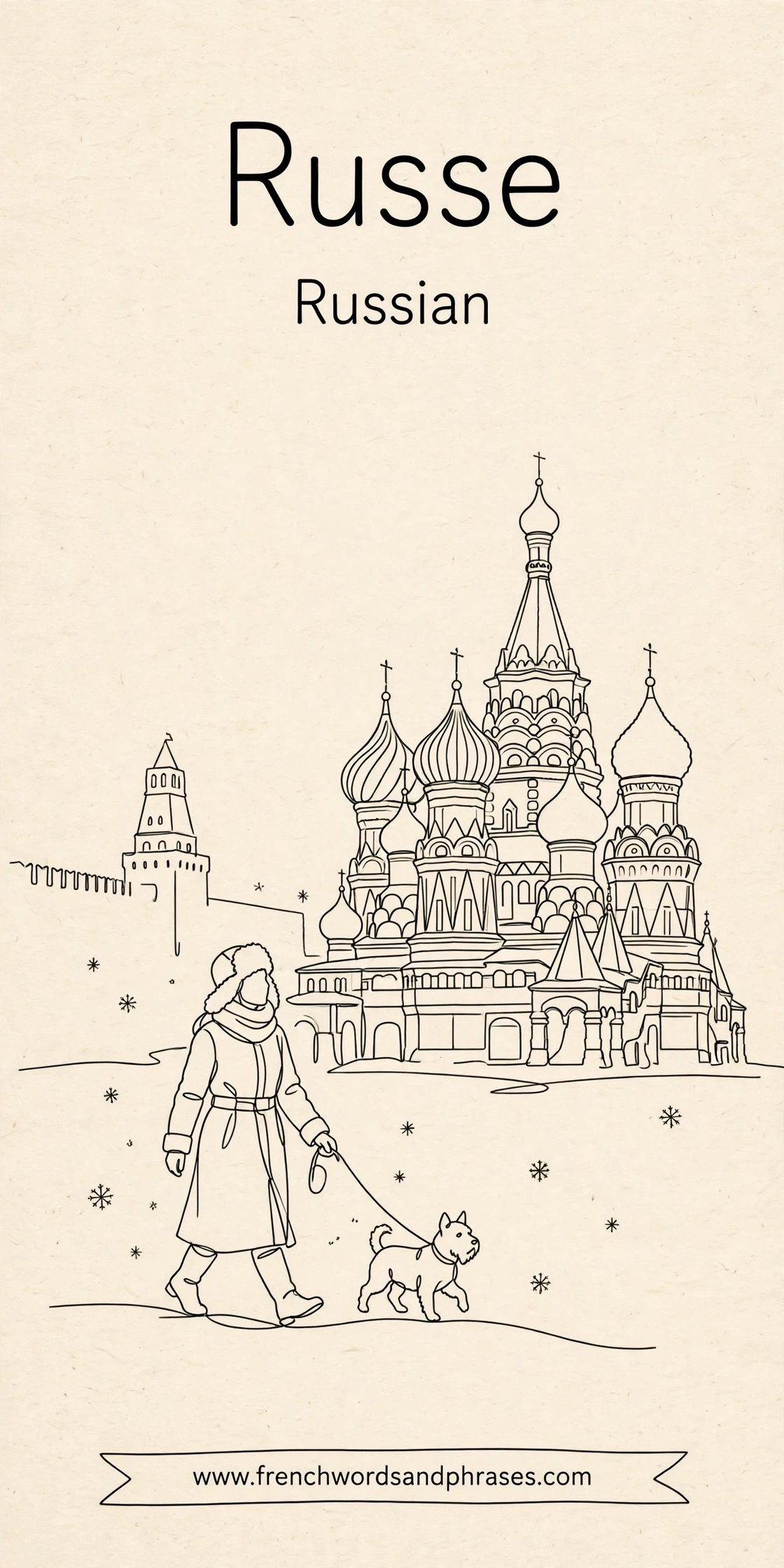
Snow falling on Red Square, the candy-coloured domes of Saint Basil’s glowing through the dusk, and a queue of fur hats outside a theatre. A vast country, a long winter, an immense literature — French calls it russe.
In this guide, you’ll learn what russe means in English, why its masculine and feminine forms are identical, why Russian people take a capital letter while the adjective and the language never do, and how russe hides inside dolls, salads and mountains. Explore French examples, English translations, and practice quizzes.
Understanding the French Adjective Russe
Russe is a French nationality adjective — it says where someone or something comes from: Russia. Its forms are a gift: masculine russe, feminine russe — identical — and one plural for everyone, russes. As a masculine noun it also names the language: le russe, Russian.
It means Russian — from Russia, or in the Russian way. It describes people (un écrivain russe, a Russian writer; une danseuse russe, a Russian dancer) and things (la littérature russe, Russian literature; les poupées russes, Russian dolls) — and, as a noun, the language written in the Cyrillic alphabet.
Type: Nationality adjective — origin and language
Answers the question: Where is it from? — Russian, from Russia
Feminine: russe — identical to the masculine; the word already ends in -e
Changes form: Only in the plural — russe, russe, russes, russes
English equivalents: Russian.
One important usage detail: as a noun naming a person, russe takes a capital letter — un Russe, une Russe. But the adjective stays lower-case — un roman russe — and so does the language: elle lit le russe, she reads Russian.
Experience the Word
Russe is the adjective of the immense — of steppes without end, of novels eight hundred pages long, of winters that test everything and ballet that conquers the world anyway.
Imagine a night train crossing Siberia, the samovar hot in the corridor, a stranger sharing his bread and his whole life story before the first stop. Seven days of rails, one country — l’immensité russe, Russian immensity, measured in time zones.
You have not just named a country of origin. You have pointed at the largest country on earth and everything it contains.
How to Use Russe in French: Complete Guide
Let’s explore how russe works in French, beginning with the whole word on one card.
Russe at a Glance
Before the details, here is the whole word on one card.
The Whole Word on One Card
Meaning, type, position and forms — russe in four lines.
| Point | Russe |
|---|---|
| Meaning | Russian |
| Type | nationality adjective — Russia |
| Usual position | after the noun — un roman russe |
| Form | russe for everyone — russes in the plural |
Example
C’est un roman russe.
It’s a Russian novel.
The Four Forms of Russe
Russe already ends in -e, so masculine and feminine are identical. Only the plural adds an s — one of the easiest agreements in French.
| Form | Russe | Example |
|---|---|---|
| Masculine singular | russe | un écrivain russe — a Russian writer |
| Feminine singular | russe | une danseuse russe — a Russian dancer |
| Masculine plural | russes | des écrivains russes — Russian writers |
| Feminine plural | russes | des danseuses russes — Russian dancers |
Example
Un écrivain russe et une danseuse russe sont célèbres dans le monde entier.
A Russian writer and a Russian dancer are famous all over the world.
Quick Quiz 1
Does russe change for a feminine noun?
Reveal the answer
No
Un écrivain russe, une danseuse russe — the form is identical.
A Russian writer, a Russian dancer.
The Feminine of Russe: Nothing Changes
Most adjectives build their feminine by adding an e. Russe was born with one, so the feminine has nothing to add — exactly like belge and suisse.
| Situation | Example |
|---|---|
| Masculine | un hiver russe — a Russian winter |
| Feminine | une âme russe — identical |
| Why | russe already ends in -e, so the feminine adds nothing |
| The plural | add s — des romans russes, Russian novels |
Example
Elle est russe, elle vient de Saint-Pétersbourg.
She is Russian, she comes from Saint Petersburg.
Where Russe Goes: After the Noun
Nationality adjectives follow the noun they describe, and russe sits comfortably after être.
| Pattern | Example |
|---|---|
| After the noun | une église russe — a Russian church |
| After être | il est russe — he is Russian |
| With an adverb | un accueil très russe — a very Russian welcome |
| Before the noun | un russe roman — not in French |
Example
Nous lisons un roman russe ce mois-ci.
We’re reading a Russian novel this month.
Quick Quiz 2
How do you say ‘a Russian novel’ — un russe roman or un roman russe?
Reveal the answer
un roman russe
The nationality adjective stands after the noun — and russe never changes anyway.
A Russian novel.
Russe as a Noun: People Take a Capital
The same word works as a noun. For a person it takes a capital letter — un Russe, une Russe — and in the masculine it also names the language, in lower-case.
| Use | Example |
|---|---|
| A man | un Russe — a Russian (man) |
| A woman | une Russe — a Russian (woman) |
| People | les Russes — the Russians |
| The language | le russe — il apprend le russe, he is learning Russian |
Example
Les Russes écrivent avec l’alphabet cyrillique.
Russians write with the Cyrillic alphabet.
Everyday Expressions with Russe
Russe hides inside some of French’s favourite images — dolls within dolls, and mountains that are not mountains.
| Expression | In English |
|---|---|
| les poupées russes | Russian dolls — the nesting matryoshkas |
| les montagnes russes | roller coasters — literally ‘Russian mountains’ |
| la salade russe | Russian salad — diced vegetables in mayonnaise |
| la roulette russe | Russian roulette |
| l’âme russe | the Russian soul — deep, vast, melancholy |
| le thé russe | Russian tea — strong, from the samovar |
Example
Les enfants adorent les montagnes russes à la fête.
Children love the roller coasters at the fair.
Quick Quiz 3
What are les montagnes russes?
Reveal the answer
Roller coasters
Literally ‘Russian mountains’ — from the ice slides of old Russia.
Les montagnes russes — the roller coasters.
Russe and Its Neighbours
Around russe stand the country noun la Russie and the nationalities of Russia’s many neighbours.
| French | In English |
|---|---|
| la Russie | Russia — the country |
| ukrainien | Ukrainian — the western neighbour |
| biélorusse | Belarusian — literally ‘white Russian’ |
| finlandais | Finnish — the north-western neighbour |
| kazakh | Kazakh — the southern neighbour |
| moscovite | of Moscow — un Moscovite, a Muscovite |
Example
La Russie est le plus grand pays du monde.
Russia is the largest country in the world.
Watch Out: The Traps Around Russe
The traps here are the capital letter and the double s that English speakers forget.
| Trap | The truth |
|---|---|
| The capital | people take a capital — un Russe; the adjective and the language do not — un roman russe, étudier le russe |
| The spelling | russe keeps its double s — never ‘ruse’, which means a trick |
| The country | Russia is la Russie — feminine: en Russie, to/in Russia |
| The alphabet | Russian is written in Cyrillic — le russe uses letters like Д and Ж |
Example
Une Russe de Moscou m’a offert des poupées russes.
A Russian woman from Moscow gave me Russian dolls.
Quick Quiz 4
Which sentence has the capital letter right: Un Russe lit un roman russe or Un russe lit un roman Russe?
Reveal the answer
Un Russe lit un roman russe
The person takes a capital; the adjective stays lower-case.
A Russian reads a Russian novel.
Russe in Everyday French: Real-Life Examples
Now that you know the word, let’s see how russe appears in everyday French.
Example 1 — Books
Ce roman russe est très long mais magnifique.
This Russian novel is very long but magnificent.
Example 2 — People
Notre professeur de piano est russe.
Our piano teacher is Russian.
Example 3 — Language
Il apprend le russe pour son travail.
He’s learning Russian for his work.
Example 4 — Food
La salade russe est servie froide, avec de la mayonnaise.
Russian salad is served cold, with mayonnaise.
Example 5 — At the fair
Les enfants veulent faire les montagnes russes.
The children want to ride the roller coasters.
Example 6 — Winter
L’hiver russe est célèbre pour son froid.
The Russian winter is famous for its cold.
Beyond Translation: The Meaning of Russe
English says Russian for the meaning of russe — and French returns the compliment with a wink: the roller coaster, that most American of machines, is in French a ‘Russian mountain’, a souvenir of the ice slides of Saint Petersburg.
Russe is the adjective of scale — the largest country, the longest novels, the deepest winter.
For the learner it is also a gift: one form for him, one form for her, an s for the plural, a capital only for the people — and a language, le russe, that opens the door to Tolstoy in the original.
How to Remember the French Adjective Russe
Remember it this way: Russe is the easy nationality — one form for everyone, a capital only for the people, and roller coasters hiding in its expressions.
- You never change it in the singular — un écrivain russe, une danseuse russe.
- You give the person a capital — un Russe, une Russe — but never the adjective or the language.
- You keep the double s — and remember les montagnes russes are roller coasters.
The key idea is russe is identical for masculine and feminine, and its people — un Russe — take the capital.
Test Your Knowledge of Russe
Let’s see how much you’ve learned. Try answering these questions before revealing the answers.
Question 1
What does russe mean?
Reveal the answer
Russian — from Russia, or in the Russian way.
Question 2
What is the feminine of russe?
Reveal the answer
russe — identical. The word already ends in -e.
Question 3
Translate: a Russian novel.
Reveal the answer
Un roman russe.
Question 4
Complete the sentence:
Elle est ______ , elle vient de Kazan, et elle parle ______ .
Reveal the answer
russe, russe
Elle est russe, elle vient de Kazan, et elle parle russe.
She is Russian, she comes from Kazan, and she speaks Russian.
Question 5
What are ‘les montagnes russes’?
Reveal the answer
Roller coasters — literally, Russian mountains.
Your Final Challenge
Can You Use It?
How would you say this in French?
“She is Russian and she is learning to read Russian novels.”
Reveal the answer
Elle est russe et elle apprend à lire des romans russes.
She is Russian and she is learning to read Russian novels.
A little French. A little curiosity. A richer everyday life.
LEARN FRENCH ONE WORD AT A TIME