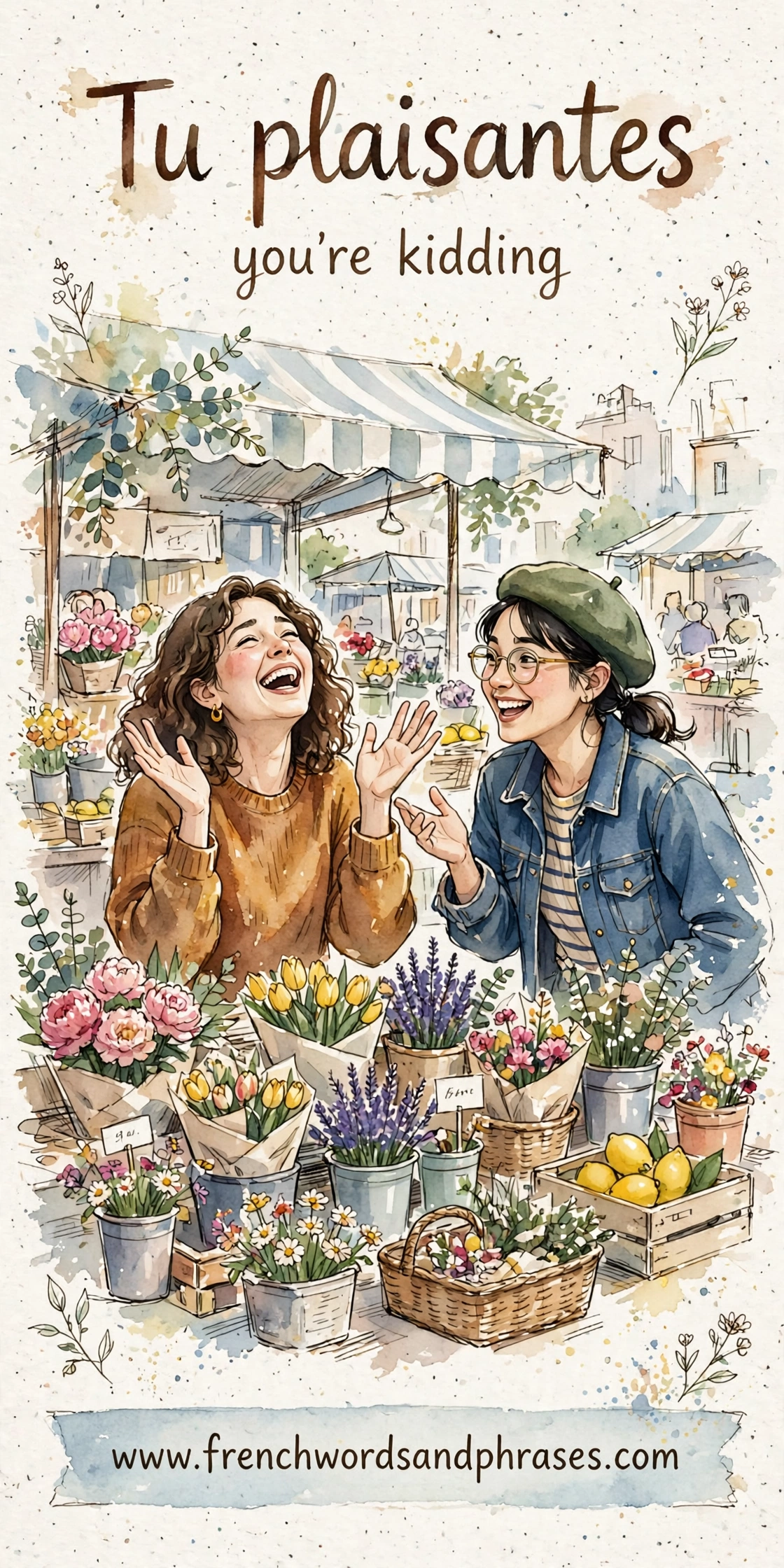
A French Word to Live By
Translate Tu plaisantes to English
/ty ple.zɑ̃t/
Tu plaisantes means you’re kidding.
Your best friend sits down, takes a breath, and announces she has won a sailing boat in a competition she barely remembers entering. You stare at her across the café table, coffee forgotten, and out comes the only possible reply: « Tu plaisantes ! »
Let’s explore how tu plaisantes works in French, beginning with the whole phrase on one card.
Understanding the French Phrase Tu plaisantes
Tu plaisantes is a French statement used as an exclamation — the tu form of plaisanter (to joke, to kid), said with wide eyes. It is not really information about the other person; it is your disbelief, wearing a sentence’s clothes.
It means you’re kidding — I cannot believe what I just heard. Half the meaning is in the tone: bright and laughing, it shares the joke; flat and slow, it means ‘you cannot be serious’ and borders on a complaint. The words stay the same, the music decides.
Type: Statement-exclamation — the verb plaisanter (to joke) doing reaction duty
Answers the need: Reacting to the unbelievable — news, prices, stories too big to swallow
Register: Informal and everyday — tu form; vous plaisantez for the polite version
Strength: Adjustable — delighted disbelief or annoyed protest, set by tone
One important usage detail: plaisanter is about joking, not laughing. Tu plaisantes accuses the other person of making a joke; for simple laughing French uses rire — tu ris. Mixing them changes the scene completely.
Experience the Word
Tu plaisantes is the sound of the brain refusing delivery — the news has arrived, but belief is still at the door.
Imagine a market stall in Nice: the vendor names a price for a small bunch of herbs that would buy a restaurant dinner in some countries. The customer laughs, shakes her head: « Tu plaisantes ! » The negotiation has begun.
French disbelief is theatrical. Tu plaisantes is the audience gasping on cue.
How to Use Tu plaisantes in French: Complete Guide
Let’s explore how tu plaisantes works in French, beginning with the whole phrase on one card.
Tu plaisantes at a Glance
The Whole Phrase on One Card
Real meaning, literal picture, English twin and register — tu plaisantes in five lines.
| Point | Tu plaisantes |
|---|---|
| What it really means | you’re kidding — I can’t believe what I just heard |
| Word for word | you are joking (plaisanter = to joke) |
| English equivalent | you’re kidding / you’re joking / no way |
| Register | informal, everyday — tu form; vous plaisantez is polite |
| Use it for | astonishing news, absurd prices, stories too good to be true |
Example
Tu plaisantes ! C’est vraiment vrai ?
You’re kidding! Is it really true?
Word by Word: The Accusation
Two pieces — a ‘you’, and a verb that accuses you of joking.
| Word | Literal meaning | Its job in the phrase |
|---|---|---|
| tu | you | the friend-form subject — this phrase lives in tu territory |
| plaisantes | are joking | from plaisanter, to joke or kid — the accusation at the heart of the phrase |
| tu plaisantes (together) | you’re kidding | a statement that works as an exclamation — the tone adds the exclamation mark |
Example
Tu plaisantes ou tu es sérieux ?
Are you kidding or are you serious?
Quick Quiz 1
What verb hides inside tu plaisantes, and what does it mean?
Reveal the answer
Plaisanter — to joke, to kid. The phrase accuses the other person of joking.
Tu plaisantes, ce n’est pas possible !
You’re kidding, it can’t be true!
When You Say It: The Disbelief Moments
Tu plaisantes fires the moment news arrives bigger than the brain’s front door.
| Situation | Example |
|---|---|
| A friend wins a prize | tu plaisantes ! raconte-moi tout ! — you’re kidding! tell me everything! |
| An absurd price | cent euros ? tu plaisantes ! — a hundred euros? you’re joking! |
| An unbelievable story | tu plaisantes, il a vraiment dit ça ? — you’re kidding, he really said that? |
| A surprise engagement | tu plaisantes ! félicitations ! — you’re kidding! congratulations! |
| Bad news you hope is false | tu plaisantes… dis-moi que ce n’est pas vrai — you’re kidding… tell me it isn’t true |
Example
Tu plaisantes ! Elle a accepté le poste à Tokyo ?
You’re kidding! She accepted the job in Tokyo?
Make It Yours: Turning the Verb Around
Plaisanter conjugates like any regular verb — so the reaction can point at anyone, including you.
| Form | French | In English |
|---|---|---|
| Tu (friend) | tu plaisantes | you’re kidding |
| Vous (polite) | vous plaisantez | you’re kidding |
| Turning it on yourself | je plaisante | I’m joking (calming someone down) |
| Asking about him | il plaisante ? | is he kidding? |
| The challenge form | tu plaisantes ou quoi ? | are you kidding or what? |
| Seriously now | sans plaisanter | no joking — seriously |
Example
Non, je ne plaisante pas, c’est la vérité.
No, I’m not joking, it’s the truth.
Quick Quiz 2
Your friend looks shocked at YOUR joke. How do you confess, with this verb?
Reveal the answer
Je plaisante ! — I am joking; the same verb, turned on yourself, calms everything down.
Je plaisante, bien sûr que je viens !
I’m joking, of course I’m coming!
Everyday Expressions: Building on the Phrase
Tu plaisantes slots into these everyday frames — each one ready to use as it stands.
| Frame | In English |
|---|---|
| tu plaisantes ! c’est vrai ? | you’re kidding! is it true? |
| non mais tu plaisantes, là ? | no but seriously, are you kidding? |
| tu plaisantes ou tu es sérieux ? | are you kidding or are you serious? |
| attends… tu plaisantes ? | wait… you’re kidding? |
| tu plaisantes ! c’est génial ! | you’re kidding! that’s amazing! |
Example
Non mais tu plaisantes, là ? Trois heures de retard !
No but seriously, are you kidding? Three hours late!
Close Cousins: The Other Gasps of Disbelief
French disbelief has a whole shelf of gasps — tu plaisantes is the classic; its cousins are slangier or shorter.
| Expression | The difference |
|---|---|
| tu plaisantes | the classic — you’re kidding, neutral-informal |
| tu rigoles | you’re joking! — rigoler is slangier, younger, more about laughing |
| c’est une blague ? | is this a joke? — asks about the thing, not the person |
| sans blague ? | no kidding? — literally ‘no joke?’, short and punchy |
| tu es sérieux ? | are you serious? — the direct challenge, no joke mentioned |
Example
Sans blague ? Tu as vraiment rencontré le président ?
No kidding? You really met the president?
Quick Quiz 3
Which cousin is the slangy, younger one — tu plaisantes or tu rigoles?
Reveal the answer
Tu rigoles — rigoler is informal slang for laughing and joking; plaisanter is the everyday standard.
Tu rigoles, ce n’est pas possible !
You’re joking, it can’t be true!
Tu plaisantes and Its Neighbours
The reaction shelf around the phrase — from the teaser that starts it to the belief that ends it.
| French | In English |
|---|---|
| tu plaisantes | you’re kidding (disbelief) |
| devine quoi | guess what (the news that triggers it) |
| je n’y crois pas | I don’t believe it (the same shock, no joke) |
| c’est incroyable | it’s unbelievable (about the event itself) |
| vraiment ? | really? (the smallest possible reaction) |
| je t’écoute | I’m listening (when disbelief turns into curiosity) |
Example
Devine quoi ? — Tu plaisantes, raconte !
Guess what? — You’re kidding, tell me!
Watch Out: The Traps Around Tu plaisantes
The traps: laughing versus joking, the flat tone that turns it into a complaint, and the tu that must sometimes become vous.
| Trap | The truth |
|---|---|
| confusing plaisanter with rire | tu ris means you’re laughing; tu plaisantes means you’re joking — different accusations |
| the flat tone | said slowly and flatly, tu plaisantes becomes a complaint — ‘you must be joking’ at a bill or a delay |
| using the tu form at work | to a client or an official, vous plaisantez keeps the joke and loses the familiarity |
| answering it literally | the reply is rarely oui or non — expect c’est vrai ! or je te jure ! (I swear!) |
Example
Je te jure, je ne plaisante pas.
I swear, I’m not joking.
Quick Quiz 4
True or false: tu plaisantes and tu ris mean the same thing.
Reveal the answer
False — plaisanter is joking, rire is laughing; you can do either without the other.
Il rit, mais il ne plaisante pas.
He’s laughing, but he isn’t joking.
Tu plaisantes in Everyday French: Real-Life Examples
Now that you know the word, let’s see how tu plaisantes appears in everyday French.
Example Example 1 — Lottery news
Tu plaisantes ! Tu as gagné combien ?
You’re kidding! How much did you win?
Example Example 2 — A restaurant bill
Quatre-vingts euros pour une salade ? Tu plaisantes !
Eighty euros for a salad? You’re joking!
Example Example 3 — A friend’s marathon
Tu plaisantes, tu as couru tout ça ?
You’re kidding, you ran all that?
Example Example 4 — A surprise visit
Tu plaisantes ! Toi, ici, à Lyon ?
You’re kidding! You, here, in Lyon?
Example Example 5 — Good grades
Tu plaisantes ! Premier de la classe !
You’re kidding! Top of the class!
Example Example 6 — Weather shock
Tu plaisantes, il neige en avril ?
You’re kidding, it’s snowing in April?
Beyond Translation: The Meaning of Tu plaisantes
Tu plaisantes is a compliment disguised as an accusation. It tells the speaker: your news is so good, so strange, so enormous that my first defence is to declare it a joke. Belief arrives a second later — the phrase just buys that second.
To say tu plaisantes is to ask the world to confirm it is really this interesting.
And it usually is. That is why the phrase is said laughing, with a hand on the arm, before the félicitations begin.
How to Remember the French Phrase Tu plaisantes
Remember it this way: Remember it this way: Tu plaisantes is disbelief with a smile — it accuses the news of being a joke.
- You hear the verb — plaisanter is to joke, so the phrase always asks: is this a joke?
- You watch the tone — bright means delighted, flat means ‘you cannot be serious’.
- You switch to vous plaisantez the moment the relationship turns polite.
The key idea is tu plaisantes means you’re kidding — plaisanter is joking, not laughing.
Test Your Knowledge of Tu plaisantes
Let’s see how much you’ve learned. Try answering these questions before revealing the answers.
Question 1
What does tu plaisantes mean?
Reveal the answer
You’re kidding — the reaction to news too big to believe at once.
Question 2
What is the polite vous version?
Reveal the answer
Vous plaisantez — same verb, polite form.
Question 3
Translate: You’re kidding! Is it really true?
Reveal the answer
Tu plaisantes ! C’est vraiment vrai ?
Question 4
What is the difference between tu plaisantes and tu ris?
Reveal the answer
Plaisanter is joking; rire is laughing. Tu plaisantes accuses someone of kidding you.
Question 5
Complete the sentence:
Tu ______ ! C’est incroyable ! (You’re kidding! It’s unbelievable!)
Reveal the answer
plaisantes
Tu plaisantes ! C’est incroyable !
You’re kidding! It’s unbelievable!
Your Final Challenge
Can You Use It?
How would you say this in French?
“How would you say this in French?”
Reveal the answer
Tu plaisantes ! Raconte-moi tout !
You’re kidding! Tell me everything!
A little French. A little curiosity. A richer everyday life.
LEARN FRENCH ONE WORD AT A TIME