
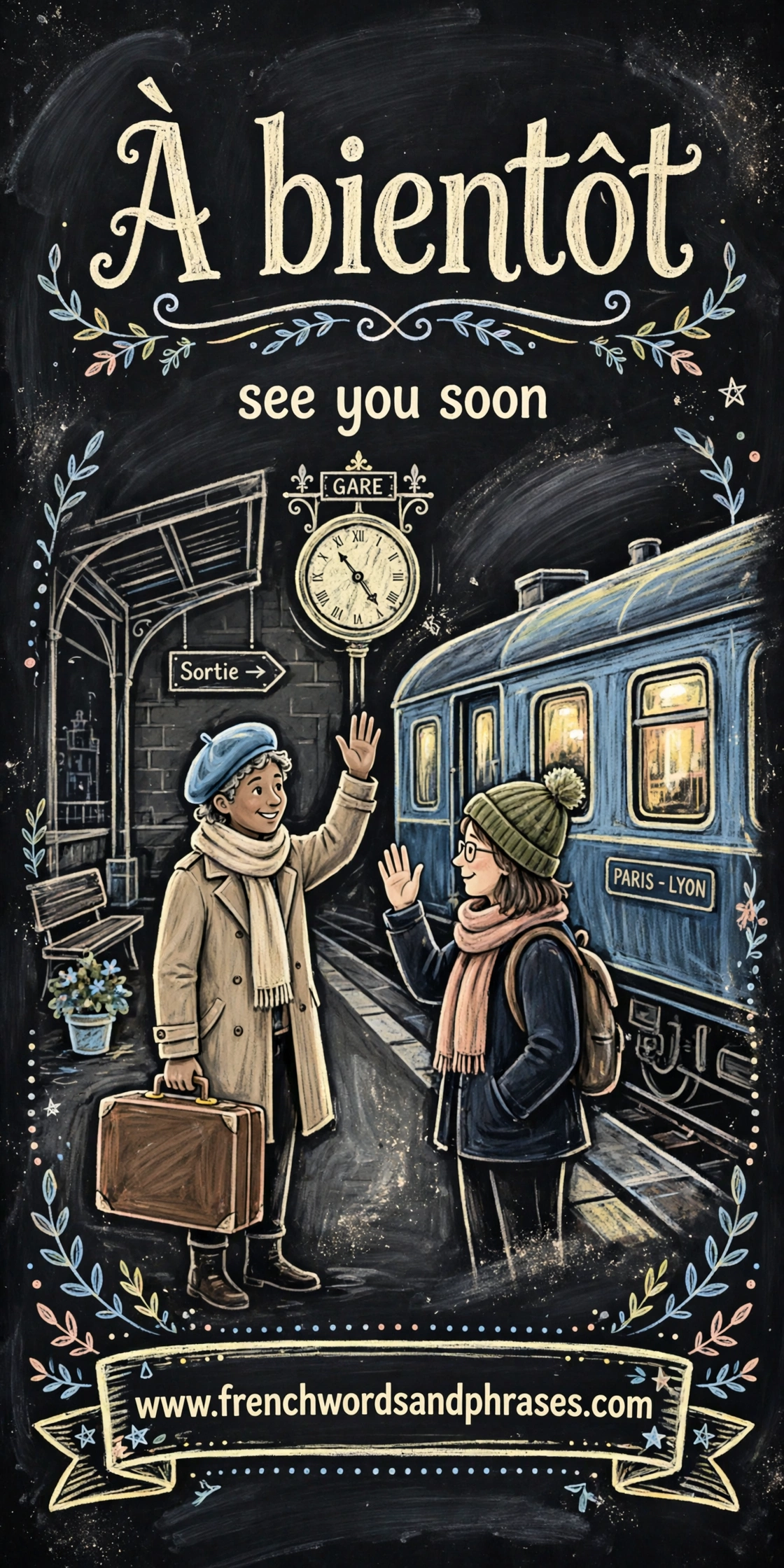
A French Word to Live By
Translate À bientôt to English
/a bjɛ̃.to/
À bientôt means see you soon.
The dinner plates are cleared, coats are found, and the little Paris street outside is quiet and golden. At the door there are kisses on both cheeks and one warm promise that makes the goodbye feel temporary: « À bientôt ! »
Let’s explore how à bientôt works in French, beginning with the whole phrase on one card.
Understanding the French Phrase À bientôt
À bientôt is a French farewell phrase — a fixed goodbye built from à (until) and bientôt (soon). Unlike most phrases in this family it never changes: the same two words serve a friend, a stranger, a crowd, or the end of a letter.
It means see you soon. The promise is built into the words: à bientôt does not close a door, it leaves it ajar. You are not saying the meeting is over — you are already scheduling the next one, even if no date exists.
Type: Farewell phrase — a fixed goodbye built on à (until) + bientôt (soon)
Answers the need: Saying goodbye with a promise — we will meet again
Register: Universal and warm — same form for tu, vous, strangers and letters
Strength: A soft promise — soon, but no date is ever named
One important usage detail: à bientôt carries a promise. Use it when another meeting is likely or at least welcome. For a final goodbye to someone you will never see again, French switches to au revoir — or, dramatically, adieu.
Experience the Word
À bientôt is the gentlest goodbye in French — it ends the evening and starts the next one at the same time.
Imagine the baker you visit every morning in a village in Provence. You have never exchanged names, but every day ends the same way: « À demain ! » — and once a week, before her Sunday closing, « À bientôt ! » The promise is the relationship.
French goodbyes are a calendar. À bientôt is the page left open.
How to Use À bientôt in French: Complete Guide
Let’s explore how à bientôt works in French, beginning with the whole phrase on one card.
À bientôt at a Glance
The Whole Phrase on One Card
Real meaning, literal picture, English twin and register — à bientôt in five lines.
| Point | À bientôt |
|---|---|
| What it really means | see you soon — we will meet again before long |
| Word for word | until soon (à = until, bientôt = soon) |
| English equivalent | see you soon / see you again soon |
| Register | universal — identical for friends, strangers and formal letters |
| Use it for | any goodbye where another meeting is likely or welcome |
Example
Merci pour la soirée — à bientôt !
Thanks for the evening — see you soon!
Word by Word: The Hinge and the Promise
Two pieces — a little hinge word, and a ‘soon’ with two older words hidden inside it.
| Word | Literal meaning | Its job in the phrase |
|---|---|---|
| à | to / until | the little hinge of French goodbyes — it points at the next meeting |
| bientôt | soon | bien (well) + tôt (early) fused into one word — sooner than you think |
| à bientôt (together) | see you soon | a fixed farewell — the words are never separated or changed |
Example
À bientôt, et merci encore pour tout !
See you soon, and thanks again for everything!
Quick Quiz 1
What are the two halves hidden inside bientôt?
Reveal the answer
Bien (well) and tôt (early) — soon is literally ‘well-early’, sooner than expected.
À bientôt, repose-toi bien.
See you soon, get plenty of rest.
When You Say It: The Promising Goodbyes
À bientôt appears wherever a goodbye wants to feel temporary.
| Situation | Example |
|---|---|
| Leaving a friend’s house | à bientôt, et merci pour le dîner ! — see you soon, and thanks for dinner! |
| Ending a phone call | on s’appelle demain, à bientôt ! — we’ll call tomorrow, see you soon! |
| A colleague leaving the office | à bientôt, bon week-end ! — see you soon, have a good weekend! |
| Your regular baker | à bientôt, madame, à la semaine prochaine ! — see you soon, see you next week! |
| Signing off an email | je vous remercie, à bientôt ! — thank you, see you soon! |
Example
À bientôt ! Passez une bonne soirée.
See you soon! Have a good evening.
Make It Yours: The Dated and Undated Promises
The phrase itself never changes — but its family lets you name the day, or keep it deliciously vague.
| Form | French | In English |
|---|---|---|
| Everyone — it never changes | à bientôt | see you soon |
| See you very soon | à très bientôt | see you very soon |
| With a hope attached | à bientôt, j’espère | see you soon, I hope |
| Tomorrow is certain | à demain | see you tomorrow |
| Later today | à tout à l’heure | see you later (today) |
| Next time, no date | à la prochaine | see you next time |
Example
À très bientôt, le plaisir était pour moi.
See you very soon, the pleasure was mine.
Quick Quiz 2
A friend leaves at 10 a.m. and you will see her again at 4 p.m. today. À bientôt or à tout à l’heure?
Reveal the answer
À tout à l’heure — that one is for later the same day; à bientôt leaves the date open.
À tout à l’heure, on se retrouve à seize heures.
See you later, we’ll meet at four.
Everyday Expressions: Building on the Phrase
À bientôt slots into these everyday frames — each one ready to use as it stands.
| Frame | In English |
|---|---|
| à bientôt, j’espère | see you soon, I hope |
| à bientôt chez nous | see you soon at our place |
| à bientôt et bonne route | see you soon and safe travels |
| à bientôt, on se téléphone | see you soon, we’ll call each other |
| à bientôt, prends soin de toi | see you soon, take care of yourself |
Example
À bientôt, prends soin de toi et des enfants.
See you soon, take care of yourself and the children.
Close Cousins: The Other Ways to Say Goodbye
French goodbyes form a whole calendar — à bientôt is the open promise; its cousins fix the date or drop it.
| Expression | The difference |
|---|---|
| à bientôt | see you soon — a promise with no date |
| au revoir | goodbye — the neutral all-purpose farewell, no promise inside |
| à plus tard | see you later — informal, usually later the same day |
| salut ! | bye! — very informal, for friends and the young |
| à demain | see you tomorrow — the promise with an exact date |
Example
Au revoir, monsieur, et peut-être à bientôt.
Goodbye, sir, and perhaps see you soon.
Quick Quiz 3
Which cousin is the plain, neutral goodbye with no promise inside — au revoir or à bientôt?
Reveal the answer
Au revoir — it simply closes the meeting; à bientôt adds the promise of another one.
Au revoir, et merci de votre visite.
Goodbye, and thank you for your visit.
À bientôt and Its Neighbours
The farewell shelf around the phrase — wishes, promises, and the one goodbye that means forever.
| French | In English |
|---|---|
| à bientôt | see you soon |
| bonne journée | have a good day (a wish for the hours ahead) |
| porte-toi bien | take care (tu form — literally carry yourself well) |
| on se voit bientôt | we’ll see each other soon (the promise said in full) |
| à la semaine prochaine | see you next week (a dated promise) |
| adieu | farewell forever (the dramatic opposite — almost never used in real life) |
Example
Porte-toi bien, et à bientôt !
Take care, and see you soon!
Watch Out: The Traps Around À bientôt
The traps: splitting bientôt in two, promising meetings that will never happen, and reaching for adieu.
| Trap | The truth |
|---|---|
| writing à bien tôt | bientôt is one single word — bien + tôt fused long ago |
| promising it to strangers you’ll never see | to a one-time taxi driver, au revoir is honest; à bientôt promises a meeting that will never happen |
| confusing it with à tout à l’heure | tout à l’heure means later today only — à bientôt can mean next week or next month |
| reaching for adieu | adieu means goodbye forever — in modern French it sounds theatrical or heartbreaking, never casual |
Example
Au revoir et merci, monsieur !
Goodbye and thank you, sir!
Quick Quiz 4
True or false: adieu is just a shorter way to say à bientôt.
Reveal the answer
False — adieu is goodbye forever; à bientôt is goodbye until soon. They are opposites.
Ce n’est pas un adieu, c’est un à bientôt.
This isn’t farewell forever, it’s see you soon.
À bientôt in Everyday French: Real-Life Examples
Now that you know the word, let’s see how à bientôt appears in everyday French.
Example Example 1 — At a friend’s door
À bientôt, et merci pour cette belle soirée !
See you soon, and thanks for a lovely evening!
Example Example 2 — On the phone
Je dois partir, mais à bientôt, promis.
I have to go, but see you soon, promise.
Example Example 3 — At the office
À bientôt, bonnes vacances à tous !
See you soon, happy holidays everyone!
Example Example 4 — Ending an email
Je vous remercie de votre réponse. À bientôt !
Thank you for your reply. See you soon!
Example Example 5 — At the market
À bientôt, madame, et bon dimanche !
See you soon, and have a good Sunday!
Example Example 6 — A grandchild leaving
À bientôt, mamie, je reviens dimanche.
See you soon, Grandma, I’m coming back on Sunday.
Beyond Translation: The Meaning of À bientôt
Some goodbyes close a door; à bientôt oils the hinge. It is the farewell of people who fully expect the story to continue — neighbours, bakers, colleagues, friends — and it turns even a routine parting into a small appointment with the future.
To say à bientôt is to refuse to say the story is finished.
That is why it also lives at the end of French letters and emails, where English reaches for the colder ‘regards’. À bientôt signs off with a handshake and a promise.
How to Remember the French Phrase À bientôt
Remember it this way: Remember it this way: À bientôt is a goodbye with a string attached — it always pulls you back.
- You hear the promise — à points forward to the next meeting, bientôt says it will be soon.
- You never change it — one form serves friends, strangers, crowds and letters.
- You keep adieu for forever — à bientôt is only for goodbyes that are not endings.
The key idea is à bientôt means see you soon — one unchanging form, and a promise inside.
Test Your Knowledge of À bientôt
Let’s see how much you’ve learned. Try answering these questions before revealing the answers.
Question 1
What does à bientôt mean?
Reveal the answer
See you soon — a goodbye that promises another meeting.
Question 2
Does à bientôt change for vous or for a group?
Reveal the answer
No — the phrase is fixed; the same two words serve everyone.
Question 3
Translate: See you soon, and thanks for the evening!
Reveal the answer
À bientôt, et merci pour la soirée !
Question 4
When is au revoir a better choice than à bientôt?
Reveal the answer
When no next meeting is likely — au revoir is the honest, neutral goodbye; à bientôt makes a promise.
Question 5
Complete the sentence:
Merci pour tout, et ______ bientôt ! (Thanks for everything, and see you soon!)
Reveal the answer
à
Merci pour tout, et à bientôt !
Thanks for everything, and see you soon!
Your Final Challenge
Can You Use It?
How would you say this in French?
“How would you say this in French?”
Reveal the answer
À bientôt, et merci pour tout !
See you soon, and thanks for everything!
A little French. A little curiosity. A richer everyday life.
LEARN FRENCH ONE WORD AT A TIME




